



🗿 Kutaisi Monuments: A Guide to the City's Sculptures and Monuments
🗿 Writers, Soviet Heritage, and Urban Sculpture · ⏱️ Half Day · 📍 Kutaisi, Imereti
🗿 What You Should Know Before Your Walk
| 📍 Location | Most monuments are concentrated in the historic city centre, while others are scattered across different districts. |
| ✍️ Literary City | Eight monuments are dedicated to Georgian writers and poets. |
| 🕊️ Soviet Heritage | Three monuments date from the Soviet era, including a sculptural complex in the city centre. |
| 💰 Admission | Free of charge; all monuments are located in open public spaces. |
🧭 Who This Guide Is For
This guide is for anyone who wants to understand the stories behind Kutaisi's monuments instead of simply taking photos. It is also useful for travelers interested in how monuments to Georgian literary figures, Soviet-era sculptures, and memorials to recent history all coexist within the same city.
📜 A city that remembers its writers
Kutaisi is called the literary capital of Georgia for more than just a fancy name: of the 25 monuments in this guide, eight are dedicated to writers and poets, more than any other topic. This is no coincidence, but part of the city's history: Kutaisi was the cultural center of the Imeretian Kingdom, and in the 19th and 20th centuries, it produced some of Georgia's most important national poets. Alongside these literary figures, the city boasts Soviet sculptures from a bygone era, monuments to state symbols, and memorials connected to far more recent and difficult events. Together, they form a rather honest portrait of the city: pride in culture, Soviet heritage, and the memory of loss.
✍️ Writers and poets
Almost a third of all the city's monuments are concentrated here.
✍️ Monument to Paolo Iashvili and Titian Tabidze
| 👤 Dedicated to | Paolo Iashvili and Titsian Tabidze |
| 🎭 Known for | Poets of the Blue Horns literary group |
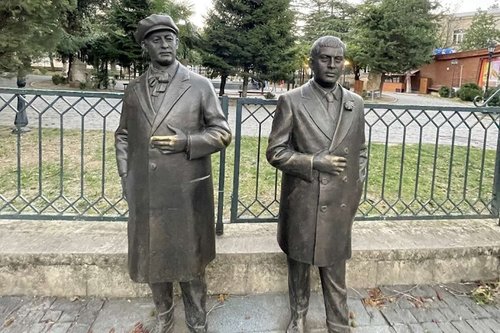
The monument is dedicated to two poets of the Blue Horns Symbolist movement, one of the most significant literary movements in Georgia in the early 20th century. Both poets were later subjected to repression: Titian Tabidze was executed in 1937, and Paolo Iashvili committed suicide that same year after learning of his comrade's arrest. A shared monument to the two friends and comrades stands in the historic center of the city, where both once lived and worked.
✍️ Monument to Shota Rustaveli
| 👤 Dedicated to | Shota Rustaveli |
| 📖 Best known as | Author of The Knight in the Panther's Skin |
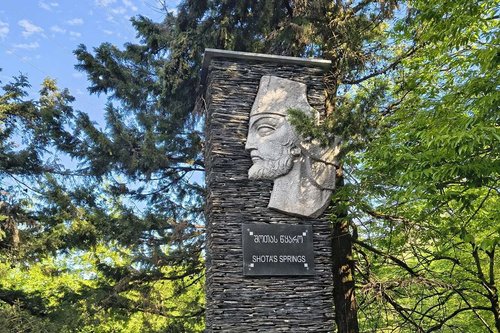
The monument is dedicated to Shota Rustaveli, the author of the 12th-century Georgian epic poem "The Knight in the Panther's Skin." Even if you haven't read the poem, you'll encounter Rustaveli's name everywhere in Georgia—main streets, theaters, and metro stations are named after him. Many tourists stop here specifically to take a photo by the monument. The monument is popularly known as "Shota's Springs"; there's a small spring nearby, hence the unofficial name.
✍️ Sculpture by Boris Gaponov
| 👤 Dedicated to | Boris Gaponov |
| 📖 Best known as | Translator of The Knight in the Panther's Skin into Hebrew |
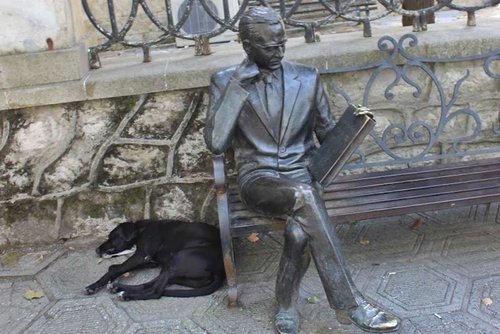
The seated sculpture is dedicated to Boris Gaponov, who translated Rustaveli's poem "The Knight in the Panther's Skin" into Hebrew, for which he received the Israel State Prize in 1967—a rare case of a Soviet translator receiving such recognition abroad during the height of the Cold War. The sculpture is life-size, making it a popular spot for tourists to take photos next to it. Many initially mistake the figure for an ordinary person sitting on a bench.
✍️ Monument to Akaki Tsereteli
| 👤 Dedicated to | Akaki Tsereteli |
| 📖 Best known as | Poet, publicist, and one of the founders of modern Georgian literature |
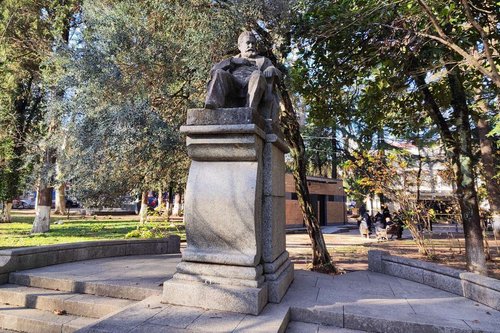
A monument to Akaki Tsereteli, a 19th-century poet and publicist, one of the leading figures of the Georgian national revival, along with Ilia Chavchavadze. If you frequently encounter Tsereteli's name on streets, squares, or museums while traveling through Georgia, it's this man we're talking about. In 1912, the first full-length Georgian documentary was made about Tsereteli's journey through Racha and Lechkhumi; it was directed by Vasili Amashukeli of Kutaisi.
Four more monuments to writers have already been discussed in separate blog articles:
| Name | Brief Description | Article |
|---|---|---|
| ✍️ Ilia Chavchavadze | Writer and publicist, Father of the Nation, canonized by the Georgian Orthodox Church | Read → |
| ✍️ Galaktion Tabidze | One of Georgia's greatest 20th-century poets | Read → |
| ✍️ Vazha-Pshavela | Classic Georgian poet, best known for his epic poems about mountain life | Read → |
| ✍️ Vladimir Mayakovsky | Russian Futurist poet whose childhood was spent in Imereti | Read → |
🎭 Figures of art and science
Composer, historian, actor, and, presumably, photographer, this category unites people who made Kutaisi famous not through literature, but through other areas of culture and science.
🎭 Monument to Zakharia Paliashvili
| 👤 Dedicated to | Zakaria Paliashvili |
| 🎵 Best known as | Composer and founder of Georgian classical music |
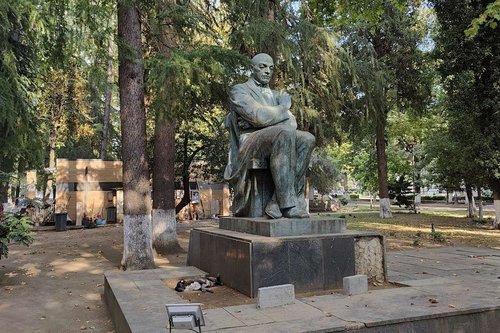
A monument to Zakharia Paliashvili, a composer considered the founder of Georgian national classical music. If you hear the operas "Abesalom and Eteri" or "Daisi" in Georgia, it's likely a work by Paliashvili. His music can still be heard on the stages of Georgian theaters. The Tbilisi Opera House bears his name, and he worked extensively with Georgian folklore, incorporating folk melodies into the operatic tradition.
🎭 Monument to Ekvtime Takaishvili
| 👤 Dedicated to | Ekvtime Takaishvili |
| 📚 Known as | Historian, archaeologist, and public figure |
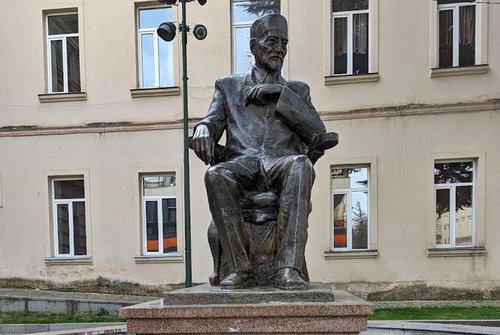
A monument to historian and archaeologist Ekvtime Takaishvili, who dedicated his life to the study of Georgian antiquities and, in the 1920s, saved some of the country's national cultural treasures by taking them abroad during the Sovietization of Georgia, and then secured their return to the country in 1945. It is thanks to him that many unique relics can be seen in Georgian museums today. The sculpture was created by Kutaisi sculptor Giorgi Kikvadze, the author of several city monuments featured in this guide.
🎭 Sculpture by Ippolit Khvichiy
| 👤 Dedicated to | Ippolit Khvichia |
| 🎬 Known as | Theatre and film actor, best known for his role as Kukusha in Mimino |
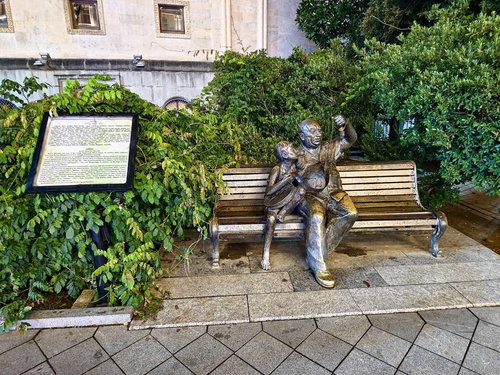
The sculpture depicts Ippolit Khvichia, a comedic theater and film actor known as the Georgian Louis de Funes for his rare ability to make audiences laugh. He is best known to audiences outside of Georgia for his role as Kukushi, the protagonist's friend, in the cult film "Mimino." You can sit on the bench next to the actor, making the monument one of the most popular photo spots in central Kutaisi. The monument stands next to the Lado Meskhishvili Drama Theater, where Khvichia performed for many years.
🎭 Sculpture of Ilo Khakiyashvili
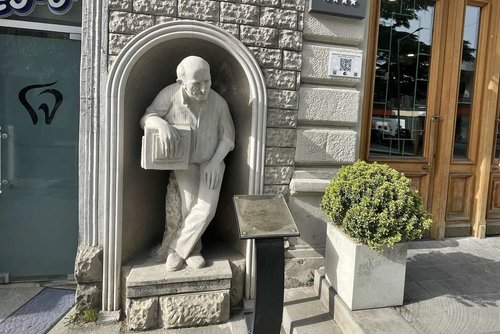
The sculpture is apparently dedicated to a Kutaisi cultural figure named Ilo. Even if the monument's identity remains uncertain, the sculpture itself has long been a recognizable feature of the city streets. There's a similarly described monument to photographer Ilo Pichkhadze in the city near an art gallery, but there's no absolute certainty that it's the same person: the names vary in different sources. It's worth double-checking on-site or with local historians.
🕊️ Soviet legacy
Three monuments remaining from the Soviet era show the city from an equally real, albeit more controversial side of its history.
🕊️ Complex of Soviet sculptures
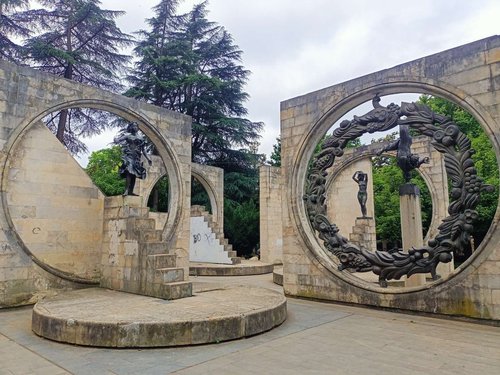
This complex of sculptures, preserved from the Soviet era, is now perceived more as a monument to the era as a whole than to specific people or events. It's a rare example where the visual language of Soviet monumental art has been better preserved than in other Georgian cities. If you're interested in Soviet architecture and art, this place is worth a visit. It clearly demonstrates how public spaces were envisioned several decades ago.
🕊️ Bust of V.I. Kikvidze
| 👤 Dedicated to | Vasily Kikvidze |
| ⚔️ Known as | Red Army commander during the Russian Civil War |
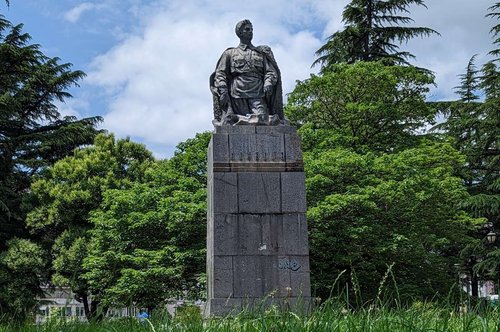
The bust is dedicated to Vasily Kikvidze, a Soviet military leader during the Russian Civil War of the early 20th century, a native of Georgia, who died in 1919 in battle with the Don Army. Such monuments are rare in Georgia today. If you're interested in Soviet history, this one is worth a look. It's one of the few remaining monuments in Kutaisi directly connected to Soviet military history.
🕊️ Sculpture "Soviet Golden Snitch"
| 🕊️ Period | Soviet era |
| 🎨 Form | Golden spherical sculpture |
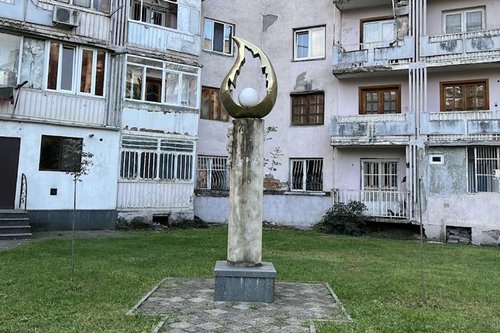
The sculpture has recently acquired the colloquial name "Soviet Golden Snitch," due to its unofficial resemblance to the golden ball from Harry Potter, although the Soviet-era sculpture itself has no connection to the film. When viewed from a certain angle, the resemblance is truly striking. Many tourists come here specifically to replicate the image of the "flying snitch." The name has caught on among locals and tourists alike and is even used in the official city directory.
🛡️ National symbols and history
Both objects in this category have already been discussed in separate blog articles.
| Name | Brief description | Article |
|---|---|---|
| 🛡️ Flag of Georgia | One of the country's tallest flagpoles, at the entrance to the city | Read → |
| 🛡️ David the Builder | King who united medieval Georgia | Read → |
🕯️Memorials of memory
Three monuments dedicated to more recent and much more difficult pages of Georgian history.
| Name | Location | Description |
|---|---|---|
| 🏆 Kutaisi Olympic Champions Memorial | 📍 Historic city centre | Collective memorial honoring Olympic champions from Kutaisi, especially wrestlers and weightlifters. |
| 🕯️ Memorial to Missing Persons | 📍 Southern part of the city | Commemorates people who went missing during the armed conflicts of the 1990s and early 2000s, primarily those related to Abkhazia and South Ossetia. |
| 🕯️ Memorial to the Victims of the Civil War | 📍 Historic city centre | Dedicated to the victims of the early 1990s Georgian Civil War, which followed the collapse of the Soviet Union and the removal of President Zviad Gamsakhurdia. |
All three monuments serve as a reminder that Georgia's recent history was not only about the restoration of independence, but also about internal upheavals and losses along the way.
🎨 Urban sculpture and art objects
Two objects in this category have already been discussed in separate blog articles.
| Name | Brief description | Article |
|---|---|---|
| 🎨 Colchis Fountain | Bronze animal figures on the city's main square | Read → |
| 🎨 The Ishkhneli Sisters | Sculptural composition inspired by a Georgian folk theme | Read → |
🎨 Picasso's Boy
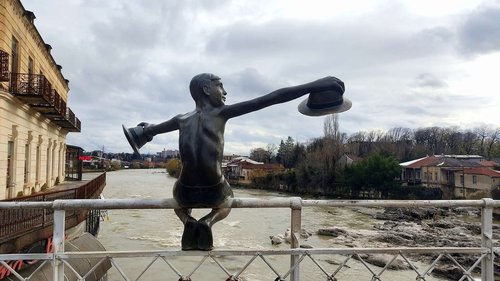
This sculpture, "The Boy with Two Hats," on the railing of the White Bridge, has already been discussed in our guide to Kutaisi's bridges: read about the White Bridge and the Picasso boy in the article "The White Bridge in Kutaisi: A Pedestrian Symbol over the Turbulent Rioni." It's one of the city's most recognizable sculptures, hard to miss while strolling through the city center. Almost every tourist stops here to take a photo.
🎨 Art installation
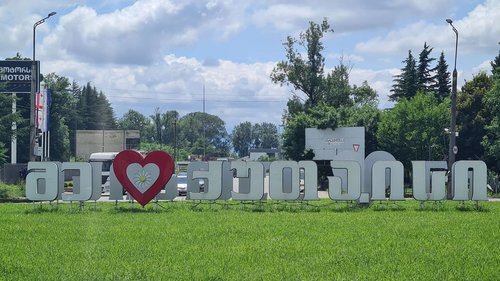
This contemporary art installation, without an official name or documented history, is another example of how Kutaisi's urban environment is being updated while preserving its historical monuments. Such objects are appearing more and more frequently in the city, gradually becoming new landmarks for strolling. If you enjoy unusual photography, be sure to stop here for a few minutes.
🎨 Monument to the native language
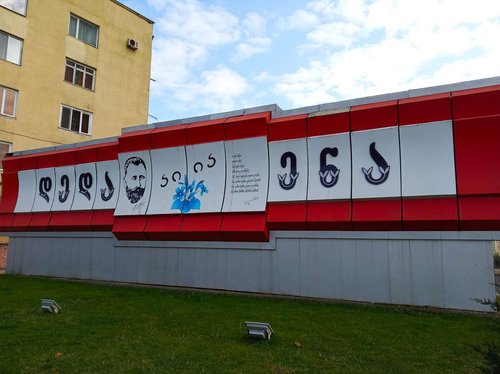
The monument is dedicated to the Georgian language and one of the oldest alphabets in the world, which has been used without significant changes for over 1,500 years. Take a closer look at the letterforms—they are completely unlike either Cyrillic or Latin. Many tourists first become interested in the Georgian alphabet after seeing this monument. Such monuments to language are not uncommon in post-Soviet countries, but in Kutaisi, it takes on special significance amid the abundance of nearby monuments to Georgian writers.
🛣️ Kutaisi Monuments Route
💡 If your time is limited, exploring the historic centre is enough to see more than half of Kutaisi's monuments. To visit all 25, plan for about half a day and use a car.
🏁 Why go see the monuments of Kutaisi
Kutaisi's monuments act as a kind of history textbook without a single line: writers showcase the city's cultural pride, Soviet sculptures recall the decades of the USSR, and memorials speak candidly of the losses of the last thirty years. If time is limited, the historic center covers more than ten monuments in a single walk, and the rest are worth seeing en route to other city attractions.
ℹ️ Information on the condition of monuments is current at the time of publication. Please verify details on site.
🧡 Continue exploring Kutaisi
- 🎨 Kutaisi Street Art: A Guide to Murals in the Old Town and University Campus
- 🏛️ Royal Residences of Imereti: Geguti Palace and Solomon II's Palace
- 🏛️ Abandoned Sanatoriums of Tskaltubo: A Guide to the Ruins of a Soviet Spa Resort
💾 Save this article to revisit it before your trip.
Which monument in Kutaisi surprised you the most? The "Soviet Golden Snitch," the Native Language Monument, or perhaps one of the literary monuments in the historic center? Share your thoughts in the comments—we read every one of them ❤️
❓ Frequently Asked Questions
💬 This guide features 25 monuments and sculptures, from literary monuments to Soviet heritage and memorials. This is not an exhaustive list of all the city's memorial sites, but it does cover the most notable ones.
💬 The city was historically the cultural center of the Kingdom of Imereti and gave Georgia several key poets and writers of the 19th and 20th centuries, including Ilia Chavchavadze, Akaki Tsereteli, and Galaktion Tabidze. Eight of the 25 monuments in this guide are dedicated to literary figures.
💬 This is the unofficial nickname for the golden, spherical sculpture from the Soviet era, which has since been given due to its resemblance to the ball from "Harry Potter." The sculpture has no connection to the book or film itself.
💬 More than ten monuments stand in the historic center and can easily be walked around in one go. The rest, including the Flag of Georgia and the Monument to the Missing, are further away and require a car.
💬 Kutaisi sculptor Giorgi Kikvadze created several city monuments, including sculptures of Ekvtime Takaishvili and Ippolit Khvichia.
Read also
- Oldest Cities in Georgia: Ancient Capitals and Heritage
- Kutaisi City Hall building on Rustaveli Avenue 3
- The former Georgian parliament in Kutaisi: a dome and a future technohub
- Kutaisi Street Art: A Guide to Murals in the Old Town and Campus
- The Georgian flag in Kutaisi: the city where the symbols were raised

5 comments
Log in to leave a comment