




🗿 Monument to David Agmashenebeli in Kutaisi: History and Meaning
🟨 The key facts first
| 🗿 What it is | An equestrian statue of King David IV Agmashenebeli (the Builder) in Kutaisi |
| 📍 Where | In front of the railway station, David Agmashenebeli Avenue |
| 🎨 Author and year | Sculptor Elguja Amashukeli, 1995 |
| 👑 Whom it honours | David IV, the unifying king, the start of Georgia's Golden Age |
| 📸 Why it is interesting | Stands on a rise: a staircase, views of the city and the Rioni river |
| 🗺️ More details | Monument to David the Builder |
💡 Tip: the monument stands right by the station, so it is convenient as the first point of acquaintance with Kutaisi, as soon as you arrive, before a walk through the centre.
🟦 What this article is about
For many visitors to Kutaisi, getting to know the city begins with this very monument: the equestrian statue of King David Agmashenebeli greets arrivals right by the station. Here we will sort out who David the Builder was and why he is considered one of the greatest rulers of Georgia, when and by whom the monument was created, how it ended up by the station, and why it should not be confused with the square of the same name in the centre of the city.
It will be useful if you are interested in the history of the monument and the figure of David IV, are seeing the statue for the first time as soon as you arrive in Kutaisi, or are searching online for "David the Builder statue Kutaisi" and want to understand what exactly is in front of you.
🗿 The monument by the station: what it is and where it stands
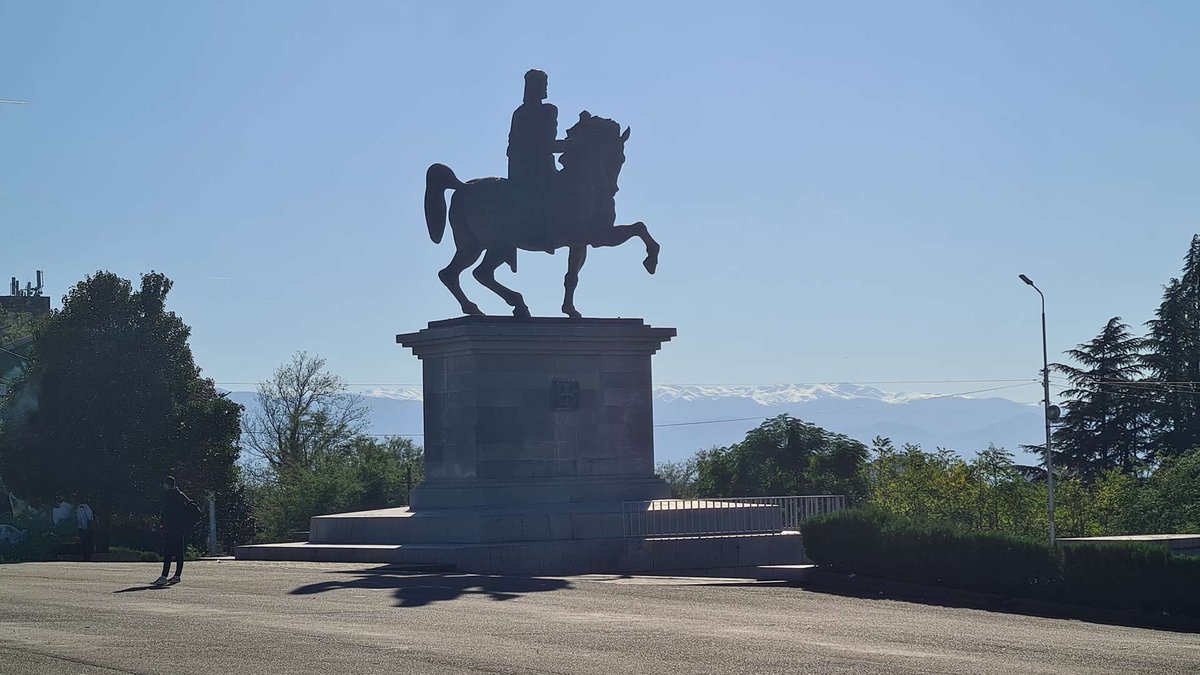
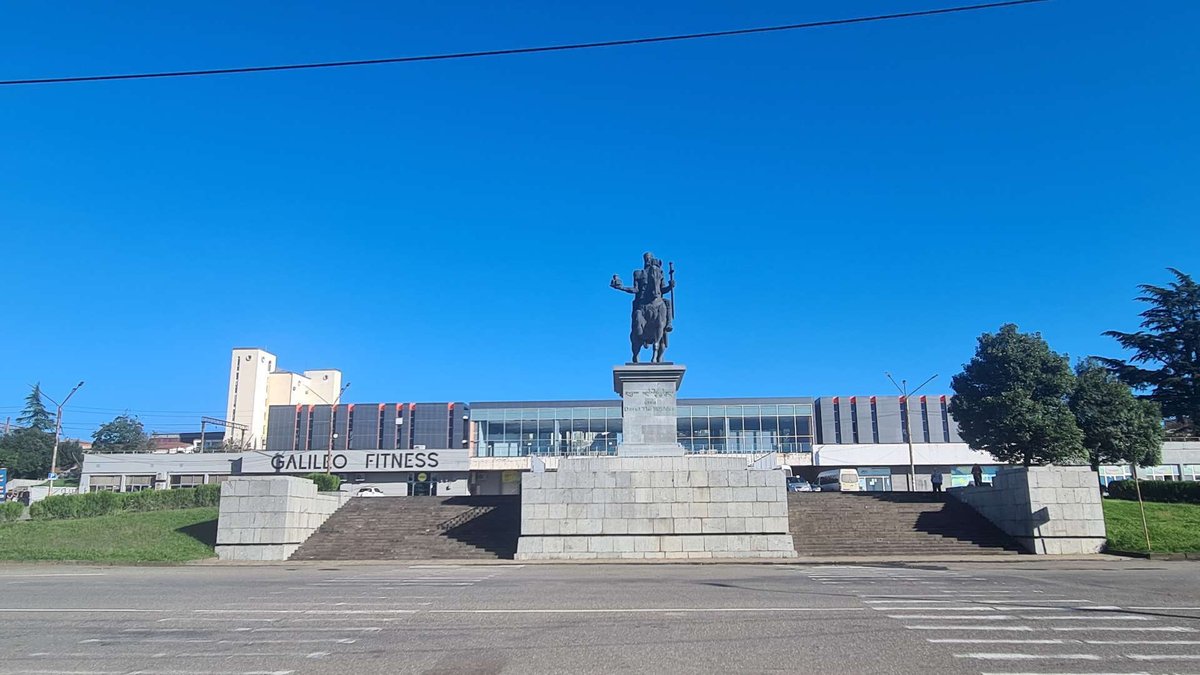
It is hard to miss the monument to David Agmashenebeli in Kutaisi: the king's equestrian statue greets the city's guests right by the railway station, on the avenue that bears his name. It is one of the first things that people arriving in Kutaisi by train see, so the monument has long become a kind of gateway to the city.
It stands on a rise, with a staircase leading up to it. The climb is worth it: from the top there is a good view of the city and the Rioni river, and a palm alley is laid out around it, so the spot is suitable both for photos and simply for catching your breath after the journey. The monument is accessible at any time: it is an open urban space, without fences or a schedule.
The monument itself depicts David IV on horseback, in the image of a strong and confident ruler. This choice is not accidental: an equestrian statue traditionally emphasises the figure of a warrior and statesman, and that is exactly how David Agmashenebeli remained in Georgia's memory.
📜 History: who was David IV Agmashenebeli
David IV of the Bagrationi dynasty is perhaps the most revered ruler in the history of Georgia. He came to the throne very young, in 1089, and reigned for 36 years, until his death in 1125. He devoted these decades to strengthening the country, and it was under him that a fragmented and weakened Georgia turned into a strong, unified state.
David's main military triumph was the Battle of Didgori in 1121, in which the Georgian army defeated a far more numerous Seljuk force. This victory opened the way to the liberation of Tbilisi and secured David's fame as a warrior-king. His reign marks the beginning of the Georgian Golden Age, an era of flourishing that continued under his descendants, including Queen Tamar.
For Kutaisi the figure of David is especially close: in his era it was western Georgia, with its centre in Kutaisi, that was the heart of the uniting kingdom. So the monument to the great king here is not by chance but a tribute to the city's historical connection with the era of the country's unification. For his contribution to the country and the defence of the faith David was canonised by the Georgian Church, and his memorial day, Davitoba, is marked on 8 February.
👑 David IV in facts
- Years of reign: 1089–1125, 36 years on the throne
- Main achievement: uniting a fragmented Georgia into a strong state
- Battle of Didgori (1121): defeat of the Seljuks, the path to liberating Tbilisi
- Legacy: the start of the Georgian Golden Age
- Memory: canonised, memorial day Davitoba, 8 February
🧩 Why "the Builder" and what "Agmashenebeli" means
The name David the Builder is often taken literally, as if the king became famous for erecting buildings and fortresses. In reality the meaning is deeper. The Georgian epithet "Agmashenebeli" (აღმაშენებელი) translates more precisely as "the Restorer" or "the Renewer," rather than simply "the builder" in the usual sense.
It is about the restoration and revival of the country as a whole: the state, the church, the cities, the culture. David gathered the fragmented lands together, strengthened the army and the faith, and laid the foundation for the flourishing of Georgia. So "the Builder" here is a builder of the state, not an architect. Of course, things were built in the literal sense under him too, monasteries and fortresses were founded, but he entered historical memory precisely as the one who rebuilt Georgia itself.
This difference in translation helps to understand why the figure of David is so revered. The monument by the Kutaisi station is dedicated not to a builder of buildings, but to a person who, in essence, gathered together and raised up an entire country anew.
🚶 How to get there and what is nearby
Getting to the monument is easiest of all: it stands right by the Kutaisi railway station, on David Agmashenebeli Avenue. If you arrive in the city by train, the statue will be one of the first things to greet you, so it is convenient to make it the starting point of a route. You can also reach it from the city centre on foot or in a few minutes by car. The exact address, coordinates and location on the map can be found in the monument's card.
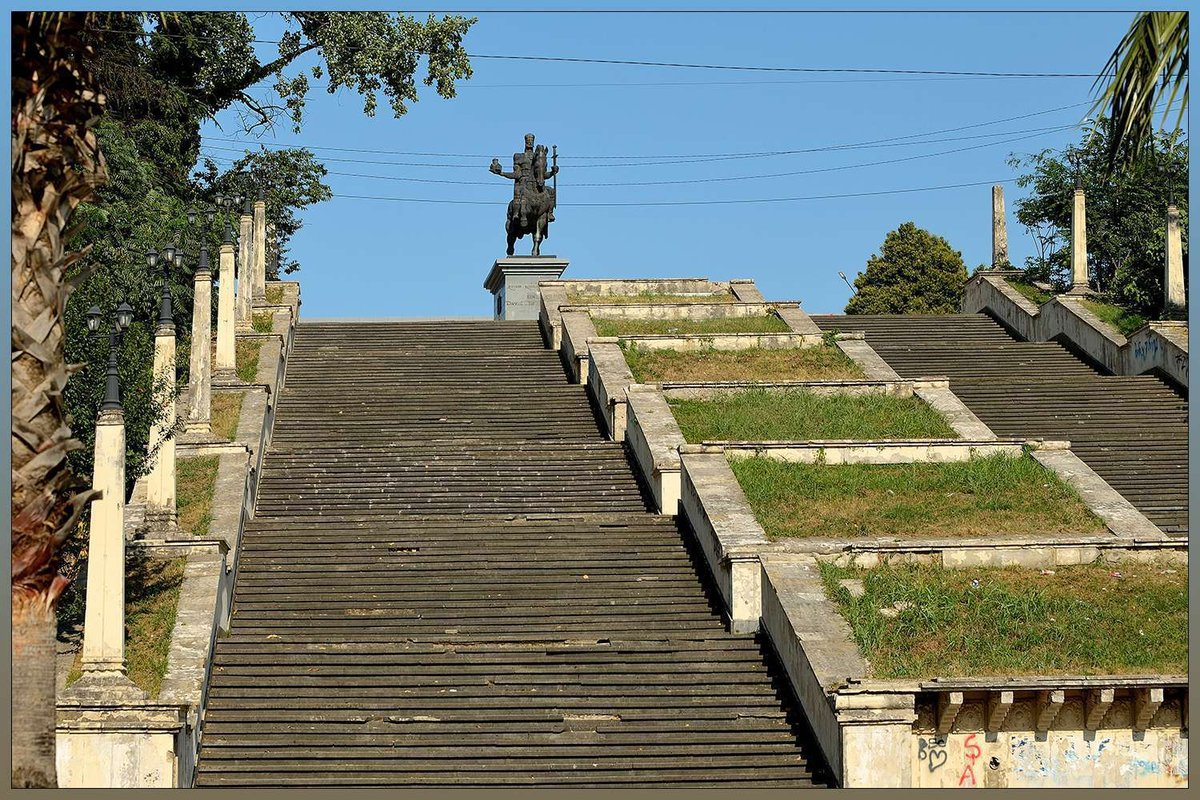
Do not spare the effort to climb the staircase up to the statue itself: from the top a view opens onto the city and the Rioni river, and the palm alley around it makes the spot pleasant for a walk. From here it is logical to continue getting to know Kutaisi: a few minutes away is the embankment with its bridges, and a little further, on the hill, the city's main symbol, Bagrati Cathedral.
🧭 Do not mix them up: the monument, the square and Tbilisi
This monument has an interesting story of relocation attached to it. The equestrian statue was created by the well-known Georgian sculptor Elguja Amashukeli, and it was set up in Kutaisi in 1995, and not by the station but in the centre of the city, on David Agmashenebeli Square, which bears the name of the same king. The monument stood there until 2011, after which it was moved to the station to free up space for the construction of the Colchis Fountain. So its present spot by the station is already the statue's second address.
Because of this, confusion easily arises, and it is worth separating three things. First, the monument itself, which this article is about, today stands by the station. Second, David Agmashenebeli Square in the centre of Kutaisi is now a different place, where the Colchis Fountain stands rather than the statue of the king. Third, the Kutaisi monument should not be confused with other monuments to David the Builder in Georgia, for example in Tbilisi: more than one statue is dedicated to the king, and each of them is in its own city.
❓ Frequently asked questions about the monument to David Agmashenebeli
💬 By the railway station, on David Agmashenebeli Avenue. The monument stands on a rise, with a staircase leading up to it, and from the top a view opens onto the city and the Rioni river.
💬 The equestrian statue was created by the sculptor Elguja Amashukeli, and it was set up in 1995. Originally, though, the monument stood not by the station but on David Agmashenebeli Square in the centre of the city.
💬 In 2011 the statue was moved from the central square to the station to free up space for the construction of the Colchis Fountain. That is how the monument got its present address.
💬 To King David IV, who is called Agmashenebeli, that is, the Builder. He reigned for 36 years, united Georgia and laid the foundation of its Golden Age, which is why he is considered one of the greatest rulers in the country's history.
💬 The Georgian epithet "Agmashenebeli" is more accurately translated as "the Restorer" or "the Renewer." David became famous not for erecting buildings but for gathering together and strengthening the state anew.
💬 No. On the square in the centre of the city there is now the Colchis Fountain, while the statue of the king itself has been by the station since 2011. Also, the Kutaisi monument should not be confused with monuments to David the Builder in other cities of Georgia.
🧡 The main points in brief
The monument to David Agmashenebeli by the station is not just a piece of city sculpture but a symbolic entrance to Kutaisi and a reason to remember whom the city owes its history to. The equestrian statue by Elguja Amashukeli appeared in 1995, and in 2011 it moved to the station, where it greets guests to this day. It is dedicated to David IV, the king who over 36 years of rule gathered a fragmented Georgia together and opened its Golden Age.
If you come to Kutaisi, climb the staircase up to the statue for the views of the city and the Rioni, and then continue your walk towards the centre: to the bridges, the embankment and Bagrati Cathedral. That way, getting to know the city will begin exactly where the united Georgia itself once began.
🧡 Read more about Kutaisi
- Palace of Solomon II: residence of the last king of Imereti
- The Red Bridge and the legend of its French origin
- A one day walk through the centre of Kutaisi
💾 Save the article to come back to it before your trip to Kutaisi.
🗣️ Now over to you
Have you seen the monument to David Agmashenebeli in Kutaisi? Share your impressions and help other travellers.
- Did you notice the statue right after arriving, by the station?
- Did you climb the staircase for the views of the city and the Rioni?
- What do you know about David IV and his role in the history of Georgia?
- Which nearby places are worth adding to a route through Kutaisi?
Share in the comments, we read every story and add your findings to the article. ❤️
ℹ️ The approaches to the monument and the staircase are sometimes under restoration, so it is better to check the condition and exact location in advance. The exact address, coordinates and map can be found in the monument's card.

1 comment
Log in to leave a comment