




🐆 Shota Rustaveli: The Poet of Georgia's Golden Age
Shota Rustaveli was the national poet of Georgia, author of The Knight in the Panther’s Skin, who lived in the age of Queen Tamar. Everyone in the country knows his name: it is carried by the main avenue of Tbilisi, a theatre, a metro station and streets in almost every town. Yet almost no reliable information about the poet himself has survived, and his biography remains one of the great puzzles of Georgian history.
📌 In Brief
- The national poet of Georgia, author of The Knight in the Panther’s Skin.
- He lived at the turn of the twelfth and thirteenth centuries, in the age of Queen Tamar.
- Tradition places him at her court as treasurer.
- Almost no reliable information about his life has survived.
- The only image of him is a fresco in the Monastery of the Cross in Jerusalem.
- His name is carried by the main avenue of Tbilisi, a theatre, a metro station and streets across the country.
❓ Who Shota Rustaveli Was in Simple Terms
Rustaveli lived at the turn of the twelfth and thirteenth centuries, during the reign of Queen Tamar, which is to say at the height of the Georgian golden age. This was the period when the country reached its greatest extent and its greatest influence, and culture rose along with politics. The poem of Rustaveli became its chief monument, and the reverse holds too: the age is largely known through the poem.
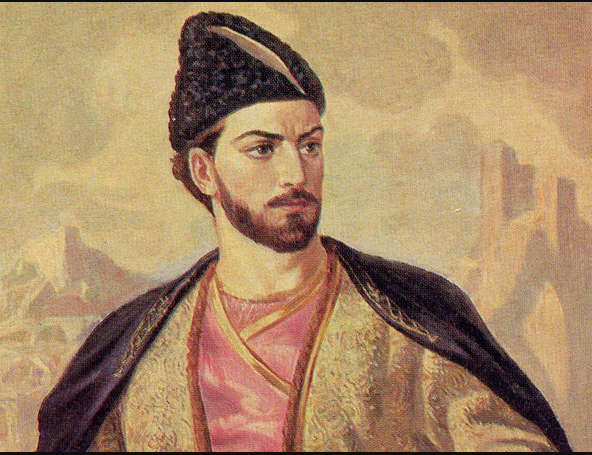
Put briefly: Rustaveli is the man who wrote a book that Georgians know by heart in places, quote in conversation and for centuries gave to brides along with the dowry. The age as a whole is covered in the piece on the golden era of the Georgian kingdom; here we are talking about the poet himself.

| Detail | Value |
|---|---|
| Period | The turn of the twelfth and thirteenth centuries. His exact dates are unknown |
| Role at court | Treasurer to Queen Tamar, by tradition and later testimony |
| Chief work | The Knight in the Panther’s Skin, in Georgian Vepkhistqaosani |
| Dedication | To Queen Tamar, in the prologue of the poem |
| What is known of him | Almost nothing: the prologue, the fresco in Jerusalem and late traditions |
| Image | A fresco in the Monastery of the Cross, Jerusalem |
| Death | In Jerusalem, by tradition; there is no firm evidence |
📜 What We Actually Know About Rustaveli
The honest answer is almost nothing. No documents about his life have survived, no letters, no testimony from contemporaries. Everything customarily told about Rustaveli is assembled from three sources: a few lines of the prologue of the poem itself, a fresco in Jerusalem, and late traditions written down centuries after his death.
Even his dates are unknown. The period is fixed through the dedication to Tamar: if the poem is dedicated to her, the author lived at her court. Everything else, the post of treasurer and the circumstances of his death included, has been reconstructed from indirect traces and later attributions.
The surname is a puzzle of its own. Rustaveli means of Rustavi, pointing to the place the poet came from. The trouble is that medieval Georgia had several settlements of that name, and which one is meant is still argued: some researchers favour the Meskhetian theory in the south of the country, others the one in Kvemo Kartli. The ancient fortifications of Rustavi survive and are covered in the article on Rustavi Fortress.
💡 Rustavi and Rustaveli Are Not the Same
The modern city of Rustavi near Tbilisi is an industrial centre that grew around a steelworks in the middle of the twentieth century. It is not the birthplace of the poet in any everyday sense: the surname points to a historical Rustavi, and which settlement was meant is still argued over. So a trip to modern Rustavi will not take you to the poet’s homeland, although a monument to him does stand there.
👑 The Poet at the Court of Tamar
The court of Tamar was a cultural as well as a political centre. Scholars, translators and poets worked there, and court literature was part of the prestige of the state no less than military victories.
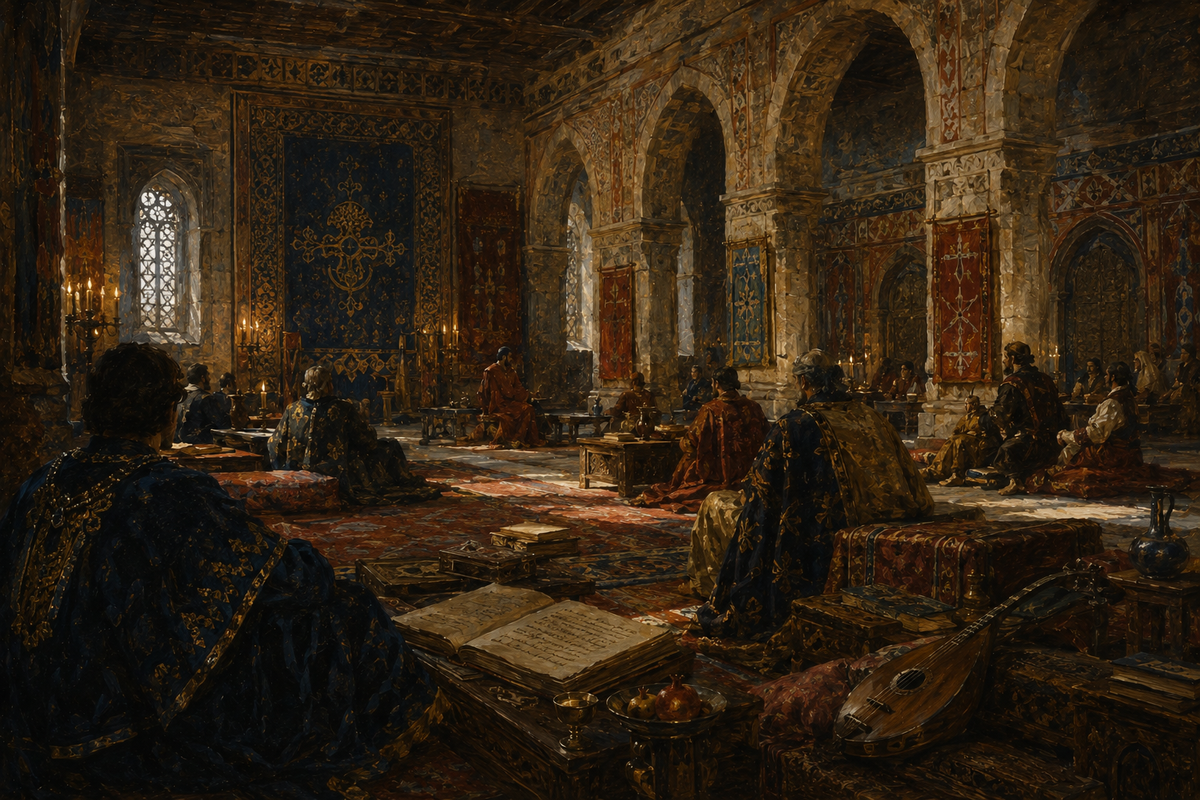
Tradition places Rustaveli at that court in a specific post: mechurchletukhutsesi, that is, treasurer. This was a serious office of state, not an honorary title for a poet. The version rests on late testimony and attributions, though, so it is best treated as a durable tradition rather than an entry in a staff list.
What remains a fact is something else: the poem is dedicated to Tamar, and the dedication stands in the prologue, written by the author himself. From this it follows that the poet was at least close to the queen and probably was not writing for a drawer.
The best known legend about Rustaveli grows from the same root: that he was in love with the queen, and the poem is a declaration that could not be made in any other way. A fine story, but a story: there is no evidence for it, and it appears in the Georgian tradition late. More about Tamar and her age is in the separate article.
🐆 The Knight in the Panther’s Skin: The Great Book of Georgia
Compressed into a few sentences, the plot runs like this. An Arabian king sends his commander Avtandil to find out who the strange knight in the skin of a big cat is, the one encountered on a hunt. The knight turns out to be Tariel, an Indian prince who has lost his beloved Nestan-Darejan. Avtandil resolves to help him, and from there the heroes travel half the world to find her.
There is no point retelling the poem further; it is better read. What matters is understanding why this particular book became for Georgia what Shakespeare is for the English or Ferdowsi for the Persians.
The reason is that the poem is not only an adventure. Its running themes are friendship and loyalty placed above personal gain, love as a force that makes a person better, and a nobility that depends on neither birth nor faith. The heroes belong to different peoples and religions, and this does not trouble the author in the slightest: his measure is conduct, not paperwork. For the twelfth century the idea is far from obvious, and it is what turned the poem into something like a code by which a person is judged in Georgia.
Hence the domestic tradition: copies of the poem were kept in families for centuries and, by tradition, given to a bride as part of her dowry. How widespread the practice really was is hard to say, but the custom itself is firmly recorded in Georgian culture.
One detail about the title. The Georgian word vepkhi is translated both as tiger and as panther or leopard, and translators have reached no settled answer: English has fixed on the panther, Russian on the tiger. It makes no difference to the meaning of the poem, but it explains why the animal changes from edition to edition.
The poem has been translated into dozens of languages. In English the first full version was made by Marjory Wardrop in 1912; in Russian the best known translators are Konstantin Balmont, Nikolai Zabolotsky, Panteleimon Petrenko and Shalva Nutsubidze. The translations differ sharply in tone, so an impression of the poem depends a good deal on whose text you happen to have.

| Detail | Value |
|---|---|
| When it was written | The age of Queen Tamar, the turn of the twelfth and thirteenth centuries. The exact date is unknown |
| Dedication | To Queen Tamar, in the prologue |
| Form | Shairi: a sixteen-syllable line, in quatrains |
| What it is about | Friendship, loyalty and love; the search for an abducted beloved that takes the heroes half across the world |
| Manuscripts | The oldest surviving copies date from the sixteenth and seventeenth centuries |
| First printed edition | Tbilisi, 1712, under King Vakhtang VI |
🖼️ The Fresco in Jerusalem: The Only Portrait
The only image of the poet considered contemporary or close to it is a long way from Georgia. In the Monastery of the Cross in Jerusalem, which was Georgian for centuries, a fresco survives on one of the pillars showing a figure with the inscription Shota.
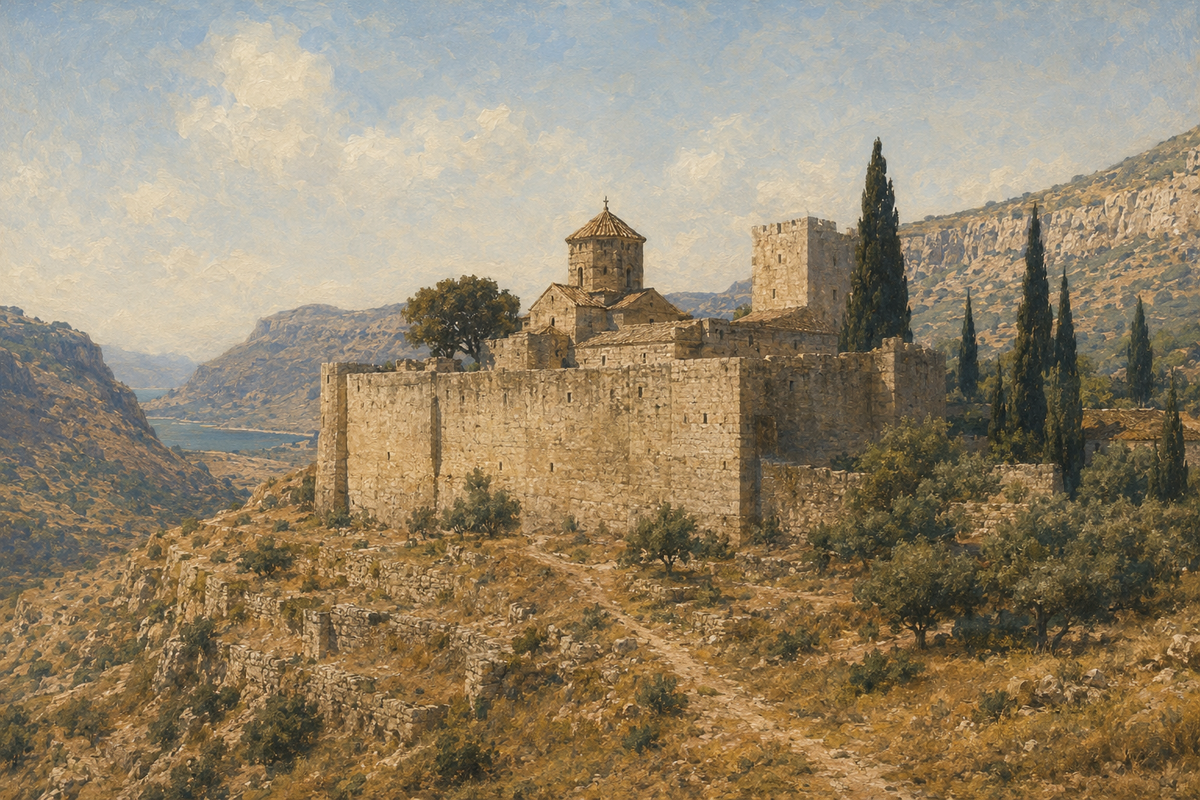
For a long time the fresco was hidden under later layers of plaster. It was cleaned in 1960 during the work of a Georgian expedition, and the event mattered to Georgian culture: the national poet had a face at last.
The monastery is also bound up with the tradition about his final years: that he went to Jerusalem, took monastic vows and died there. There is no documentary confirmation of any of it, but the fresco with its inscription gives the version a weight no other has.
In the prologue the poet explains why he took up the work: he sets out to praise the queen, whose name he gives outright, and speaks of her as a light worth writing for. There is no author’s name in the usual sense and no biographical detail; everything the poem says about itself amounts to the dedication and a few lines about its purpose.
A retelling of the prologue in our own words, with no translation quoted
✨ Rustaveli in Georgian Culture
The poem lives in the language. Many of its thoughts have passed into everyday speech and are used as sayings, often with no awareness of where they come from. The sense of one of the best known can be put like this: what is truly yours is only what you have managed to give away, and whatever you have hidden should be counted as lost. Another holds that a real friend is known not at the table but in trouble, and that for a friend nothing should be spared.
In Georgia the name of the poet functions as a mark of the highest cultural rank. It is carried by the state prize for literature and the arts, by the institute of Georgian literature, by the leading drama theatre of the capital and by the main avenue of the country. Anniversaries of the poem have been marked as events of state.
The result is a paradox: almost nothing is known about the man, and his presence in the country is absolute. Georgia knows its greatest poet by one fresco and one book, and that has proved enough for eight centuries.
🗺️ Rustaveli on the Map: Avenue, Metro, Theatre
The name Rustaveli turns up in Georgia more often than the name of any ruler. Below are the main places, so that the poet is not confused with the place names.
| Place | Where | What It Is |
|---|---|---|
| Rustaveli Avenue | Tbilisi | The main street of the country and the ceremonial axis of the capital |
| Monument to Shota Rustaveli | Tbilisi | The principal monument to the poet in the capital |
| Rustaveli Theatre | Tbilisi | The leading drama theatre of Georgia |
| Rustaveli Metro Station | Tbilisi | A central station beneath the avenue |
| Statue of Shota Rustaveli | Akhaltsikhe | A monument in Samtskhe, the region of the Meskhetian theory of his origin |
| Rustaveli streets | Across Georgia | A central street in almost every town in the country |
❓ Frequently Asked Questions About Shota Rustaveli
💬 The national poet of Georgia, who lived at the turn of the twelfth and thirteenth centuries and wrote The Knight in the Panther’s Skin. By tradition he served as treasurer at the court of Queen Tamar.
💬 About friendship and loyalty. The commander Avtandil helps the knight Tariel find his abducted beloved, and the search takes them half across the world. The running themes are friendship, love and a nobility that depends on neither birth nor faith.
💬 Treasurer, by tradition, mechurchletukhutsesi in Georgian. The version rests on late testimony; there is no documentary confirmation of the post.
💬 That is a legend. The poem is indeed dedicated to Tamar, with the dedication in the prologue, but there is no evidence of a romance, and the story appears in the Georgian tradition late.
💬 In the Monastery of the Cross in Jerusalem. The fresco showing a figure with the inscription Shota was cleaned in 1960 by a Georgian expedition.
💬 No. Modern Rustavi is an industrial city that grew up in the middle of the twentieth century. The surname points to a historical Rustavi, and which settlement was meant is still argued over.
📌 Key Points in Brief
The case of Rustaveli is rare even by medieval standards: a country has known its greatest poet for eight centuries while knowing practically nothing about him. No dates, no documents, no testimony from contemporaries; only a dedication in the prologue, a fresco on a pillar in a Jerusalem monastery and late traditions out of which the familiar biography was assembled. What did survive is the thing that mattered, the book. The Knight in the Panther’s Skin outlived its author, his age and most of the states that existed on the map at the time, and it still sets the standard in Georgian culture for what a person ought to be. The name now carried by an avenue, a theatre and a metro station stands behind that book, not the other way round.
💗 Read Next
💬 Now Over to You
- Have you read The Knight in the Panther’s Skin, and in whose translation?
- Did you know that almost no information about the life of the poet has survived?
- Which thoughts from the poem have you heard in ordinary speech without knowing the source?
- Should we write a separate piece on the poem: the heroes, the plot, the symbolism?
Tell us in the comments: good arguments and corrections make their way into the article.

5 comments
Log in to leave a comment