



🏛️ Abandoned Tskaltubo Sanatoriums: A Guide to the Ruins of a Soviet Resort
📋 What to Know Before You Visit
| 📍 Location | Tskhaltubo town, Imereti region, about 7 km from Kutaisi |
| 🚗 How to Get There | By car from Kutaisi, 15-20 minutes. Alternatively, minibus (marshrutka) No. 30 from the Red Bridge in Kutaisi |
| 🏛️ Number of Objects | During the Soviet era, between 19 and 22 sanatoriums and 9 bathhouses were built in the town. In this guide, we break down the most accessible and interesting ones in detail |
| 💰 Admission | Free almost everywhere, there are no ticket booths or entry fees |
| 🥾 What to Bring | Closed-toe shoes, a phone flashlight, and respect for private owners and security guards where buildings are already closed |
🧭 Who will find this article useful
This guide will be useful for those who want to see Soviet Empire-style resorts with their own eyes, not just in photographs, and understand which sanatoriums were built for miners, which for railway workers, and which were the private health resorts of the Central Union. It will also be useful for those who simply want to plan a day trip from Kutaisi and avoid a haphazard tour of the city.
📜 City of Health Resorts: Where Did 19 Sanatoriums Come From in One Place
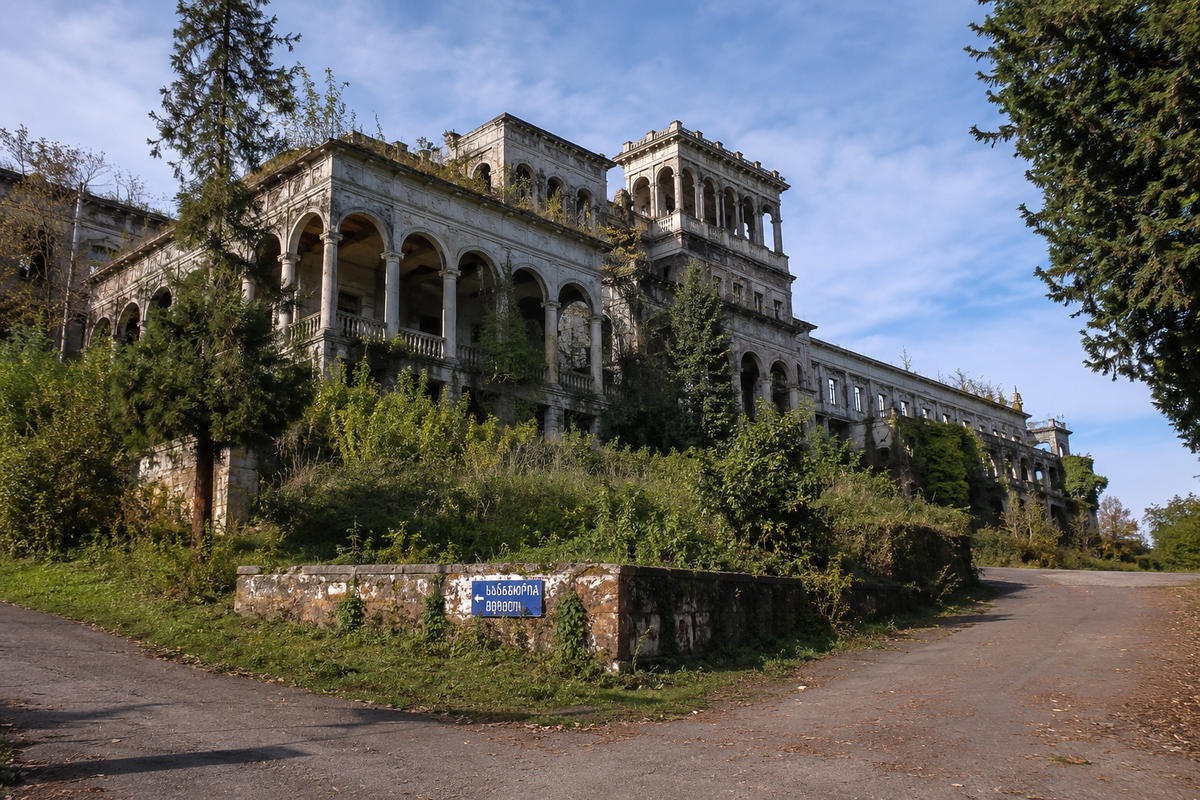
Radon springs near Tskaltubo were known even before the Common Era, but the city's true prosperity began in the 1920s and 1930s, when the water was recognized as having medicinal properties at the state level. Legend has it that after Stalin personally underwent treatment here, he ordered every Soviet department to build its own health resort in Tskaltubo. Thus, sanatoriums for miners, metallurgists, railway workers, geologists, the Central Union, and dozens of other organizations sprang up around the central park. By the early 1990s, the city had 19 to 22 sanatoriums and nine bathhouses. After the collapse of the USSR, funding ceased, and most of these buildings gradually fell into disrepair.
💧 Balneological buildings: why everything was built
Radon water was the radon of the resort; it was a place for treatment, not just relaxation, so the institute and baths are worth checking out first.
🏛️ Institute of Balneology
📍 Tskaltubo Central Park
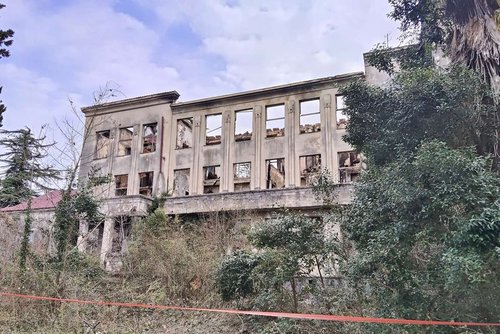
The colonnaded building was constructed in 1939 for a branch of the Scientific Research Institute of Balneology, which was studying the therapeutic properties of the local radon water. It was from here that the resort obtained scientific evidence that the water was truly therapeutic. The façade with its tall columns stands out among the neighboring sanatoriums, although the building was never used as a place of residence. According to some reports, it was recently damaged by fire and is temporarily fenced off; the entrance may be blocked.
🛁 Bathhouse No. 8
📍 Tskaltubo Central Park
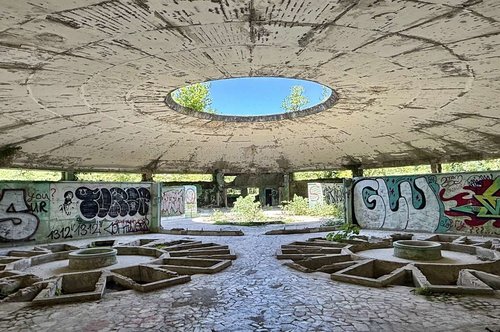
A round concrete building with four entrances and a large opening in the dome, its shape has earned it the nickname "UFO" locally. During the day, the sun shines directly through the opening into the center of the hall, making it one of the resort's most recognizable and frequently photographed landmarks. The bathhouse is often considered one of the main symbols of Tskaltubo, alongside the Medea sanatorium. Inside, remnants of Soviet-era pools and tilework remain, although the water has long since stopped flowing.
🛁 Bathhouse No. 5
📍 Tskaltubo Central Park
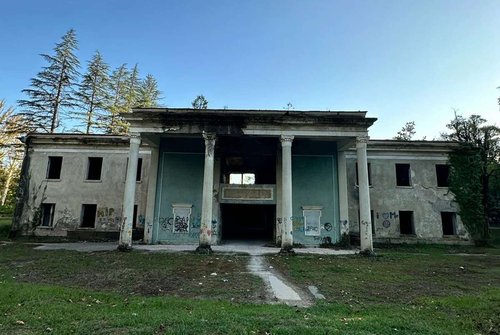
Another of the former nine bathhouses in the central park, built in the 1950s for radon baths. It's less well-preserved than Bathhouse No. 8, but it's interesting for the same spirit of an abandoned Soviet spa, just steps from the still-functioning Spring No. 6. There are no signs or markers, so tourists often pass by without a hint. Admission is free, and, like the neighboring bathhouses, there are no security or tickets.
🏛️ Trade Union Sanatoriums: A Competition Between Ministries
Each department of the USSR built its own health resort using its own industry budget, so sanatoriums competed with each other in scale and luxury, almost like individual palaces.
🏛️ Sanatorium Metallurg
📍 Baratashvili street
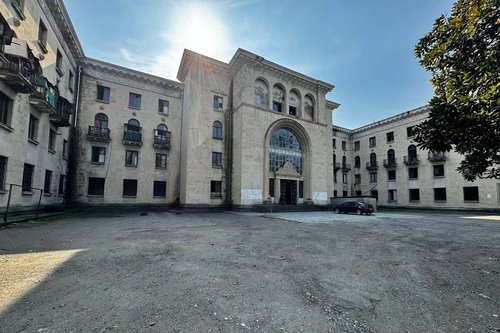
Built between 1955 and 1957 for workers in the metallurgical industry, it has been significantly better preserved than many neighboring sanatoriums thanks to its more robust structure. Inside, the large chandelier in the main hall, the assembly hall, and the dining room remain intact. The access road from Baratashvili Street leads directly to the main entrance, making it one of the easiest sanatoriums to access at the resort.
🏛️ Sanatorium Shakhtar
📍 Rustaveli Street, next to the stadium
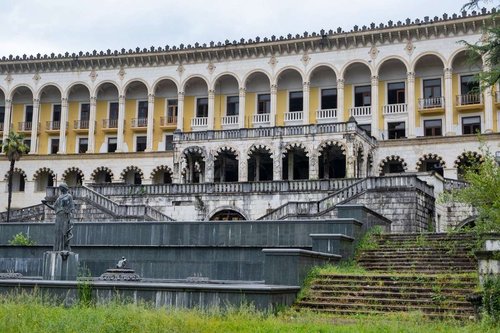
One of the resort's most expensive and luxurious sanatoriums, built in 1951-1952 by architects M. Melegi and G. Khimshiashvili specifically for miners. The interiors are better preserved than the others, down to the stucco ceilings and marble trim. A spiral staircase leads to the roof, where a gazebo with a view of the sunset and neighboring sanatoriums remains. In 2015, the building was purchased by a private investor and fenced off; it is now one of the city's most inaccessible sanatoriums.
🏛️ Sanatorium Zheleznodorozhnik
📍 Baratashvili street
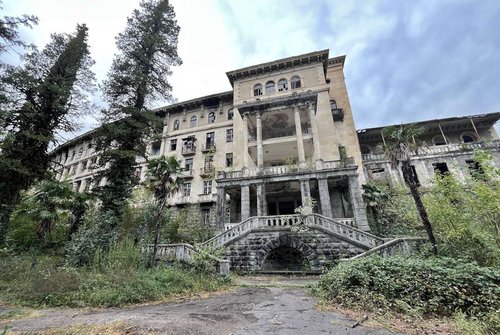
The railway workers' health resort was also known at various times as the Kolkheti Hotel. The building retains traces of its former luxury, but cracks appear in the walls, and a damp smell pervades the area. In the 2020s, the 33,000-square-meter site was put up for auction as part of the state resort restoration program. Under the terms of the deal, the new owner is obligated to build a hotel complex with at least 120 rooms there.
🏛️ Sanatorium Geologist
📍 Behind the Tbilisi sanatorium
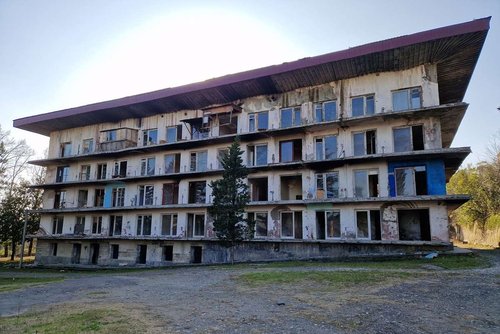
One of the resort's newest sanatoriums, built in 1975-1976, when the opulent Stalinist Empire style had already given way to the modest Soviet architecture of the later decades. From the outside, it's a mere gray box compared to the neighboring palaces, so many tourists pass it by. The neighboring children's sanatorium, "Gelati," with its turret on the roof, is literally a stone's throw away, so it's worth visiting both buildings back-to-back.
🏛️ Samgurali Sanatorium
📍 The eastern part of the resort area
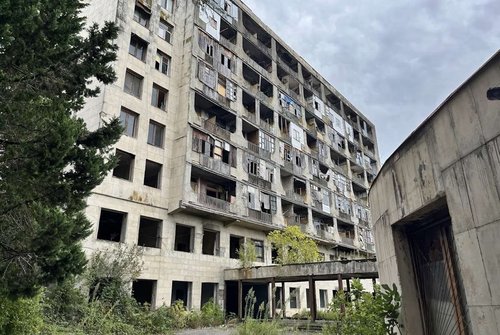
Its architecture is noticeably younger than the classic Stalin-era sanatoriums, likely built in the late Soviet period. The sanatorium was one of the first to be sold to an investor as part of the "New Life for Tskaltubo" program, so it's possible the building is already closed to the public and undergoing renovation. It's located in the eastern part of the resort area, near the Imereti sanatoriums and the Aya Hotel.
🏙️ Sanatoriums in the regions and cities of Georgia
These health resorts were named not after ministries, but after places: the capital, regions, and the resort itself, which made them a kind of calling card for the entire republic.
🏙️ Tbilisi Sanatorium
📍 The central part of the resort area
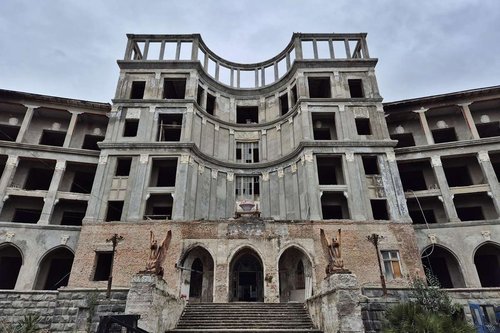
One of the oldest sanatoriums in Tskaltubo, built in 1951, it is easily recognizable by the two winged griffins at the main entrance and the courtyards with the remains of fountains and palm trees. Despite decades of neglect, the overall layout and ceremonial façade are still legible. Inside, staircases, columns, and decorative elements remain partially preserved, reminiscent of the resort's former luxury. Today, the sanatorium is considered one of the most recognizable abandoned landmarks.
🏙️ Imereti Sanatorium
📍 The eastern part of the resort area
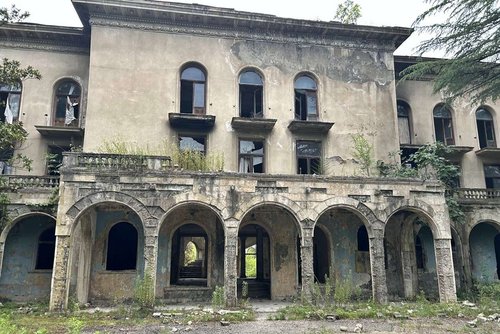
One of the most spectacular sanatoriums for photographers: the main hall is built under a dome with a powerful echo, audible only if you stand exactly in the center. A large, ever-present puddle usually stands in front of the grand staircase, creating some of the resort's most beautiful reflective shots. The building was put up for auction as part of the same privatization program as the neighboring Zheleznodorozhnik sanatorium.
🏙️ Iveria Sanatorium
📍 Near the Shakhtar sanatorium
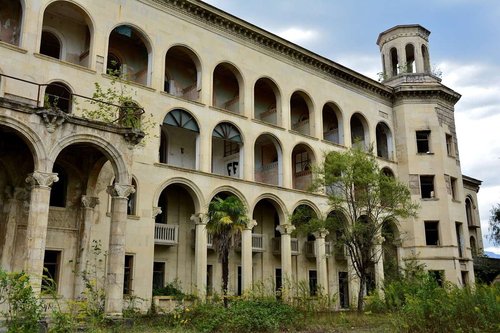
Completed in 1962, it was part of the Shakhtar sanatorium until 1967, when it became a separate building. Currently, the sanatorium stands empty and unguarded, and access is easier than at the neighboring Shakhtar. Inside, the central hall with its striking staircase and stucco ceiling is worth noting—it's the best-preserved part of the building. In 2016, it was auctioned off with the understanding that it would be converted into a hotel with approximately 160 rooms, but renovations have yet to begin.
🏙️ Sanatorium Tskhaltubo
📍 Near the central park
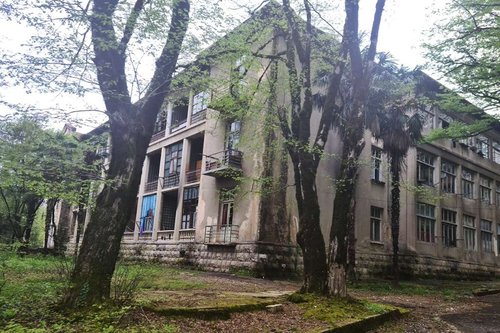
One of the city's oldest buildings, built in 1931, is named after the resort itself. From the main entrance, it's just a few minutes' walk to Spring No. 6, a still-operating hydrotherapy facility in the central park. The sanatorium has already been sold to investors under the state restoration program. Its current condition and availability should be confirmed before visiting.
🏺 Sanatoriums with legends and slogans
Some of the health resorts were named not by profession or region, but by myths and Soviet ideals, hence Medea from Colchian legends and Friendship as a symbol of internationalism.
🏺 Medea Sanatorium
📍 The intersection of the central streets of the resort area
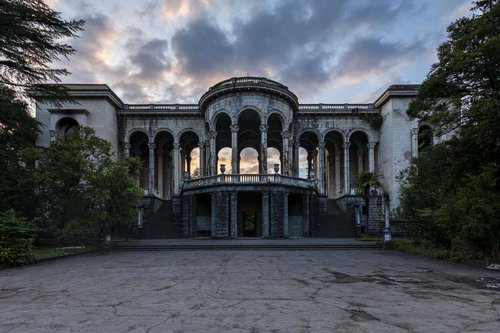
The sanatorium of the Central Union, the agency responsible for food supplies throughout the Soviet Union, is considered one of the most beautiful buildings in Tskaltubo: tall columns at the main entrance, a grand staircase, and an inner courtyard reminiscent of a palace rather than a health resort. Sources differ on the exact date of construction, citing everything from the mid-1950s to 1962. One wing is significantly better preserved than the others and has long been a favorite spot for photographers.
🏺 Gelati Sanatorium
📍 Near the Geolog sanatorium
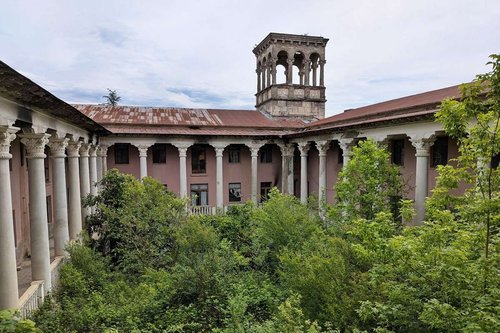
Named after the famous monastery near Kutaisi, it was built between 1953 and 1964. A decorative observation tower remains on the roof, and in the courtyard, a remnant from the building's former use as a children's sanatorium, you can still see an unusual mosaic area with animal images. The sanatorium can only be reached by climbing one flight of stairs, but even from there, the entire courtyard of the complex is clearly visible. The sanatorium is located just a few steps from the Geolog Hotel.
🏺 Sanatorium Savane
📍 The eastern part of the resort area
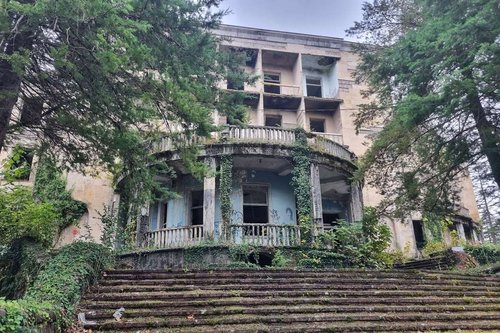
Opened on May 1, 1975, as a 150-bed boarding house and clinic, the architects were A. Intskirveli and P. Potskhishvili. The building was originally designed in a more opulent Stalinist style, but during construction, the decor was pared down to a bare minimum. As a result, the sanatorium resembles the resort's earlier buildings, but has a noticeably more modest appearance. This is a noticeable sign of the more economical Soviet architecture of the 1970s.
🏺 Druzhba Sanatorium
📍 Western part of the resort area
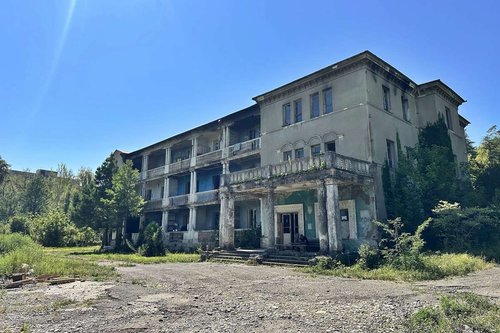
One of the resort's earliest sanatoriums, built in 1937, long before the main boom of Stalinist Empire style in the late 1940s and 1950s. In Georgian, the sanatorium is also called "Megobroba," which also translates as "friendship." The name reflects the Soviet idea of international friendship among peoples, common in the design of health resorts throughout the Soviet Union. The sanatorium is located in the western part of the resort area, a few minutes' walk from the second building, "Druzhba 2."
🏺 Sanatorium Druzhba 2
📍 The western part of the resort area, not far from the Druzhba sanatorium
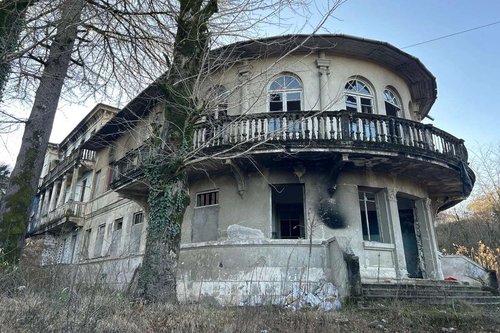
The second building of the Druzhba sanatorium, located a couple of minutes' walk from the first. There's little detailed history of this building, but together, the two buildings provide a glimpse into how the sanatorium expanded as the resort's popularity grew. Like the first building, this building is unguarded and open to the public. It's convenient to plan your route so you visit both buildings in a row, avoiding unnecessary detours through the city.
🏨 Hotel Aya: another era
This building stands out from the crowd: it is younger than the others and appeared after the main Soviet construction boom.
📍 The eastern part of the resort area
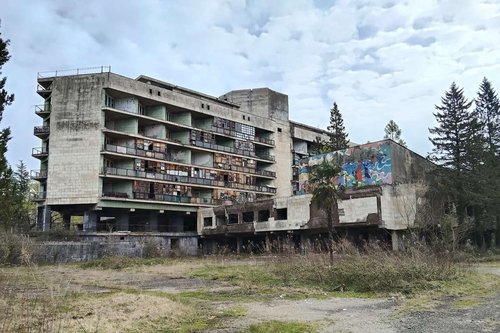
Unlike the other buildings, Aya is not a Stalin-era sanatorium, but a more recent hotel. The building's main attraction is the mosaic in the main hall, characteristic of Soviet decorative art of the 1970s and 1980s. The hotel is located in the eastern part of the resort area, near the Savane and Samgurali sanatoriums. Despite its later construction, the building retains the same air of abandonment as the neighboring palaces.
Some buildings are guarded by private owners who are preparing them for restoration. If you see a new fence, a lock on the gates, or security guards, the sanatorium is most likely closed to the general public, and it is best not to try to bypass them. The floors and staircases in many sanatoriums are unstable, especially after rain, making sturdy, closed-toe shoes essential. Also, keep in mind that the status of several sanatoriums can change at any moment: some have already been sold to investors and are undergoing preparation for restoration or interior demolition, so check for up-to-date information before your trip.
🗺️ How to visit all the sites in one day
The sanatoriums are located compactly, all within two to three kilometers of Tskaltubo's central park. The route is most conveniently structured into three sectors: the western sector starts from the Druzhba sanatorium, the central sector centers around Bathhouse No. 8, and the eastern sector encompasses Shakhtyor, Iveria, and the Institute of Balneology. A map with numbered detours and color-coded sectors is included as a separate file.
🏁 Why come here
Tskaltubo serves as a cross-section of Soviet history in a single small town: the competition between ministries for the most luxurious sanatorium, the myth of Tsentrosoyuz and Medea, the war in Abkhazia that changed the fate of the abandoned buildings, and the state's current attempt to transform the ruins into a new resort. Even if you don't plan to visit all the sites in the collection, a couple of the most characteristic ones, like Medea, Shakhtyor, and Bathhouse No. 8, are enough to understand why this city so attracts photographers from all over the world.
ℹ️ The privatization status, availability, and condition of sanatoriums are changing: some buildings have already been sold to investors, while others are being prepared for restoration or interior demolition. Check the current situation before your trip, especially if you're traveling for a specific property.
Have you been to Tskhaltubo? Which sanatorium impressed you the most—Medea, Shakhter, or maybe the completely unexpected Geolog? Let us know in the comments below, we read them all ❤️
❓ Frequently asked questions
💬 According to various sources, between 19 and 22 sanatoriums and 9 bathhouses were built in the city during Soviet times. This selection covers the most accessible and interesting buildings; some very small or completely demolished buildings were not included.
💬 In most cases, yes, there are no security guards or tickets at the entrance. However, a few buildings, such as Shakhtar and the Institute of Balneology, may be fenced or guarded; access to these buildings should be confirmed on site.
💬 Yes, most of Tskaltubo's abandoned buildings have long been popular locations for photo shoots, including weddings. There are no formal restrictions on photography, but if the sanatorium is guarded by a private owner, it's best to ask permission beforehand at the entrance. Out of respect for those who live or work, it's best not to enter locked parts of the building or photograph in areas where people live or work.
💬 The most commonly named are "Medea," "Shakhtyor," and Bathhouse No. 8. "Medea" is known for its grand staircase and columns, "Shakhtyor" has the best-preserved interiors, and Bathhouse No. 8 is recognizable by its shape and the light effect in its dome.
💬 The easiest way is by car from Kutaisi; the journey takes 15-20 minutes. Minibus #30 also departs from Kutaisi and leaves from the "Red Bridge" stop.
💬 Yes, the state is selling some buildings to investors as part of the "New Life for Tskaltubo" program; several sanatoriums have already been purchased and are being prepared for renovation. This means that the accessibility and condition of these facilities may change faster than the average for other abandoned buildings in Georgia.
💬 Exercise caution: floors and stairs are sometimes in disrepair, especially after rain. Sturdy, closed-toe shoes and a flashlight are essential, and avoid entering secure or restricted areas to avoid causing problems for yourself or the building's owners.

2 comments
Log in to leave a comment
Я чув, що там крім самих санаторіїв є ще й гарячі джерела. Чи варто їх відвідати, якщо я все ж рішуся на цю подорож?!