


👑 Queen Tamar of Georgia: Life, Reign and the Golden Age
Tamar ruled Georgia from 1184 to 1213, and under her the medieval Georgian kingdom reached the peak of its power. She was crowned with the male title mepe, meaning king, rather than dedopali, the word for a king’s wife. She divorced her first husband, defeated his armies twice, and was canonised by the church after her death. Dozens of fortresses, bridges and churches across Georgia carry her name, and she built almost none of them.
In Short
- She ruled for 29 years, from 1184 to 1213. She had become her father’s co-ruler as early as 1178.
- She held the title mepe (king), not dedopali (a king’s consort).
- Two marriages: Yuri Bogolyubsky (divorce) and David Soslan (the father of her children).
- Canonised by the Georgian Orthodox Church; her feast day falls on 14 May.
- Her grave has never been found.
❓ Who Was Queen Tamar, Explained Simply
Tamar was born into the family of King George III and was the great-granddaughter of David IV the Builder, the king who crushed the Seljuks at Didgori in 1121 and brought Tbilisi back under Georgian rule. By the time she came to power the Bagrationi dynasty had held the throne for centuries, and the unified kingdom was half a century old.
Tamar did not build that state. Her great-grandfather unified the country, her father put the army and the treasury in order, and David himself was buried at Gelati, the monastery he founded. What Tamar did was different: she held on to that inheritance when the nobility tried to rewrite the rules in its own favour, and she pushed the kingdom’s influence further than anyone before her.
| Detail | Value |
|---|---|
| Name | Tamar. With the royal title: Tamar Mepe |
| Lifespan | around 1166 – 1213. The exact date of birth is unknown |
| Reign | 1184–1213. Co-ruler with her father from 1178 |
| Dynasty | Bagrationi |
| Title | mepe (king). In full titulature: king of kings |
| Father | George III, King of Georgia |
| Mother | Burdukhan, daughter of an Ossetian ruler |
| Great-grandfather | David IV the Builder |
| Spouses | Yuri Bogolyubsky (around 1185, divorced). David Soslan (around 1189) |
| Children | George IV Lasha and Rusudan. Both later took the throne |
| Canonisation | Holy Righteous King Tamar. Feast day 14 May |
| Burial place | Not established |
📛 Why Tamar Is Called King and Not Queen
In Georgian, a king’s wife is a dedopali. The ruler is a mepe. Tamar was crowned mepe, and that was no formality: the title answered the question of who actually took the decisions in the country.
English, like most European languages, translates her as queen simply because she was a woman. That is a convenience of translation, not a term from the Georgian sources. It is also why one of the main avenues in Batumi is named after Tamar Mepe and not Tamar Dedopali.
The popular line about “the first woman king” needs one correction. More precisely: Tamar was the first woman on the Georgian throne to hold the full royal title and rule in her own right, rather than alongside a husband or a son.
🏰 The Road to the Throne: Co-Rule and Coronation
👑 Heir to the Bagrationi
Her great-grandfather left Tamar a unified country, the victory at Didgori and the monastery of Gelati, where he was buried himself. Her father, George III, came to the throne in 1156. His claim to the crown was weaker than that of his nephew Demna, and he crushed the conspiracy raised in the nephew’s favour without mercy. George had no son. He had a daughter.
📜 Co-Ruler From 1178, Crowned Again in 1184
To make sure that nobody could challenge Tamar’s rights after his death, George III did something unusual: he crowned his daughter while he was still alive. That was in 1178. For six years father and daughter ruled together, and in those years Tamar saw the machinery of power from the inside.
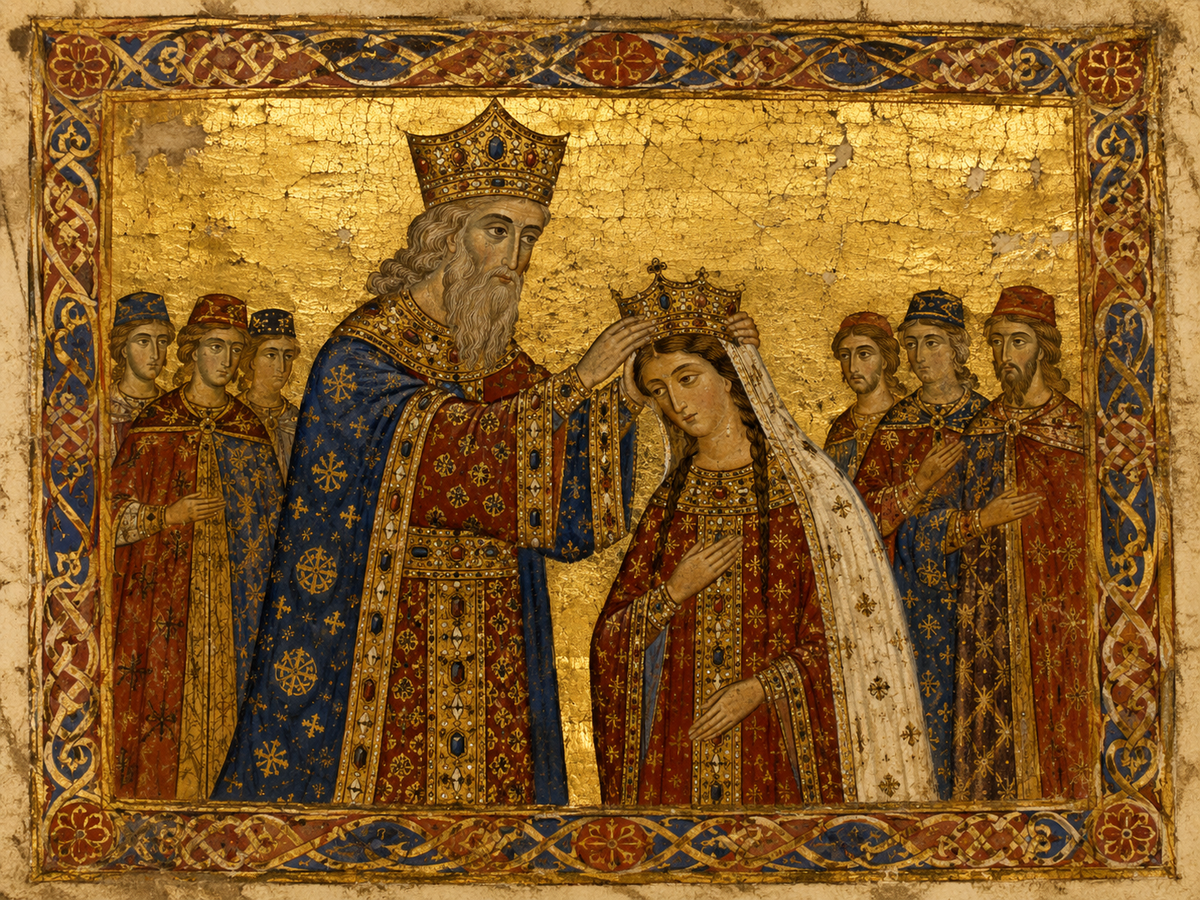
George III died in 1184. Tamar was crowned a second time, now as sole ruler.
⚖️ The Early Years: Nobles, the Darbazi and a Bargain Over Power
A young ruler with no father standing behind her looked convenient to the aristocracy. The darbazi, the council of the high nobility, demanded concessions. Kutlu-Arslan, the royal treasurer, and his allies proposed a separate body that would take the decisions while the crown was left only to approve them. Tamar ordered his arrest, the nobles threatened to rise, and the affair ended in a compromise. Supreme power stayed with Tamar.
Her first years on the throne went on personnel: she removed the nobles she did not want and put her own people into the key posts. The court itself did not stay in one place. Royal residences were scattered across the country: Tbilisi, the palace at Geguti near Kutaisi, and Okros Chardakhi.
💍 Tamar’s Two Marriages: Yuri Bogolyubsky and David Soslan
❌ The First Marriage: Yuri Bogolyubsky
Her first husband was chosen for her by the court. Around 1185 she was married to Yuri, son of Andrei Bogolyubsky, prince of Vladimir-Suzdal. After his father was murdered Yuri fled Rus and lived among the Cumans, and it was from there that he was brought to Tbilisi. He could fight. Being the husband of a Georgian ruler, judging by the outcome, he could not.
The marriage lasted about two years. The Georgian chronicles put the divorce down to Yuri’s drinking and his vices, though how much of that is truth and how much a convenient version written by the winning side is hard to say. Tamar divorced him and sent him away to Constantinople.
Then came the part the court had not expected. Yuri returned, part of the nobility of western Georgia proclaimed him king, and Tamar had to go to war against her own former husband. The revolt was put down. Yuri tried once more, this time with foreign military backing, and lost again. After that he disappears from the Georgian chronicles.
💚 The Second Marriage: David Soslan
Her second husband Tamar chose herself. Around 1189 she married David Soslan, an Ossetian prince who had grown up at the Georgian court. He made no claim to power of his own and took exactly the place the ruler needed him to take: that of a commander. The victories at Shamkor and Basiani are tied to his name. David died around 1207, a few years before his wife.
👶 The Children: George IV Lasha and Rusudan
There were two children, and both later took the throne. George IV, known as Lasha, ruled after his mother from 1213 and died in 1223, with the Mongols already at the border. His sister Rusudan took the crown next, and the country she inherited was a very different one.
An Interesting Fact
A crowned ruler getting divorced in the twelfth century was close to impossible. Tamar divorced, sent her former husband abroad, married again, and twice fought off his attempts to take the throne by force. According to the chronicles the court formalised the decision, but it was the ruler herself who pushed for it.
⚔️ Tamar’s Reign: Victories and a Kingdom at Its Height
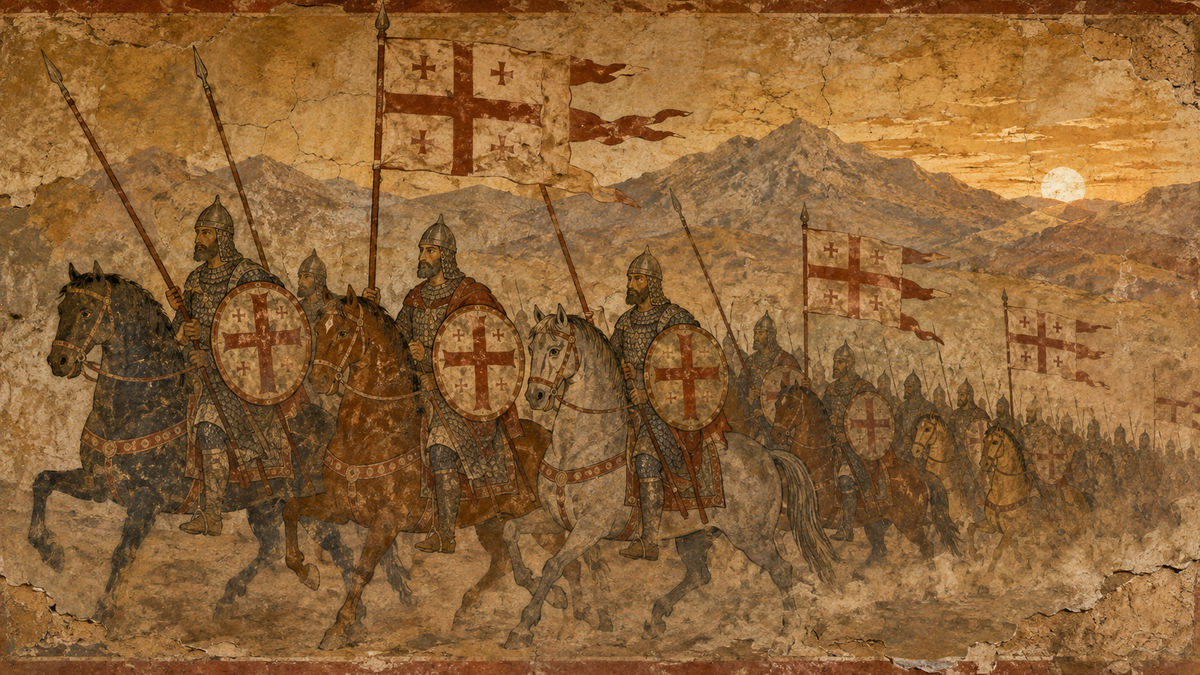
🗡️ The Battle of Shamkor, 1195
In 1195 the atabeg Abu Bakr raised an army against Georgia. The Georgian forces, commanded by David Soslan, met him at Shamkor in what is now northern Azerbaijan and defeated him. The town was taken. The caliph’s banner captured in the battle was, by tradition, presented by Tamar to Gelati.
🏹 The Battle of Basiani, Around 1203
Rukn al-Din, the Sultan of Rum, sent Tamar a letter demanding submission, and the tone of that letter, if the chronicles are to be believed, was insulting. The Georgian army marched out to meet him and destroyed the Seljuk force at Basiani, north-east of present-day Erzurum. The sources give different dates: anywhere from 1202 to 1204.
🌊 “From Sea to Sea” and the Empire of Trebizond
The phrase “from sea to sea”, from the Black Sea to the Caspian, does not describe the state borders of Georgia but its sphere of influence. Neighbouring emirates paid tribute, Georgian garrisons stood in foreign cities, and coins were struck in the ruler’s name. In 1204, when the Crusaders took Constantinople, Tamar backed her Komnenos relatives, and the Empire of Trebizond appeared on the southern shore of the Black Sea.
| Year | Event | What It Meant |
|---|---|---|
| 1178 | Crowned in her father’s lifetime | George III makes his daughter co-ruler and settles the question of succession |
| 1184 | Death of George III, second coronation | Tamar becomes sole ruler |
| around 1185 | Marriage to Yuri Bogolyubsky | The husband is chosen by the court, not by the ruler |
| around 1187 | Divorce and the exile of Yuri | Two revolts by him follow, both put down |
| around 1189 | Marriage to David Soslan | The ruler gains a commander she can rely on |
| 1195 | Battle of Shamkor | Defeat of the atabeg Abu Bakr |
| around 1203 | Battle of Basiani | Defeat of the Sultan of Rum. The sources date it from 1202 to 1204 |
| 1204 | Support for the Komnenoi | The Empire of Trebizond appears on the southern Black Sea coast |
| 1213 | Death of Tamar | The throne passes to her son, George IV Lasha |
How the state itself worked under Tamar, where the money in the treasury came from, what happened to the cities, to trade and to the church, we cover separately: the Golden Age of the Georgian kingdom. This article is about the person, not about the era.
📜 Tamar and Culture: Rustaveli, Vardzia and the Arts
Shota Rustaveli’s “The Knight in the Panther’s Skin” was written at Tamar’s court and dedicated to her: the prologue names the ruler outright. The legend that Rustaveli was hopelessly in love with her and withdrew to a monastery because of it has been alive for centuries, but it remains a legend. So little is known about the poet himself that even the years of his life are disputed.
Vardzia, the cave city in Samtskhe-Javakheti, was begun in the rock under George III and finished under Tamar. A fresco with her portrait survives there. Up and down the Kura gorge from Vardzia stand the fortresses of Khertvisi and Tmogvi: they guarded this stretch of the road.
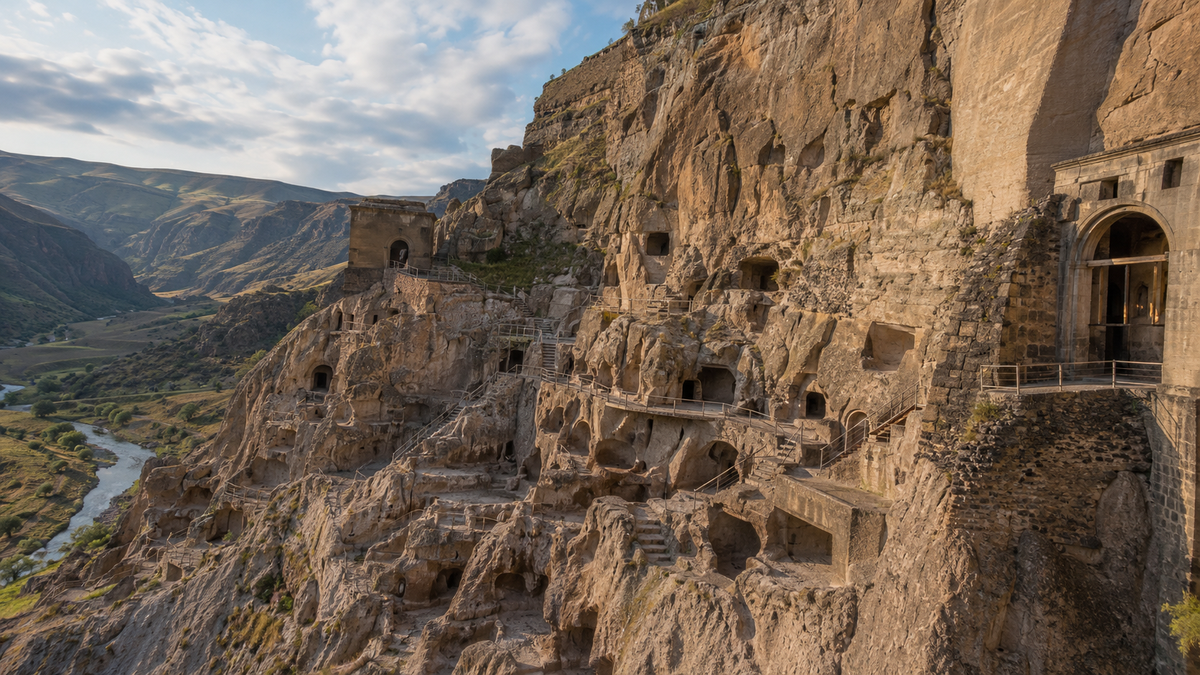
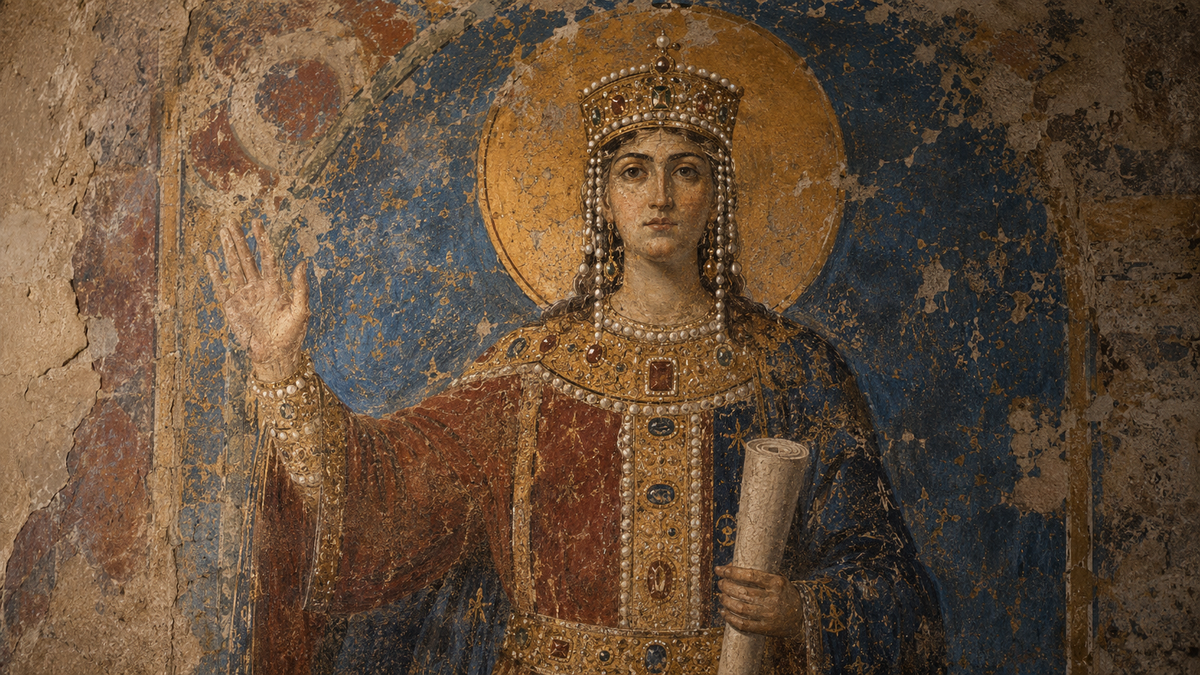
Portraits made in Tamar’s lifetime are few, and every one of them is a wall painting: Vardzia, Betania and Kintsvisi. Historians use the phrase “made in her lifetime” with care: some of the images may have been added later.
⛪ Saint Tamar: Canonisation and Feast Day
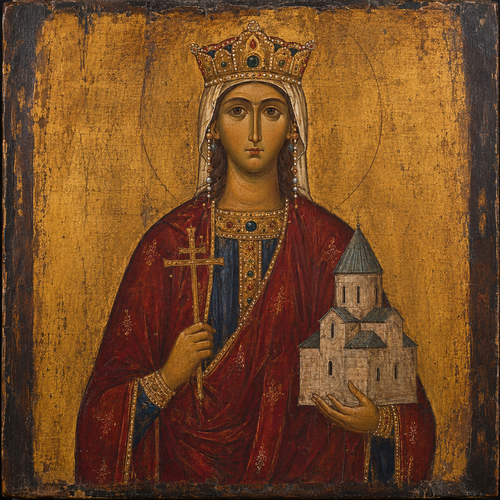
The Georgian Orthodox Church venerates Tamar as a saint. Her feast day falls on 14 May. She is also commemorated on the Sunday of the Myrrh-bearing Women, and that date moves: it depends on Easter.
The popular name for the feast is Tamaroba. Liturgies are served in the churches, and in villages with a church dedicated to her a communal table is laid. We cover the feast itself separately: how Tamaroba is celebrated in Georgia.
🕯️ The Mystery of the Grave: Where Is Queen Tamar Buried?
Tamar’s grave has never been found. That is the only thing about her burial that is known for certain. Everything else is a theory.
Gelati. The Bagrationi family vault, where David the Builder lies. Looking for the ruler beside her great-grandfather makes sense, but the excavations did not find her.
A secret burial. The chronicle tradition says that the burial place was hidden deliberately, so that enemies could not desecrate the remains. This version explains why the grave is not where it ought to be.
Jerusalem. A third theory links the burial to the Monastery of the Cross, which in those years belonged to the Georgians. There is no direct evidence, only indirect mentions in medieval sources.
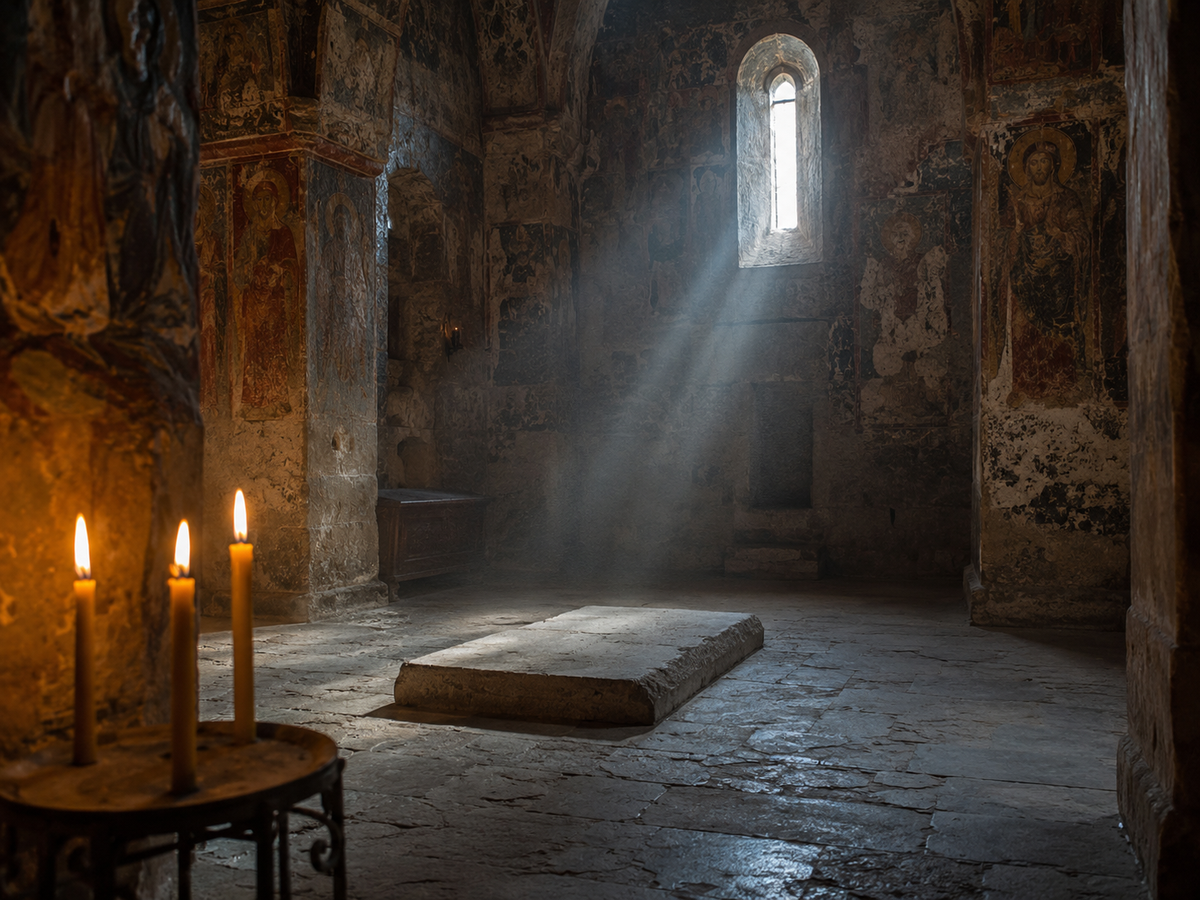
The chronicle compilation “Kartlis Tskhovreba” relates that the farewell to the ruler was lavish and public, while the burial was secret. The coffin was carried out at night, the grave was left unmarked, and only a handful of people knew where it was. This was done, the chronicle says, so that enemies could not desecrate the remains.
A retelling of the chronicle tradition, not a verbatim quotation.
🗺️ What Bears Queen Tamar’s Name: Castles, Bridges, Churches, Streets
Travelling around Georgia without running into Tamar’s name is close to impossible. Tamar’s castles, Tamar’s bridges, Tamar’s churches, Tamar Mepe Avenue in Batumi.
One caveat is needed here, without which all this geography misleads. Folk memory does not work like an archive: the name of the great ruler attached itself to anything old and beautiful. Many of the “bridges of Queen Tamar” in Adjara were built centuries after her death. And the best known “Tamar’s castle”, the one in the Darial Gorge, has nothing to do with her: it belongs to the wicked queen of the mountain legends, whom Lermontov later put into verse, and that settled the confusion for good.
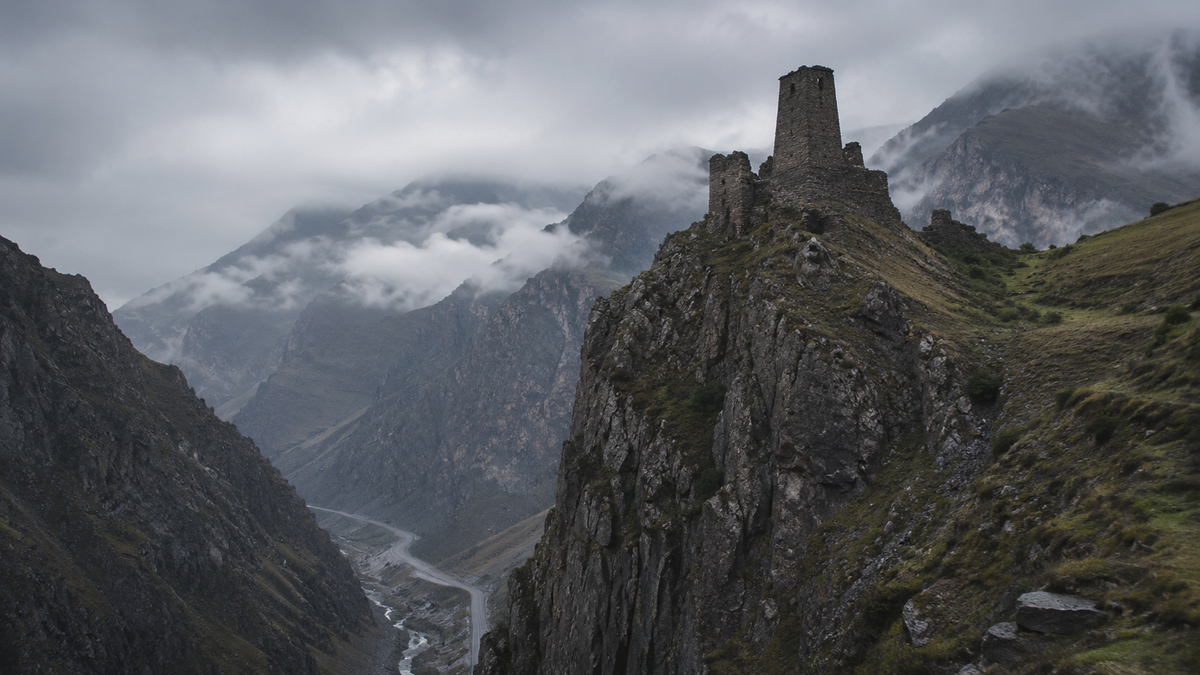
| Site | Where | In Brief |
|---|---|---|
| Tamar’s Castle | Darial Gorge | A tower above the Terek. No link to the historical ruler: the name comes from a mountain legend |
| Khornabuji Fortress | Kakheti, near Dedoplistskaro | A fortress on a cliff, known locally as the castle of Queen Tamar |
| Akhaldaba Fortress | Borjomi Gorge | Another “Tamar’s castle”, this one on the road into the mountains |
| Tamari Church | Village of Amamlo | A twelfth-century church, contemporary with the ruler |
| Kveshi Fortress | Bolnisi | Known from the seventh century, rebuilt in the twelfth, under Tamar |
| Vardzia | Samtskhe-Javakheti | The cave city finished under Tamar. A fresco with her portrait survives inside |
| Dandalo Bridge | Adjara | One of the arched bridges locally called the bridges of Queen Tamar |
Dozens of streets, fortresses, bridges and churches in Georgia carry Queen Tamar’s name: listing them all is impossible. Gathered here are the best known sites, the ones we cover in separate articles.
❓ Frequently Asked Questions About Queen Tamar
💬 From 1184 to 1213, which is 29 years. She became her father’s co-ruler earlier, in 1178, which is why the year 1178 sometimes appears as the start of her reign.
💬 She was crowned with the title mepe, which is Georgian for king. The word for a ruler’s consort, dedopali, was never applied to her.
💬 There were two. The first, Yuri Bogolyubsky, son of Andrei Bogolyubsky: the marriage ended in divorce and in two revolts on his part. The second, David Soslan, a commander and the father of her children.
💬 Nobody knows: the grave has never been found. Three theories are discussed, Gelati, a secret burial, and the Monastery of the Cross in Jerusalem.
💬 The feast day is 14 May, and Tamaroba, the popular celebration in her honour, falls on the same day. She is also commemorated on the Sunday of the Myrrh-bearing Women, which is a moveable date.
💬 To Queen Tamar: the prologue of the poem names her outright. The legend about the poet being in love with her has no evidence behind it.
💬 No. Most of the sites that carry her name were built either earlier or much later, and it was folk memory that attached her name to them.
📌 The Short Version
Tamar took the crown from her father’s hands, fought off a nobility that wanted to limit royal power, divorced her first husband and twice defeated his armies. Under her the Georgian army won Shamkor and Basiani, and the influence of the kingdom stretched from the Black Sea to the Caspian. Rustaveli wrote “The Knight in the Panther’s Skin” at her court, and her portrait survives on a wall at Vardzia. The church made her a saint, and her grave has still not been found.
Read Next
- The Golden Age of the Georgian Kingdom: how the country worked at the height of its power
- The Feast of Tamaroba: how Georgia marks the day of Saint Tamar
- Vardzia: the cave city finished in the ruler’s lifetime
- From King David to the Russian Empire: the rulers of Georgia in one overview
- David IV the Builder: Tamar’s great-grandfather, the king who unified Georgia
- Shota Rustaveli: the poet who dedicated “The Knight in the Panther’s Skin” to the ruler
💬 Over to You
Tamar is one of those figures everyone has a version of. Tell us yours.
- Which theory about the grave do you find more convincing: Gelati, a secret burial, or Jerusalem?
- Which of the places named after Tamar have you seen with your own eyes, and which one stayed with you?
- Did you know that Tamar’s title translates as king rather than queen?
- Which ruler of Georgia should we cover next: David the Builder, Vakhtang Gorgasali or Erekle II?
Write to us in the comments. If you know a fortress, a bridge or a church carrying Tamar’s name that is missing from our list, tell us about it and we will add it.

5 comments
Log in to leave a comment
Но вот что меня смущает: она оставила после себя кучу памятников, но сама почти ничего не построила. Это как если бы ты оставил след, но сам шагал мимо. В Грузии до сих пор ощущается её влияние, а я всё-таки ловлю себя на мысли, как сложно быть женщиной в таком положении. Невероятная личность, однозначно.