


⚔️ Erekle II: The Last Great King of Georgia
Erekle II was king of Kakheti from 1744 and of the united kingdom of Kartli-Kakheti from 1762 to 1798, the last strong ruler of an independent eastern Georgia. His reign holds the victory at Aspindza, the Treaty of Georgievsk with Russia and the sack of Tbilisi by the army of Agha Mohammad Khan. Three years after his death the kingdom ceased to exist and passed into the Russian Empire.
📌 In Brief
- King of Kakheti from 1744 and of the united kingdom of Kartli-Kakheti from 1762 to 1798.
- As a young man he took part in Nader Shah’s Indian campaign and saw the taking of Delhi.
- He defeated an Ottoman force at Aspindza in 1770.
- In 1783 he signed the Treaty of Georgievsk, placing his kingdom under Russian protection.
- In 1795, at the age of seventy-five, he took the field at Krtsanisi against Agha Mohammad Khan and lost Tbilisi to fire.
- He is buried in Svetitskhoveli Cathedral in Mtskheta, alongside other kings of Georgia.
❓ Who Was Erekle II in Simple Terms
Erekle II belonged to the Bagrationi, the dynasty that had ruled Georgia since the end of the first millennium. He came from its Kakhetian branch: his father Teimuraz II was king of Kakheti, and through his mother Erekle was a grandson of Vakhtang VI, king of Kartli and the compiler of its law code. Both eastern Georgian lines, the Kakhetian and the Kartlian, met in him.
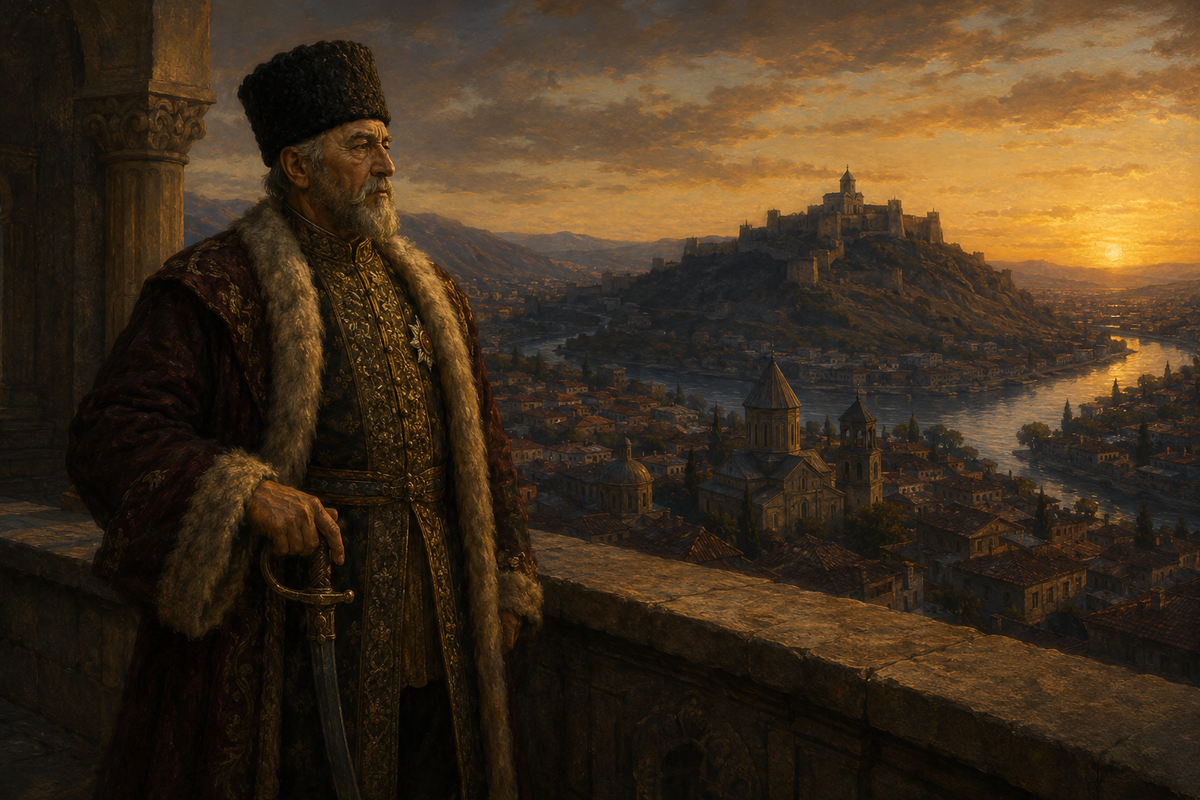
One clarification matters here. Kartli-Kakheti was eastern Georgia, not the whole country: the western lands were under Ottoman control at the time and lived a separate political life. When Erekle is called the last great king of Georgia, what is meant is the eastern kingdom and the fact that no independent statehood outlived him.
| Detail | Value |
|---|---|
| Lifespan | 1720–1798. Some sources give 1721 as the year of birth |
| Reign | Kakheti from 1744, the united Kartli-Kakheti from 1762 to 1798 |
| Dynasty | The Bagrationi, Kakhetian branch |
| Father | Teimuraz II, king of Kakheti and later of Kartli |
| Mother | Tamar, daughter of Vakhtang VI, which made Erekle his grandson |
| Wife | Darejan Dadiani, whose name the Sachino palace in Tbilisi carries |
| Heir | George XII, the last king of Kartli-Kakheti |
| Residences | Tbilisi and Telavi, with the fortress palace of Batonis-tsikhe |
| Burial | Svetitskhoveli Cathedral, Mtskheta |
📛 Erekle, Irakli or Heraclius: The Name and the Nickname Patara Kakhi
All the forms are correct. Erekle is the Georgian form, the one used in Georgia and the one carved on the monuments. Irakli is the form that settled in Russian, and through Russian books it reached a good deal of the literature. English-language works sometimes latinise the name as Heraclius II, following the Byzantine emperor.
Popular memory gave the king the nickname patara kakhi, which translates as the little Kakhetian. It is traditionally explained by two things at once: the king was short, and he came from Kakheti. The phrase sounds homely, but in Georgian it carries respect, something closer to our Kakhetian.
One king should not be confused with another. Erekle I ruled at the turn of the seventeenth and eighteenth centuries and was the grandfather of the king in this article.
🐘 Youth: The March on Delhi with Nader Shah
The future king learned soldiering a long way from Georgia. In the late 1730s the Persian ruler Nader Shah gathered an army for a campaign into India, and Georgian contingents marched with him. Erekle was about seventeen.
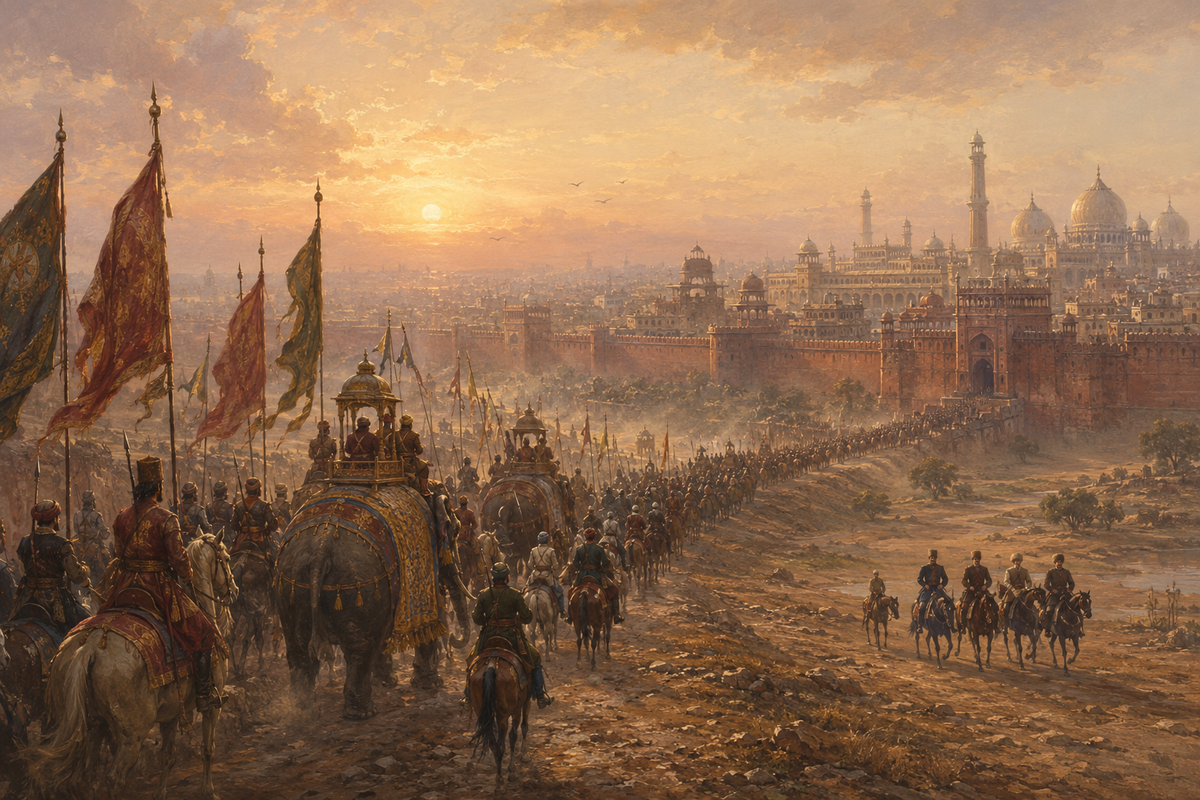
The campaign ended with the taking of Delhi in 1739 and the removal of an enormous quantity of plunder. For the young prince it was more than a war: it was a look at great Asian politics from the inside, at how empires are built, how quickly they come apart and what an alliance with a strong neighbour actually costs. That schooling explains a good deal about his later decisions.
💡 An Interesting Fact
The future king of eastern Georgia took part in the capture of Delhi. In 1739 the army of Nader Shah entered the Mughal capital, and a Georgian contingent was part of that campaign. The sources say little about what Erekle himself did there, but the bare fact is worth holding on to: the man who would later sign a treaty with St Petersburg had watched one of the richest capitals in Asia being stripped in his youth.
👑 The Union of Kartli and Kakheti
In 1744 Nader Shah confirmed Teimuraz II as king of Kartli and his son Erekle as king of Kakheti. The result was an unusual arrangement: father and son ruling two neighbouring kingdoms at once and acting together. That partnership held for eighteen years.
In 1762 Teimuraz II died and Erekle took the second crown. This is how the single kingdom of Kartli-Kakheti came about, with Tbilisi as its capital. For eastern Georgia it was an important turn: instead of two permanently competing thrones there was now one authority, one tax base and one army.
The capital remained Tbilisi, but the king’s home town was Telavi, and the Kakhetian residence mattered to him no less than the capital. The fortress palace of Batonis-tsikhe, where Erekle was born and where he ended his life, still stands in the centre of the town: there is a separate article on the palace of King Erekle in Telavi.
🛡️ The Wars and Reforms of Erekle II
The Battle of Aspindza, 1770
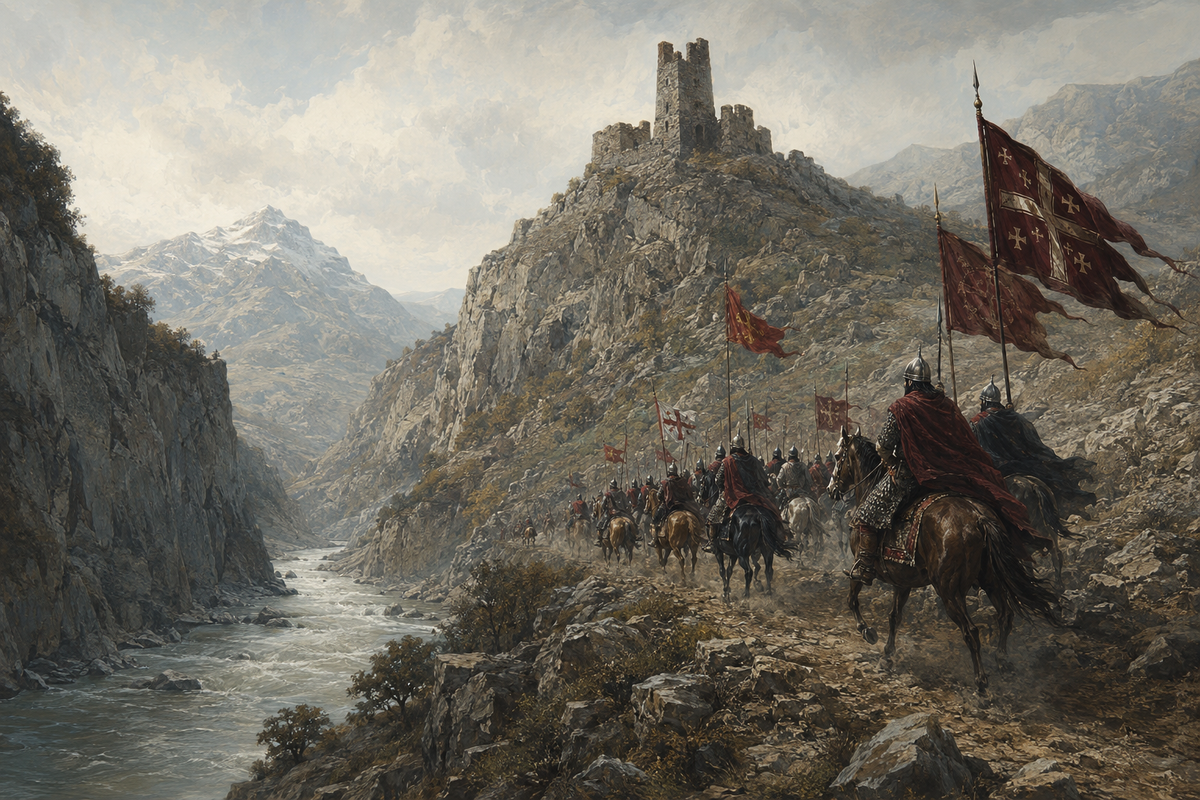
On 20 April 1770 the army of Erekle defeated an Ottoman force near Aspindza in Samtskhe. The battle entered Georgian military tradition as a model of a victory won by the smaller side. Today Aspindza is a small resort municipality in the south of the country, on the road to Vardzia.
Lekianoba: The Raids That Never Stopped
The daily affliction of the kingdom was not the great wars but lekianoba, the name given to the constant raids by highland bands from the north-eastern slopes of the Caucasus. The bands came for plunder and captives, emptied villages and went back into the mountains. Nobody managed to stop them altogether, and a large share of the kingdom’s strength went on defence rather than on development.
Reforms: Army, Crafts and Printing
The answer to the raids was the morige army, a duty roster: a set number of men served in turn, and for the first time the kingdom had a force that was permanently ready rather than a levy that took weeks to assemble.
Besides the army, Erekle worked on what we would now call the economy: he restored mining and copper smelting, encouraged craft workshops, revived printing and opened schools. The scale was modest, since the country was at war almost continuously, but the direction was the right one.
📜 The Treaty of Georgievsk, 1783: Why Erekle Chose Russia
By the early 1780s the position of Kartli-Kakheti looked like this. Persia pressed from the south and east, the Ottoman Empire from the south-west, and raids came down from the north. The kingdom had survived by manoeuvring between the two large neighbours, but the room for manoeuvre had run out: too few people, an empty treasury, no allies among equals. Erekle was looking for a third force to balance the first two.
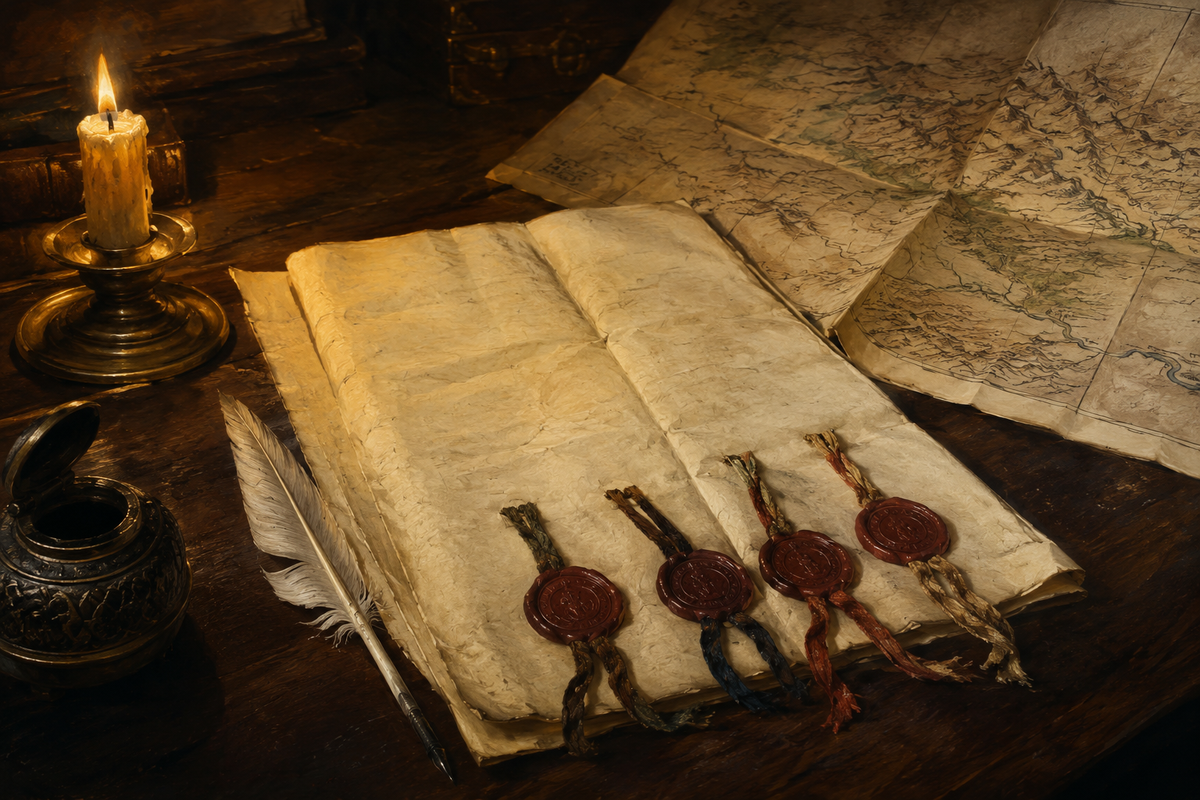
On 24 July (4 August) 1783, in the fortress of Georgievsk in the North Caucasus, a treaty was signed that entered history as the Treaty of Georgievsk. Pavel Potemkin signed for Russia, and the king’s plenipotentiaries Ioane Bagration-Mukhraneli and Garsevan Chavchavadze signed for Georgia. The document established a Russian protectorate over Kartli-Kakheti.
The bargain was symmetrical: the kingdom renounced its dependence on Persia and recognised the supreme authority of the Russian emperor, receiving military protection and a guarantee of the throne for the house of Erekle in return. The terms below follow the wording of the document.
| What Russia Undertook | What Kartli-Kakheti Undertook |
|---|---|
| To recognise Erekle II and his heirs as kings of Kartli-Kakheti, with the throne secured to his house | To renounce vassal dependence on Persia and on any other power |
| To take the kingdom under its protection and to defend its territory | To recognise the supreme authority of the Russian emperor, with each accession confirmed by him |
| To keep two battalions of infantry with artillery in Kartli-Kakheti | To conduct foreign relations with Russia’s knowledge |
| To grant the Georgian nobility the same rights as the Russian nobility, with a seat in the Synod for the catholicos | To keep its internal government, its own laws, courts and church |
How the treaty was carried out afterwards, what happened after 1801 and how eastern Georgia entered the empire is set out in the article on how power changed hands in Georgia from King David to the Russian Empire. This article stays with the biography.
🔥 The Battle of Krtsanisi, 1795: The Old King’s Tragedy
Twelve years after the treaty the test came from exactly the quarter it had been expected from. Agha Mohammad Khan Qajar, then uniting Persia, demanded that Erekle tear up the agreement with Russia and return to the Persian orbit. When he refused, the khan moved his army on Tbilisi.
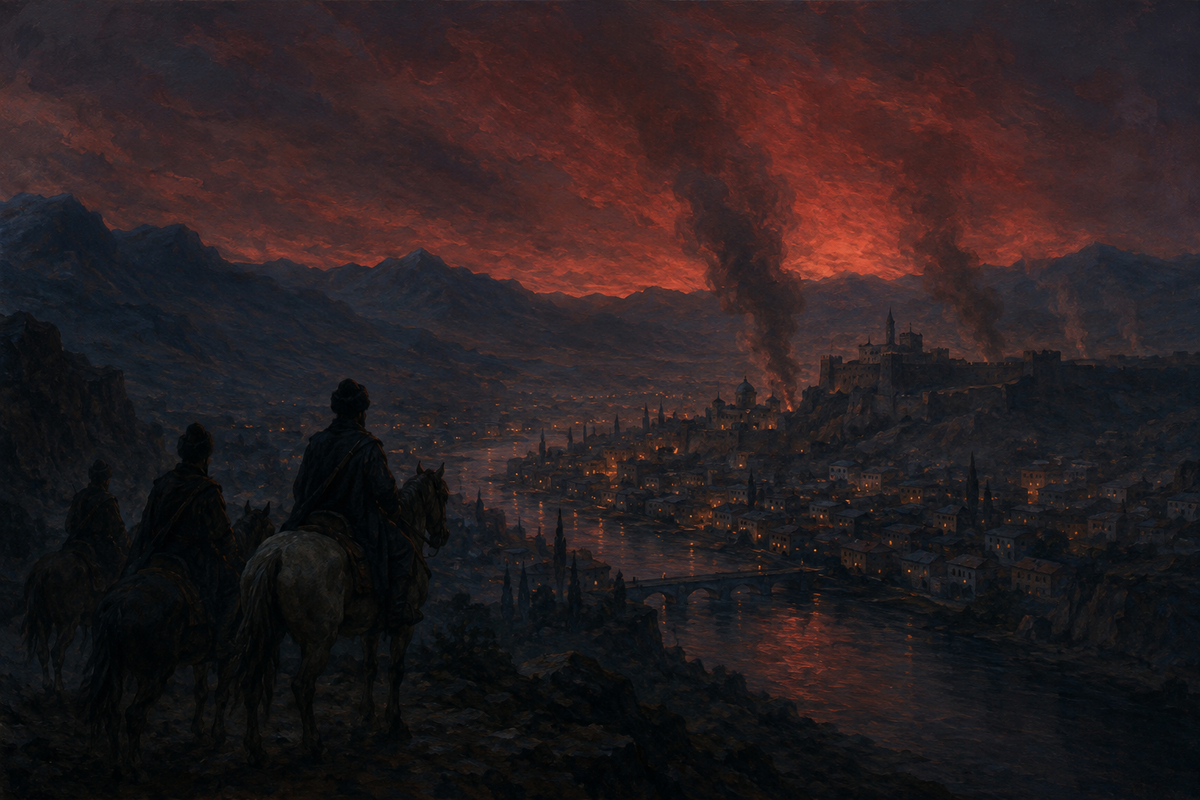
The battle was fought on the Krtsanisi field on the south-eastern approaches to the city between 8 and 11 September 1795. The forces were not comparable: the Persian army had many times the numbers. The seventy-five-year-old king took the field himself and, by the accounts, was led away by his grandsons once the outcome was clear. Tbilisi was taken and burned, the city was plundered and many of its people were carried off. Erekle withdrew into
The military help promised under the treaty had not arrived by the time of the battle. That is a fact recorded in the documents and in the historiography; the reasons and the judgements belong to specialists. What matters for the biography is different: the king who had built his whole later policy around the alliance with Russia met the decisive war without an ally.
A page of its own in that battle belongs to the three hundred Aragvians, a detachment from the Aragvi gorge that covered the retreat and was almost entirely killed. The figure of three hundred is the traditional one and comes from Georgian memory of the event. The Georgian Orthodox Church numbered the fallen among the saints. The story is a large one and deserves a separate article.
Contemporary accounts describe Tbilisi after the withdrawal of Agha Mohammad Khan’s army as a city in ruins: it burned for several days, a large part of the population was killed or carried off, and the capital took decades to recover.
A paraphrase of contemporary accounts as reported in the historiography
🕯️ Final Years: Telavi and the Grave in Svetitskhoveli
After 1795 Erekle never returned to Tbilisi. He spent his last years in Telavi, in Batonis-tsikhe, and by the accounts he never recovered from the destruction of the capital. On 11 (22) January 1798 the king died at the age of seventy-seven.
He was buried in Svetitskhoveli Cathedral in Mtskheta, the principal burial place of the Georgian kings: Vakhtang Gorgasali lies there too, and so do other rulers of the country.
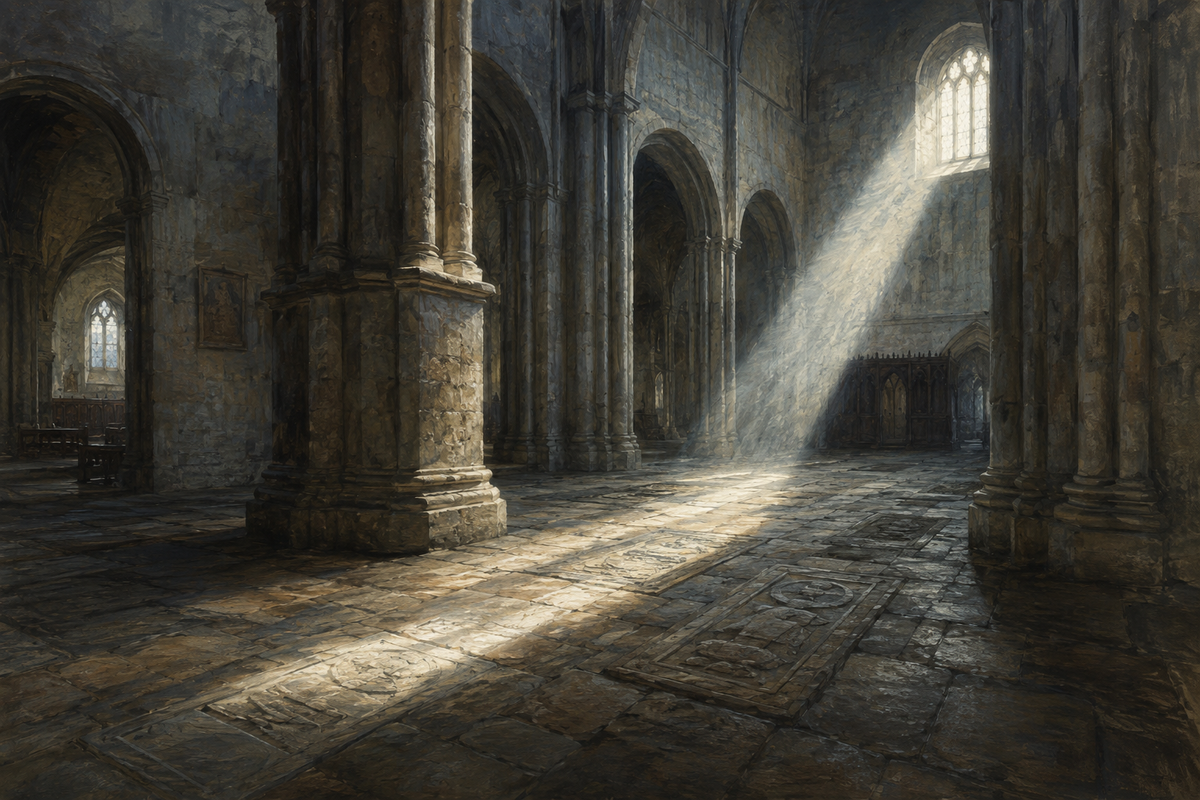
The throne passed to his son George XII. He reigned a little over two years and became the last king of Kartli-Kakheti: in 1801 the kingdom was abolished and absorbed into the Russian Empire.
| Year | Event |
|---|---|
| 1720 | Born in Telavi, son of Teimuraz II |
| 1737–1740 | Takes part in Nader Shah’s Indian campaign; Delhi falls in 1739 |
| 1744 | Becomes king of Kakheti while his father Teimuraz II receives Kartli |
| 1762 | On his father’s death the two crowns unite as the kingdom of Kartli-Kakheti |
| 1770 | Defeats an Ottoman force at Aspindza |
| 1783 | Signs the Treaty of Georgievsk |
| 1795 | The battle of Krtsanisi and the sack of Tbilisi |
| 1798 | Dies in Telavi and is buried in Svetitskhoveli |
🗺️ Remembering Erekle II: Telavi, the King’s Bath and the Monuments
The traces of Erekle are scattered across three towns: Telavi, Tbilisi and Mtskheta. Most of them, naturally, are in Kakheti. More on what to see in the Kakhetian capital is gathered in the piece on the Telavi History Museum and in the article on the town itself.
🗺️ Remembering Erekle II on the Map
Base map labels from OpenStreetMap appear in the local language. Tap a marker to open the description.
Telavi. The fortress and palace, the king’s favourite residence.
Telavi. The main monument to the king, in front of the fortress.
Telavi. A town garden beside the royal residence.
Telavi. The history of Kakheti and the age of Erekle.
Tbilisi, Abanotubani. A sulphur bath in the bath quarter.
Tbilisi. The residence of the king’s wife above the Metekhi slope.
Mtskheta. The burial place of Erekle II.
| Place | Where | What Is There |
|---|---|---|
| Batonis-tsikhe, Palace of King Erekle II | Telavi | The fortress and palace, the favourite residence of the king, today a museum complex |
| Equestrian Statue of Erekle II | Telavi | The main monument to the king, standing in front of the fortress |
| Old Garden of King Erekle II | Telavi | A town garden beside the royal residence, carrying the king’s name |
| Telavi History Museum | Telavi | An exhibition on the history of Kakheti and the age of Erekle |
| Bath of King Erekle | Tbilisi, Abanotubani | A sulphur bath in the bath quarter, named after the king |
| Darejan Palace, Sachino | Tbilisi | The residence of the king’s wife above the Metekhi slope |
| Svetitskhoveli Cathedral | Mtskheta | The burial place of Erekle II and of other Georgian kings |
❓ Frequently Asked Questions About Erekle II
💬 He became king of Kakheti in 1744, and in 1762, after his father’s death, he united the crowns and ruled the kingdom of Kartli-Kakheti until his own death in 1798.
💬 Erekle is the Georgian form of the name and Irakli the Russian one. Patara kakhi translates as the little Kakhetian: the nickname is linked to the king’s short stature and his Kakhetian origin.
💬 A treaty establishing a Russian protectorate over the kingdom of Kartli-Kakheti, signed on 24 July (4 August) 1783 in the fortress of Georgievsk. The kingdom renounced its dependence on Persia and Russia undertook to defend it.
💬 The army of Agha Mohammad Khan Qajar defeated the Georgian force outside Tbilisi between 8 and 11 September 1795 and sacked the city. The seventy-five-year-old Erekle fought in person and withdrew into Kakheti after the defeat.
💬 The capital was Tbilisi, while his favourite residence was the fortress palace of Batonis-tsikhe in Telavi: the king was born there and spent his final years there.
💬 In Svetitskhoveli Cathedral in Mtskheta, the principal burial place of the Georgian kings.
💬 His son George XII, the last king of Kartli-Kakheti. He died in 1800, and in 1801 the kingdom was abolished and annexed to the Russian Empire.
📌 Key Points in Brief
Erekle II lived a long life and saw two different worlds: a youth under the banners of Nader Shah and an old age spent negotiating with St Petersburg. He gathered eastern Georgia into a single kingdom, built a standing force, won Aspindza and tried to close the country’s central problem with a treaty with its large northern neighbour. The calculation did not work out as intended: in 1795 the kingdom faced the Persian army alone, and three years after the king’s death independent statehood came to an end. That is why he is called the last great king: he was the last to rule Georgia as a sovereign in his own right.
💗 Read Next
- From King David to the Russian Empire: How Power Changed Hands in Georgia
- Telavi: The City of Erekle II and the Capital of Kakheti
- The Palace of King Erekle in Telavi
- Svetitskhoveli in Mtskheta: The Cathedral and the Royal Tombs
- Pharnavaz I: The First King and the Birth of the Georgian Monarchy
- Vakhtang Gorgasali: Warrior King and Founder of Tbilisi
- David the Builder: How Georgia Became the Strongest Kingdom in the Caucasus
- Queen Tamar: The Golden Age of Georgia
💬 Now Over to You
- Have you been to Batonis-tsikhe in Telavi, and is it worth a trip of its own?
- Do you think Erekle had another way out in 1783? Different views are welcome here, there is no ready answer.
- Which episode of his life struck you more: the march on Delhi or Krtsanisi?
- Which of the Bagrationi should we write about next?
Tell us in the comments: good arguments and corrections make their way into the article.

2 comments
Log in to leave a comment