




Historic Dandalo Stone Arch Bridge by the Ajaristskali River
This old stone crossing over the Ajaristskali River stands near Dandalo village, on the road from Batumi towards Keda and Khulo.
🧭 What this article covers and who it is for
This guide helps you decide whether Dandalo Bridge is worth adding to a mountain Adjara route, how to reach it from Batumi, and what to notice on site beyond the standard photo of the arch. It is useful for travellers heading towards Keda, Khulo or Goderdzi Pass, and for those who like old stone roads, quiet river stops and places with a little grit in their story.
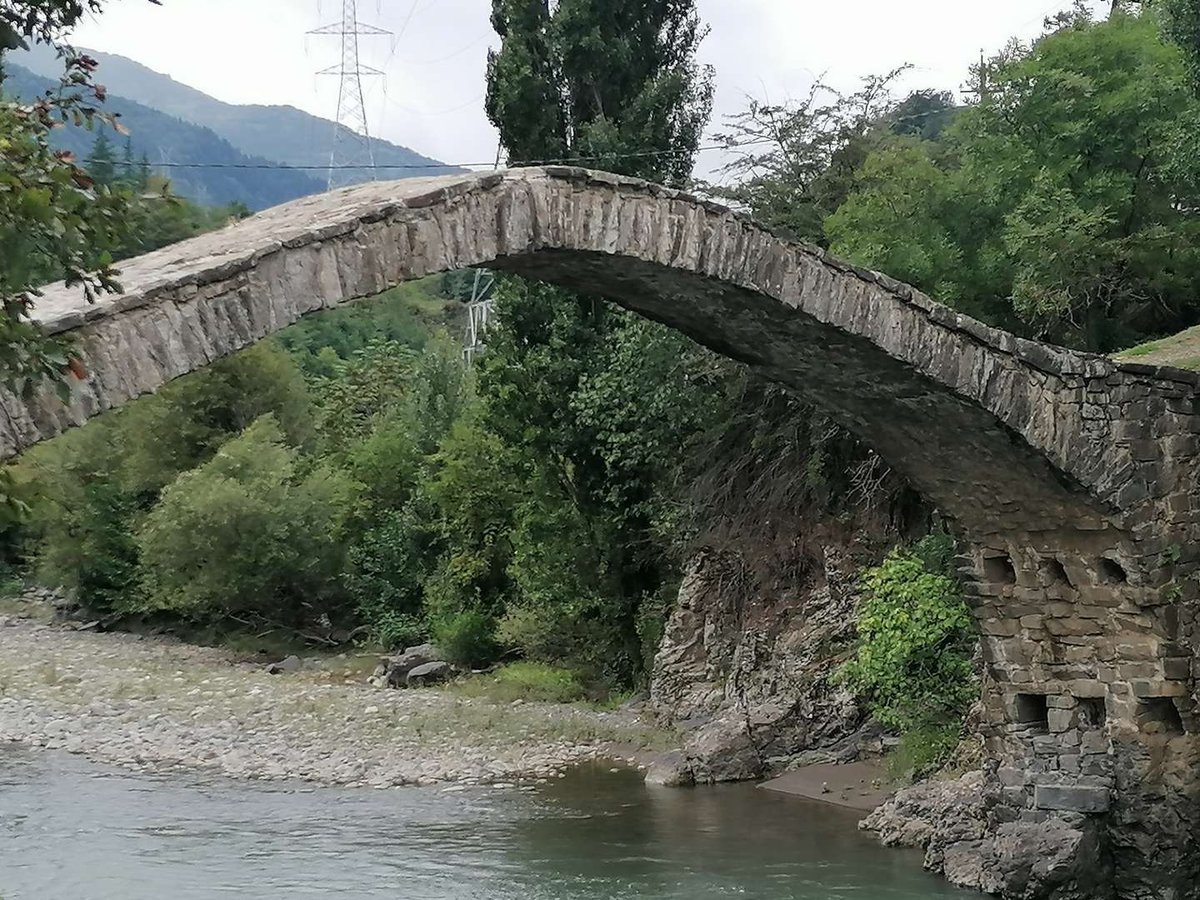
Dandalo Bridge in Adjara is easy to miss if you drive along the Batumi, Keda, Khulo road only for the bigger stops. It does not greet visitors with loud signs, ticket booths or a queue for photos. It simply stands over the Ajaristskali River, holding its stone arch, and quietly reminds you that mountain Adjara began with roads, crossings and people who knew how to build for the long run.
There is one detail that catches the eye almost at once: the bridge does not run in a straight line. Its shape bends in a soft S-curve, as if the stone adjusted itself to the rocks, the current and the old road. That is why Dandalo is worth seeing not as a random stop by the road, but as a small open-air lesson in old mountain engineering.
If you want to turn one stop into a fuller route through the region's old crossings, keep our guide to stone arch bridges in Adjara nearby. In this article, we stay with Dandalo and look at it closely: where the bridge is, how it is built, how to get there from Batumi and what to combine it with.
🏰 Where Dandalo Bridge is located
Dandalo Bridge is in Keda Municipality, near Dandalo village, over the Ajaristskali River. If you drive from Batumi towards Keda and then further to Khulo, this crossing is almost on the way. You do not need a long detour, a difficult trail or a separate hike.
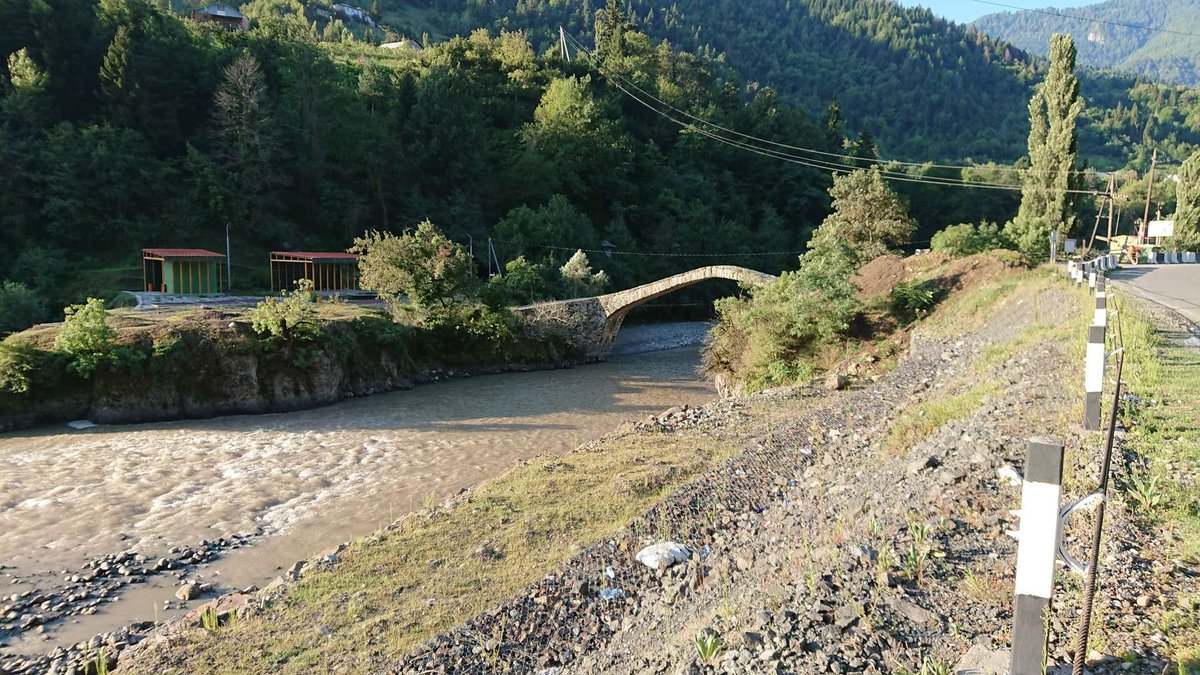
For travellers, the main landmark is simple: the Batumi, Keda, Khulo road. This is the route where seaside Adjara gradually slips behind you, and the road begins to gather river bends, green slopes, small villages and old roadside points. Dandalo fits this journey well: it is a short stop, but it has a proper mood. Not a museum behind glass, but a living stone bridge right by the water.
The Ajaristskali River matters here as much as the arch itself. It explains why the bridge was built in this exact spot. In a mountain area, bridges were not placed where the view was pretty. First came firm banks, rocky supports, a usable road approach and a place where a stone arch could last. At Dandalo, all of this can still be read on site: the bank, the current, the bend of the road and the stone work together.
If you are travelling from Batumi by car, the bridge is easy to add to a route towards Keda, Makhuntseti, Khulo or further towards Goderdzi Pass. If you go by minibus, ask the driver in advance where to get off for Dandalo. In mountain areas, village names and roadside turns are not always obvious to a first-time visitor.
📜 Why a stone bridge appeared here
To understand Dandalo, it helps to look not only at the stone arch, but also at the road around it. Adjara lived for a long time through the connection between the coast and the mountain districts. Below were the port, trade, town life, markets and the road to the sea. Higher up, in valleys and villages, life followed another rhythm: gardens, pastures, family routes, local roads, paths to passes and neighbouring regions.
A bridge in such a place was not decoration. It solved a very practical problem: how to cross a fast mountain river without depending on the weather every time. Timber crossings are easier to build, but water, humidity and stones take their toll quickly. A stone arch needs more labour, but it lasts longer when placed well.
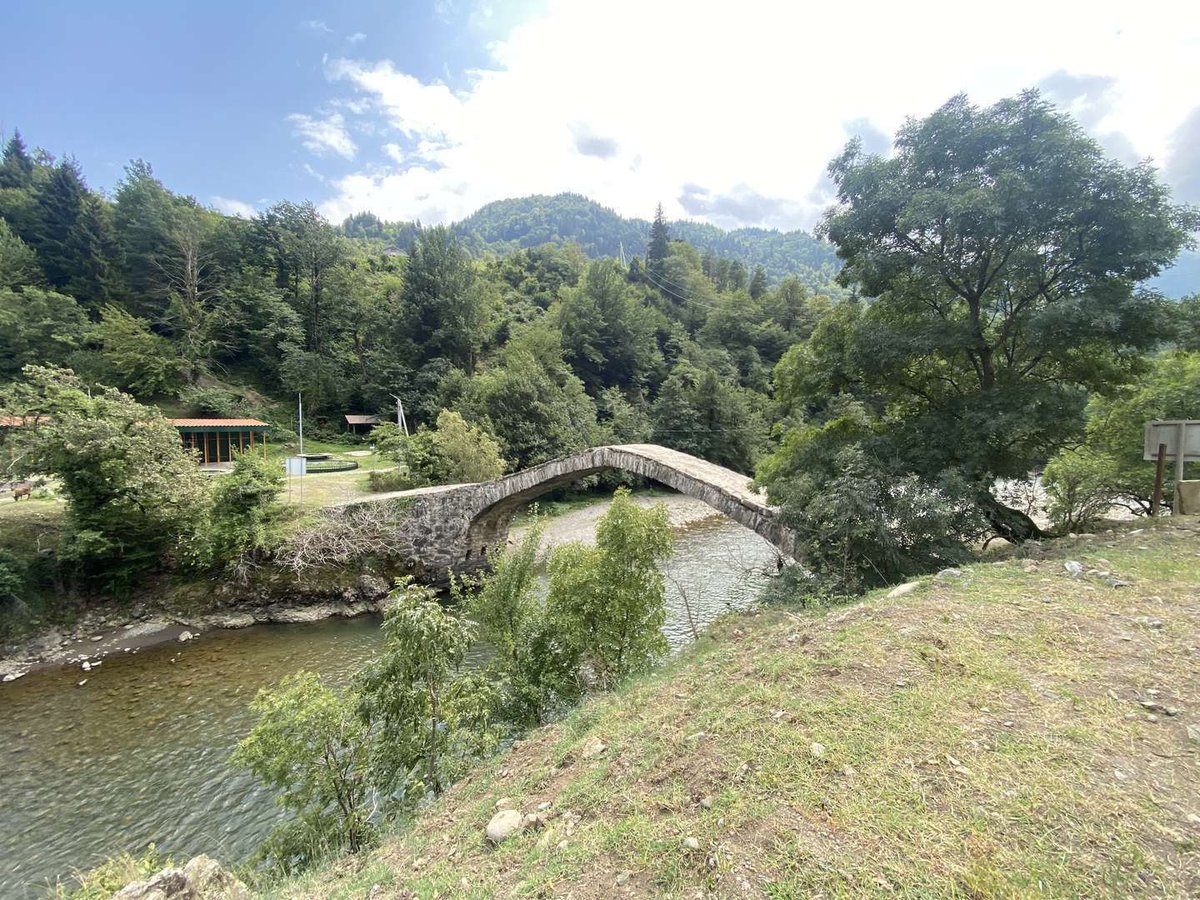
At Dandalo, the chosen point makes sense. The banks give support, the river narrows, and the road can continue through the valley. That is why the bridge looks so natural, almost as if it had always belonged here. In reality, that natural feel comes from calculation: where to set the base, how to raise the arch, how to lead the road to the crossing, and how to make it usable for people and pack animals.
Bridges like this show the old road culture of Adjara. The goal was not to build wide, loud or ceremonial. The goal was to build firmly. So a person could cross the river, goods could reach the market, and a village would not be cut off after rain. That is why Dandalo is interesting not only as a monument, but also as a trace of everyday life once held together by crossings like this.
🧱 How Dandalo Bridge is built
Dandalo Bridge is interesting not because of its size, but because of the way it sits in its place. This is not a ceremonial city bridge, and not a modern structure where every line has been straightened. It follows another logic: first the terrain, then the stone, then the road.
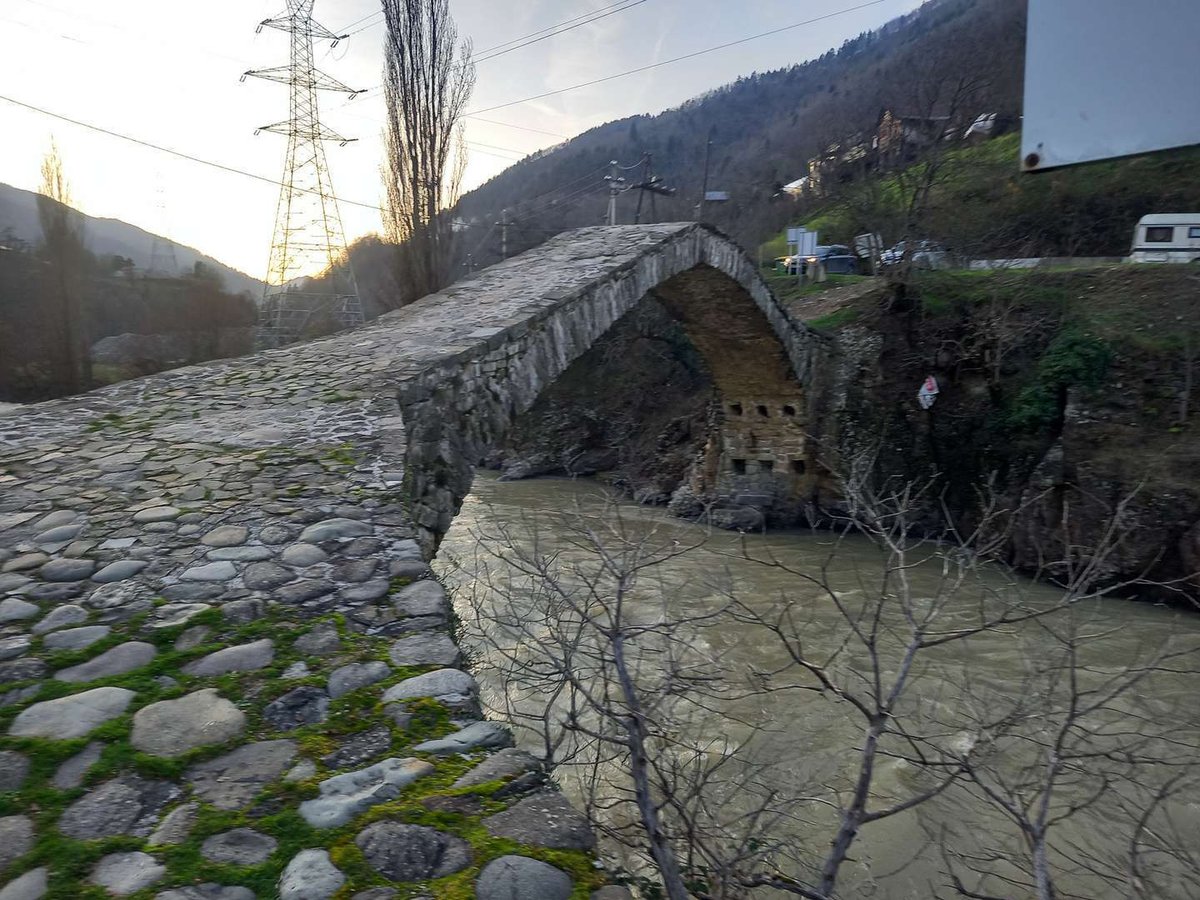
The main material is local limestone. The stones are bound with lime mortar, so the masonry looks dense but alive. Not a smooth concrete surface, but a hand-built structure where each section relates to the bank, the water and the bend of the old route.
The most noticeable feature of Dandalo is its S-shaped form. The bridge does not run in a straight line. Its deck bends softly, almost following the movement of the road. For a visitor, this is a striking detail. For a builder, it is a harder task: such a form needs careful calculation, because the load is not distributed in the same way as in a simple straight arch.
The supports are tied to natural rock sections. On a mountain river, that is not a small detail, it is the foundation of durability. If the base is weak, the water will explain the problem quickly, no lecture required. At Dandalo, the site does not feel accidental: the arch stands where the terrain helps the structure rather than fighting it.
Sources may give slightly different measurements for the bridge, so the safest wording is simple: about 35 metres long. That is enough to understand the scale without arguing with a measuring tape across centuries. The bridge is narrower in the middle and wider near the approaches. On site, this makes sense: the crossing connects real banks and an old road, not abstract points on a diagram.
🏞️ What you can see on site and where to photograph
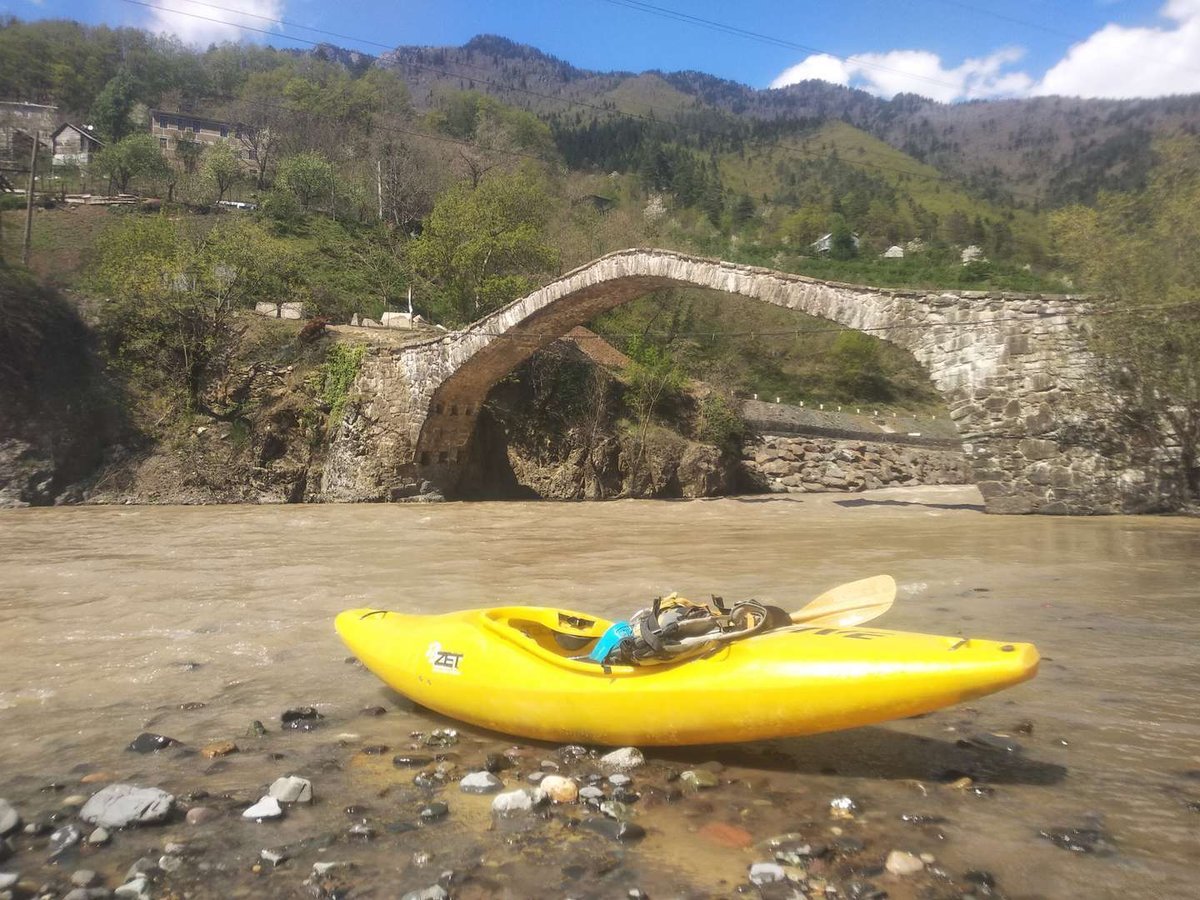
Dandalo reveals itself gradually. First you see the arch over the river. Then you notice that the bridge is not straight. Then the masonry, the approaches and the rocky supports begin to stand out, and the structure starts to feel less like a simple old crossing and more like a precise answer to a difficult place.
The first good angle is from the side. From there, you can see the arch, the river and the relationship between the bridge and the banks. If you stand too close, the shape disappears and the bridge becomes just an old stone surface. From a little distance, it reads more clearly: an arc over the Ajaristskali, green slopes around it and the line of the old road still present in the bend.
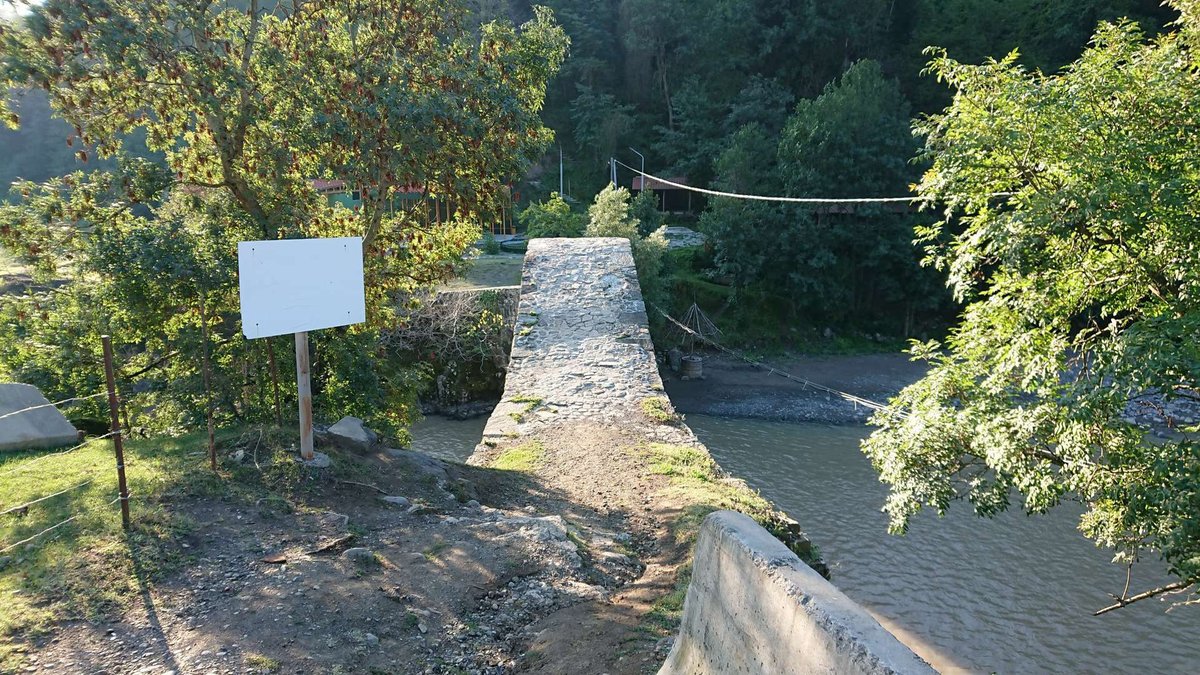
The second useful angle is from the approach. This is where the soft turn of the deck is easier to see. That curve makes Dandalo more than an old crossing. It is the detail that keeps you looking for a few minutes longer, not for a loud photo moment, but to understand how old builders worked with difficult terrain.
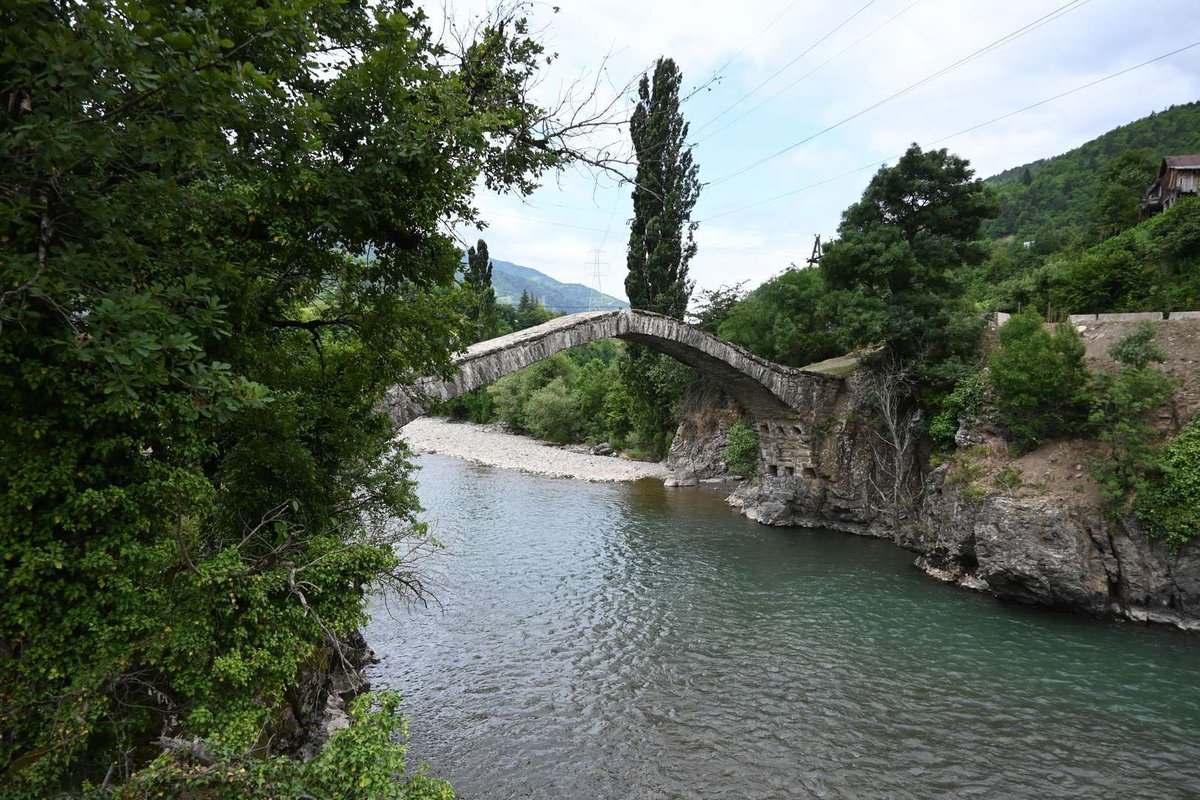
The third layer is the masonry. Stones of different sizes, traces of age, the damp colour of limestone, transitions from arch to support. These fragments work well in photos and help show the age of the bridge without overexplaining it. Sometimes one close-up of stone says more than a wide shot from the road.
After rain, the place becomes more beautiful and more complicated at the same time. The river sounds stronger, the green turns darker, and the stone looks richer in colour. But the approaches can be slippery. No need for heroics here: the old bridge has survived centuries, and a traveller only needs to survive the holiday calmly.
🚌 How to get there from Batumi
From Batumi, travel towards Keda and Khulo. Dandalo is not a difficult standalone destination, but a stop on the road into mountain Adjara. That is why it makes more sense to see it together with other points in the Ajaristskali valley.
By car, the route is the easiest to understand: leave Batumi, follow the road towards Keda, then continue in the direction of Dandalo and Khulo. The road is mountainous, so allow extra time. Even if your navigation app looks optimistic, real life may add roadworks, rain, a slow section or a sudden wish to stop by the river. Mountains have a charming habit of reminding people that they are not in charge of the schedule.
By minibus, look for routes towards Keda, Shuakhevi or Khulo. Before boarding, ask the driver whether you can get off at Dandalo or near the bridge. Think about the return journey in advance, especially if you are travelling later in the day. In mountain Adjara, transport can feel less frequent and less predictable than in central Batumi.
With a guide or private driver, the route becomes calmer. The driver will know where it is safer to stop, and a guide can explain how Dandalo connects to the old crossings of the region. This format is useful if you want to see not only the bridge, but also nearby natural points. For example, you can combine the trip with Makhuntseti Waterfall or continue towards Goderdzi Pass, if the season and timing allow it.
If you are only building a broader plan for the region, it is worth checking the catalogue of natural attractions in Adjara. It helps you avoid overloading the day and choose points that really fit the road, not just the map.
🗺️ What to combine with Dandalo Bridge
Dandalo rarely becomes the only goal of the day, and that is fine. Its strength lies in the road. It works well as one of the stops between Batumi and mountain Adjara: a short pause by the river, old stone, a few photos, and then the route continues.
The clearest short-trip combination is Batumi, Keda, Dandalo, Makhuntseti. This route does not require complicated logistics and gives a good contrast: a seaside city, the Ajaristskali valley, an old stone bridge, a waterfall and another well-known arched crossing near Makhuntseti. The main thing is not to turn the day into a race. If you rush to the next stop every ten minutes, mountain Adjara becomes just a folder of photos.
If you have more time, you can continue towards Khulo and Goderdzi. Adjara becomes higher, cooler and quieter there. This route needs an early start, a weather check and enough time in reserve. In that case, Dandalo works as the first calm stop before the longer road.
Dandalo also fits well into a route through old bridges. You do not need to collect every crossing in the region in one day. It is enough to choose a few points along the road and see them not as separate objects, but as traces of an old route. Then the trip feels connected: river, road, stone, villages and mountain Adjara without rush.
🌿 When to go and what to keep in mind
In spring and early summer, the area around Dandalo is especially green. The river sounds stronger, the slopes look fresh, and the stone becomes darker and more expressive after rain. This is a good season if you want to see mountain Adjara alive, humid and a little wild.
In summer, the bridge is easy to include in a day trip from Batumi. The days are long, the route is easier to plan, and you can connect it with Keda, Makhuntseti or other points in the valley. In hot weather, take water and remember that the area around the river and stones may still be damp. Do not expect city-style facilities right next to the bridge.
Autumn feels calmer. The light is softer, the greenery changes tone, and the travel pace slows down. For photography, this is a pleasant time: less harsh sun, more depth in the landscape. If you want to do more than quickly tick the bridge off a list, autumn works well.
In winter, everything depends on weather and road conditions. The bridge itself is still there, of course, but a trip into mountain Adjara needs more care. If the route continues towards Khulo or Goderdzi, check the road situation in advance. Seasonality is felt more strongly in the mountains than by the sea.
In any season, pay attention to shoes, water safety and parking. Dandalo does not look dangerous, but it is an old stone crossing by a mountain river. After rain, approaches may be slippery. With children, choose calm viewpoints and avoid wet stones or river descents.
- wear non-slip shoes
- save the map in advance
- avoid wet edges
- watch children near the river
- do not block the road with your car
Over to you
Have you visited Dandalo Bridge, or are you planning a route through mountain Adjara? Share how you got there, what you combined with this stop and which old bridges of the region stayed in your memory. Your experience can help other travellers plan the road with fewer surprises.
Information checked and updated on 1 June 2026. Before travelling, check road conditions, transport and access to the bridge, especially after rain and during the winter season.
❓ Frequently asked questions
Dandalo Bridge is in Adjara, in Keda Municipality, near Dandalo village and the Batumi, Khulo road. It crosses the Ajaristskali River.
The distance from Batumi is about 60 km. Travel time depends on transport, weather, season and road conditions in mountain Adjara.
The bridge is usually dated to the 9th-10th centuries. Tourist sources do not give one exact construction year, so it is safer to describe it as a medieval crossing of that period.
Its most noticeable feature is the S-shaped form. The bridge does not run in a straight line, but bends with the terrain, rocks and river.
You can see the bridge on site, but be careful on the stone surface. After rain, the stones may be slippery, and it is better not to take risks near the river for a photo.
A guide is not necessary for a short stop. Still, a guide can help explain how the bridge connects to the old roads of Adjara and why its shape is technically interesting.
You can usually make a short stop nearby, but do not expect a large tourist car park. Leave the car only where it does not block the road.
It is easy to combine with Keda, the Ajaristskali valley, Makhuntseti, other arched bridges in Adjara or the road towards Khulo.
Yes, if you are careful. Children should know in advance that this is an old stone bridge over a river, not a play area by the water.
Spring, summer and early autumn are easier for a green and scenic stop. After rain and in winter, road conditions and access to the bridge matter more.

40 comments
Log in to leave a comment
不禁想问,附近是否还有其他值得探访的历史遗迹?
В статье очень живо описывается, как выглядят сами арки, почему они были необходимы для прохождения караванных дорог, и как мост выдерживает века, несмотря на речные потоки и горный климат. Особенно впечатляет то, что Дандало считается памятником национального значения — и это не удивительно, ведь его сложная S‑образная конструкция говорит о невероятной инженерной мысли того времени.
Советы в рейтинге — как добраться сюда на маршрутках или такси, где удобнее припарковаться, и какие стороны моста лучше всего смотрятся на фото — очень помогли мне спланировать поездку и сделать её максимально комфортной и увлекательной. Впечатления других путешественников дополняют картину: окружающая природа Аджарии, шум горной реки и древние камни создают атмосферу настоящего приключения.
После прогулки до моста я заглянул в одно из небольших кафе у дороги — отличное место, чтобы отдохнуть с видом на горы и попробовать местные блюда.
Как вы думаете, стоит ли тратить целый день в Аджарии на посещение подобных архитектурных скрытых жемчужин или лучше сосредоточиться на более известных достопримечательностях региона?