


👑 David IV the Builder: The King Who United Georgia
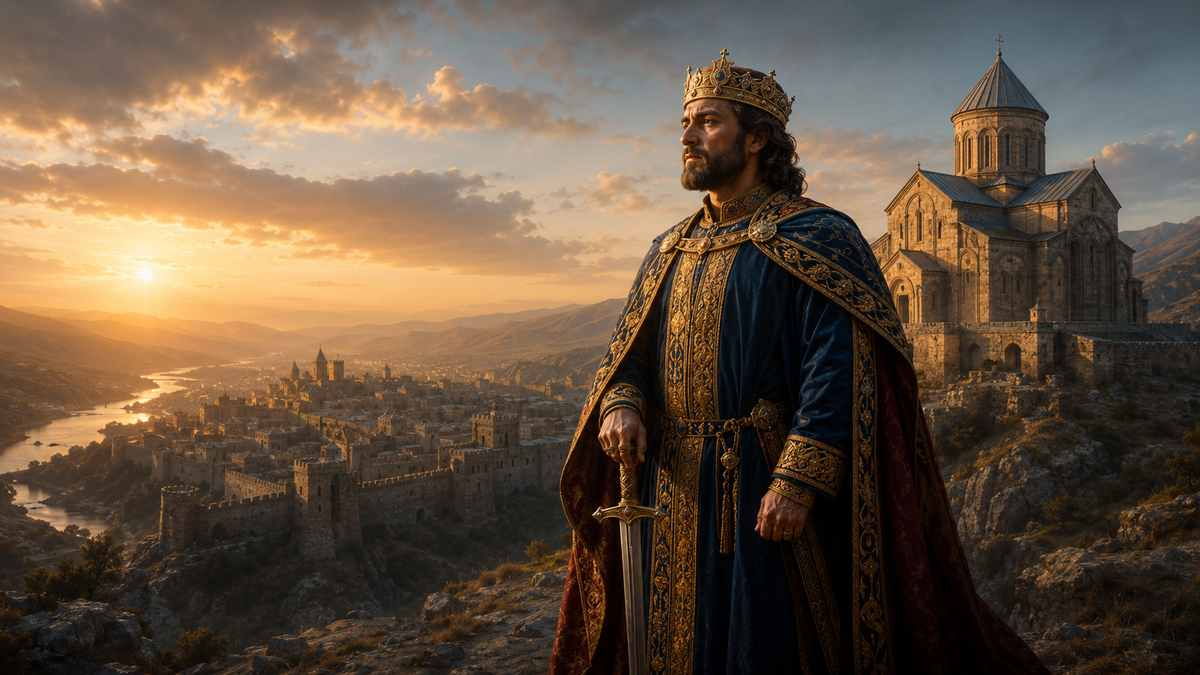
David IV the Builder, known in Georgian as Davit Aghmashenebeli (დავით აღმაშენებელი), ruled Georgia from 1089 to 1125: he pulled a country wrecked by the Seljuks back together into a single kingdom and set its golden age in motion. He took the crown at sixteen, when the towns lay in ruins and the capital was Kutaisi, because Tbilisi was still held by a Muslim emir. Thirty-six years later his heir inherited a state whose influence stretched from the Black Sea to the Caspian.
📌 In Short
- Ruled for 36 years, from 1089 to 1125.
- Took the throne at 16, when the country lay in ruins after the Seljuk invasions.
- Crushed a Seljuk coalition at the Battle of Didgori on 12 August 1121.
- Won Tbilisi back in 1122 and moved the capital there from Kutaisi.
- Founded Gelati Monastery and its academy, and is buried there.
- Canonised as a saint. His feast day is 8 February, the Davitoba holiday.
- Great-grandfather of Queen Tamar: the golden age began with him and peaked with her.
❓ Who Was David the Builder? A Simple Explanation
David IV was a king of Georgia from the Bagrationi dynasty and the son of George II. His place in history is the one held by Europe’s great consolidator kings: he inherited the wreckage and left behind a state. It was under David that scattered, ravaged lands became one country again, with one army, one church and one capital.
Everything people mean by “the golden age of Georgia” rests on his foundations. His grandson, George III, put the army and the treasury in order, and his great-granddaughter, Queen Tamar, took the kingdom to the height of its power. David never saw that peak himself: he prepared it.
| Detail | Value |
|---|---|
| Name | David IV the Builder. In Georgian, Davit Aghmashenebeli (დავით აღმაშენებელი) |
| Lifespan | c. 1073 – 1125. Died in Tbilisi on 24 January 1125 |
| Reign | 1089–1125, thirty-six years |
| Age at accession | 16 |
| Dynasty | Bagrationi |
| Epithet | Aghmashenebeli: “the Builder”, also translated as “the Restorer” |
| Father | George II, King of Georgia |
| Heir | His son, Demetrius I |
| Greatest victory | The Battle of Didgori, 12 August 1121 |
| Canonisation | Saint and Right-Believing King. Feast day 8 February, the Davitoba holiday |
| Burial place | Gelati Monastery, near Kutaisi |
🏗️ Why “the Builder”? What Aghmashenebeli Means
The Georgian epithet აღმაშენებელი (aghmashenebeli) comes from a verb meaning to raise up or to build anew. English usually renders it as “the Builder”, although “the Restorer” is closer to the point: this is not a king who laid bricks, but a king who rebuilt a country.
He did put up a great deal: churches, bridges, roads and caravanserais. But the name was not earned by any of them, and it was not an official title in his lifetime either. It settled on him later, in the chronicles and in church tradition.
You will also meet him spelled Agmashenebeli, without the “h”, and numbered in different ways. Modern works call him David IV, church sources sometimes say David III the Restorer, and older literature has David II. These are not different kings, only different ways of counting the Bagrationi rulers. Like most modern editions, we use David IV.
🌑 A Young King in a Ruined Country: How David Came to Power
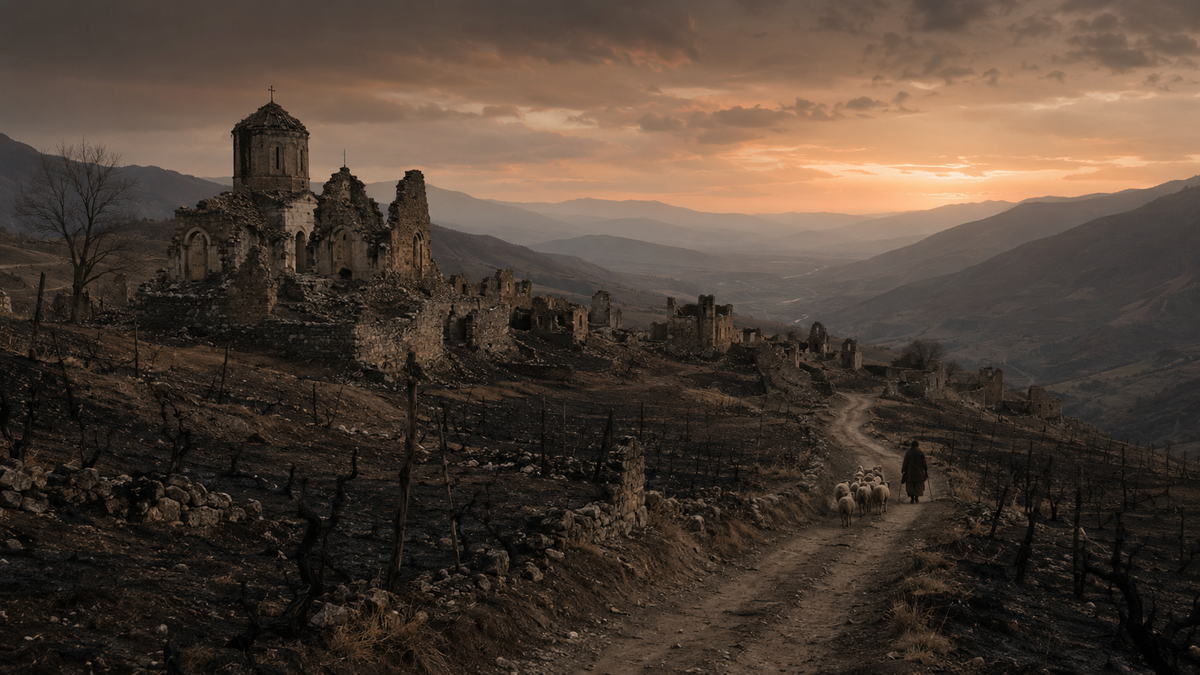
The country David inherited in 1089 was a kingdom on paper only. Twenty years earlier the Seljuks had swept in, and Georgians still remember that period as didi turkoba (დიდი თურქობა), “the great Turkish trouble”: an invasion that emptied the lowlands. Nomads burned the crops and drove off the livestock, peasants fled into the mountains, and the towns stood empty.
Tbilisi had been living a life of its own for centuries by then: a Muslim emir sat in the city. The capital of the Georgian kingdom was Kutaisi, made the capital by Bagrat III, who also built Bagrati Cathedral there (David had nothing to do with that church: these are different kings).
The chronicles say that George II could no longer carry the weight of ruling a country he was unable to defend, and handed the crown to his son. David was sixteen.
The first years went on work that never makes it into heroic chronicles. The king brought people back to abandoned homes, rebuilt the rural economy, brought unruly nobles to heel and quietly assembled an army. Events abroad helped: in 1092 the great Seljuk sultan Malik-Shah died and his empire broke up into emirates, and from the late 1090s the Crusades drew Seljuk forces south. Around 1099 David stopped paying tribute to the Seljuks.
⚙️ David’s Reforms: How the State Was Rebuilt
There would have been no victory at Didgori without the twenty years of unglamorous work that came before it. The reforms ran along three lines at once.
⛪ Church Reform: The Council of Ruisi-Urbnisi
In 1103 the king summoned a church council at Ruisi and Urbnisi in Shida Kartli. It stripped their sees from bishops who had bought or inherited their way into office and put the king’s men in their place. The church, which the nobility had controlled until then, became a pillar of the throne. At the same time the bishopric of Chqondidi was merged with the post of the king’s chief adviser, and David’s old tutor, George of Chqondidi, effectively took charge of the government.
🐎 The Army: A Standing Force and the Kipchaks
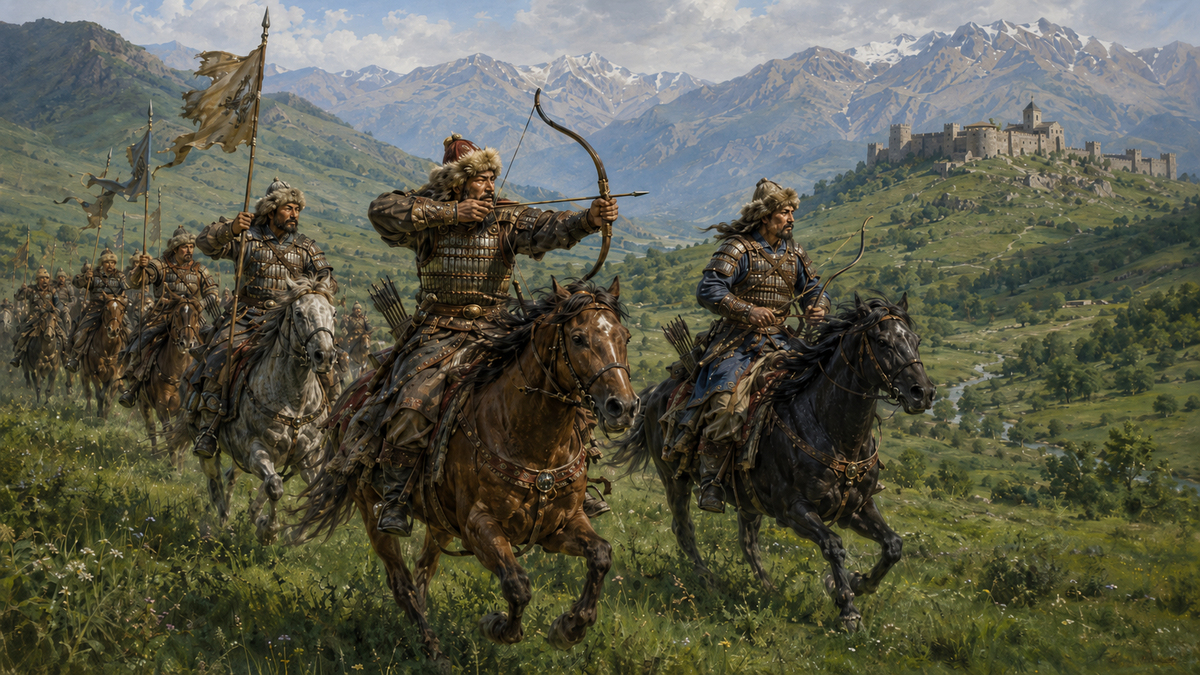
A levy that the nobles raised before a campaign and disbanded afterwards was no use against the Seljuks. David built a standing army answerable to the king alone, and solved the cavalry problem in an unexpected way: he invited the Kipchaks in from the North Caucasus. The chronicles put the migration at around forty thousand families, a figure best treated as a chronicler’s estimate rather than a census. The Kipchaks were given land, and every family supplied the king with a warrior in return.
🏛️ Court and Government: Backing Servicemen Over Bloodlines
Nobles who were used to bargaining with the crown lost their leverage. David abolished rebellious duchies, took their fortresses, and appointed men who owed their careers to him personally rather than to their birth. Centralisation looked dull and worked perfectly: by the 1120s the king ran the army, the church and the treasury with no middlemen in between.
-
Step 1
⛪ The Church
The Council of Ruisi-Urbnisi, 1103: new bishops, and an alliance between throne and church.
-
Step 2
🐎 The Army
A standing force under the king’s own command, and Kipchak cavalry instead of a noble levy.
-
Step 3
🏛️ Government
Rebellious duchies abolished, offices filled by servicemen rather than by great families.
-
Step 4
📚 Learning
Academies at Gelati and Ikalto: no need to go abroad for an education any more.
⚔️ The Battle of Didgori (1121): The “Miraculous Victory”
On 12 August 1121, on the field of Didgori south-west of Tbilisi, the Georgian army met a coalition of Muslim rulers. It was led by Ilghazi, the emir of Mardin, joined by the Seljuk Toghrul and the emir Dubais. David forced the fight into narrow ground where the enemy’s numbers could not be brought to bear, and broke the coalition. Georgian tradition has its own name for that day: dzlevai sakvirveli (ძლევაჲ საკვირველი), “the miraculous victory”.
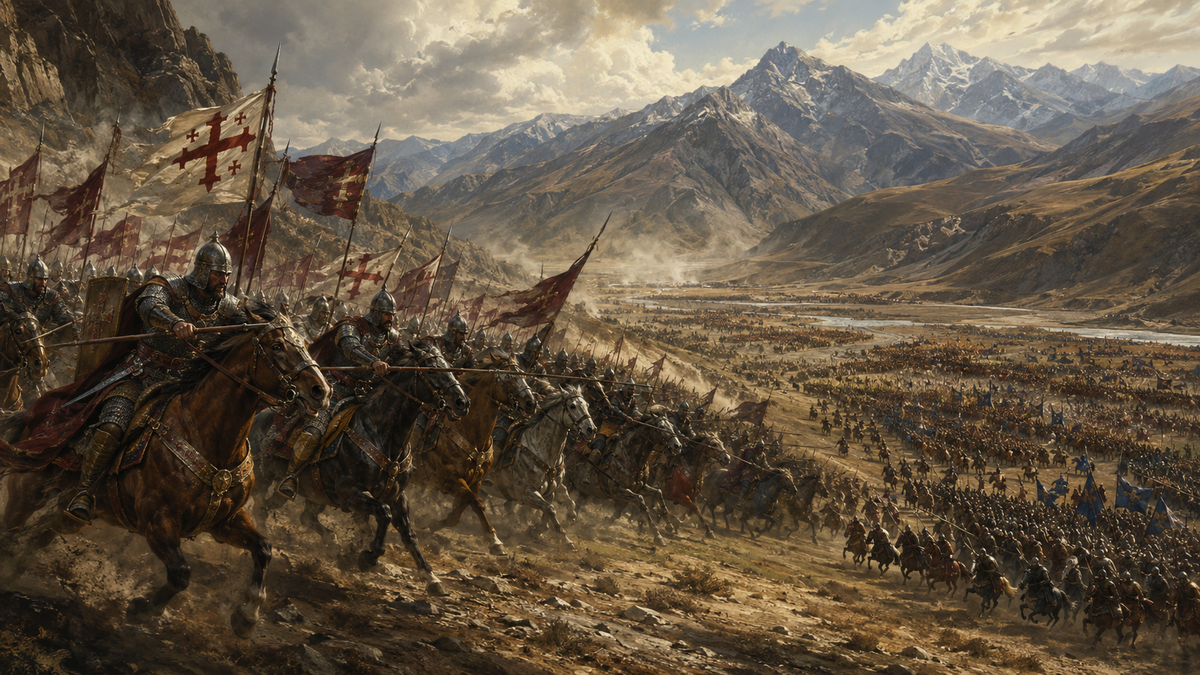
A word about the size of the armies. The chronicles speak of hundreds of thousands, and those figures travel through popular accounts as fact. Historians treat them with caution: medieval writers counted their enemies rather differently from statisticians. We quote such numbers only as what the chronicles say.
The date has variants too. 12 August is the accepted one today, though older encyclopaedias give 15 August: the discrepancy comes from different manuscript copies of the chronicle.
The Didgori Monument stands on the battlefield, and a popular cycling route from Tbilisi leads up to it.
💡 Did You Know?
Georgians still celebrate Didgori. The festival is called Didgoroba, and it takes place where it all happened: on the battlefield, beside the Didgori Monument. For the country this is not merely the anniversary of a battle, but a day of national unity.
🏙️ The Liberation of Tbilisi (1122) and the Uniting of Georgia
A year after Didgori, David took Tbilisi. The city had spent almost four centuries under an Arab and later a Seljuk emirate, and winning it back meant that the Georgian lands were gathered around a single centre once again. The capital moved from Kutaisi to Tbilisi, and it has stayed there ever since.
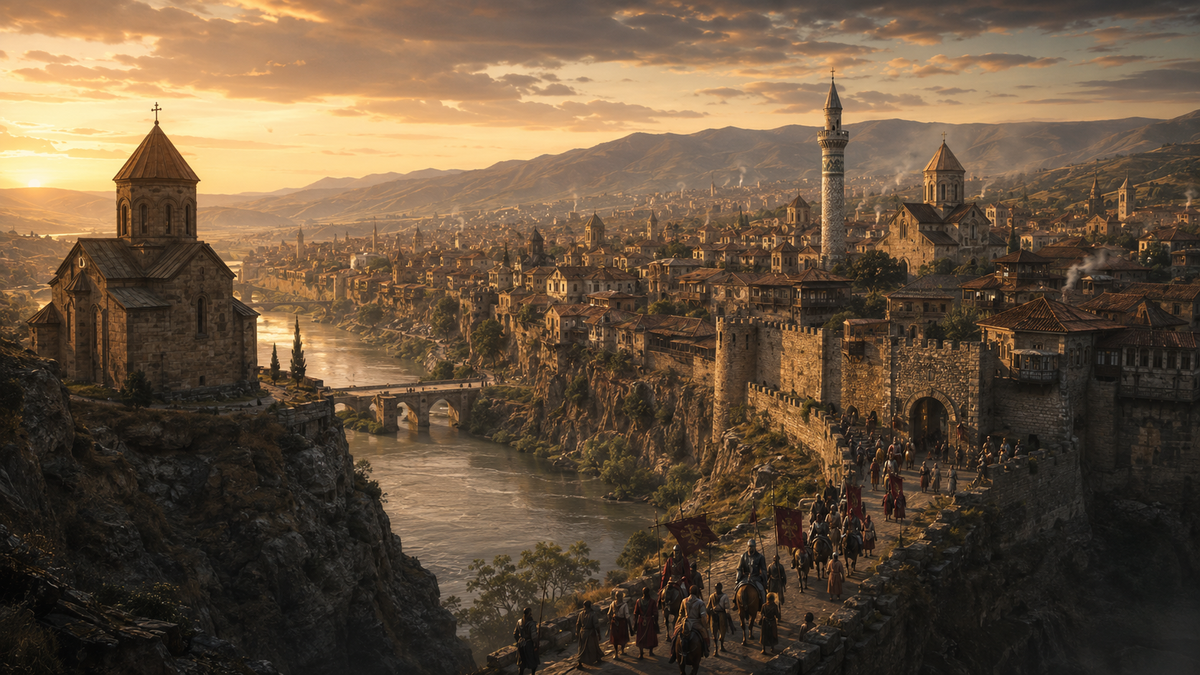
What follows is not what you would expect from a victorious medieval king. David left the Muslim community of Tbilisi in peace: the mosque kept working, merchants kept trading, and Muslims kept their own courts. Muslim writers of the period recorded his patronage with some astonishment, and it is on their testimony that this reputation rests.
The kingdom was being pieced together before Tbilisi and after it. Kakheti and Hereti were annexed in 1104, David took Ani in 1124, and neighbouring Shirvan fell into dependence on Tbilisi.
| Year | Event | What It Meant |
|---|---|---|
| 1089 | David IV takes the crown | George II hands the throne to his sixteen-year-old son |
| c. 1099 | Tribute to the Seljuks stops | Georgia is no longer a tributary and starts acting on its own |
| 1103 | The Council of Ruisi-Urbnisi | Church reform: the church becomes a pillar of royal power |
| 1104 | Kakheti and Hereti annexed | The eastern lands return to the kingdom |
| 1106 | Gelati is founded | A monastery and academy near Kutaisi, and the king’s future burial place |
| 1121 | The Battle of Didgori, 12 August | A Seljuk coalition is destroyed: the “miraculous victory” |
| 1122 | Tbilisi is taken | The capital moves from Kutaisi to Tbilisi |
| 1124 | Ani is taken | The kingdom’s influence reaches well beyond the Georgian lands |
| 1125 | David dies, 24 January | The throne passes to his son, Demetrius I |
What became of David’s state afterwards is a separate story. Under his grandson George III and his great-granddaughter Queen Tamar the country reached the height of its power, and how the age itself was organised is covered in our article on the golden age of the Georgian kingdom. This one is about the man, not the era.
📚 Gelati: The Academy, a “New Athens” and the King’s Grave
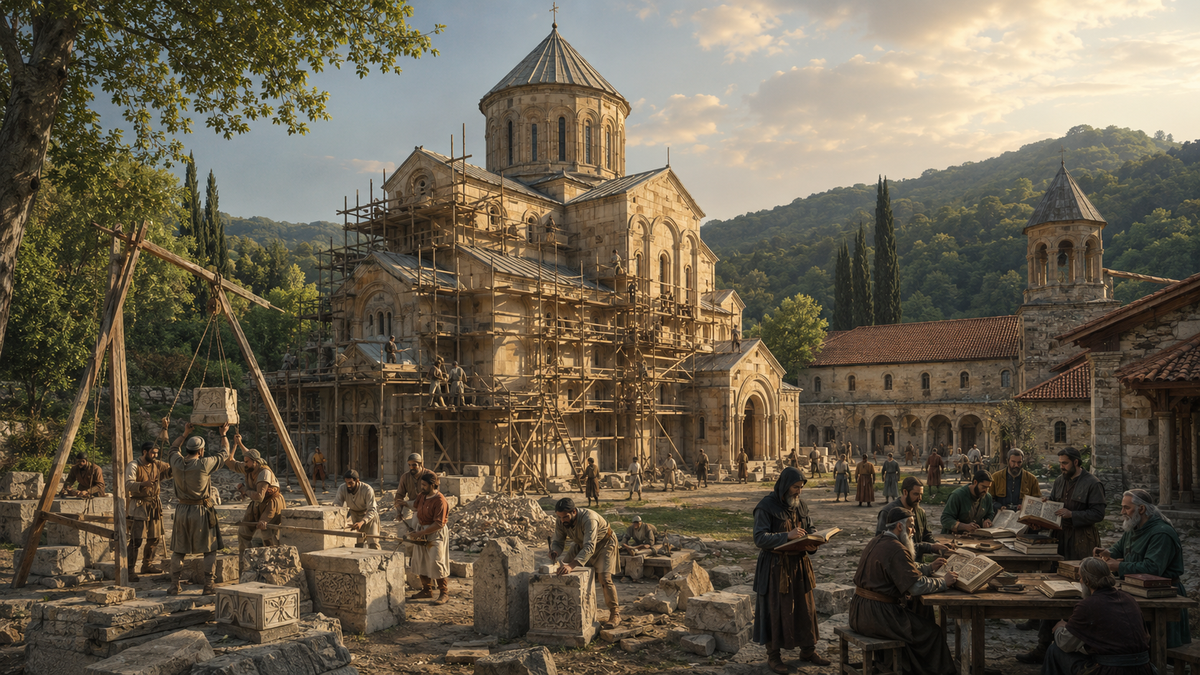
In 1106 the foundations of Gelati Monastery were laid near Kutaisi. For David this was not simply a church but a plan: he opened an academy beside the monastery and gathered there the kind of scholars you would previously have had to travel to Mount Athos or Constantinople to study under. The philosopher Ioane Petritsi taught at Gelati, and a second academy was founded at Ikalto in Kakheti. Contemporaries called Gelati “a second Athens” and “a second Jerusalem”: these are judgements rather than official titles, but they show what the monastery meant to the country.
David died in Tbilisi on 24 January 1125. He was buried at Gelati, at the entrance, under a slab in the gate church. Tradition says the king asked for it himself, so that everyone who entered would step on his grave. No document setting out that wish survives; what survives is a tradition every Georgian knows. The inscribed slab, on the other hand, is very much there.
The iron gates of Ganja stand in the monastery as well: David’s son, Demetrius I, brought them home as spoils of war and gave them to his father’s foundation.
🙏 The Saint King: Canonisation and the Hymns of Repentance
The Georgian church canonised David at the end of the 13th century, making an exception to its own rule: sainthood normally went to martyrs and monastics. His feast falls on 26 January in the old calendar, that is 8 February in the new one. The holiday is called Davitoba, and the main service is held at Gelati.
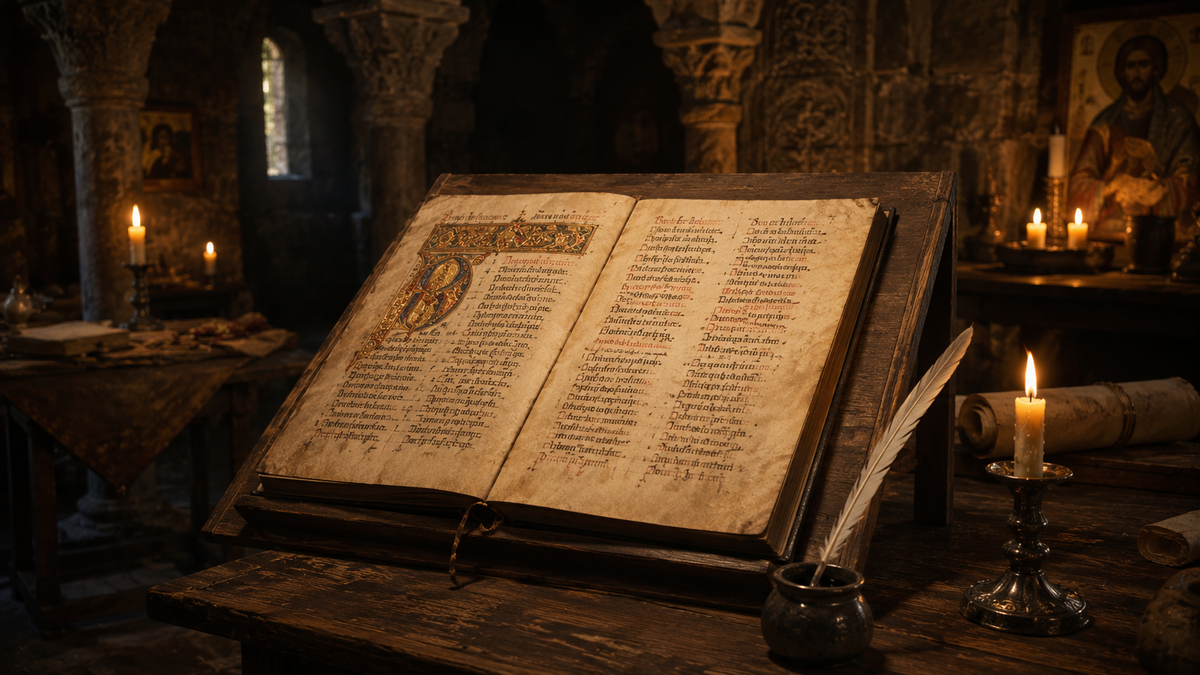
There is one more line in his biography that nobody expects. He is credited with the Galobani Sinanulisani (გალობანი სინანულისანი), the “Hymns of Repentance”: a cycle in which the victor of Didgori writes not about victories but about his own sins. The attribution is traditional, and it explains a good deal about the way this king is remembered: not only as a commander, but as a man who judged himself more harshly than his contemporaries ever did.
🗺️ Remembering David the Builder: Monument, Avenue, Airport
No Georgian king’s name turns up more often than David’s, apart from Tamar’s. Here are the main places, with a link for each.
| Landmark | Where | In Brief |
|---|---|---|
| Monument to David the Builder | Kutaisi | Equestrian statue by Elguja Amashukeli, 1995. Moved to the railway station in 2011 |
| The Didgori Monument | Didgori field, near Tbilisi | A memorial on the site of the 1121 battle, and the setting for Didgoroba |
| David Aghmashenebeli Avenue | Tbilisi | One of the main streets of the city, lined with 19th-century buildings |
| David the Builder Airport | Kopitnari, near Kutaisi | The international airport carries the king’s name. |
| The Order of David Aghmashenebeli | State decoration | One of Georgia’s highest honours, awarded for outstanding service to the country |
The history of each place, along with addresses and routes, is in the linked articles: here we have deliberately kept to a single line.
❓ Frequently Asked Questions About David the Builder
💬 From 1089 to 1125, thirty-six years in all. He came to the throne at sixteen and reigned until his death.
💬 The Georgian epithet aghmashenebeli means both “builder” and “restorer”. It refers to the country he rebuilt after the Seljuk invasions rather than to any buildings, and it was not an official title in his lifetime.
💬 On 12 August 1121 David defeated a coalition of Muslim rulers on the field of Didgori near Tbilisi. Georgians call it the miraculous victory: it opened the road to recovering Tbilisi.
💬 Tbilisi was taken in 1122, a year after Didgori. A Muslim emirate had held the city for almost 400 years, so the kingdom’s capital had stayed in Kutaisi. Once the city was won back, the capital moved to Tbilisi.
💬 He needed cavalry he could keep under arms permanently rather than a levy raised before each campaign. The chronicles say around 40,000 Kipchak families moved to Georgia: they were given land, and the king got an army.
💬 At Gelati Monastery near Kutaisi, at the entrance, under a slab in the gate church. Tradition holds that the king asked to be buried this way, so that everyone entering would step on his grave.
💬 He was her great-grandfather. The line runs from David IV to his son Demetrius I, his grandson George III and his great-granddaughter Tamar.
📌 The Short Version
A sixteen-year-old king inherited a country people had walked out of, and in thirty-six years he put it back together. He replaced the bishops, raised a standing army, brought in Kipchak cavalry and took away the nobles’ right to bargain with the throne. In 1121 he broke a Seljuk coalition at Didgori, in 1122 he won Tbilisi back and moved the capital there, and in 1124 he took Ani. He founded Gelati, opened an academy there, and was buried under a slab at its entrance. The church made him a saint, and the country he assembled reached its golden age two generations later.
💗 Read Next
- Queen Tamar: David’s great-granddaughter and the summit of the golden age
- The Golden Age of the Georgian Kingdom: how the country worked at its height
- Gelati Monastery: David’s academy and his burial place
- The Didgori Monument: a memorial on the 1121 battlefield
- From King David to the Russian Empire: the rulers of Georgia in one overview
💬 Now Over to You
David is one of those figures people still argue about. Tell us what you think.
- Have you been to Gelati and seen the slab at the entrance: did you step on it or walk around it?
- Which is more impressive: the victory at Didgori, or the twenty years of reform that made it possible?
- Which Bagrationi should we cover next: George III, Demetrius I or Bagrat III?
- Did you know that the equestrian statue in Kutaisi no longer stands where it once did?
Tell us in the comments. If you know a place connected with David the Builder that is missing from our list, tell us about that too: we will add it.

1 comment
Log in to leave a comment