



🗺️What to See in Georgia on a Single Trip: Main Regions and Routes
Georgia in one trip
Six directions and one for later
Svaneti
watchtowers high in the mountains
The list above is the map of this article: each point is covered in detail below.
Georgia is compact. A single trip fits in what other countries spread across separate journeys: snowy peaks, a wine valley, the Black Sea, churches carved straight into rock. Distances are short: from the capital you reach the big mountains or the wine country in a few hours. So the question of what to see in Georgia on one trip has a shorter answer than it seems. Pick two or three directions and link them into a route. Fifty points off a general list only get in the way here.
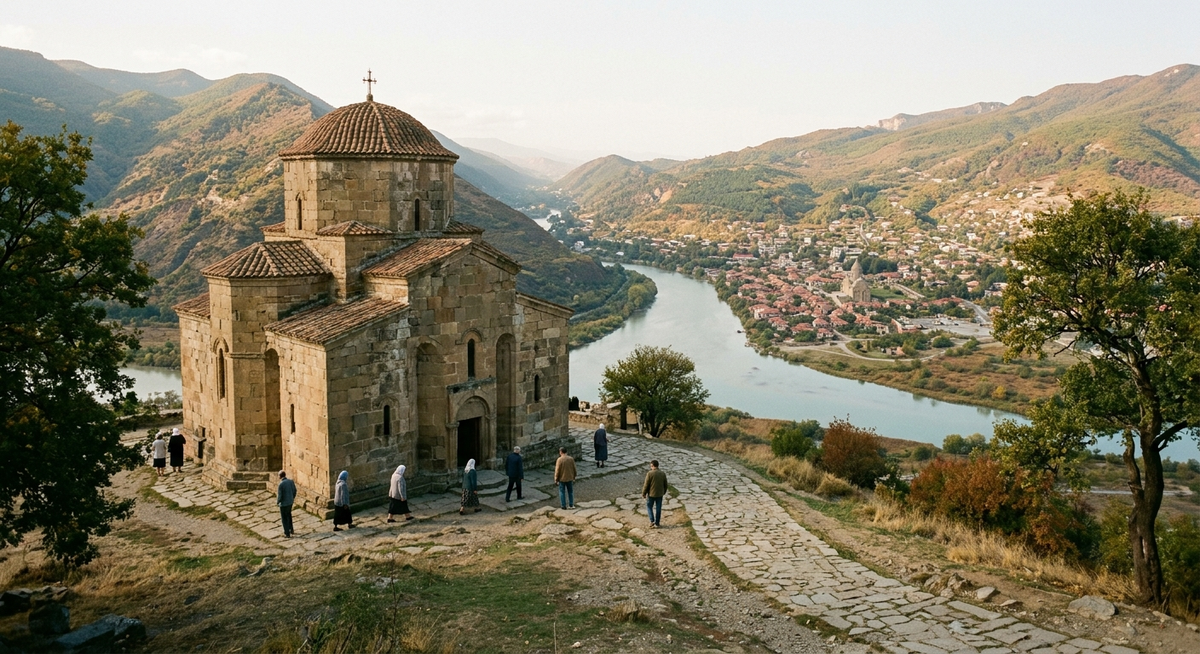
Almost every route starts in Tbilisi. From here both wine-country Kakheti and the Georgian Military Road into the high mountains are close. The west lives differently: Kutaisi with its canyons and caves, the coast with its subtropics and sea. On the map this reads as two axes: an eastern one around Tbilisi and Kakheti, and a western one from Kutaisi towards Batumi. Between them the country crosses in a day. The north stands apart: people go to Svaneti for its stone towers, and they set aside separate days for it because the road takes time.
You do not need to cover everything in one go, and that is fine. In a week you can realistically link the capital, wine and one set of mountains. Ten days add the coast. For Svaneti and a slow, deep look, set aside two weeks. Some people make Tbilisi a base and travel out on day trips; others go in a line from east to sea. Further down: each region on its own, the seasons, and ready-made routes for 7 and 10 days.
🧭 How Many Days You Need for Georgia
For a first trip, 7 to 10 days is the sweet spot. A week gathers the east: the capital, wine, one set of mountains. Ten days add the western axis with the sea. Under five days works too, but then it is more honest to take Tbilisi plus one excursion and not chase the whole country. Two weeks are needed if you want Svaneti or a slow pace without daily transfers.
Days are eaten not by the number of points but by the road between them. Mountain stretches and the east-west crossing take half a day each. So it is better to build the route in clusters: settle in one place for a couple of nights, tour the surroundings, then move on. One-night stops in three towns in a row wear you out more than the map suggests.
Capital and one outing
Tbilisi, Mtskheta nearby, one day for Kakheti or the mountains. A taste of the country with no long transfers.
The classic east
Tbilisi, the Georgian Military Road to Kazbegi, Kakheti with wine. A relaxed first route.
East plus the sea
The west joins the east: Kutaisi with canyons and caves, Batumi and the coast.
Deeper, with the northern mountains
Svaneti with its towers appears, and a slower pace: fewer transfers in a row, more time on the ground.
📅 When to Go: Seasons by Region
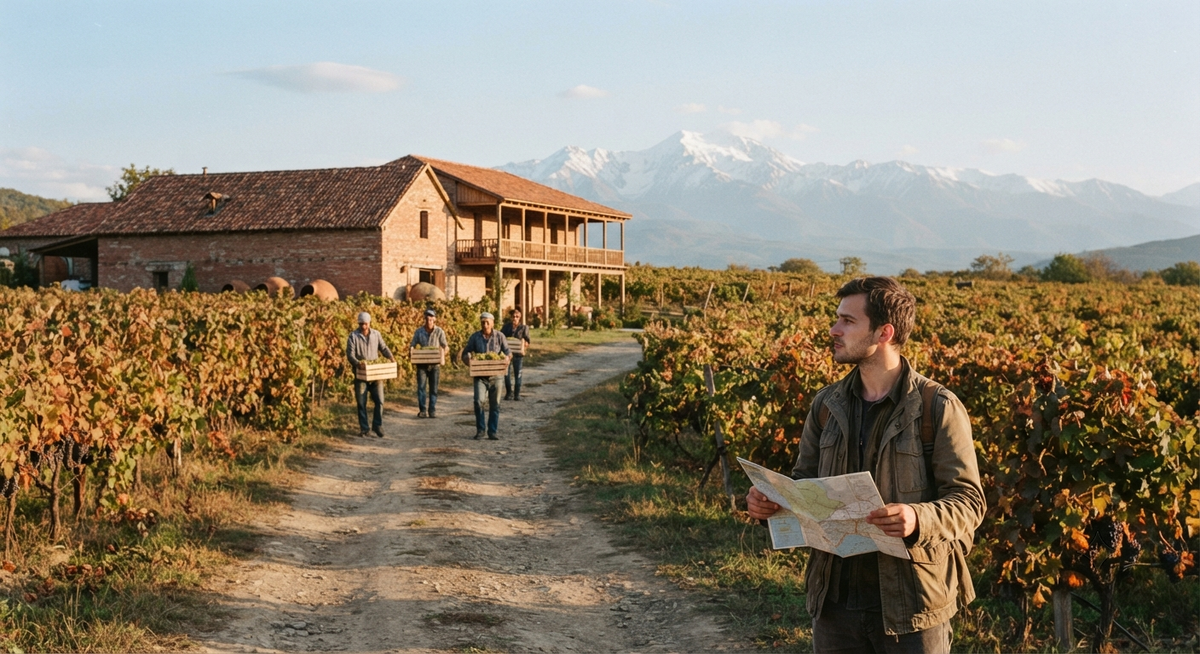
Georgia has no single best month; it all depends on the direction. The sea works from June to September. People head into the big mountains in summer and early autumn, while the roads are open. Wine is tied to autumn: September and October are rtveli, the harvest, and Kakheti comes alive then. Tbilisi takes visitors year round; summers in the city are hot, while spring and autumn are mild.
The gap between regions is what creates the main planning fork. A beach July is good in the mountains too, whereas the road to Svaneti or up to Gergeti can still be hard in spring because of snow and mud. Gudauri and Khatsvali flip the picture in winter: there it is ski season, but the mountain roads then demand attention.
🏙️ Tbilisi and cities
🍷 Kakheti (wine)
🏔️ Kazbegi and the big mountains
🌊 The coast (Batumi, Ureki)
🗼 Svaneti
🏙️ Tbilisi and Mtskheta: Where to Start
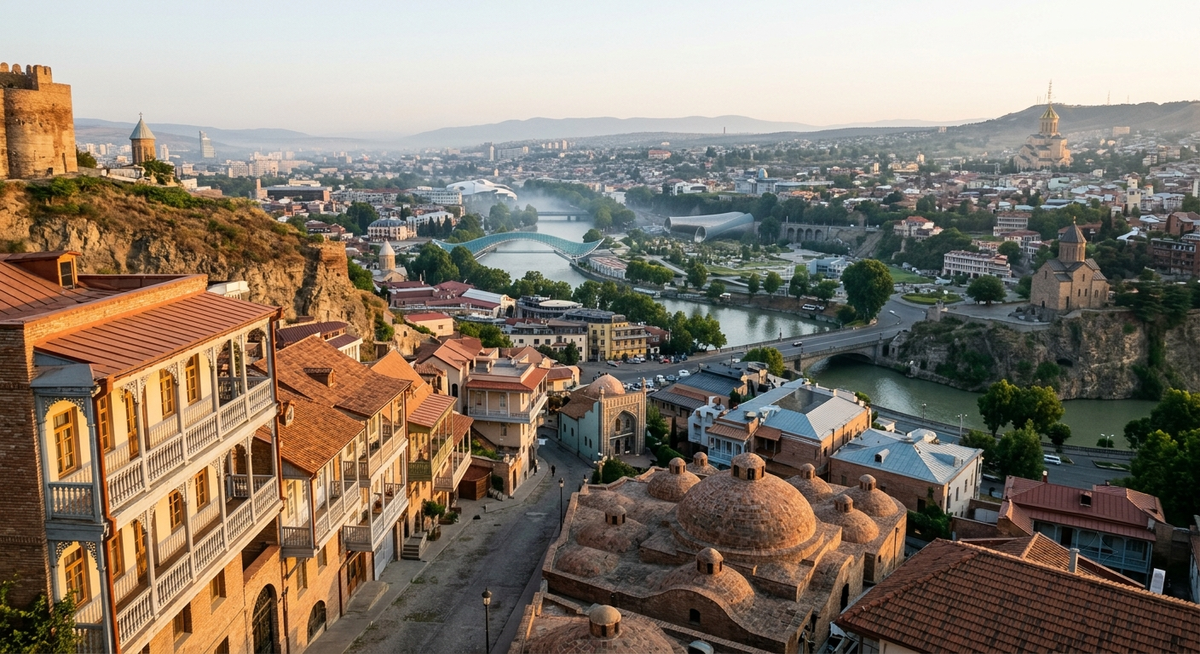
Almost everything in Georgia starts here. Tbilisi sits on the Mtkvari river, and its old part is a dense tangle of streets below the Narikala fortress: carved balconies, the sulphur baths of Abanotubani in the Old Town quarter, the Metekhi church above the cliff. A cable car runs up to the fortress, and from the top you see the whole centre and the new bridges. A walk through the historic core takes a day, and another day easily dissolves into cafés, courtyards and climbs up the surrounding hills.
Half an hour from the city stands Mtskheta, the ancient capital and spiritual centre of the country. There are two key churches here: the Svetitskhoveli cathedral in the town itself and Jvari on the hill above the confluence of the Mtkvari and the Aragvi. People take Mtskheta as a half-day outing, often on the way somewhere further, towards the mountains or into Kakheti. That makes the Tbilisi plus Mtskheta pairing a natural start to any route.
What to see in the city itself, in detail and by district, is covered by a separate guide to Tbilisi. On the overall route, keep the capital as a base: almost every direction of a first trip fans out from here.
🍷 Kakheti: Wine and Monasteries
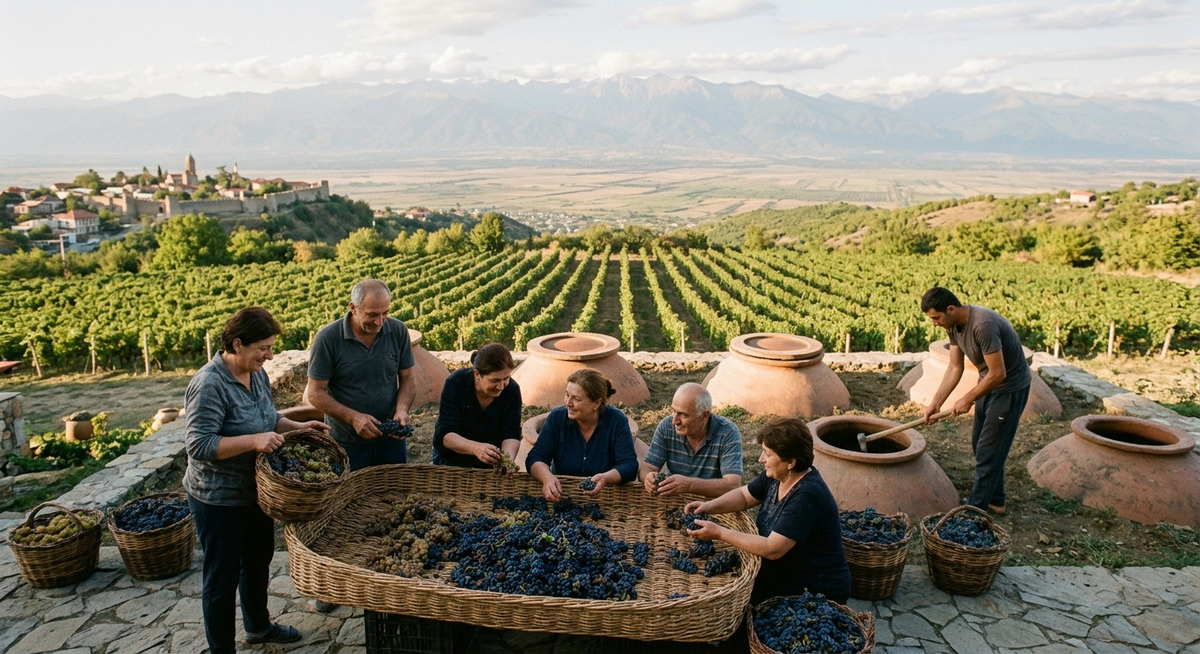
The eastern wine country lies a couple of hours from Tbilisi and asks to be the first overnight outing on a route. The symbol of Kakheti is Signagi, a town on a hill behind a fortress wall, with a view over the Alazani valley and a distant ridge. Below it stands the Bodbe monastery, tied to the name of St Nino, the woman who brought Christianity to Georgia. Old cloisters are scattered across the valley: the Alaverdi cathedral, the fortress-monastery of Gremi, the ruins of Nekresi on a slope.
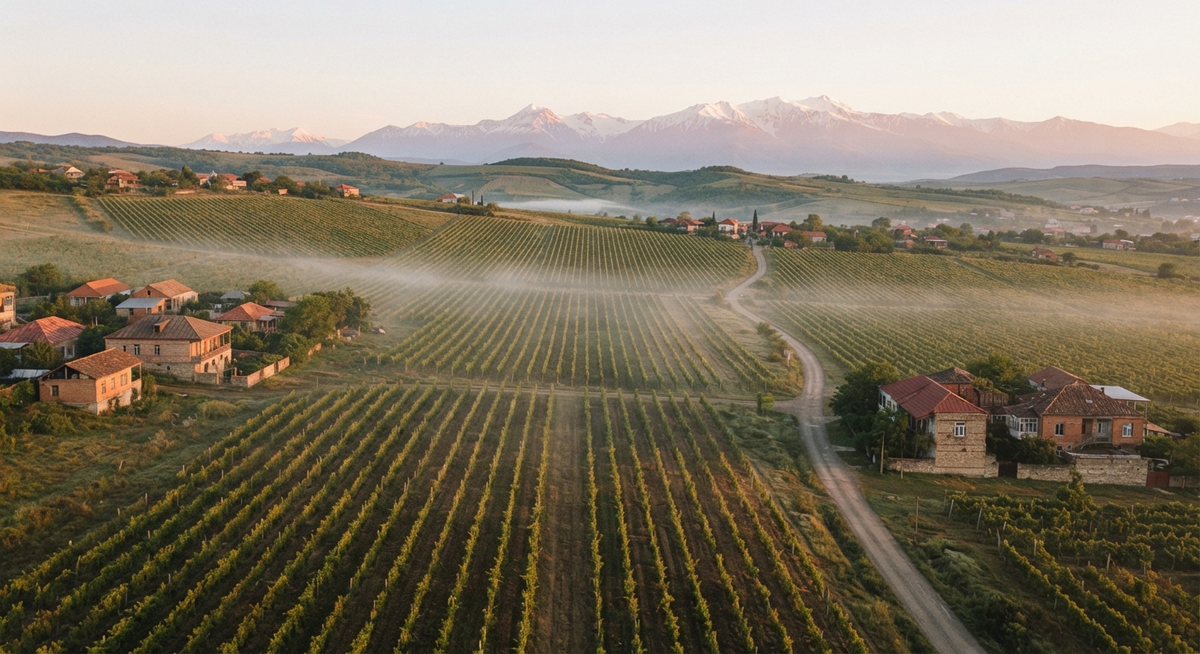
The main thing here, though, is not the stones but the wine. Kakheti is the heart of Georgian winemaking, and they make it here by an ancient method in qvevri, clay vessels buried in the ground. Cellars and family estates are open for tastings, and in autumn, at rtveli, the region lives by the harvest. Telavi, the regional centre, works well as a base for trips around the valley.
It makes sense to place Kakheti right after Tbilisi, while you are in the east. Routes around the estates, monasteries and valley towns are gathered in the piece on what to see in Kakheti.
🏔️ Kazbegi and the Georgian Military Road
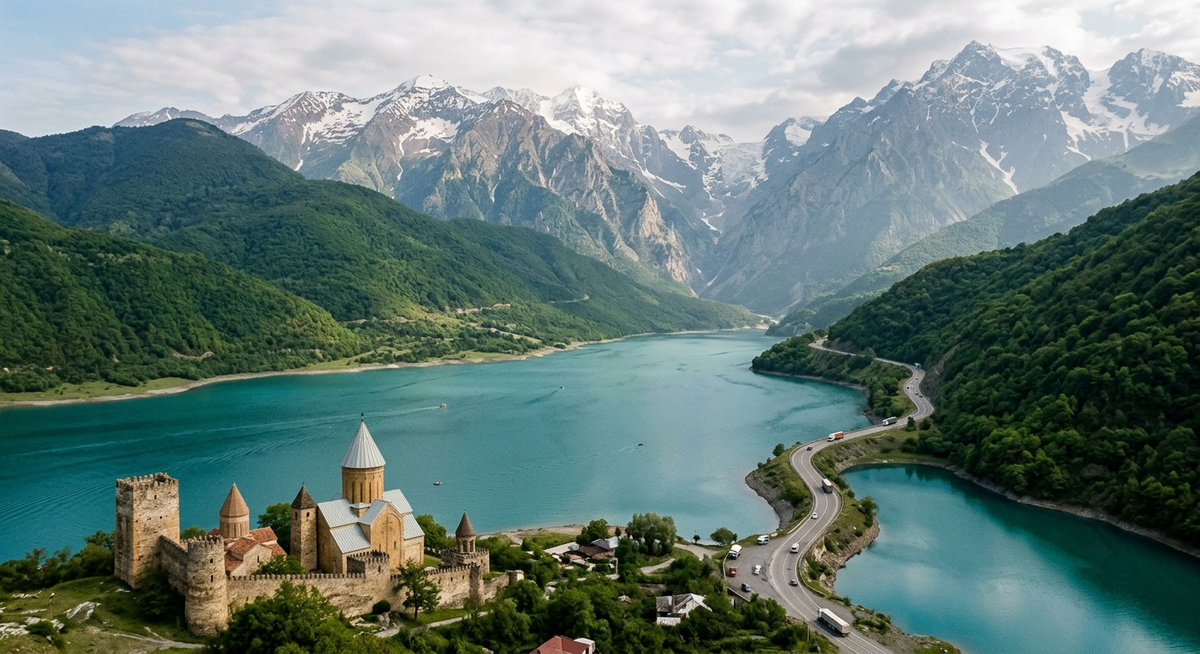
If your trip needs big mountains, Kazbegi and the road to it deliver them. The Georgian Military Road runs north from Tbilisi over a pass and is an attraction in itself: along the way stand the Ananuri fortress above the turquoise Zhinvali reservoir, then the ski resort of Gudauri and the Friendship of Peoples viewpoint looking into the gorge. As you climb, the landscape shifts from green slopes to stark cliffs.
The route ends at Stepantsminda (Kazbegi) at the foot of the 5,000-metre Mount Kazbek. On a spur above the village stands the Gergeti Trinity Church, Tsminda Sameba, one of the country's most recognisable images: a lone church with a snowy peak behind it. People go up on foot or by off-road transfer. The weather here is changeable and the mountain is often hidden by cloud, so it is better to set aside a night for Kazbegi rather than racing it in a day.
The road, the stops along it and the surroundings of Stepantsminda are set out in detail in the guide to the Georgian Military Road. On the overall route, this is your mountain day or two.
🕳️ Cave Towns: Uplistsikhe and Vardzia
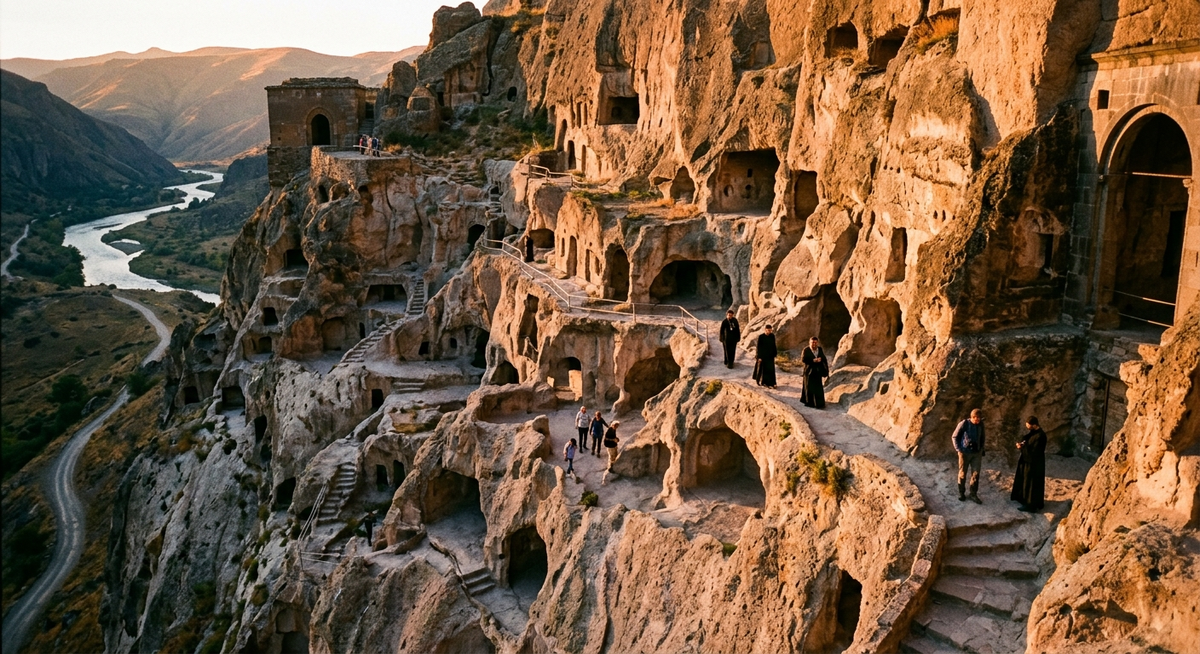
A separate layer of Georgia is its towns cut straight into rock. Closer to Tbilisi, near Gori, stands Uplistsikhe, one of the country's oldest towns: streets and halls carved into a rock massif above the Mtkvari river. It is easy to combine with Gori on the way west.
Further south, near the Turkish border, lies Vardzia, a 12th-century cave monastery tied to Queen Tamar. It is a multi-tiered complex built into a sheer slope: cells, passages and a frescoed church run deep into the mountain. Vardzia is out of the way, so people take it as a separate long outing or fold it into a route via Akhaltsikhe and the Rabati fortress. Further east still, right on the border, hides the rock-cut monastery of Davit Gareja, but it is entirely off to the side and calls for a separate trip with a check on access.
These places are far apart geographically, so on a short trip people take just one.
🏞️ Kutaisi and the Centre: Gelati, Canyons, Caves
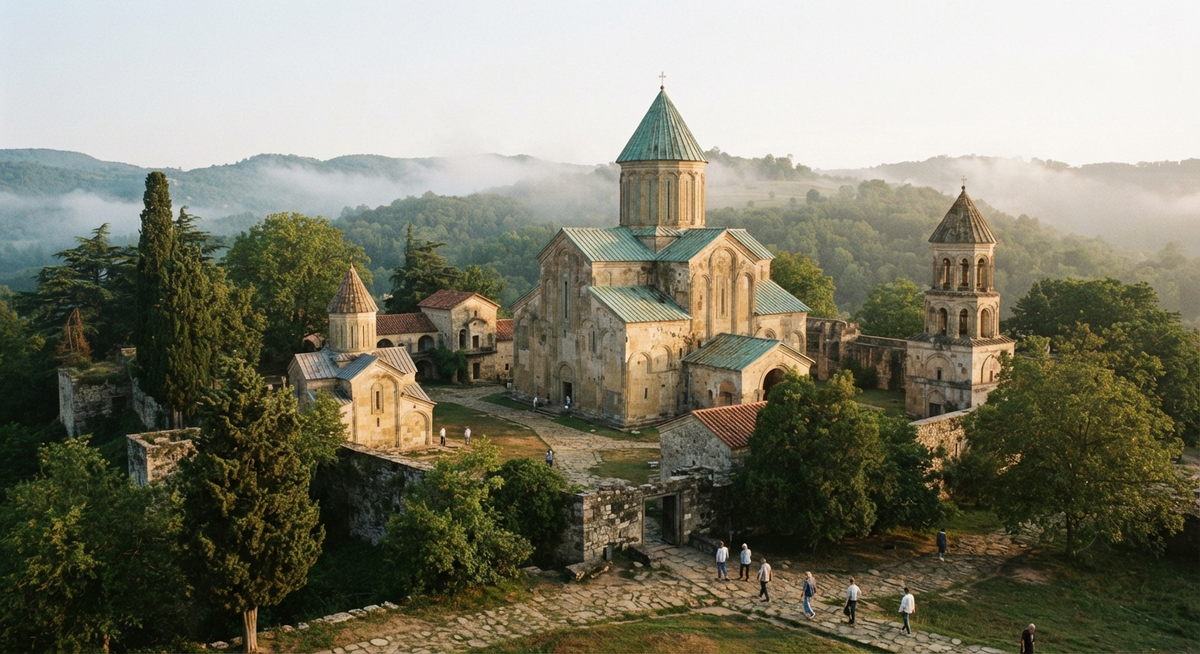
The western axis begins with Kutaisi, the country's second city and a convenient base for Imereti. In the city itself the Bagrati cathedral stands on a hill, and a few kilometres away, amid greenery, sits the Gelati monastery, a medieval centre of learning with surviving mosaics and frescoes. Gelati is on the UNESCO World Heritage list.
Nature is concentrated around Kutaisi. The Martvili canyon is crossed by boat along turquoise water between sheer walls. The Okatse canyon is a suspended trail above a drop, with the Kinchkha waterfall falling nearby. Underground hide the caves: Prometheus at Kumistavi with its lighting and underground river, Sataplia with fossilised dinosaur footprints. All of this is a day or two of points with a base in Kutaisi.
The region conveniently links the east with the coast: the sea is within reach from here.
🌊 Batumi and the Black Sea Coast
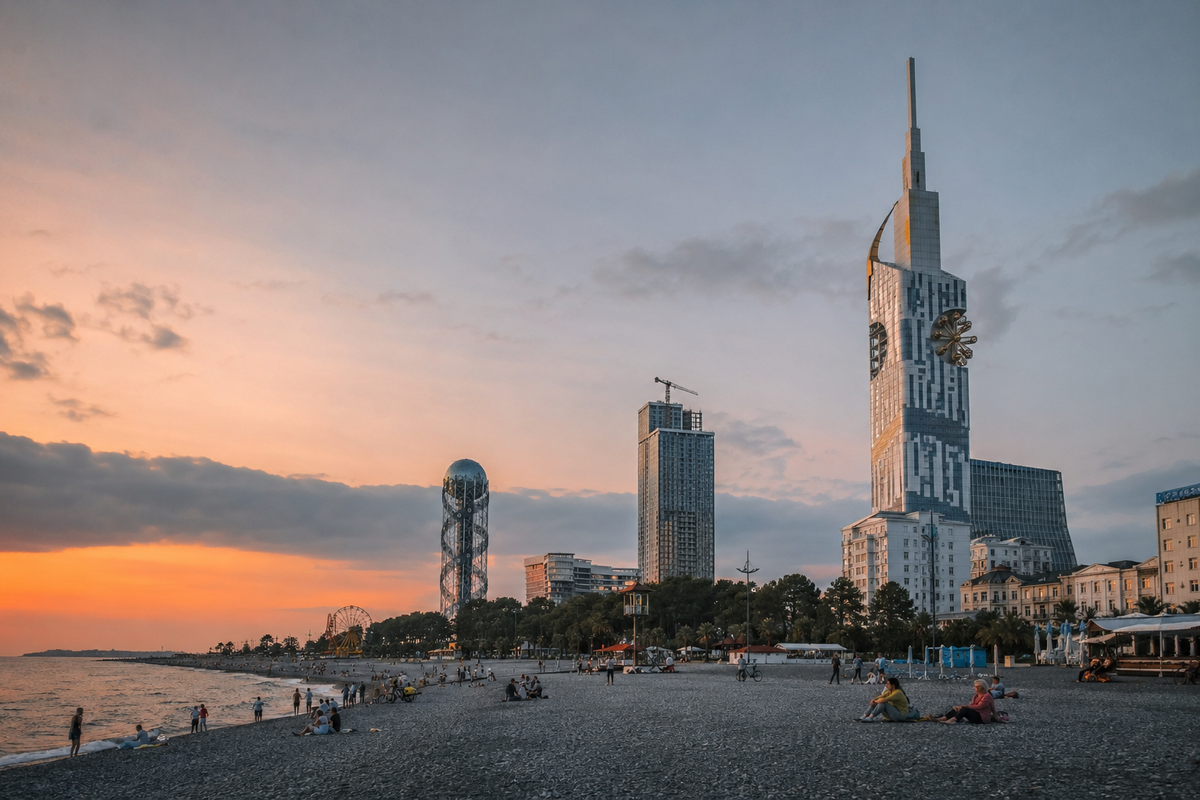
The seaside part of the trip is Batumi and the strip of beaches around it. Batumi itself is a study in contrast: a seafront boulevard several kilometres long, old quarters with balconies and, next to them, a district of towers by the water. On the promenade stand the moving sculpture "Ali and Nino" and the Alphabet Tower with Georgian letters spiralling up it. The evening boulevard with its fountains is a part of the city in its own right.
Beyond the city the coast varies. To the north stretch pebbly Chakvi and Kobuleti, and the green cape of Mtsvane Kontskhi with a botanical garden on the slope down to the sea. To the south, near the Turkish border, stands the Roman-Byzantine fortress of Gonio. A separate point is Ureki, with its black magnetic sand, to which a health-giving effect is attributed: the place is presented as a resort factor rather than a treatment, and with chronic conditions it is sensible to speak to a doctor first.
The coast closes the trip with sea and subtropics. What to see in the city and its surroundings is gathered in the piece on what to see in Batumi.
🗼 Svaneti: Towers and Mountains
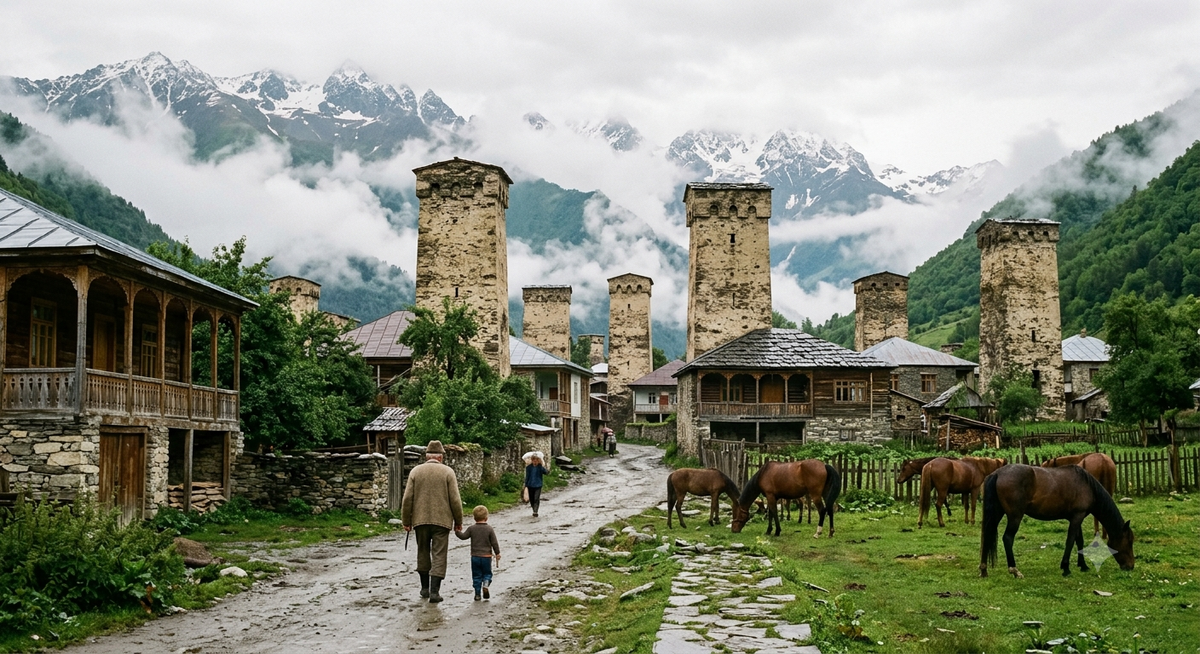
Svaneti stands apart, and this direction is for those with time to spare. This high-mountain region in the north-west is known for its family stone towers, which served for centuries as both dwelling and defence. Mestia, the regional centre, is ringed by peaks, with the twin-headed Ushba above it and quarters of old towers and a museum in the town itself. From here people set out to lakes and viewpoints, and in winter the small Khatsvali resort works nearby.
Further into the mountains lies Ushguli, one of the highest continuously inhabited villages in Europe, with the towers of Chazhashi under the Shkhara glacier. The road there is long and in places hard, which is what makes Svaneti a separate story rather than a stop in passing. People set aside several days for it and a settled season, because outside summer access drops sharply.
Svaneti is worked into a route when there are two weeks for the country or when the mountains are the main goal of the trip.
🗺️ Ready-Made Routes: A Week and 10 Days
Next are three ready schemes for different amounts of time. The logic of all of them is the same: hold to clusters and do not move every day.
A week in the east · 7 days Capital, mountains and wine with no crossing to the west.
-
1
Tbilisi2 nights
Old town, Narikala, sulphur baths. A half-day outing to Mtskheta: Svetitskhoveli and Jvari.
-
2
Kazbegi1 night
The Georgian Military Road, with Ananuri and Gudauri on the way. The Gergeti church below Mount Kazbek.
-
3
Kakheti, Signagi1 night
Back through Tbilisi into the wine country. Signagi, the Bodbe monastery, a tasting at an estate.
-
4
Tbilisifinish
Back to the capital, more of the city and a spare day for what you missed. Fly out from here.
East plus the sea · 10 days The west with the coast attaches to the eastern loop, linear from the capital to the sea.
-
1
Tbilisi and Mtskheta2 nights
The old town and the ancient capital side by side.
-
2
Kazbegi1 night
The Georgian Military Road, a mountain outing with Ananuri on the way.
-
3
Kakheti, Signagi1 night
Wine, the Bodbe monastery, the Alazani valley.
-
4
Kutaisi2 nights
Transfer west. Gelati, the Martvili and Okatse canyons, the Prometheus cave.
-
5
Batumi and the coast2 nights
The boulevard, the botanical garden, the Gonio fortress. Return by daytime train or fly out from Kutaisi or Batumi.
Deeper, with the northern mountains · 14 days Two weeks give time for Svaneti and a calm pace without daily transfers.
-
1
The eastern part4 nights
Without rushing: Tbilisi, Mtskheta, Kazbegi, Kakheti.
-
2
Kutaisi2 nights
Canyons, caves, Gelati.
-
3
Mestia3 nights
Transfer into the mountains. Towers, museum, viewpoints above the village.
-
4
Ushguliday trip
The Chazhashi towers under the Shkhara glacier.
-
5
The coast or Kutaisi2 nights
Descent towards the sea or back to Kutaisi, a rest before flying out.
🚗 How to Move Between Regions
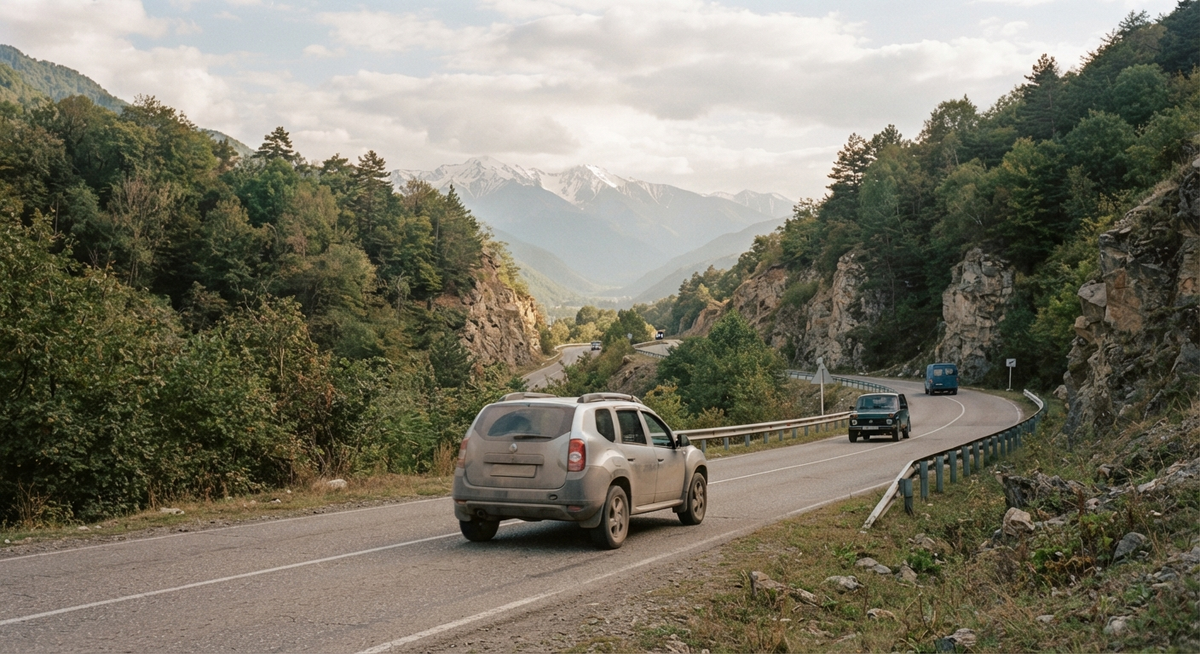
Three ways link the clusters, and the choice changes the whole character of the trip. Renting a car gives freedom and opens up the mountains: to Gergeti, into Svaneti, out to the far canyons it is simplest under your own steam. But mountain roads call for experience and a sober read of the season, and in winter some passes are hard. Without a car, shared minibuses (marshrutkas) carry you around the country, cheaply and everywhere, only their timetable is loose, and return transport from remote corners is worth checking in advance.
The long east-west hops are covered by the train. A fast daytime service runs between Tbilisi and Batumi, with stops in Kutaisi and towards Zugdidi, the jumping-off point for Svaneti. This is the calmest way to cross the country, with no wheel and no switchbacks. Into the mountains, people continue from the hub points by transfer or off-road vehicle.
Little time and no car
Base yourself in Tbilisi and take radial day trips by transfer or in small groups. Less logistics, more of the places themselves.
You have your own or a rented car
The mountains and far points open up and the schedule is flexible. Weigh the season and the difficulty of mountain roads, especially outside summer.
You are travelling between Tbilisi and the sea
The daytime train to Batumi with a stop in Kutaisi is handy. After that, a minibus or taxi on the spot to the point you need.
Kazbegi or Svaneti are on the plan
Build in a time buffer for the road and watch the weather. In the shoulder season, access to the mountains drops sharply.
🏛️ What Holds the Set Together
On the map these are different worlds: a wine valley, snowy mountains, subtropics by the sea. But several threads run through the country and stitch them, so the trip does not fall apart into random points. The first thread is the ancient churches: they stand in the capital, above a mountain gorge and in the rock itself, from Jvari above Mtskheta to Gelati near Kutaisi. Three places in that row are on the UNESCO World Heritage list: the historical monuments of Mtskheta, the Gelati monastery, and Upper Svaneti with the towers of Ushguli.
The second thread is the table. Wine has been made in qvevri here for thousands of years, and the method itself is inscribed on UNESCO's intangible heritage list, along with Georgian polyphony and the Georgian script. A tasting in Kakheti and a feast with toasts are as much a part of the route as the fortresses. The third thread is simple: everything is close. The compactness of the country is what lets you link, on one trip, what seems unlinkable, mountains in the morning and the sea by evening.
Have you already put together your route around Georgia? Leave a review on Madloba: tell us how many days you set aside, what you would cut or add, and which region landed hardest. First-hand details like these help those planning a first trip.
The information is current as of July 2026. Before travelling, check the season, the weather, the accessibility of mountain roads, transport timetables and the current conditions for visits.
❓ Frequently Asked Questions
💬 Seven to ten days is the sweet spot. A week gathers the east: Tbilisi, Kakheti and one set of mountains. Ten days add the west with the coast. For Svaneti and a calm pace, set aside two weeks.
💬 The classic week-long route is Tbilisi with an outing to Mtskheta, the Georgian Military Road to Kazbegi, and Kakheti with wine. All of this is the east of the country, with short transfers. The sea and the west do not fit into a week without rushing.
💬 Yes, and ten days are enough for it. First the east with the Kazbegi mountains, then a transfer west to Kutaisi and Batumi. The daytime train conveniently links Tbilisi and the coast.
💬 It depends on your goal. The sea works from June to September, the big mountains are open in summer and early autumn, and wine is tied to September and October. Tbilisi is good year round, and most comfortable in spring and autumn.
💬 Not necessarily. The train and shared minibuses cover most directions, and transfers run between cities. But your own car greatly simplifies the mountains and far points. Check return transport from remote areas in advance.
💬 For a first visit, take Tbilisi, Mtskheta, Kazbegi and Kakheti, the core of the country with minimal transfers. If you have time, add the west: Kutaisi with its canyons and Batumi with the sea.
💬 The World Heritage list includes the historical monuments of Mtskheta, the Gelati monastery, and Upper Svaneti. Separately, on the intangible heritage list, are qvevri winemaking, polyphonic singing and the Georgian script.

5 comments
Log in to leave a comment