




Metekhi Church in Tbilisi: 6th-Century Cathedral above the Kura
⛪ Things to Know Before You Visit
| 📍 Location | Cliff above the Mtkvari River, Metekhi District, Tbilisi. Visible from anywhere in the Old Town |
| 📅 Built | 6th century — King Vakhtang I Gorgasali. Current appearance dates back to the 1289 restoration |
| 🏛️ Architectural Style | Cross-in-square, four supporting columns. Rock (stone) |
| 💎 Unique Element | Grapevine relief from the 12th–13th centuries — the only one of its kind in Tbilisi |
| 🖼️ Icons | "100,000 Metekhi Martyrs", "Saint Shushanik", "Abo of Tbilisi" (M. Sabinin) |
| ⚰️ Resting Here | Saint Shushanik — a Georgian martyr who died for her faith in the 5th century |
| 💰 Admission | Free. Dress code: modest clothing, headscarf for women |
🧭 Who This Article Is For
Metekhi is not just a beautiful church on a cliff above the river. It is a place where 15 centuries of Tbilisi's history are packed into a single architectural structure. The church burned, was used as a gunpowder magazine, then as a prison, and later as a theater studio. The artist who saved it from demolition ordered by Beria was arrested and sentenced to death. This article is for those who want to step inside with a deep understanding of this place.
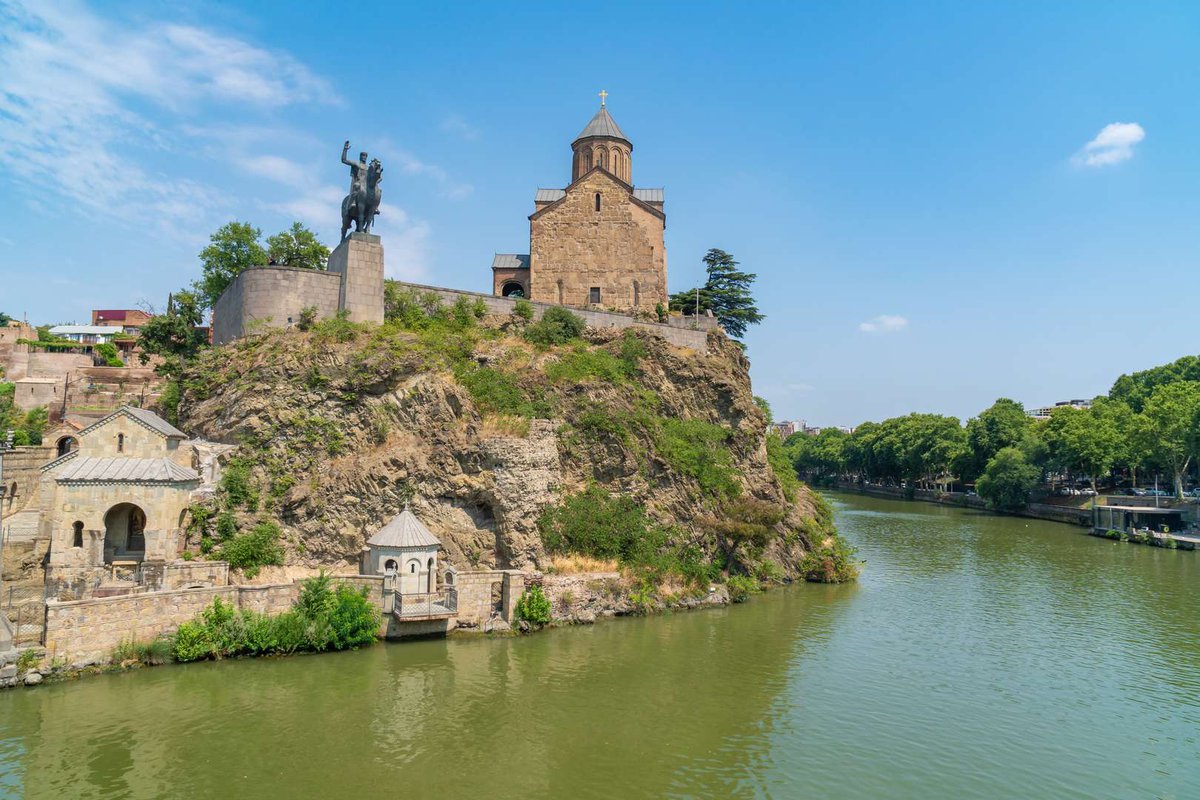
📜 History in Dates: Everything the Church Endured
- 6th century. King Vakhtang I Gorgasali builds the church and an adjacent palace, surrounded by fortress walls. It serves as a royal residence. The church is dedicated to the Virgin Mary — named after the Icon of the Metekhi Mother of God, which was kept here. The icon has not survived to our day.
- 1226. Mongol invasion. The palace is destroyed. The church is heavily damaged.
- 1289. Demetrius II restores the church. The current appearance of the building dates precisely from this restoration.
- 1654. King Vakhtang V uses the temple as a gunpowder storehouse.
- 1748. Heraclius II wins Metekhi back from the Turks, orders its restoration, and builds a new brick dome. The inscriptions on the walls date back to this era.
- 1795. A fire occurs during the invasion of Agha Mohammad Khan. It is restored by King George XIII.
- 1819. The commander in the Caucasus, A. Yermolov, demolishes the defensive wall and builds a prison on the territory. A two-story building and barracks appear.
- 1903. Lado Ketskhoveli, a Georgian revolutionary, is killed in this prison.
- Soviet Era. The prison was demolished. Lavrentiy Beria intended to demolish the church itself. Artist D. Shevardnadze stood up to protect the monument. For this, he was arrested and sentenced to death by firing squad.
- 1979. The building houses a youth studio of the State Drama Theater. Later, it becomes an artist's workshop.
- Spring 1988. Patriarch Ilia II revives the church. A cross is installed on the dome, and services resume. The iconostasis is restored through public donations.
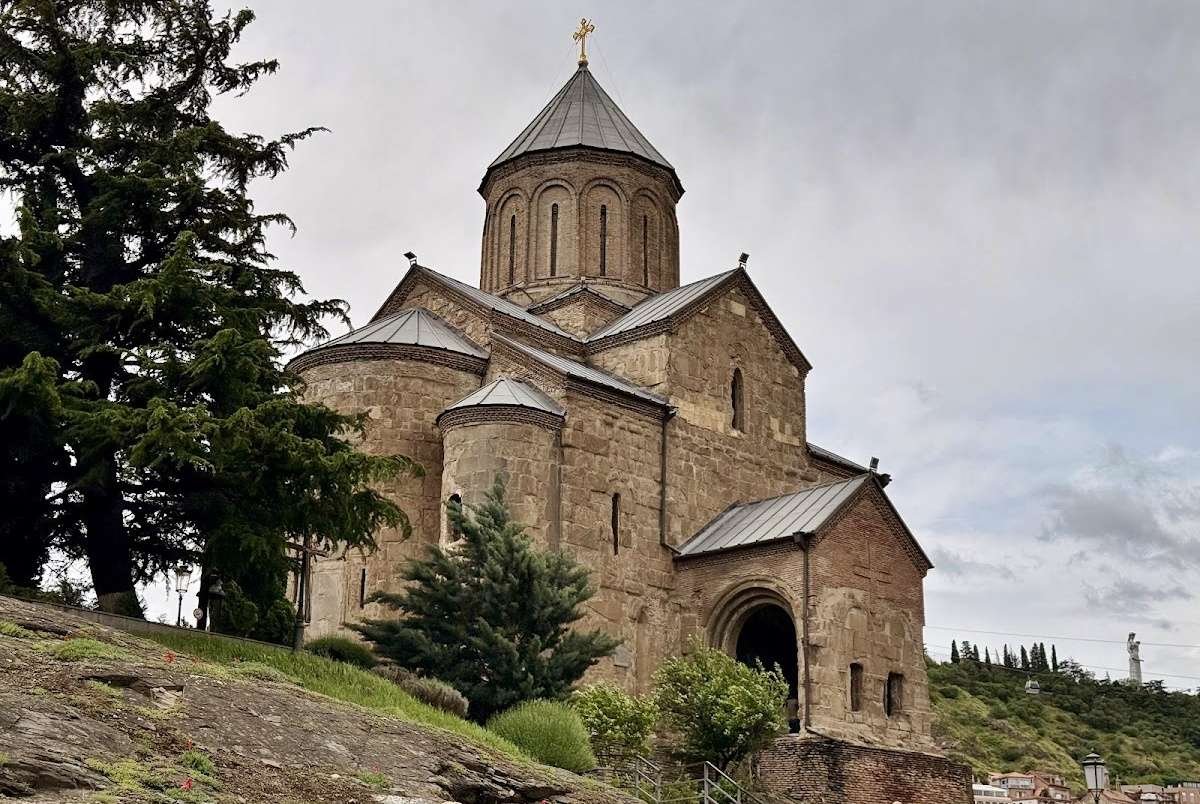
🏛️ Architecture: What to See and Where
- The Eastern Wall — best preserves its original appearance. Here you can find stone windows with patterned frames: a rare surviving element.
- The Grapevine Relief — located right here. This image dates back to the 12th–13th centuries and is the only surviving decorative monument of that period in Tbilisi. Nowhere else.
- The Northern Wall — features a covered gallery-portico. The upper part was restored with brick, while the lower part is original masonry. Few churches from the Golden Age have preserved this part of the structure.
- The Southern Wall — heavily reconstructed with brick. From one of the observation decks, you can see how much it differs from the rest: a buttress (vertical support) is attached to it.
- Inscriptions on the Walls — a historical monument. On the southern wall is an inscription from 1919. On the western wall, there are several inscriptions from different eras.
- The Interior — more modest compared to the facades. In the 18th century, the vaults were altered from semicircular to pointed. The walls are painted gray; the murals of those times have not survived.
🖼️ Icons Worthy of Attention
- "100,000 Metekhi Martyrs" — an icon dedicated to the citizens of Tbilisi who died for their faith.
- "Saint Shushanik" — the relics of this 5th-century Georgian martyr rest in the church. She refused to convert to Zoroastrianism along with her husband and died in captivity.
- "Abo of Tbilisi" — painted in oil by the artist M. Sabinin. Over time, the icon has darkened so much that it is almost impossible to see the details. Sabinin's original works can only be seen here. He also painted the famous icon "The Glory of the Georgian Church".
🗺️ The Legend of the Name "Metekhi"
According to legend, the Shah of Ossetia, Bagatar, kidnapped three-year-old Khvaramze, the sister of King Vakhtang. To get her back, Vakhtang agreed to a duel. He swore he would not shoot while Bagatar was crossing the river. However, he broke his oath — he shot and killed his opponent. To seek redemption for his broken word, he erected several churches, including Metekhi.
"Metekhi" translates as "I broke" — meaning he broke the oath.
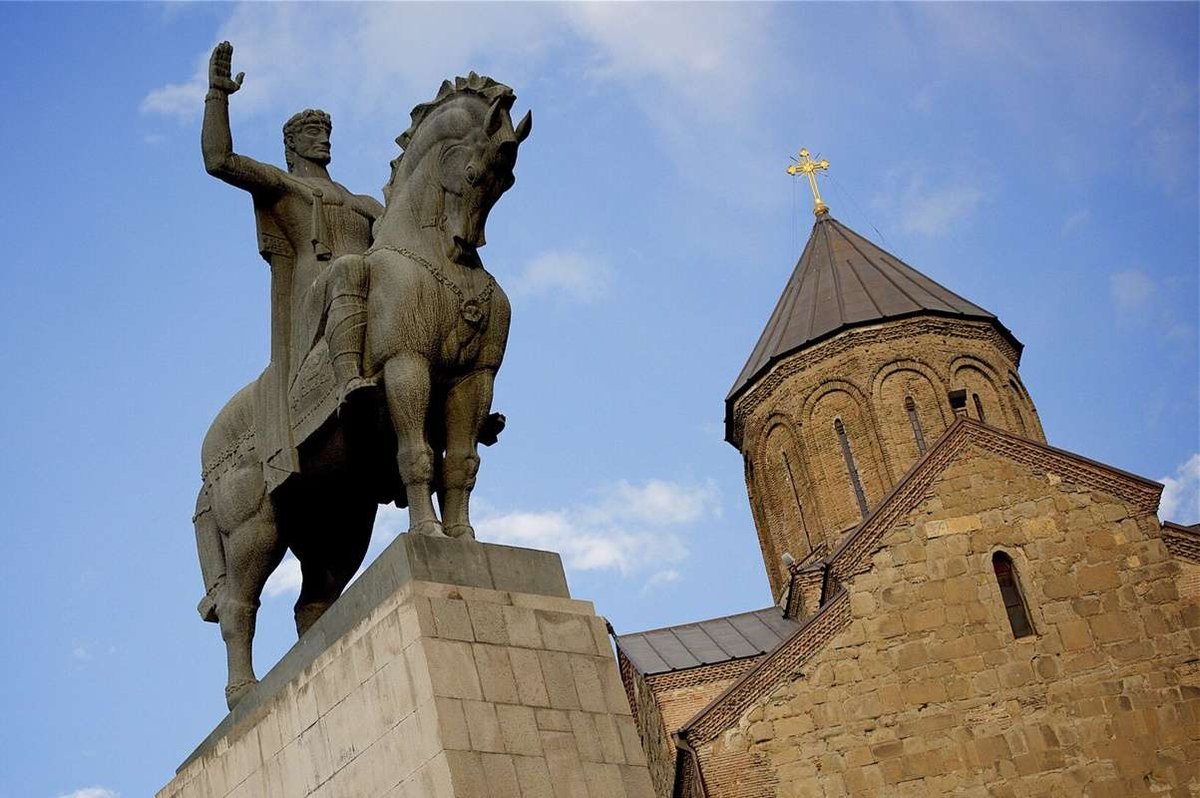
Next to the church stands the equestrian statue of Vakhtang Gorgasali — one of the most recognizable landmarks of Tbilisi.
The best view of Metekhi is not from the inside, but from the outside: from Narikala or from the Bridge of Peace. The equestrian statue of Vakhtang Gorgasali and the silhouette of the church above the river form one of the main symbols of Tbilisi. Come in the morning: fewer tourists, better light. View the eastern wall from the outside — that's where the grapevine and carved window frames are. Examine the western wall from the inside — there are several inscriptions from different historical eras. Be sure to find Sabinin's icon: it is very dark, but it is the original, the only one in Tbilisi.
🗺️ How to Conduct Your Visit
1️⃣ Start from the outside — walk around the perimeter of the church and examine all the walls. The difference between them is very noticeable.
2️⃣ Find the stone window frames and the grapevine relief on the eastern wall — this is the main architectural rarity.
3️⃣ Go inside. Let your eyes adjust. The gray walls create an ascetic space — the mood is different from many other Tbilisi churches.
4️⃣ Find the three key icons — "100,000 Martyrs", "Saint Shushanik", and "Abo of Tbilisi" (Sabinin).
5️⃣ Read the inscriptions on the southern and western walls — each is dated, representing literal layers of different eras.
6️⃣ Walk out to the equestrian statue of Vakhtang Gorgasali and look at the view from the cliff — one of the best viewpoints over the Mtkvari and Old Tbilisi.
💬 What Visitors Say
"It's amazing how Metekhi Church, despite all the destruction and changes, still retains its grandeur. The grapevine on the walls and the ancient stone window frames seem to convey the legends of the past to us."
"Just an incredible combination of architectural structures and nature. To create such beauty on a cliff. The Church of the Mother of God has preserved a distinctive feature in the form of a grapevine image. You won't see this anywhere else."
"The church survived so many turmoils but did not turn into ruins like many other churches and fortresses in Georgia. This place is a must-visit."
"What a stunning story! I had no idea that so many centuries of history, legends, and tragic events were hidden behind this architectural gem. The description of Shushanik's fate was especially touching."
🏁 Why It's Worth Visiting
Metekhi is 15 centuries in a single building. A royal residence, Mongol invasion, restoration, gunpowder, a prison, a theater studio, an artist under threat of execution — and a rebirth in 1988. The 12th-century grapevine is the only one of its kind in Tbilisi. Icons, the relics of Shushanik, wall inscriptions. All this is on a cliff above the river, with a view visible from anywhere in the city. Admission is free.
ℹ️ The church is active, admission is free. Dress code: modest clothing, headscarf for women. Coordinates: Metekhi District, cliff above the Mtkvari River. Nearby is the equestrian statue of Vakhtang Gorgasali. Information is current at the time of publication.
Have you been to Metekhi Church? What remembered the most — the grapevine relief, the icons, the view from the cliff, or the story of the artist who saved the church at the cost of his freedom? Tell us — we read all the comments ❤️
❓ Frequently Asked Questions
💬 The church is located in the Metekhi district on a cliff above the Mtkvari River. From the Old Town, it is a 10–15 minute walk across the bridge. The landmark is the equestrian statue of Vakhtang Gorgasali on the edge of the cliff. It is clearly visible from the Bridge of Peace and Rike Park.
💬 In the 6th century — founded by King Vakhtang I Gorgasali as part of the royal residence (palace + church + fortress walls). The current architectural appearance was formed after the restoration by Demetrius II in 1289.
💬 Yes. In 1819, by order of the Caucasus commander Yermolov, the defensive wall was demolished and a prison was built. It was there that the Georgian revolutionary Lado Ketskhoveli was killed in 1903. The Soviet authorities demolished the prison.
💬 Saint Shushanik is a 5th-century Georgian Christian martyr. She was the daughter of a military commander and the wife of ruler Varsken, who converted to Zoroastrianism and demanded the same from his wife. Shushanik refused, was imprisoned, and died there. Her relics are kept in Metekhi Church.
💬 Lavrentiy Beria gave orders to demolish the church. Georgian artist D. Shevardnadze stood up to defend the monument — for this, he was arrested and sentenced to death by firing squad. The church was saved. For a long time, it did not welcome parishioners: it housed a theater studio, and later an artist's workshop. It was revived as a church in the spring of 1988 under Patriarch Ilia II.
💬 On the eastern wall, a grapevine relief from the 12th–13th centuries has been preserved. It is the only decorative monument of that era that has reached us in Tbilisi. Nowhere else in the city has such a thing survived.
💬 According to legend — "I broke". King Vakhtang broke his oath and, to atone for this, built several churches, including Metekhi. The name signifies a broken word, a violated vow.
💬 On the edge of the cliff next to the church stands the equestrian statue of Vakhtang I Gorgasali — the founder of the church and one of the symbols of Tbilisi. This is one of the best viewpoints over the Mtkvari River.

26 comments
Log in to leave a comment
Статья очень живо и подробно рассказывает о том, как собор служил главной духовной крепостью столицы, пережил реставрации и стал символом стойкости и веры. Особенно ценны советы местных жителей — где лучше сделать остановку для фото, как поймать лучший свет на рассвете и на что обратить внимание, чтобы почувствовать дух места во всей полноте. Я уже успел прогуляться вокруг собора, заглянуть внутрь и ощутить невероятное спокойствие, которое царит в этом месте, даже когда вокруг шумит туристический центр.
Отдельно порадовали отзывы других путешественников: они подсказывают уютные кафе рядом, где можно попробовать настоящую грузинскую кухню после экскурсии, и делятся практическими нюансами — как добраться, где удобнее оставить машину и в какое время лучше планировать визит, чтобы избежать толпы.
Благодарю каталог мадлобу за такую глубокую и вдохновляющую подборку!
А вы бы предпочли посетить Метехский собор утром, когда свет мягкий и тёплый, или вечером, когда огни города создают особую атмосферу?