




Gelati: David the Builder’s Monastery near Kutaisi
The Gelati Monastery Complex is located 11 kilometers northeast of Kutaisi, in the Tskaltsitela River valley. The monastery was founded by the King of Georgia, David IV Agmashenebeli (the Builder) (1089-1125). The monastery grounds are surrounded by a fortified wall and comprise five buildings: the main Cathedral of the Dormition of the Virgin Mary (built in 1106, measuring 35 x 36 x 34 m); to the east of the main cathedral is the Church of St. George (12th century); the two-tiered Church of St. Nicholas (12th-14th centuries); to the northwest of the main cathedral, on a spring, stands a bell tower with a stone arched gazebo (13th century) and the building of the Gelati Academy.
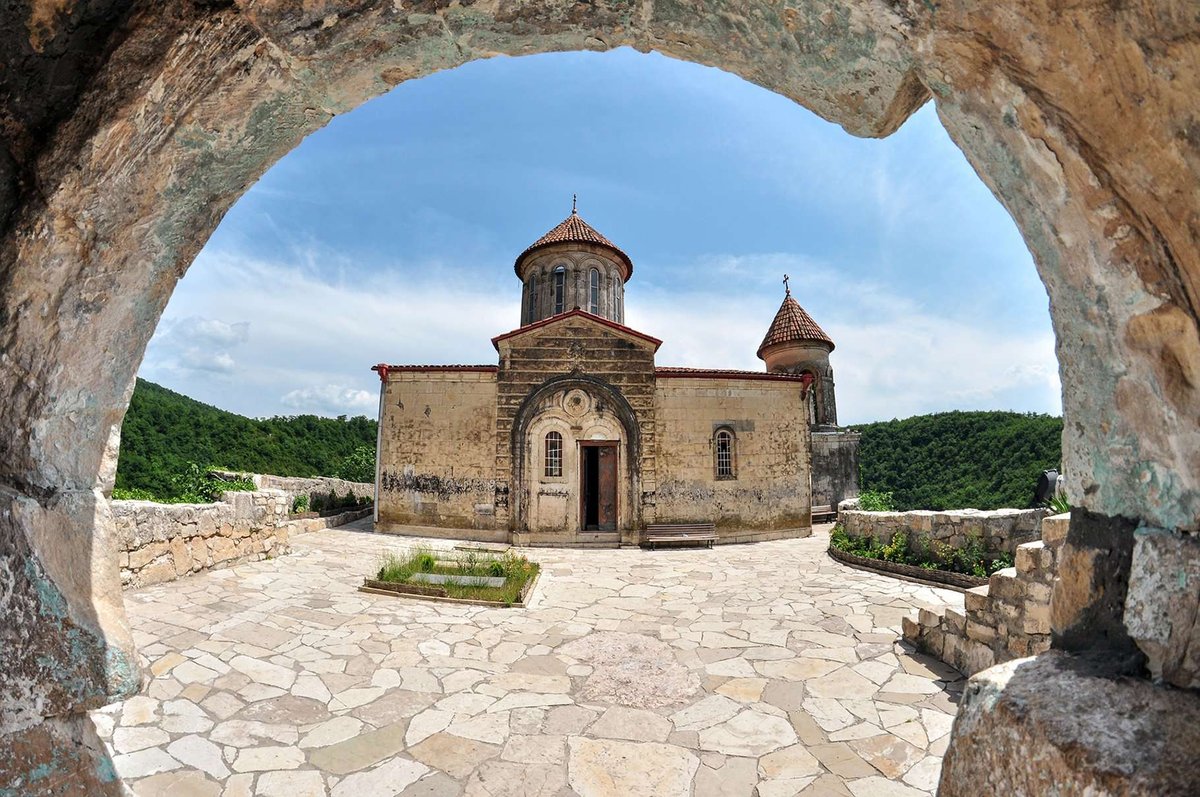
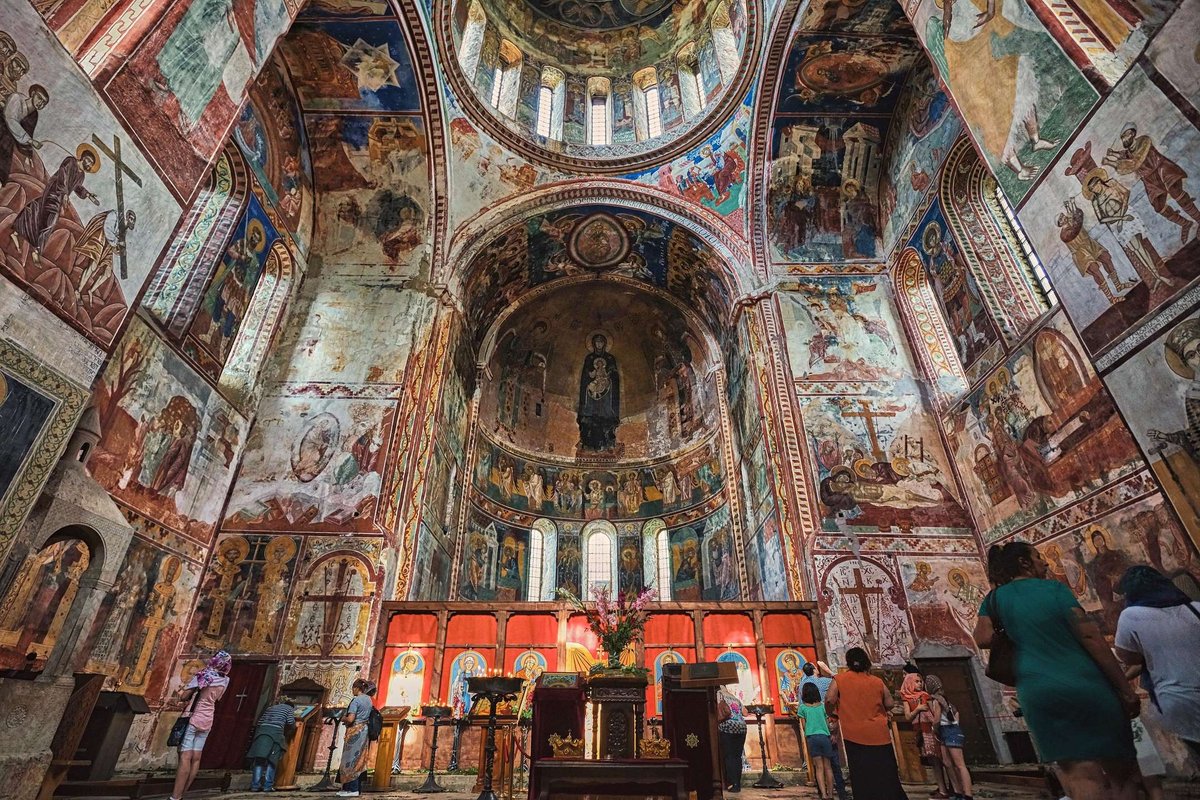
The main cathedral is finished in hewn eclair stone and is rich in frescoes. A Gelati mosaic (depicting the Virgin and Child, and the Archangels Gabriel and Michael) has been preserved on the altar vault. A 12th-century fresco depicting a church assembly is in the western vault. The southern prayer hall contains two images of David VI Narin (1246-1293): one in royal attire, the other in monastic garb. The northern wall depicts members of the Imeretian royal family (16th century), and also houses a portrait of David IV Aghmashenebeli (1089-1125). The portrait was restored in the 16th century.
On the southern side of the wall, within the main gate, is the tombstone of David Aghmashenebeli (the grave itself is presumably located beneath the monastery). According to historical sources, Gelati was the burial place of the kings of a united Georgia, and all the kings of the 12th-13th centuries (David IV, Dmitry I, George III, Tamara, and George IV), as well as the Imeretian kings of the 16th-19th centuries (Bagrat III, George II, George III, Alexander V, Solomon I, and the last Georgian king, Solomon II) are buried in Gelati.
Gelati was a royal monastery, and from the 12th-15th centuries it was directly subordinate to the king and prime minister. The rector of the Gelati Academy enjoyed high status at court and was almost equal in importance to the Catholicos-Patriarch. The monastery's senior nuns were members of the royal council.
In the 1520s, a bishop's see was established in Gelati, and at the end of the 1500s, the residence of the Catholicos-Patriarch was moved from Pitsunda to a safer location in Gelati. At various times, Gelati housed a rich collection of Georgian manuscripts and a national treasure (the Khakhuli Icon of the Mother of God). In 1923, the Bolsheviks closed the monastery. It reopened in 1990.
The Gelati Monastery Complex also includes the Gelati Academy, the main educational center of medieval Georgia. Contemporaries compared it to the Academies of Jerusalem and Athens, as its educational process drew simultaneously on the scientific traditions of antiquity and Christianity. Along with teaching, the academy also conducted translation and scholarly work, and produced original works.

41 comments
Log in to leave a comment
Особенно ценно, что автор рассказывает не только об архитектуре, но и о её исторической ценности: монастырь основан царём Давидом Строителем в начале XII века и был важным религиозным и просветительским центром, где работали выдающиеся учёные и создавались уникальные рукописи.
Мне также понравились отзывы путешественников и советы от местных в рейтинге, которые помогают понять, как лучше спланировать визит, какой маршрут по комплексу выбрать и на что обратить внимание, чтобы почувствовать атмосферу этого древнего святого места. Такая подборка действительно помогает увидеть Грузию глубже.
Спасибо каталогу Madloba за эту вдохновляющую статью. Какие впечатления у вас остались от фресок и мозаик внутри главного собора, и что из описанного в рейтинге вы бы хотели увидеть в первую очередь?