


🏰 Why Jvari Monastery Is Georgia's First UNESCO World Heritage Site
🏰 Jvari Monastery Above Mtskheta
A 7th-century church on a rocky summit at the confluence of the Kura (Mtkvari) and Aragvi rivers, Georgia's first site on the UNESCO World Heritage list (since 1994). It's visible from nearly anywhere in Mtskheta, and the panorama from its walls is one of the country's most recognizable views.
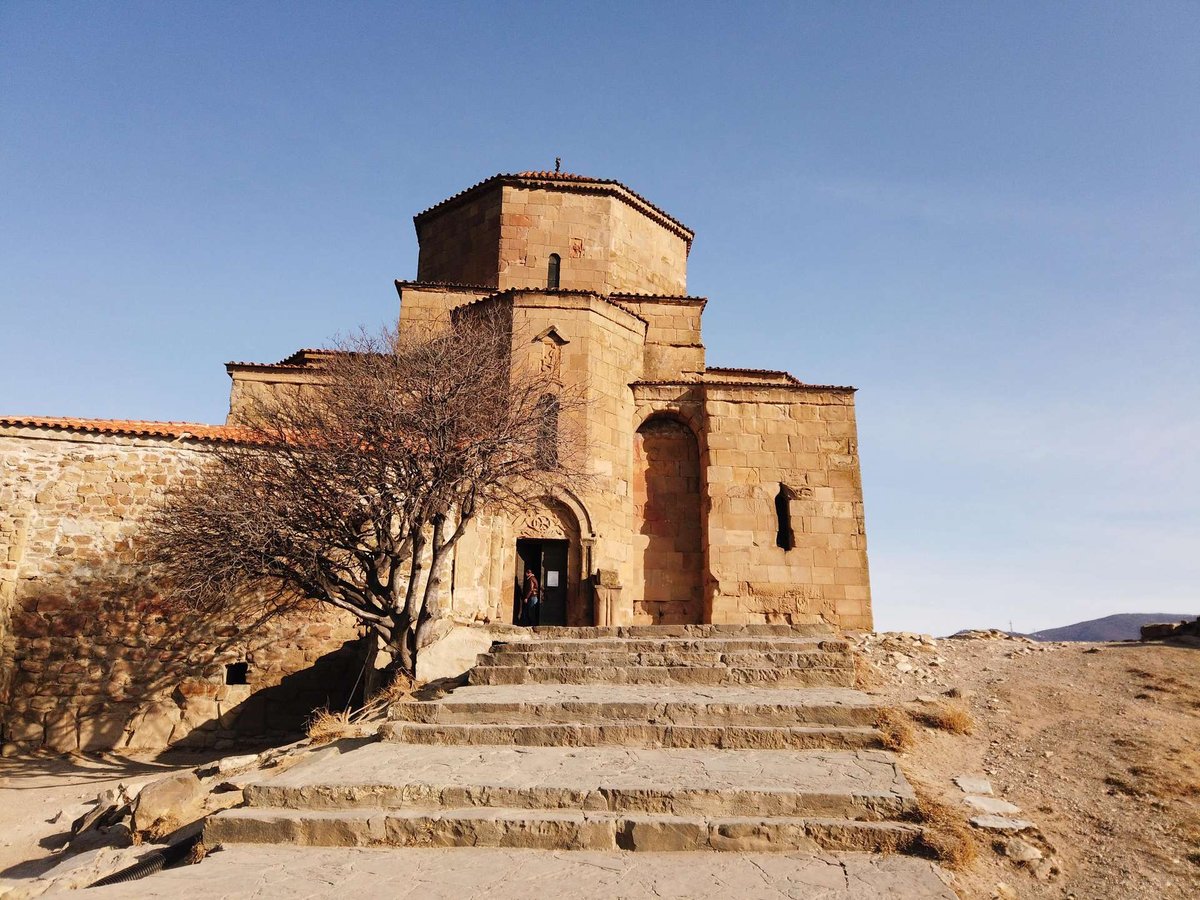
Jvari Monastery stands on a rocky summit above the confluence of two rivers, the Kura (Mtkvari in Georgian) and the Aragvi, about 21 km from Tbilisi and a couple of kilometres from Mtskheta, Georgia's ancient capital. It's the country's first monument added to the UNESCO World Heritage list, back in 1994, as part of the "Historical Monuments of Mtskheta" ensemble.
The name itself means "cross": according to tradition, it was here, in the early 4th century, that St. Nino planted a wooden cross on the site of a pagan shrine, marking Christianity's triumph in Kartli. The church visible today from almost anywhere in Mtskheta was built around that spot two centuries later, and Jvari has remained one of Georgia's most recognizable sights ever since, both as a silhouette on the mountain and as the source of the panorama seen from its walls.
📍 Where Jvari Stands and Why It's Visible From Everywhere
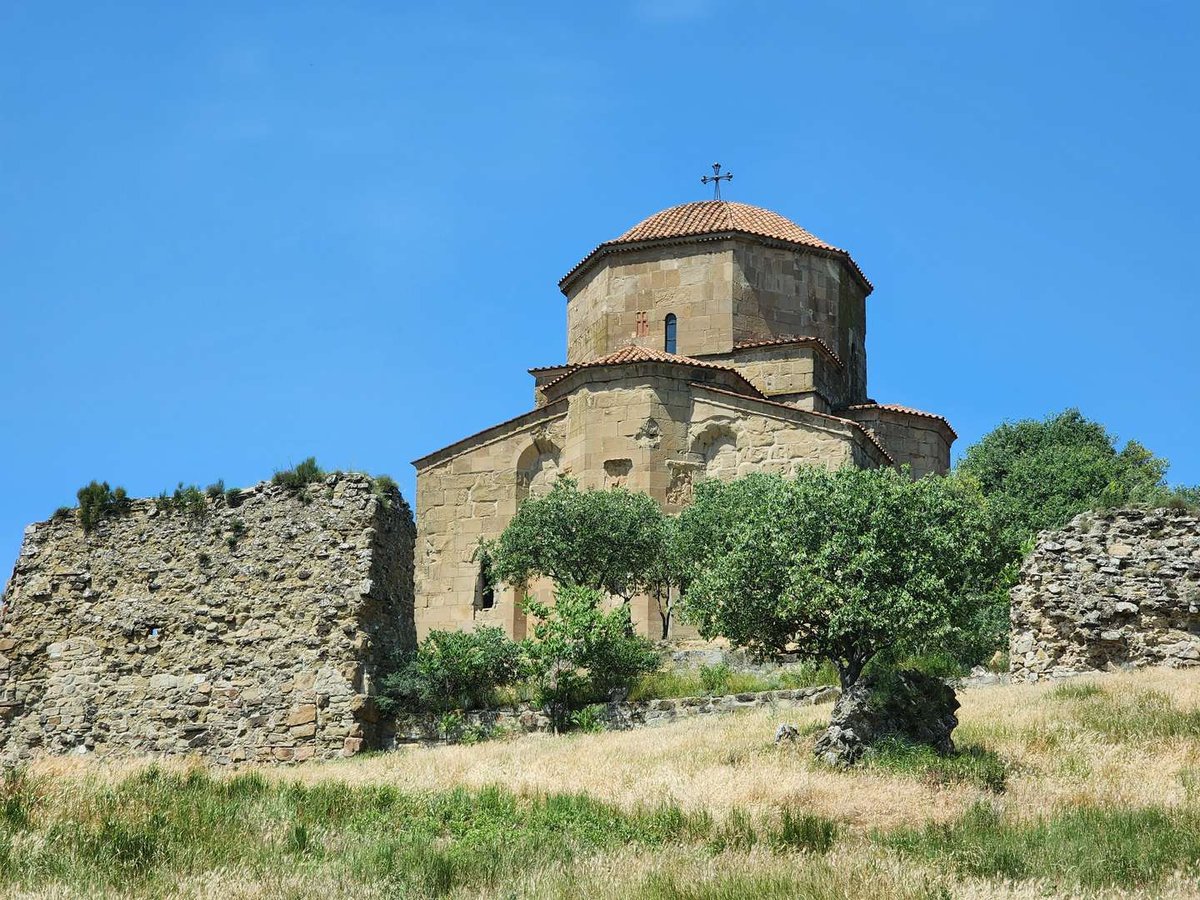
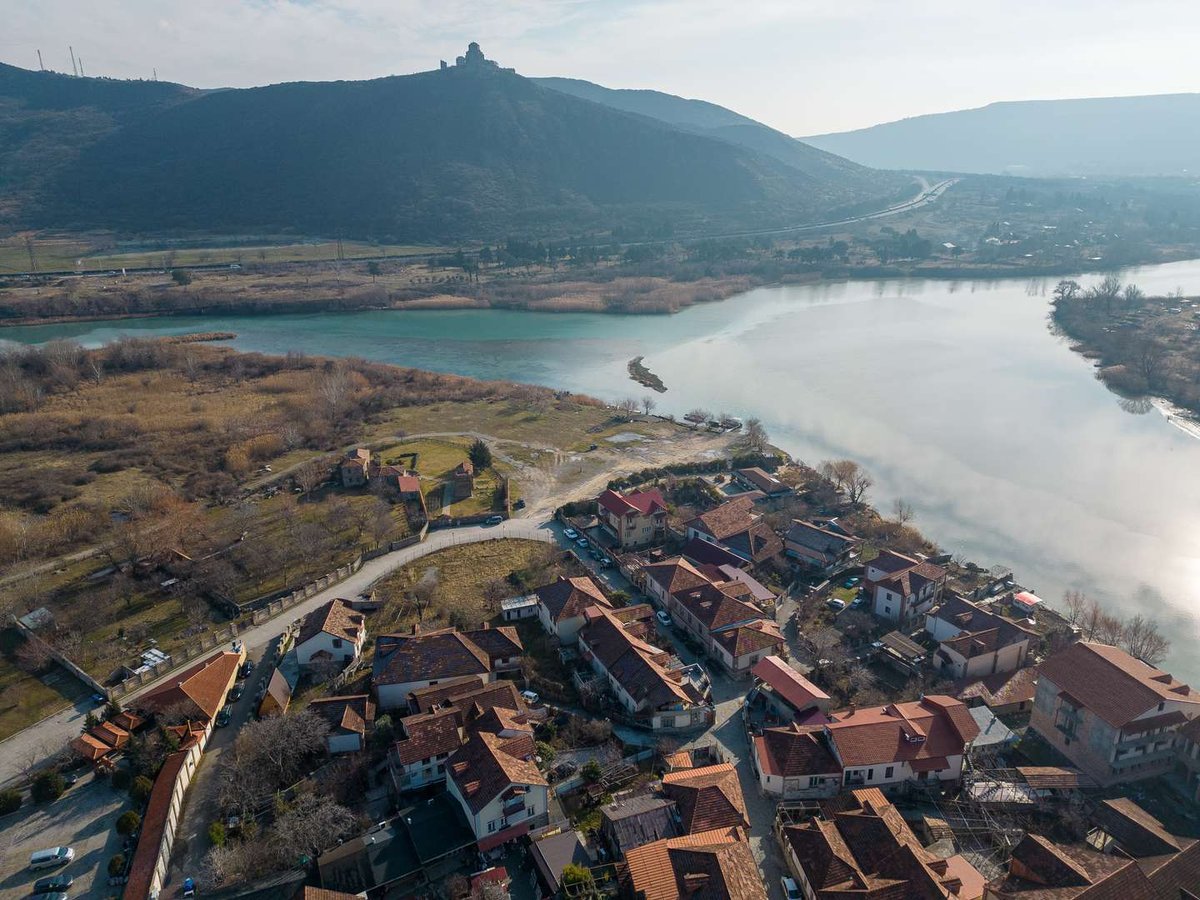
The monastery sits on a freestanding rocky mountain rising directly above the point where the muddy Kura meets the turquoise Aragvi. The position isn't accidental: the mountain is visible from nearly any point in low-rise Mtskheta, and the church itself was built to complete the summit harmoniously rather than simply sit on top of it. The proportions of the mountain and the building are matched so precisely that from a distance they read as a single form.
Two routes lead up: through the settlement of Zahesi or through the village of Mukhatgverdi, both winding up in switchbacks to the summit. Without navigation, the junctions are hard to follow, so it's worth marking the point on a map in advance. The road to the top is paved, there's parking by the monastery, and a short climb leads from there to the church.
✝️ The Legend of St. Nino's Cross
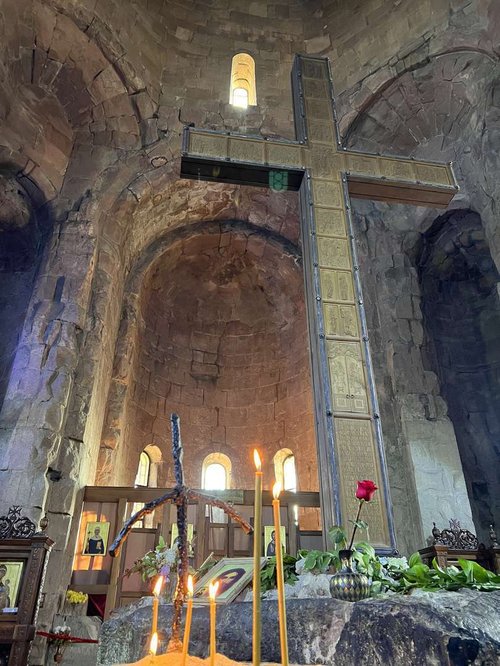
The name "Jvari" and the whole history of the site begin with a single legend. In the early 4th century, after King Mirian converted to Christianity, St. Nino, equal to the apostles, raised a large wooden cross on the mountaintop, on the site of a former pagan shrine. By tradition it was one of three crosses she erected, alongside those on Mount Thkhoti and at Ujarma.
The cross was venerated as miraculous across the Christian Caucasus long before a church stood on the mountain. A fragment of that original historic cross survives and now stands in the Svetitskhoveli Cathedral in Mtskheta. In 2009 a new cross, made of cypress and five times larger than the earlier one, was installed inside Jvari itself, on a stone platform at the centre of the church that may predate the building.
🏛️ Architecture: Two Churches on One Mountain
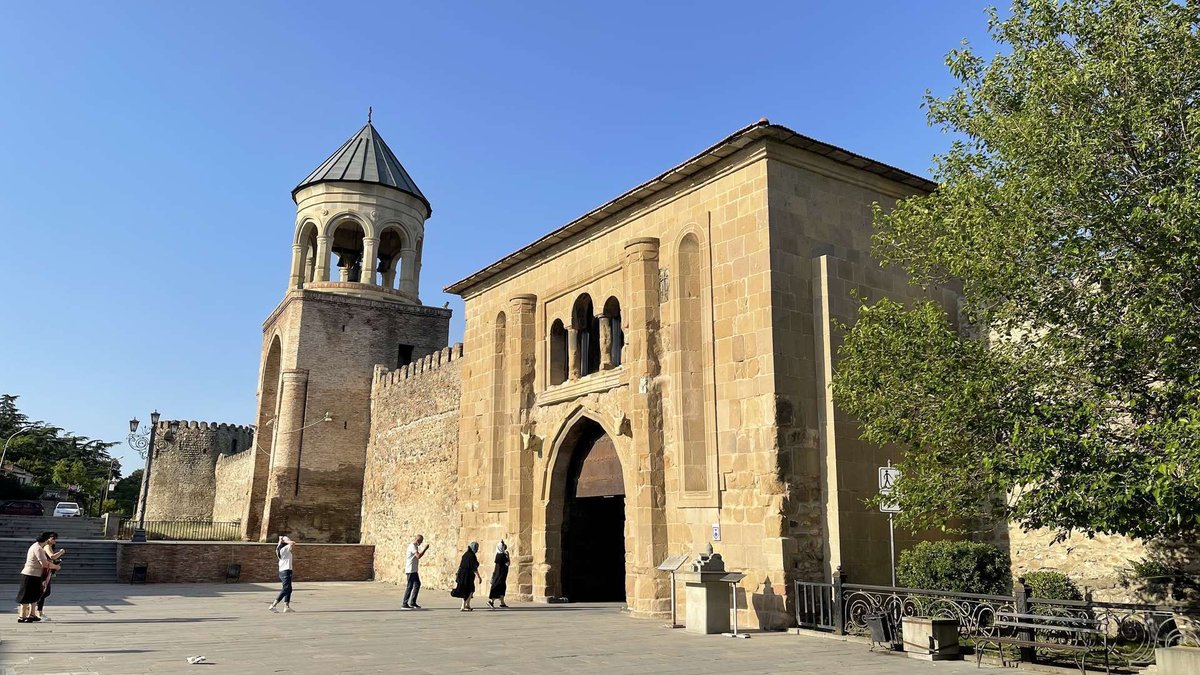
Two churches from different periods actually stood on Jvari mountain. The first, a small church, was already there by 545; only ruins remain of it today. The larger church, the one that survives, was raised at the turn of the 6th and 7th centuries, around 590–605, commissioned by Stepanoz I, ruler (eristavi) of Kartli. The building measures roughly 18 by 22 metres.
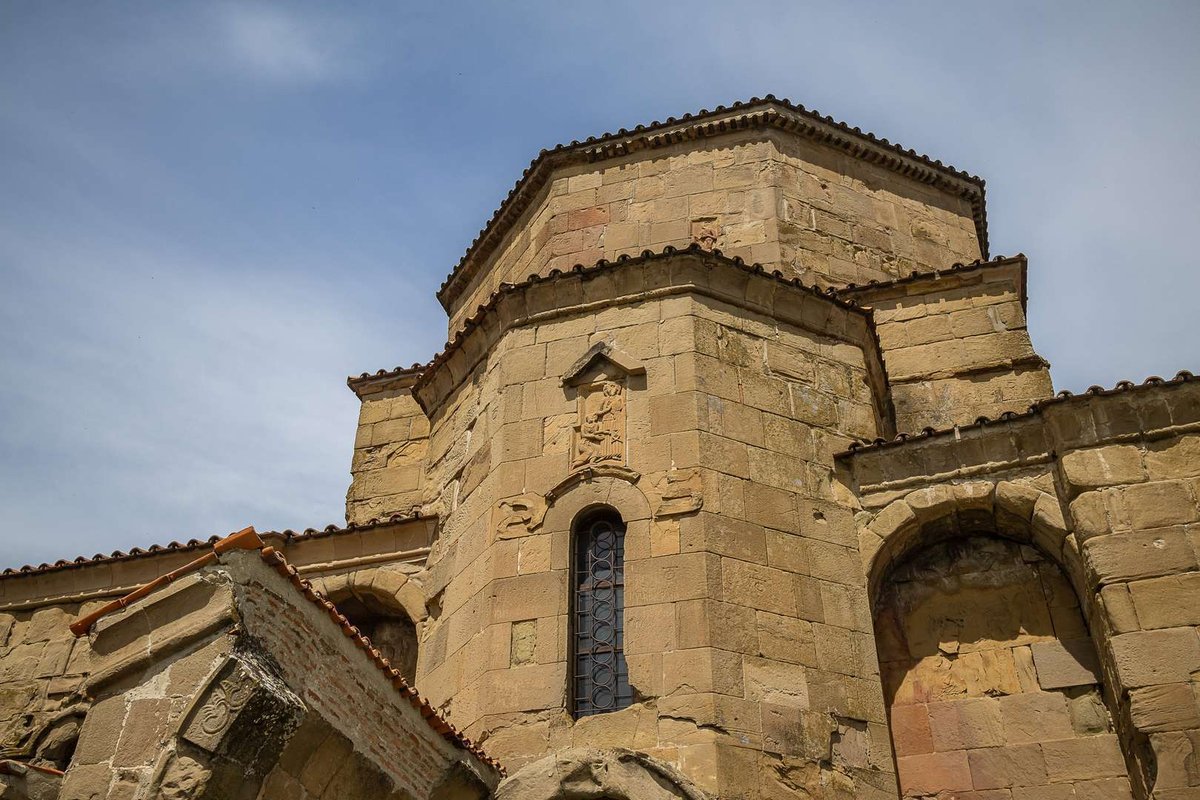
Architecturally, Jvari is built as a tetraconch: four semicircular apses form an equal-armed cross with a dome at the centre. For Georgia at the time, where domeless basilicas predominated, this was an innovative form, and after Jvari the tetraconch became one of the main types of Georgian church architecture. The transition from the square interior to the octagonal drum of the dome is achieved through a squinch, an arch spanning from the curve of one apse to the curve of the next, on which the dome rests. Squinches of this kind were used before the classical elements we're used to today existed, and in Jvari this early, still unrefined technique is clearly visible.
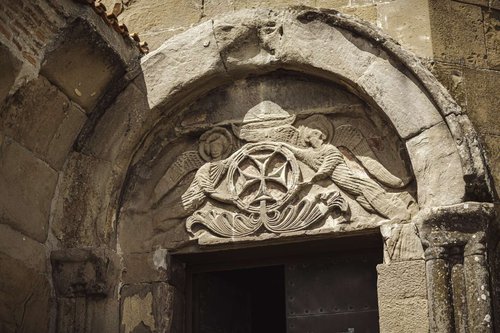
The east facade bears reliefs of three rulers, Stepanoz, Demetre and Adarnase, above the three windows of the altar apse. Four inscriptions survive on the walls, carved by the builders in the Asomtavruli script; the best known reads: "Cross of the Saviour, have mercy on Stepanoz, patrician of Kartli." On the south facade, the tympanum bears a carved composition depicting the Exaltation of the Cross, and at the edge of the dome drum is the figure of an unknown person, possibly the architect himself.
Inside, Jvari is deliberately austere: there are no frescoes or wall paintings, only stone and light from narrow windows. At the centre, on a stone platform, stands the cross. This simplicity is part of the design: here, proportion matters more than decoration.
📜 From Holy Site to Ruin and Back
Jvari's history is one of rise and long neglect. In the early medieval period, the monastery was one of the most important spiritual and pilgrimage centres of the Christian Caucasus. During the Soviet era the site fell into decline: by some accounts, a pioneer camp used the grounds for a time, access was restricted, and the building slowly deteriorated without upkeep.
Change began in the 1990s. In 1992 the site was handed to an Orthodox monastic community, and church services resumed. In 1994 Jvari became the first Georgian monument on the UNESCO World Heritage list. But the status didn't spare the building from another blow: in 2004 the monastery was added to the World Monuments Fund's list of the 100 most endangered sites. Large-scale restoration began in 2007, vaults were reinforced, reliefs were cleaned and conserved, and Jvari was later removed from the endangered list.
One detail worth mentioning honestly: despite the name "monastery," historical sources contain almost no direct evidence that a real monastic community, with abbots, brethren and records, ever existed at the church. The only hint is a disputed reference in Lermontov's poem "The Novice" ("...where, embracing like two sisters, the streams of the Aragva and Kura murmured together, there stood a monastery..."), which many associate with Jvari, though the poem itself never names it directly. Perhaps a single monk was once attached to the church, giving formal grounds for calling the site a monastery. Today, though, it genuinely is an active monastic community: services have run here again since 1992.
📋 Jvari Monastery in Facts
🌄 The Viewpoint: Where to Get the Best Shot of Mtskheta
Many people come to Jvari for this view alone. From the platform by the monastery walls you can see all of Mtskheta, the Kura valley, the Aragvi valley, Mount Baginети and the ancient settlement of Armazi. The most striking part is the confluence itself: the Aragvi runs in a clear turquoise band, the Kura is clay-brown, and where they meet the colours blend like diluted watercolour.
If you want that exact shot, visit in the morning. By late afternoon Mtskheta falls into shadow from the sun, and the church's main, eastern facade ends up shaded too. Morning light gives both a clean panorama and a well-lit facade with its reliefs.
🕊️ The Feast of Candlemas at Jvari
One detail worth knowing when planning a trip: on 15–16 February, Jvari marks the Feast of Candlemas (in Georgian, "Mirkma"), one of the most revered Orthodox holidays. A service is held at the church, and in some Georgian villages a custom called "Amparia," the day of lit torches, survives: in the evening, villagers light a shared bonfire and compete to see who can throw a burning torch the farthest.
If your trip coincides with these dates, expect more visitors than usual, with the service running on its own schedule. On other days of the year, Jvari carries on with the ordinary life of an active monastery, without the holiday crowds.
🗺️ Jvari Monastery on the Map
Open in Google Maps🚗 Getting There and What to Know
From Tbilisi to Jvari is about 21 km, a drive of 30–40 minutes depending on traffic. From Mtskheta you can reach the top in 10–15 minutes by taxi or car: on foot it's a long, shadeless switchback climb, hard going in the heat. Public transport doesn't run to the summit itself, so most visitors come by taxi, with a guide, or as part of a Mtskheta tour.
Many people combine a visit to Jvari with seeing Mtskheta itself: the distance is short, and a route through two or three UNESCO sites usually takes half a day. Keep the dress code in mind: shoulders and knees should be covered, and there are usually wraps at the entrance for anyone who arrives underdressed. Entry to the monastery is free.
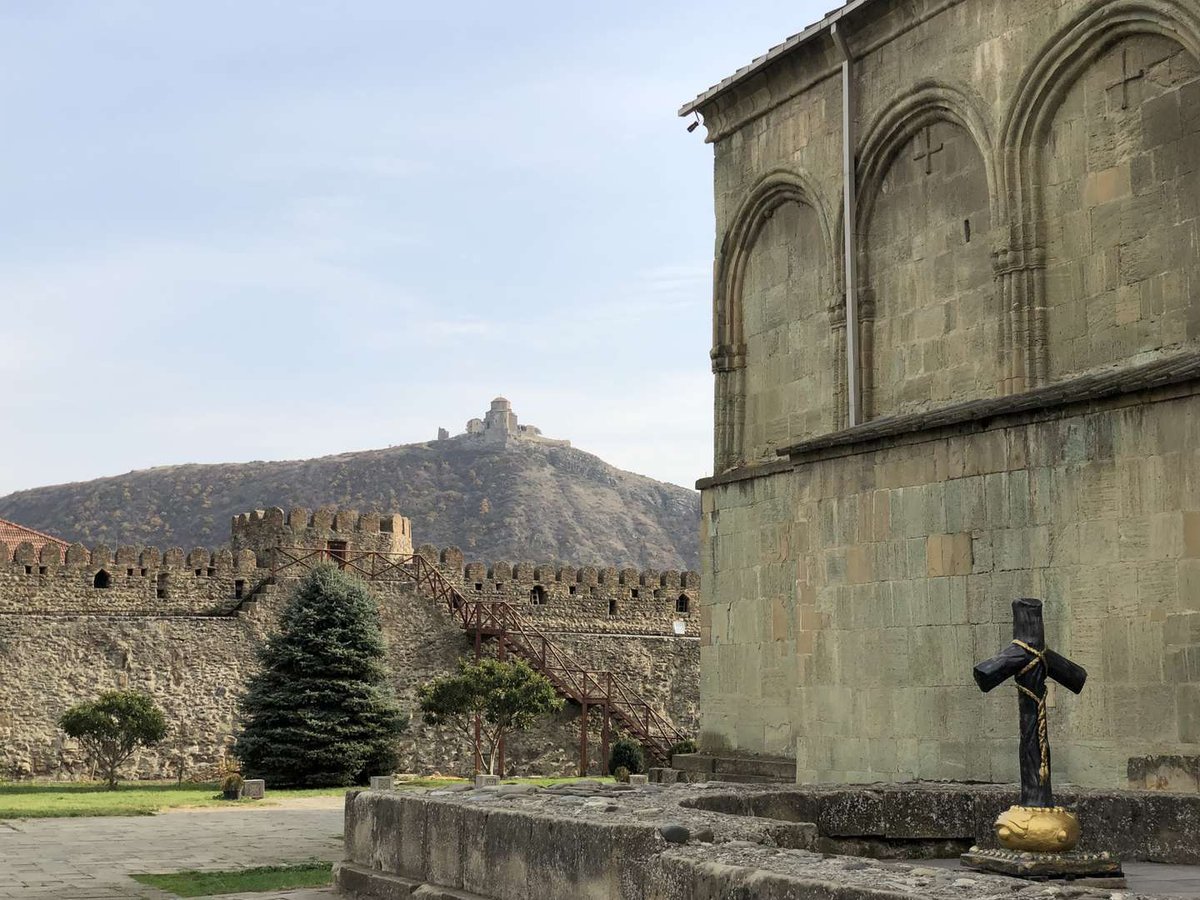
Jvari is a rare case where architecture, history and a mountain view all carry equal weight. People come here not just for the 7th-century tetraconch and the status of Georgia's first UNESCO site, but for the panorama that explains why this exact spot was chosen for St. Nino's cross sixteen centuries ago. If you're planning a day in Mtskheta, put Jvari first on the list, ideally in the morning.
Have you been to Jvari Monastery? Tell us in the comments on Madloba: did you manage to catch the famous shot of the river confluence, and did your visit happen to fall on the Feast of Candlemas?
Information is current as of June 2026. The schedule of services and access to parts of the monastery may change, especially on church holidays, so check before your trip.
📚 Read Next Mtskheta and its UNESCO sites
❓ Frequently asked questions
On a rocky mountain at the confluence of the Kura and Aragvi rivers, about 21 km from Tbilisi and a few kilometres from Mtskheta, in the Mtskheta-Mtianeti region.
The monastery was added to the UNESCO World Heritage list in 1994, as part of the "Historical Monuments of Mtskheta" ensemble, ahead of any other Georgian monument.
"Cross." By tradition, it was here, in the early 4th century, that St. Nino erected a wooden cross on the site of a pagan shrine, marking the adoption of Christianity in Kartli.
A small church stood on the mountain as early as 545; only ruins remain of it today. The larger, surviving church was built at the turn of the 6th and 7th centuries, around 590–605.
Historical sources contain almost no direct confirmation of a monastic community at the church, aside from a disputed reference in Lermontov. But since 1992, a genuine monastic community has been active here, holding regular services.
A tetraconch: four semicircular apses form an equal-armed cross with a dome at the centre. It was an innovative form for its time, one that went on to influence Georgian church architecture broadly.
Public transport doesn't run to the summit. Most people take a taxi from Tbilisi or Mtskheta, go with a guide, or join a tour.
A panorama of Mtskheta and the confluence of two rivers, the turquoise Aragvi and the muddy Kura. For the best shot and a well-lit facade, it's worth visiting in the morning.
Candlemas, one of the major Orthodox holidays. On these days the church sees more pilgrims than usual, and some villages keep the tradition of "Amparia," a day of lit torches.
Yes, shoulders and knees must be covered. Entry is free, and wraps are usually available at the entrance for anyone dressed inappropriately.

37 comments
Log in to leave a comment
Но вот что меня терзает: как же так, что этот шедевр всего лишь первый объект ЮНЕСКО в Грузии? 🤔 Столько скрытых сокровищ, и не все о них знают! Лично я мечтаю подняться туда, чтобы почувствовать всю магию этого места, а не только увидеть его на фото. Поделитесь, кто уже был на Джвари? Как там с доступностью, если решишь поехать в более позднее время года?
ואיך לגבי הנוף מעמק קורה-ארגווי? התמונה אולי נראית מדהימה, אבל האם היא מוסיפה לסיפור של ג'ווארי? אני לא בטוח. יש הרגשה כאילו כל מסע בחיים שלנו נמדד לפי מה שאנחנו רואים - אבל מה עם מה שאנחנו מרגישים? יש למקום הזה נשמה?
וכי מה עם כל עולי הרגל שגודשים את המקום? האם הם רואים את אותו דבר שאני רואה?
אני תוהה אם יש יותר מאשר פשוט אבן ואלפים בשקד. אם הייתי מגיע לשם, מה הייתי באמת פוגש, את ההיסטוריה או את בטן התיירות?