



🌉 The Red Bridge in Kutaisi: the "Eiffel Bridge" over the Rioni
🟨 The key facts first
| 📍 What it is | An iron bridge over the Rioni River in central Kutaisi |
| 📅 Opened | In 1862, the first iron bridge in Kutaisi |
| 📐 Dimensions | 36 metres long, 8.5 metres wide |
| 📝 Name | წითელი ხიდი (Tsiteli Khidi), the Red Bridge in English |
| 🚶 How to get there | About a 5 minute walk from the White Bridge and the city centre |
| 🎟️ Entry | Free, at any time |
| 🗺️ More details | Address, map and opening hours |
💡 Tip: visit at sunset, when the river and the lighting look their best, and combine it with the White Bridge just five minutes away.
🟦 What this article is about
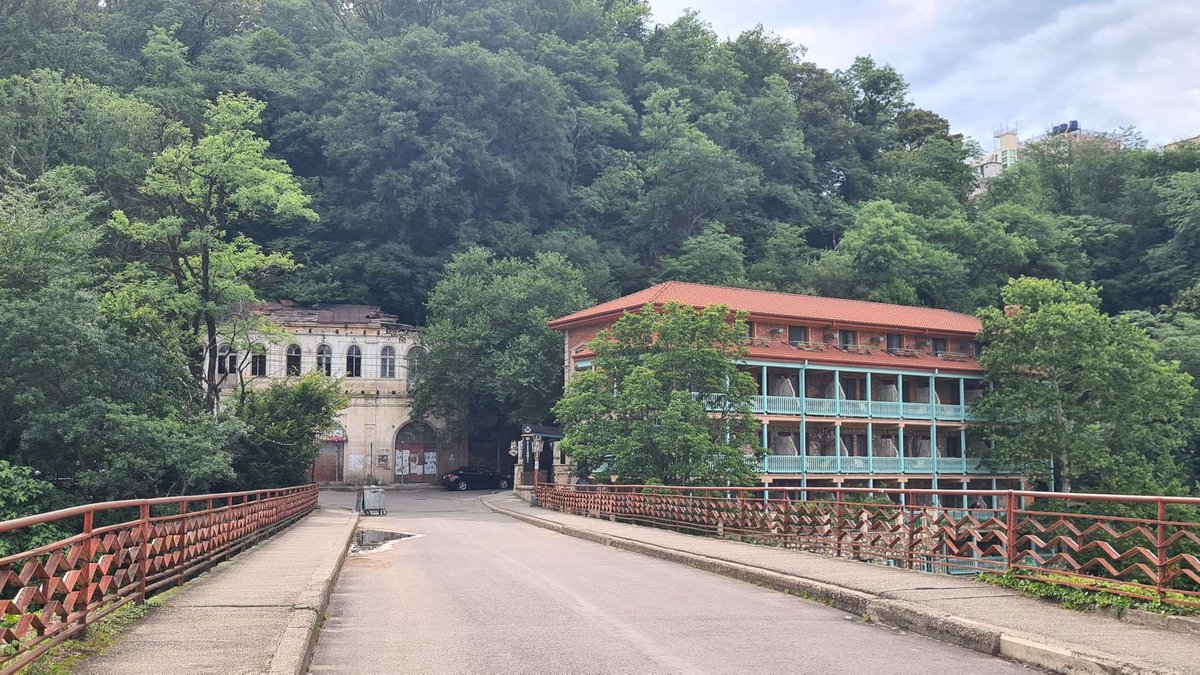
The Red Bridge is easy to walk straight past: it looks like an ordinary city bridge, and Kutaisi has several of them. Yet this is the one tied to the most stubborn local legend (the one about Paris and Eiffel), and it was the first iron bridge in the city. Here you will find a short history of the bridge, the truth behind the legend, its Georgian name and how the word "red" ended up in it, along with the practical side: how to walk there in five minutes from the centre and what to see nearby.
It will be useful if you are coming to Kutaisi for a day or two and planning a route through the centre, if you enjoy urban and engineering history, or if you simply came across the phrase "Eiffel bridge" and want to know whether it is true or just a nice story.
📜 History of the bridge: from the engineer Postelnikov to 1862
The story of the Red Bridge is usually traced back to 1859, when the project was drawn up by the military engineer Postelnikov. Construction began in 1860, and this was a case where local materials were not enough: the iron structures were ordered in France and brought to Kutaisi already finished. Assembly was completed in 1862, and the bridge was opened and consecrated that same year.
By today's standards the size is modest: about 36 metres long and 8.5 metres wide. But size was not the point. For mid 19th century Kutaisi this became the first iron bridge, and by local tradition it is also called the first iron bridge in all of Transcaucasia. Earlier, people crossed the Rioni on wooden and stone crossings that the river kept washing away, so an iron structure was a real technological step forward for the city.
There is a French trace in this story too, which is why the bridge is remembered beyond Kutaisi: the metal, after all, was ordered in Paris. This is where the famous Eiffel legend grew from. Whether it is true, we look into below. 👇
🗼 The "Eiffel bridge": truth or a beautiful legend?
If you ask locals what the Red Bridge is famous for, many will tell you first of all that it was brought from Paris, from the very workshop where the famous tower was put together. It sounds good, and it is this phrase that most often brings tourists here. But once you lay the story out by dates, things turn out to be less clear cut.
What is known for certain: the metal for the bridge really was ordered and made in France, then brought to Kutaisi. The French trace is real. But the specific Paris factory linked to the famous engineer already belongs to the realm of city legend. The bridge opened in 1862. The famous Frenchman's own company only appeared in the mid 1860s, and the Paris tower rose as late as the end of the 1880s. In other words, "that particular production" simply did not yet exist in the needed form at the time of construction, and the engineer himself was then at the start of his career rather than the owner of a legendary works.
Does this mean the legend is empty? Not quite. The French origin of the metal, the fashion for calling everything Parisian after one famous name, and the reputation of that era as the age of great bridge builders came together into one convenient story that the city has been retelling for over a century. So it is more accurate to put it this way: the bridge does have French roots, while a direct link to the famous workshop remains a beautiful but unproven legend.
| 🗣️ City legend | ✅ What is known for certain |
| The metal was cast at Eiffel's factory, the same one that made the Paris tower | The structures were ordered and made in France, then delivered to Kutaisi |
| The bridge is directly linked to the name of the celebrated engineer | The bridge opened in 1862, while the famous company and the tower appeared much later, so the dates do not match |
| It is the city's main engineering sensation | It is the first iron bridge in Kutaisi, and that is where its real historical value lies |
The bridge's French roots are real, while a direct link to the famous workshop remains a legend.
🌉 Why this legend gets confused with the White Bridge
It is easy to get muddled here, and even people from Kutaisi do. A similar story about Paris and a French workshop is often told in the city about the White Bridge as well, which stands just five minutes away. It has its own biography: it was rebuilt later, around the 1870s, and locals sometimes call it the "French" or "Parisian" bridge. Because of this, the two stories merged into one, and the legend wanders from bridge to bridge.
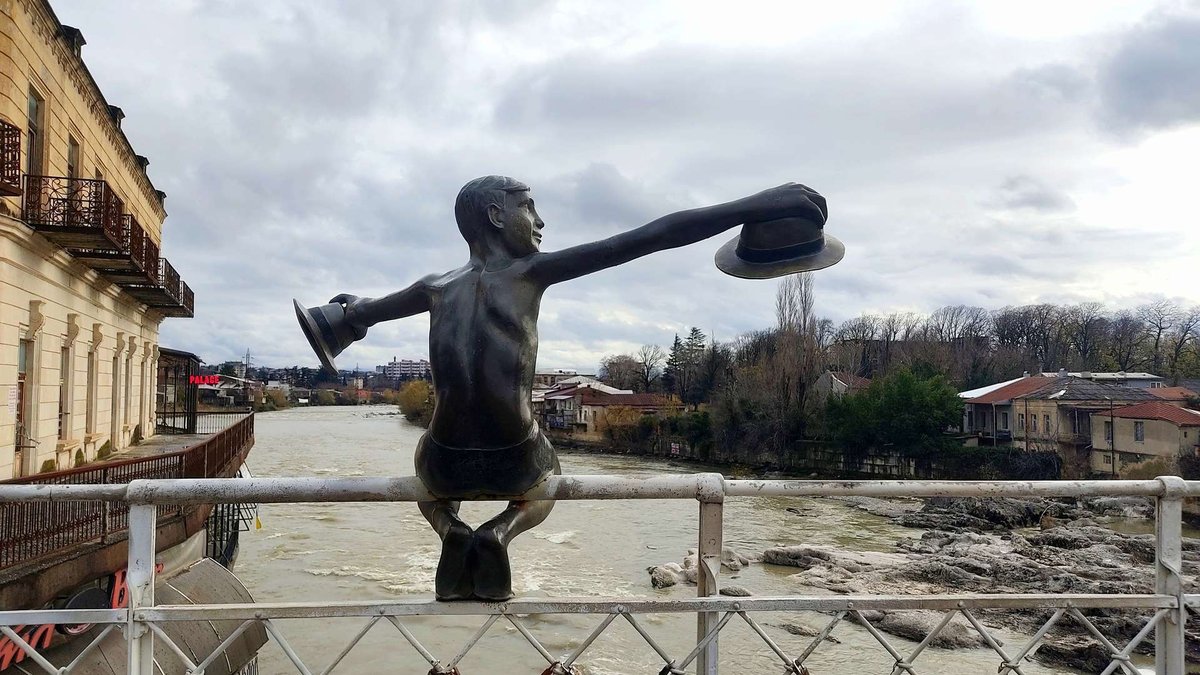
In short: both the Red and the White Bridge are connected to French metal and have grown similar stories around them, but these are two different bridges with different dates and fates. The Red one was built earlier and became the first iron bridge in the city. The White one was made into a footbridge and is famous for the sculpture of a boy on its railing. So if you hear "there it is, that bridge from Paris" on the embankment, do check which bridge is actually meant.
❤️ Why the bridge is called "Red"
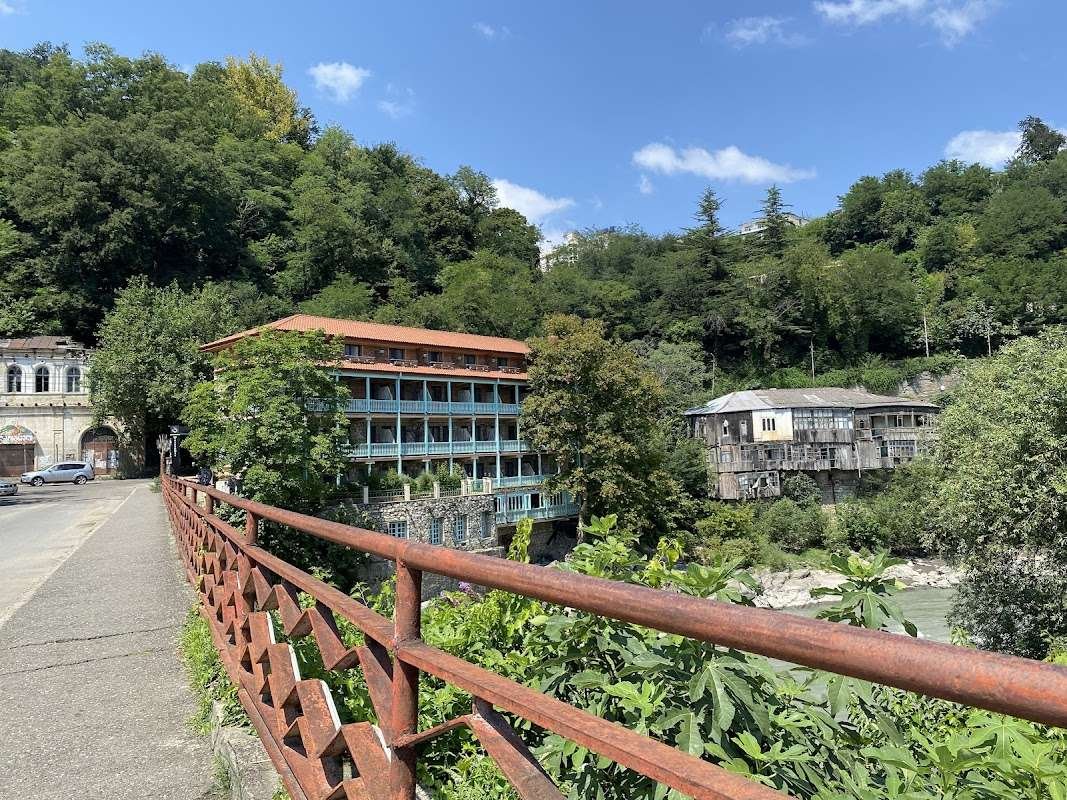
The name is the simplest one possible: by colour. The iron structure was painted red, and that colour stuck to the bridge as its name. The same city logic works here as with its neighbour: the White Bridge was called white because it was painted white, and this one became the Red Bridge because of its colour. There is no tangled story behind the name, and that is its charm: the bright truss above the grey green Rioni is visible from afar and instantly explains why the bridge is called this way.
In Georgian it is called წითელი ხიდი, which reads as "tsiteli khidi": წითელი means "red" and ხიდი means "bridge".
It is worth keeping in mind that there is more than one "Red Bridge" in Georgia. The name also belongs to an old border bridge over the Khrami River on the way to Azerbaijan, and that is a completely different site at the other end of the country. So if you are looking specifically for the Kutaisi bridge, keep the key markers close at hand: the Rioni River, the centre of Kutaisi, the iron truss.
🚶 How to get to the Red Bridge
The Red Bridge stands right in the centre of Kutaisi, so the easiest way to reach it is on foot. From the White Bridge and the central part of the city it is about a five minute walk at an easy pace along the river. A landmark for those coming from Rustaveli Avenue: on the way to the bridge, by the road, stands the monument to the poet Galaktion Tabidze with a muse descending towards him, you cannot miss it.
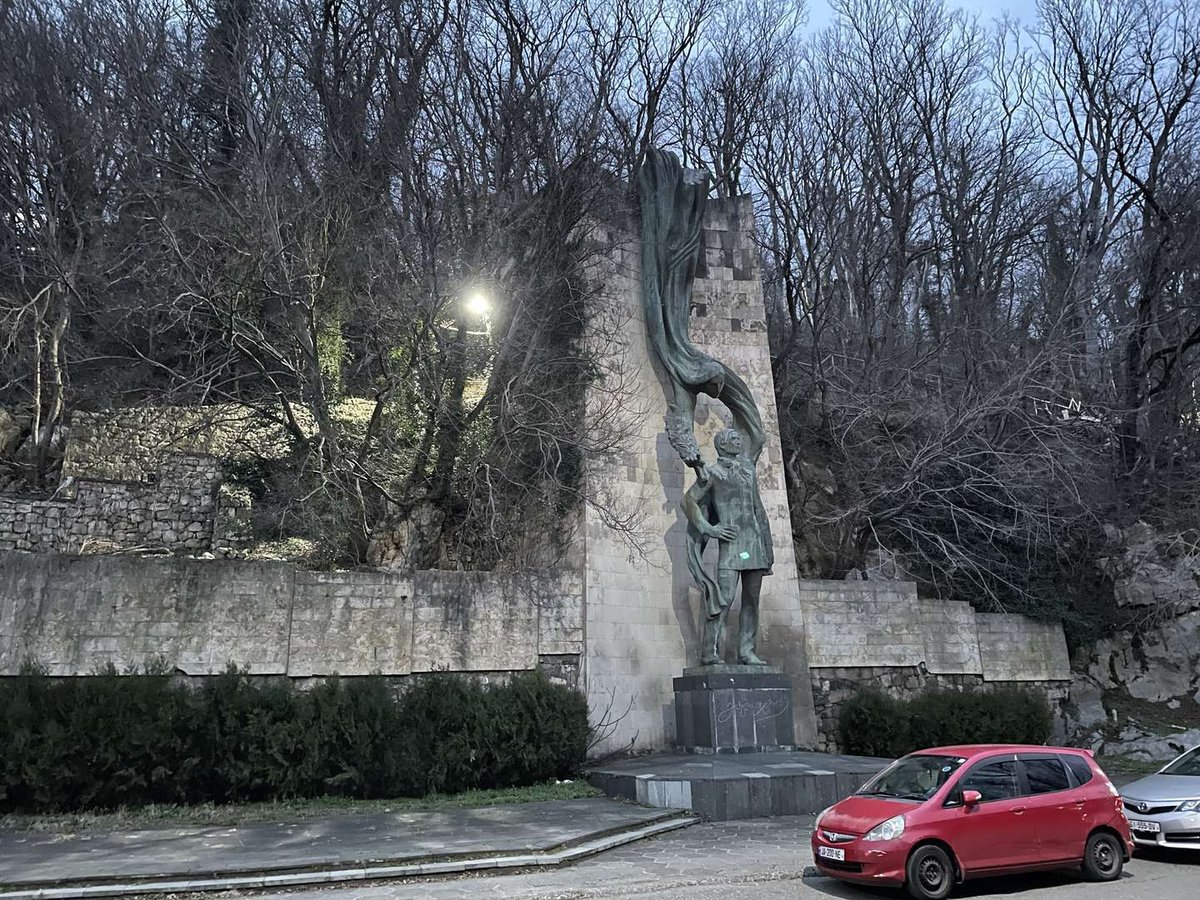
The bridge itself connects Tabidze Street and Paliashvili Street, so whichever bank you come from, you reach it along one of them. It is a working road bridge, but nobody stops you from walking across it and pausing in the middle to look out over the Rioni. If you navigate by the neighbouring bridges: upstream stands the Chain Bridge, and downstream from the Red Bridge along the river is the Rustaveli Bridge.
There is no need to look for an entrance, tickets or opening hours: the bridge is always open and free. The easiest thing is to combine it with a walk through the centre and drop by the White Bridge, five minutes away, at the same time.
👀 What to see nearby
It is best not to visit the Red Bridge on its own but to fit it into a walk through the centre: almost all the main spots of old Kutaisi are within walking distance along the Rioni. From the bridge itself there is already a view of the wooden houses clinging to the river bank, so you can start taking it in right from the middle of the span.
First of all, drop by the White Bridge five minutes away: it is pedestrian and famous for the bronze figure of a boy on its railing, a character from an old Georgian film. On the way from Rustaveli Avenue you will pass the monument to the poet Galaktion Tabidze with a muse descending towards him. If you want a panorama, there is an observation point nearby from which the bridge and the river can be seen in full. From there you can head to the city's other symbols: the Chain Bridge upstream, the Rustaveli Bridge downstream, the Colchis Fountain with its golden figures in the centre, and of course Bagrati Cathedral on the hill.
📍 Nearby, 5 to 20 minutes on foot
🌉 White Bridge
A pedestrian bridge with the sculpture of a boy on its railing, a 5 minute walk away.
Read more🗿 Monument to Galaktion Tabidze
The poet with a descending muse, by the road between Rustaveli and the bridge.
Read more👁️ Viewpoint by the Red Bridge
A spot from which the bridge and the Rioni are seen in full, handy for photos.
Read more⛲ Colchis Fountain
A central square with golden figures inspired by Colchian archaeological finds.
Read more⛪ Bagrati Cathedral
The main symbol of Kutaisi on the hill, visible from many points in the city.
Read more💬 What the locals say
For the people of Kutaisi the Red Bridge is not so much a sight as part of the familiar city scenery, one tied to several warm little signs. The main one belongs to spring: a magnolia blooms near the bridge, and when it opens up, people in the city say that spring has truly arrived. For many residents this is the unspoken marker of the changing season, and they come here specially with a phone for the shot.
People also love this place for its seagulls: they circle over the Rioni and settle on the water, especially towards evening, giving the busy centre an unexpectedly seaside mood. In the evenings the bridge becomes a spot for unhurried walks: locals come out to stroll along the river, to stand in the middle, to watch the water and the old houses on the bank light up. If you want to see the bridge the way the people of Kutaisi themselves know it, come not in the midday heat but at sunset.
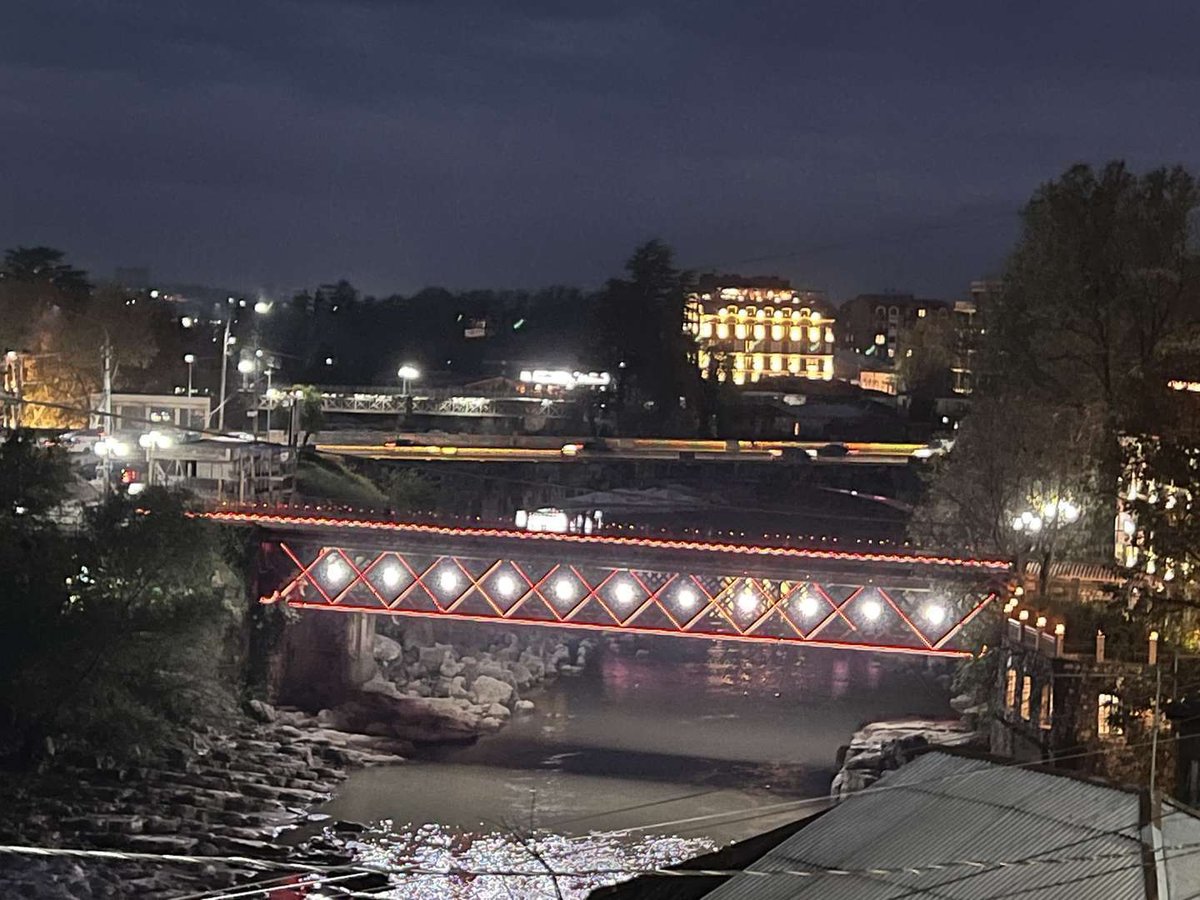
📸 Editor's tip: the best angles for photos
The most rewarding shot comes not from the bridge itself but slightly to the side, from the embankment or a nearby viewpoint: that way the whole red truss fits into the frame, with the Rioni and the bank with its wooden houses behind it. Shooting from the bridge itself, catch the perspective of the span along the railing, which adds depth and emphasises the metal structure.
As for the time of day, soft light works best: early morning, when the embankment is empty, or sunset, when the red of the truss grows warmer and reflections appear on the water. At midday the light is harsh and flat, and the bridge comes out washed out in photos. If you happen to catch the magnolia blooming season, be sure to bring it into the frame in the foreground: a shot like that instantly shows that you were here in spring.
📸 Photo cheat sheet
- Best angle: from the embankment or a viewpoint, so the whole truss fits in with the river behind it
- From the bridge: a shot along the span and railing for depth
- Time: early morning or sunset, at midday the light is flat
- In spring, bring a blooming magnolia into the foreground
🧾 Checklist before your visit
🧾 What to bring and keep in mind
✅ Comfortable shoes: you reach the bridge and the nearby spots on foot along the embankment
✅ Time for sunset: in soft light both the bridge and the river look their best
✅ A camera or a charged phone: the angle with the truss and the Rioni is worth it
✅ Room in your route for the White Bridge, five minutes away
✅ Half an hour to walk the centre: the fountain, the Tabidze monument, cathedral views along the way
❓ Frequently asked questions about the Red Bridge
💬 More of a beautiful legend than a fact. The metal for the bridge really was ordered in France, and the French trace is real, but a direct link to the famous engineer's factory is not confirmed. The bridge opened in 1862, while his celebrated company and the Paris tower appeared noticeably later, so by the dates the story does not add up.
💬 Because of the colour. The iron truss was painted red, and the name stuck to the bridge. It is the same logic as with the neighbouring White Bridge, which was called white after its paint.
💬 წითელი ხიდი, read as "tsiteli khidi": წითელი means "red" and ხიდი means "bridge".
💬 These are two different bridges over the Rioni, a few minutes' walk from each other. The Red one was built earlier and became the first iron bridge in the city, and it carries car traffic. The White one is pedestrian and famous for the bronze figure of a boy on its railing. A similar legend about French origins is told about both, which is where the confusion comes from.
💬 About a five minute walk from the central part of the city and the White Bridge, along the river. A landmark on the way from Rustaveli Avenue is the monument to Galaktion Tabidze. The bridge connects Tabidze Street and Paliashvili Street.
💬 The bridge was built between 1860 and 1862, so it is over a century and a half old. It is a metal truss road bridge about 36 metres long and 8.5 metres wide, the first iron bridge in Kutaisi and one of the first in the Caucasus.
💬 No, the bridge is always open and free. It is an ordinary city bridge that you can walk across at any time, with no separate entrance or tickets.
🧡 The main points in brief
The Red Bridge does not impress with its size and gets lost easily among the other bridges of Kutaisi, yet it was this one that became the first iron bridge in the city and gained the most enduring local legend. Its French roots are real, while the loud tale about the famous Paris workshop remains a beautiful legend, and that is its whole character: a modest looking bridge with a century and a half of city talk behind it.
If you are in Kutaisi, set aside a few minutes for it on your way along the Rioni, drop by at sunset and be sure to walk on, towards the White Bridge and the centre. That way the Red Bridge turns not into a separate box to tick but into part of a living walk through the old town.
🧡 Read more about Kutaisi
- The White Bridge and its boy on the railing
- Bagrati Cathedral, the main symbol of the city
- A one day walk through the centre of Kutaisi
💾 Save the article so you do not have to look for the way to the bridge on the spot.
🗣️ Now over to you
Have you been to the Red Bridge? Tell us how you found it, and help other travellers see it at its best.
- What time did you come and which angle did you like the most?
- Did you catch the magnolia blooming near the bridge?
- Have you heard your own version of the legend about the bridge's French origins?
- What else in the centre of Kutaisi is worth seeing on the way to the bridge?
Share in the comments, we read every story and add your findings to the article. ❤️
ℹ️ Information about the route, the surroundings and access to the bridge is current as of the publication date and gathered from open sources. Details may change over time, so it is worth checking them on the spot before your trip. The exact address and a map are given on the Red Bridge page.

4 comments
Log in to leave a comment
En le traversant, on sent le Rioni en dessous, impétueux, comme si chaque goutte d'eau murmurait des secrets passés. Les environs sont assez charmants aussi, avec des petits cafés où l'on peut prendre un café en regardant le monde passer. J’y retournerais sans hésiter, juste pour profiter de ces vues. C'est un beau mélange de calme et d'histoire vivante.