


🏰 A Complete Guide to the Churches and Monasteries of Racha-Lechkhumi: From Nikortsminda to the Oni Synagogue
🏰 Why Such a Small Region Has So Many Churches
The answer sits in one date: in 1010 Bagrat III founded the Duchy of Racha, and the new administrative unit needed spiritual centres of its own. Over the following decades Nikortsminda, Patara Oni, Zemo Krikhi and Mravaldzali went up almost simultaneously. What you see in Racha today is the trace of one political decision, stretched across a thousand years.
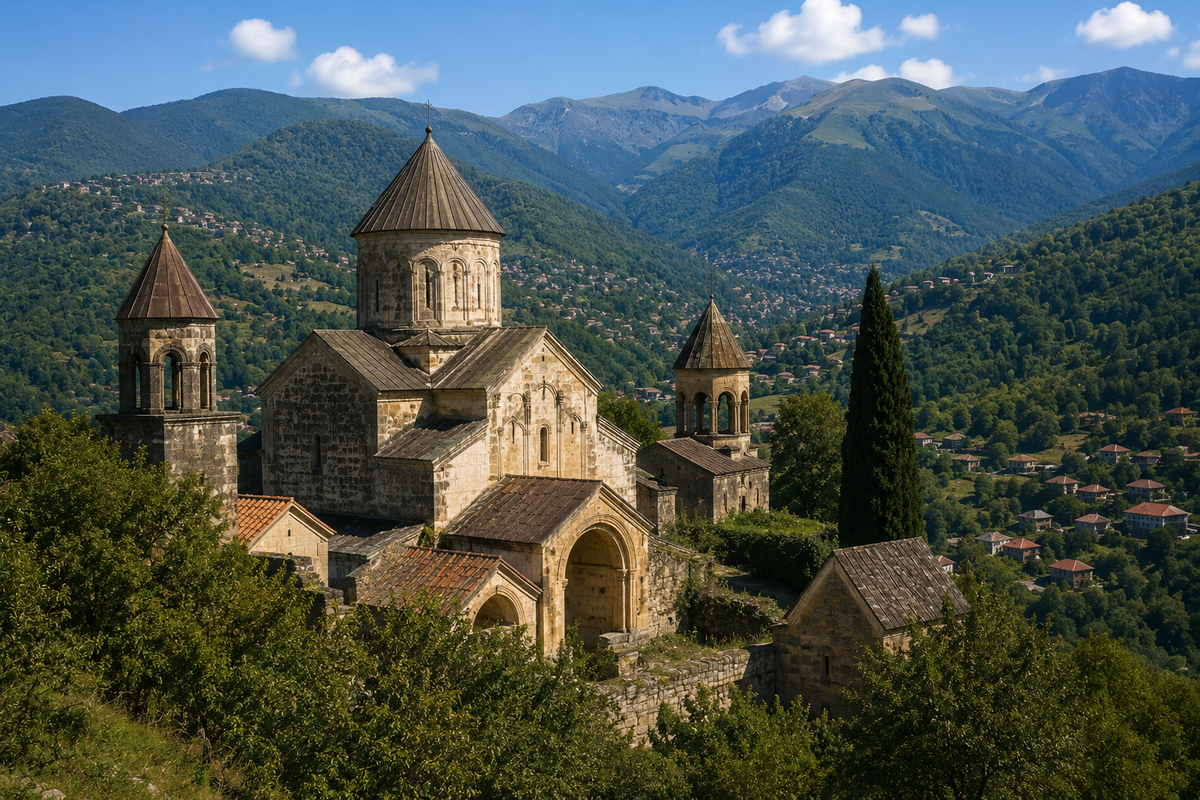
The churches of Racha-Lechkhumi come to sixteen sites across three municipalities: Ambrolauri, Oni and Tsageri. Nikortsminda and Barakoni are the famous ones, but the list runs well past them: there's a monastery from the 9th century, a church on the summit of a two-kilometre mountain, and a synagogue designed in Europe.
Their number isn't accidental. In 1010 Bagrat III, the first king of a united Georgia, founded the Duchy of Racha. The new administrative unit needed spiritual centres, and over the following decades Nikortsminda, Patara Oni, Zemo Krikhi and Mravaldzali went up almost at once. It's the architectural residue of one decision, reaching us a thousand years later.
Mountain isolation is what preserved it. Large campaigns rarely reached Racha, but neither did large construction projects, which is why 11th-century churches here are often more authentic than in better-known places down on the plain.
⛪ Nikortsminda: The Main Church of Racha
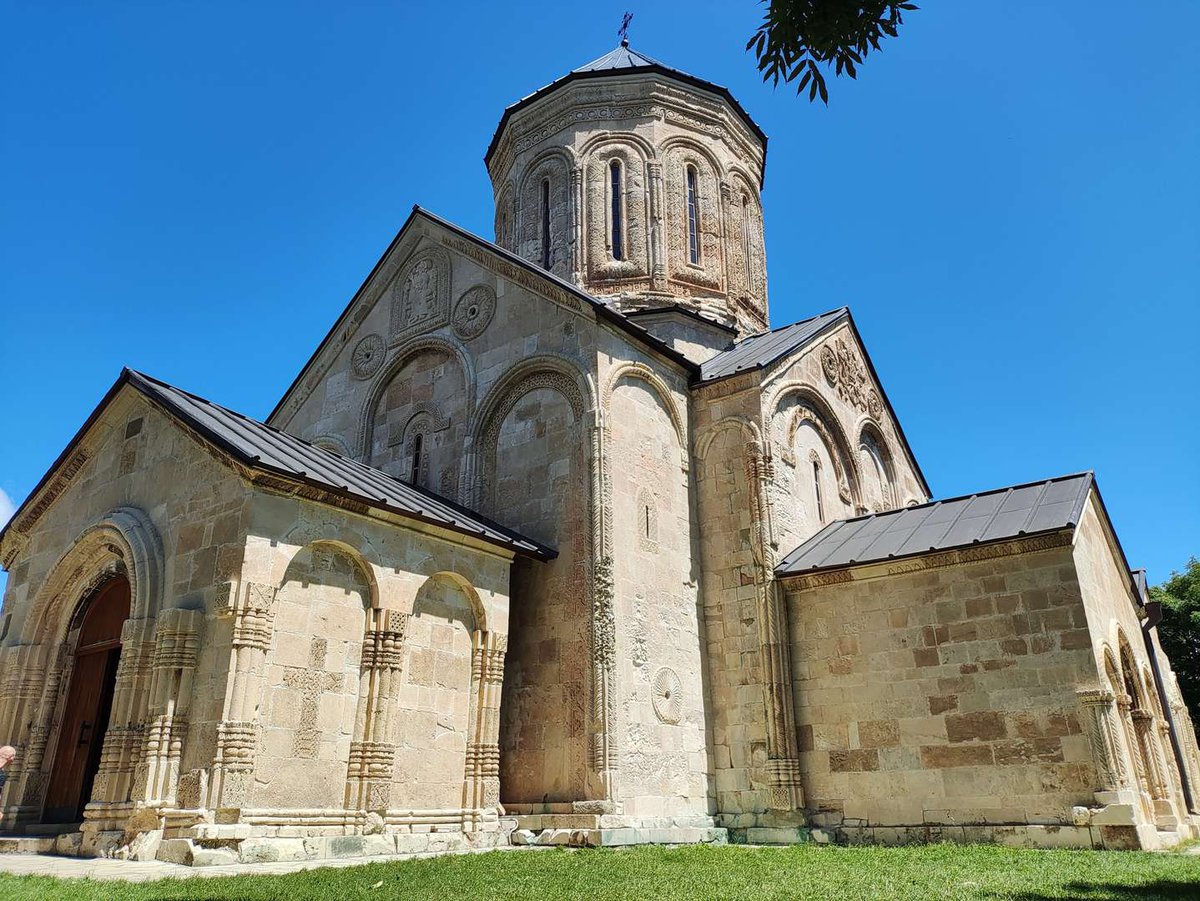
Nikortsminda Cathedral was built between 1010 and 1014 under Bagrat III and counts as a symbol of the golden age of Georgian architecture. It stands in the village of Nikortsminda, Ambrolauri Municipality, at 42.45923, 43.08820. The Shaori Reservoir is a few minutes' drive away.
What it's known for is the stone carving. The facades are covered in reliefs dating from the 11th and 15th centuries, depicting the nobles of Racha and Imereti of the time. That's not ornament, it's a historical document: portraits cut into stone.
On UNESCO specifically, because this is where people keep getting it wrong. Nikortsminda is not a World Heritage Site. Since 24 October 2007 the cathedral has sat on the tentative list, alongside Alaverdi, Ananuri, Vardzia and twelve other sites. The tentative list is a roster of candidates: a country nominates what it considers worthy itself. There's still a long road from there to nomination and inscription, and plenty of sites have hung on that list for decades.
From Nikortsminda you can walk to the ruins of the ancient Udabno (Chelishi) monastery and the Areula river. There's more on this church and Barakoni in a separate piece, Nikortsminda and Baracone.
🏛️ Barakoni: The Church of an Ambitious Duke
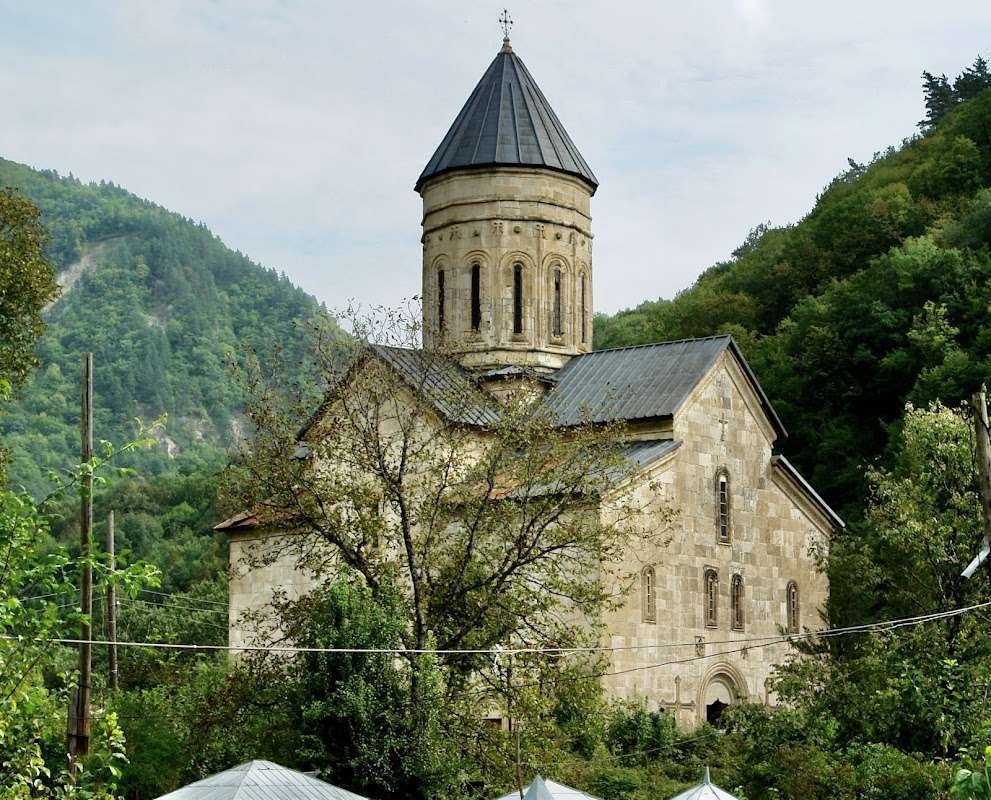
The Barakoni Church of the Mother of God stands in the village of Tsesi, Ambrolauri Municipality, on a cliff directly above the confluence of the Rioni and the Lukhuni, at 42.541837, 43.219443. It was built in 1753 by the master Avtandil Shulavreli, commissioned by Rostom, the eristavi of Racha.
The inscriptions on the facades turn the church into a signed document. The architect's name is carved on the eastern facade above the window, Rostom appears on the western, southern and northern ones, and the western facade also names his brother, the Catholicos-Patriarch of Western Georgia. The building is a cross with right angles and no annexes; the dome rests on the corners of the altar walls and two columns. The exterior walls are generously carved, with the oldest work in the niches of the eastern facade.
In scale, Barakoni is one of the largest church buildings of its era not just in Racha but in all of Georgia, on a par with the Nikortsminda katholikon. That appears to have been the point. Rostom considered himself the equal of the Imeretian king, and the scale of the church was part of the statement. It ended badly: the king captured the eristavi and had his eyes put out. Rostom's grave survives at the church he built.
On the hill across the river stand the ruins of Mindatsikhe castle, where, by tradition, Queen Tamar spent her childhood. In her time a church stood slightly aside from the present Barakoni; part of its foundation survives. The 1991 earthquake badly damaged the church, and it has since been restored and is active.
🕍 The Oni Synagogue: A European Design in the Mountains of Racha
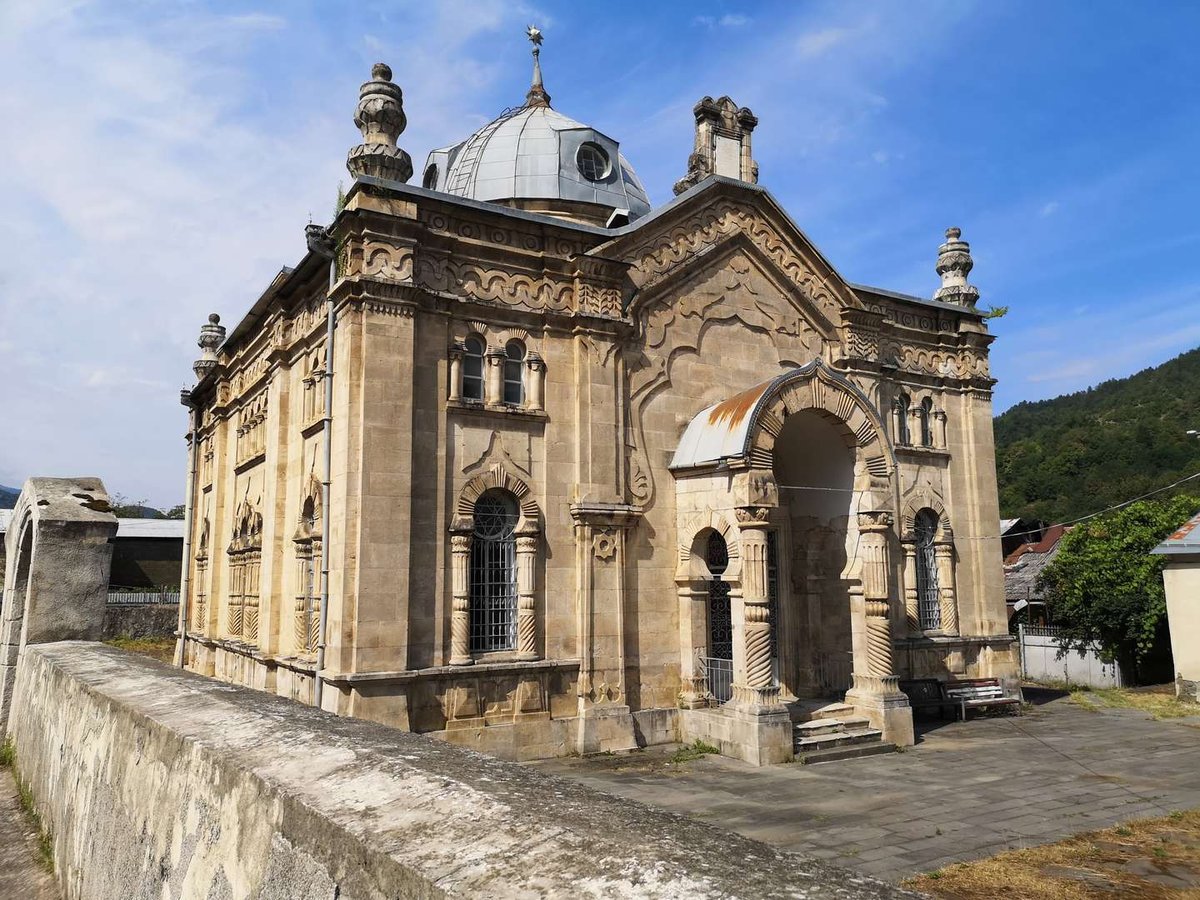
The most unexpected site on the whole list. The synagogue in Oni was built in Moorish style, rare for Georgia, and its design was brought from Europe by Rabbi Eliyahu Amshikavi. It stands at 53 Vakhtang VI Street, at 42.587082, 43.446422, and is active.
Dates and titles are messier here than the guidebooks suggest. The building was completed in 1895, the community in Oni goes back at least to the early 19th century, and Georgian Jews lived here long before that. The synagogue is often called the first or oldest in Georgia, but the title is disputed: the synagogue in Akhaltsikhe carries an 1862 inscription and makes the same claim. The phrasing that won't mislead anyone: one of the oldest working synagogues in the country.
Its value isn't in the record. In a mountain town surrounded by 11th-century Georgian churches, a building from an entirely different architectural world suddenly appears. That contrast is what makes it interesting, and it's the one stop that breaks the monotony of a church route through Racha.
⛰️ The Church of Maximus the Confessor: A Grave Above the Tskhenistskali
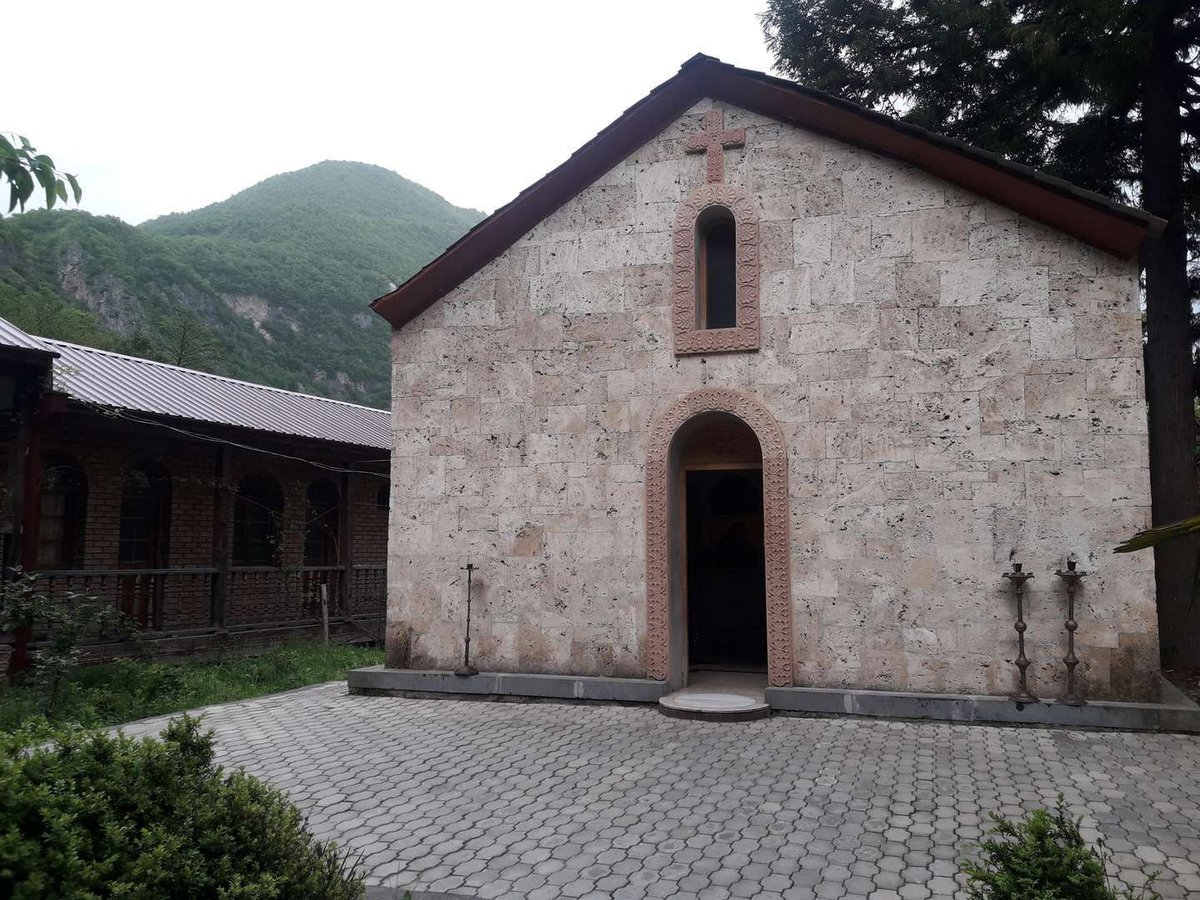
It stands on the crest of a rocky ridge, at the meeting of the borders of Svaneti and Lechkhumi, above the narrow outlet of the Tskhenistskali, in Tsageri Municipality. Coordinates 42.65686, 42.77487.
Maximus the Confessor, a 7th-century Byzantine theologian, was exiled to Lazica, in what is now western Georgia. That much is historical. That he's buried here is an attribution by tradition: academic sources put it carefully, noting that "there is a view that Maximus is buried near Tsageri," resting on Vakhushti's account and on traditions preserved in Lechkhumi to this day. In 2003 Bishop Stephane of Tsageri and Lentekhi identified a place in the high mountains of Lentekhi district where the saint presumably spent his last days.
For Lechkhumi this is a shrine of more than local significance, which is rare for a small mountain district. Locals are restoring the church themselves. The view over the Tskhenistskali gorge is a reason to climb up here on its own.
🐻 Zemo Krikhi: A Bear on the Altar Wall
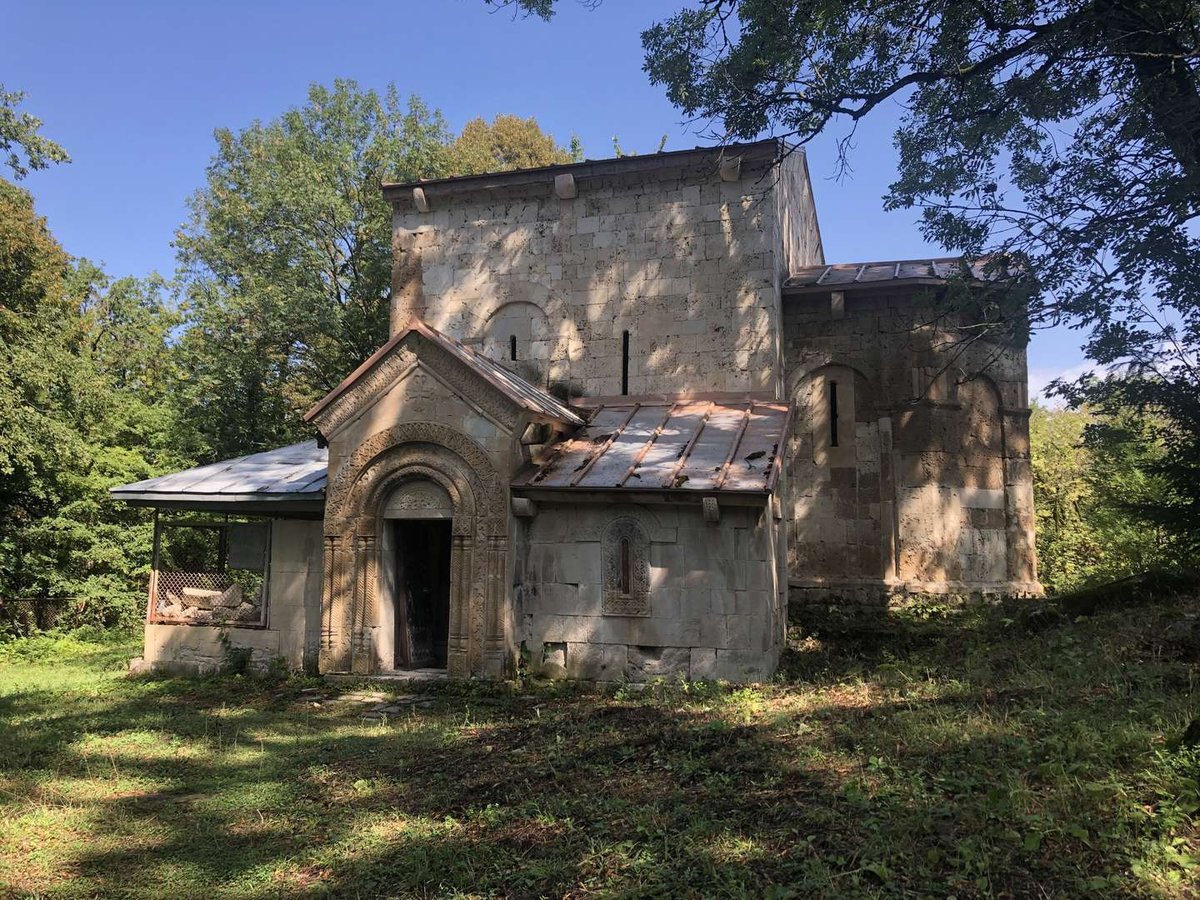
The most underrated church in the region. The Church of the Archangels in the village of Zemo Krikhi, Ambrolauri Municipality, stands on the left bank of the Krikhula river at 42.496867, 43.193566. It was built at the turn of the 10th and 11th centuries from well-hewn stone and lime, and renovated and extended westward in 1884.
It's a hall structure with a five-sided protruding apse in the east and a southern annex. Carving runs both outside and in, with the portal and the chapel window especially worked. Remains of 11th-century painting survive in the interior. It stands among century-old lindens and giant yew trees.
But the reason to come is one detail. Carved into the altar wall are relief images of a she-bear with two cubs. In an 11th-century Orthodox church. There's no canonical explanation for it, and that's exactly what makes it the best thing in Racha: a live trace of pre-Christian belief that a mason calmly cut into the wall of the church's main space.
🗿 The Church of St. George in Mravaldzali
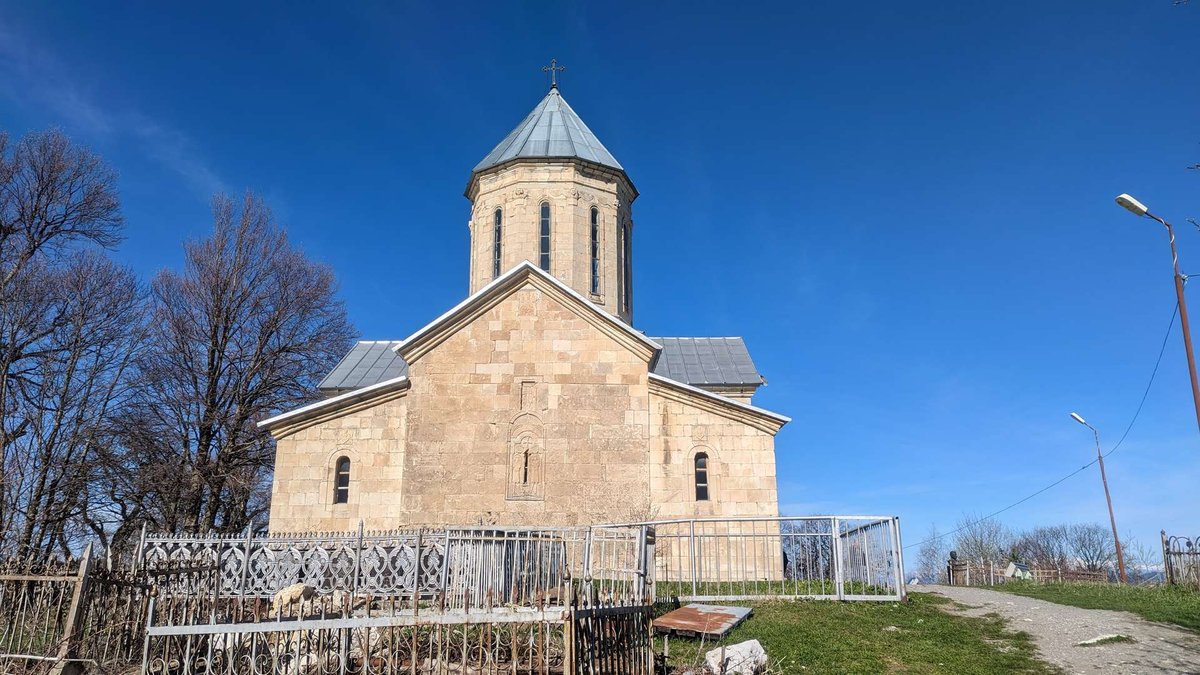
It stands in the village of Mravaldzali, Oni Municipality, at 42.514993, 43.343395. Its history starts in the 11th century: its construction is thought to have accompanied the founding of the Duchy of Racha in 1010.
It began as a modest hall building with ornament, lapidary inscriptions and painting. In 1894, under Archpriest Mikheil Skhirtladze, the church was substantially rebuilt and expanded: it became cross-domed, and only the eastern section of the original church survived. The 1991 earthquake badly damaged the 19th-century structure, and the older part took damage too.
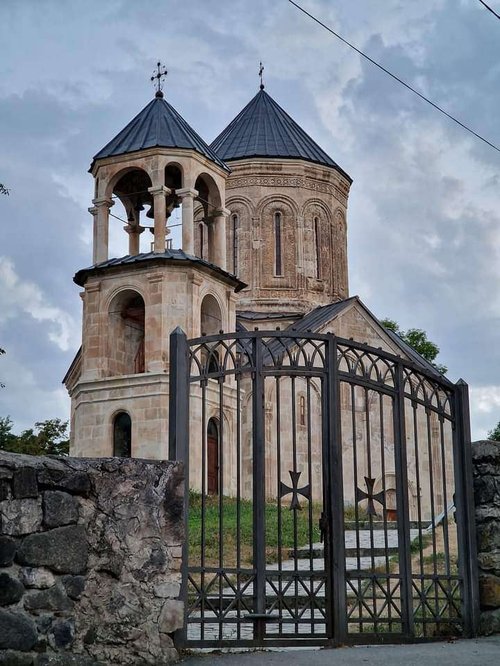
Not far from the village lies a heart-shaped karst lake that locals call the Lake of Love. Don't confuse it with the Sikvaruli Waterfall near Ambrolauri: two different places.
⛪ The Khotevi Archangel Church
It's in the village of Khotevi, Ambrolauri Municipality, at 42.467967, 43.138637. It was raised in the 17th century by order of Prince Merab Tsulukidze, which is a different era entirely from the churches of the duchy.
The church didn't just survive hard times, it rose from ruins. Right by the village stands Khotevi fortress, which gives a view over the church. One of those rare stops where you get two sites for one.
⛰️ The Khvamli Church: A Temple on the Summit
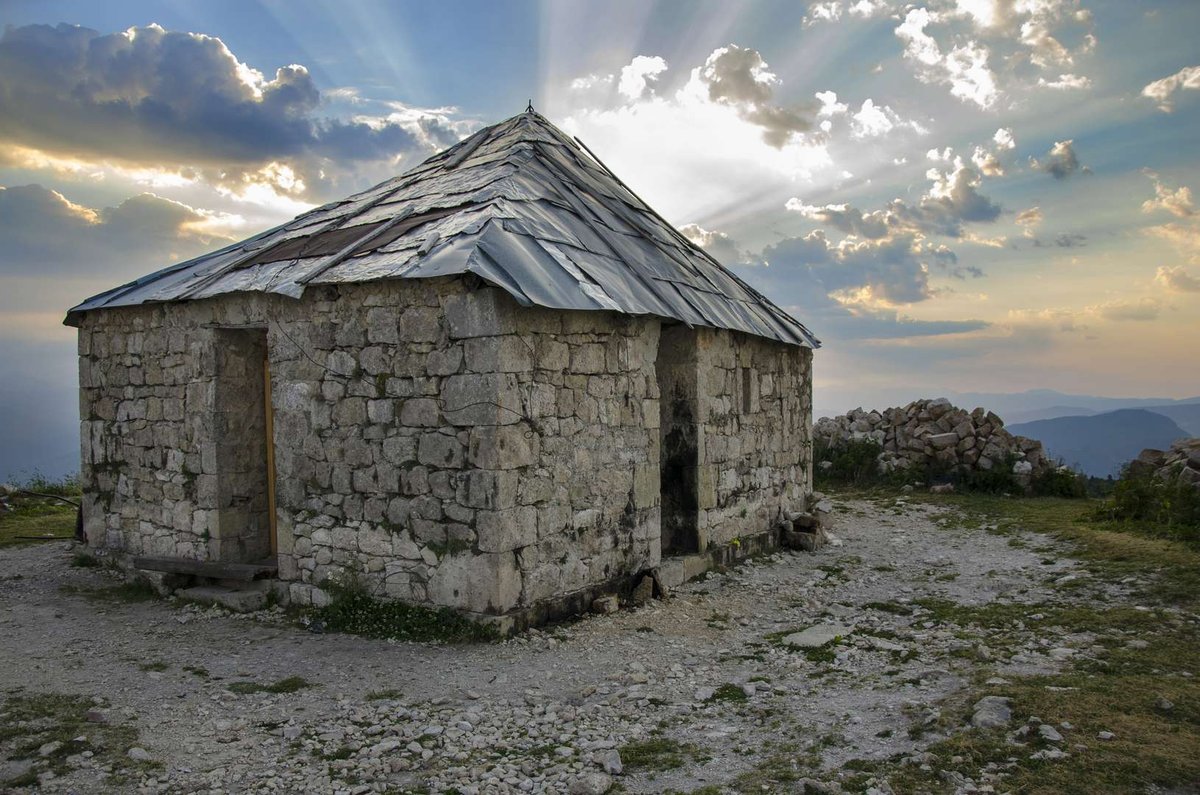
The Khvamli massif rises to 2,002 metres on the border of Tsageri and Tskaltubo municipalities, and on its highest points stands the Church of St. George, at 42.508564, 42.715720. It's the highest church in the region and the only one not tied to a river valley.
Strictly speaking it's a complex: the ruins of an 11th–13th century church, a temple built in 1910, a wall and monastic cells. Only outlines remain of the old church. When the new one was being built in 1910, locals found an inscribed stone dated to the 12th–13th centuries, now kept in the Kutaisi museum. The inscription asks St. George to be protector of the eristavt-eristavi and his children. Which means the church on the summit was a princely foundation, not a village one.
For the Khvamloba festival the church receives crowds of pilgrims. The climb needs preparation: this is a full trek, not a drive-up. There's a separate piece on the massif itself, its caves and the Amirani legend: The Khvamli Massif.
📋 The Churches of Racha by Age: 9th Century to the 20th
🧭 A Navigator to the Churches of Racha
16 sites⛪ Ambrolauri Municipalitysix churches, including both of the major ones ›
🕍 Oni Municipalitythe synagogue, a 9th-century monastery and Upper Racha ›
⛰️ Tsageri Municipality and LechkhumiMaximus the Confessor, Khvamli, Tabori ›
🗺️ All 16 Churches of Racha-Lechkhumi on the Map
Open in Google Maps📜 Two Waves and the Gap Between Them
Lay the dates out in order and the region's history reads itself.
Earliest of all is Skhieri Monastery: monastic life began there in the 9th century. Then comes the wave of the duchy: Zemo Krikhi at the turn of the 10th and 11th centuries, Nikortsminda in 1010–1014, Raketi in the first third of the 11th century, Mravaldzali around the same time. After that, a gap of several centuries, out of which only Labechina protrudes, built in the 12th century, destroyed by an earthquake and rebuilt in the 13th–14th. Then a new surge in the 17th and 18th centuries: Khotevi, Tskheti, Tabori, Barakoni.
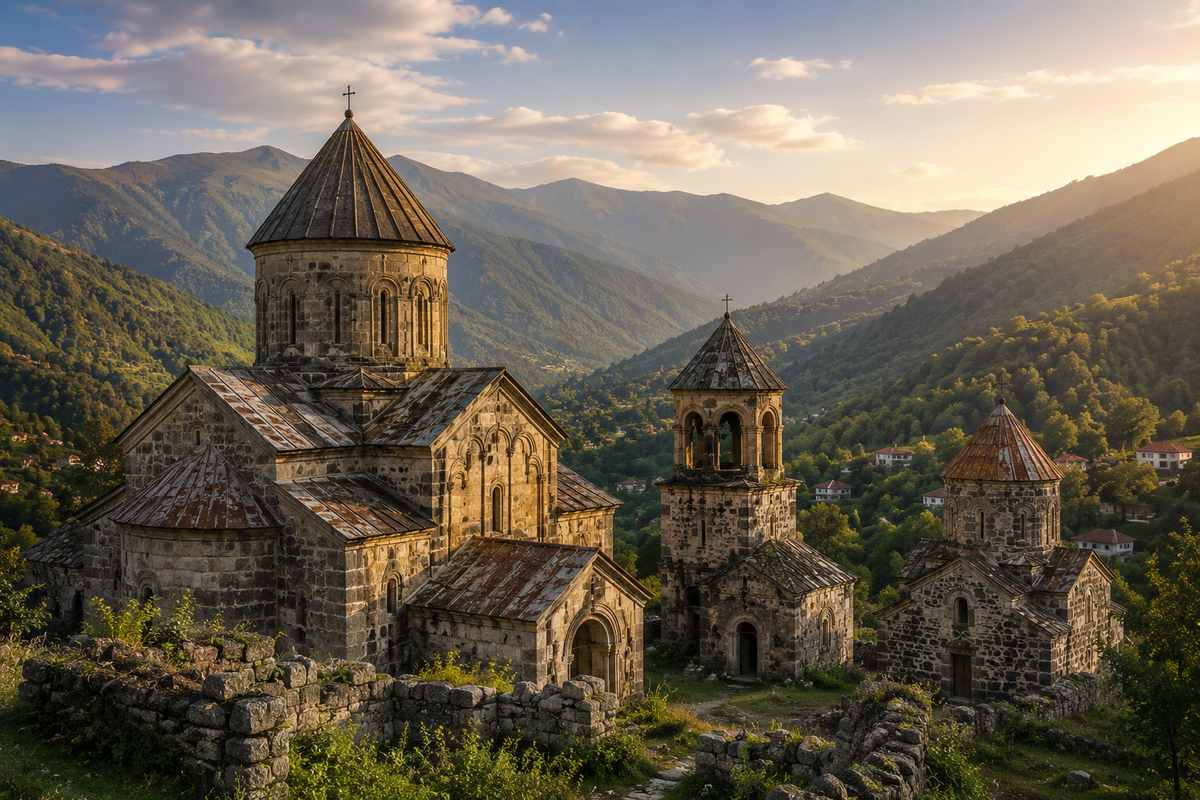
Between the two waves sit the Mongol invasions and the break-up of the country into rival kingdoms. In the 880s of the 13th century David VI Narin punished the Racha eristavi Kakhaberidze severely for treason and abolished the duchy outright. There was no one left to build, and nothing to build with.
The difference between the waves shows in the architecture too. The 11th-century churches are modest: hall buildings, small domes, simple plans. Racha is a mountain basin hemmed in by ridges, and hauling in a large workshop, moving stone by the tonne and raising a church on lowland scale was simply hard. Local masons did what they could: small forms, but quality carving. Nikortsminda and Barakoni are the exceptions, both for the same reason: the resources of power stood behind them.
Isolation cuts both ways. Mravaldzali shows it well: an 11th-century hall church was rebuilt as cross-domed in 1894, leaving only the eastern section of the original. Nineteenth-century restorations in Racha often did more damage than centuries of neglect.
🗿 What Else Is Nearby
Churches in Racha rarely stand alone. From Nikortsminda you can walk to the Udabno and Sakinule caves, with an arched spring and an ice cave. Khotevi fortress stands beside the Khotevi church. From Barakoni you can see the ruins of Mindatsikhe across the river.
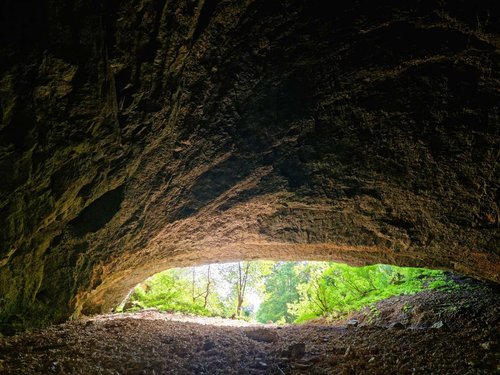
It's also worth understanding why the churches sit where they do. Look at the map above: they're tied to river valleys, because valleys are the only places people live in the mountains. Barakoni at the Rioni–Lukhuni confluence, Zemo Krikhi on the bank of the Krikhula, the Tskheti church above the Lajanura gorge, Maximus the Confessor above the Tskhenistskali. The one exception is the Khvamli church on the summit, and that one was princely rather than parish. There's a separate guide to the rivers of Racha-Lechkhumi on that geography.
First-time visitors usually pair the churches with a tasting of Khvanchkara wine: the vineyards sit in the same gorges as the churches. For the region as a whole, with its resorts, food and history, see Racha-Lechkhumi and Lower Svaneti.
The churches of Racha are chapters of one story: in 1010 the duchy was founded, churches appeared, the Mongols cut it all short, the 18th century built again, the 19th rebuilt, the 20th forgot, and the 21st is rediscovering. Nikortsminda and Barakoni are on every map; the other fourteen are waiting. And it's usually where the tour buses don't go that the interesting things turn out to be: a she-bear on an altar wall, for instance, is worth a full day on the road.
Been to the churches of Racha? Tell us in the comments on Madloba: which ones you saw, and which one stayed with you.
Information is current as of July 2026. Some churches are active, others are in ruins and need restoration. The state of the access roads into the mountain villages depends on the season, so check locally before you set off.
📚 Read Next Racha in more detail
❓Frequently Asked Questions
The catalogue holds 16 sites: Nikortsminda, Barakoni, the Oni synagogue, Skhieri Monastery, the Church of Maximus the Confessor near Tsageri, St. George in Mravaldzali, the Khotevi Archangel, the Khvamli church, Zemo Krikhi, Raketi, Labechina, Tskheti, the Mother of God in Tabori, Dzhoisubani, Gona and Goni.
No. Since 24 October 2007 the cathedral has been on UNESCO's tentative list, meaning it's a candidate. It has not been inscribed on the World Heritage List itself.
Skhieri Monastery in Oni Municipality: scholars believe monastic life began there in the 9th century. The oldest church is Zemo Krikhi, built at the turn of the 10th and 11th centuries.
The master Avtandil Shulavreli, in 1753, commissioned by Rostom, the eristavi of Racha. The architect's name is carved on the eastern facade above the window, which was rare for the period.
In 1010 Bagrat III founded the Duchy of Racha, and the new administrative unit needed spiritual centres. Over the following decades Nikortsminda, Patara Oni, Zemo Krikhi, Mravaldzali and others went up.
It was built in Moorish style, rare for Georgia, with a design brought from Europe by Rabbi Eliyahu Amshikavi, and completed in 1895. It's often called the oldest in Georgia, though the synagogue in Akhaltsikhe disputes the title with an 1862 inscription.
A 7th-century Byzantine theologian exiled to Lazica, in what is now western Georgia. His grave is associated with the church in Tsageri Municipality above the Tskhenistskali gorge, though this is an attribution by tradition rather than an established fact.
The Church of St. George on the Khvamli massif, at around 2,000 metres. It's a complex: the ruins of an 11th–13th century church and a church from 1910. Crowds of pilgrims climb up for the Khvamloba festival.
One day realistically covers the Ambrolauri group: Nikortsminda, Barakoni, Khotevi and Zemo Krikhi, all along the Ambrolauri–Oni road. The Oni and Tsageri sites need days of their own, and the Khvamli church needs a full trek.
Read also
- Two Caves in Racha: Udabno Desert Cave and Sakinule Ice Cave
- Natlismtsemeli Monastery, Gareji: History, Frescoes, Route
- Church of St. Elijah the Righteous, Tskhvarichamia: History
- Bakhmaro Wooden Church: History, Construction Date, and Practical Route
- Rural Shrines of Imereti: a Guide to the Region's Small Churches and Monasteries

4 comments
Log in to leave a comment