




⛪ Nikortsminda Cathedral: The Carved Stone Lacework and Frescoes of Racha
⛪ Nikortsminda Cathedral at a Glance
An early 11th-century cross-dome St. Nicholas cathedral in Racha, a masterpiece of Georgian architecture famed for its stone carving and frescoes. A candidate on the UNESCO World Heritage tentative list.
From the outside the church reads as a cross, while inside a complex six-conch space unfolds beneath the dome. That's why Nikortsminda is called one of Georgia's most unusual cathedrals.
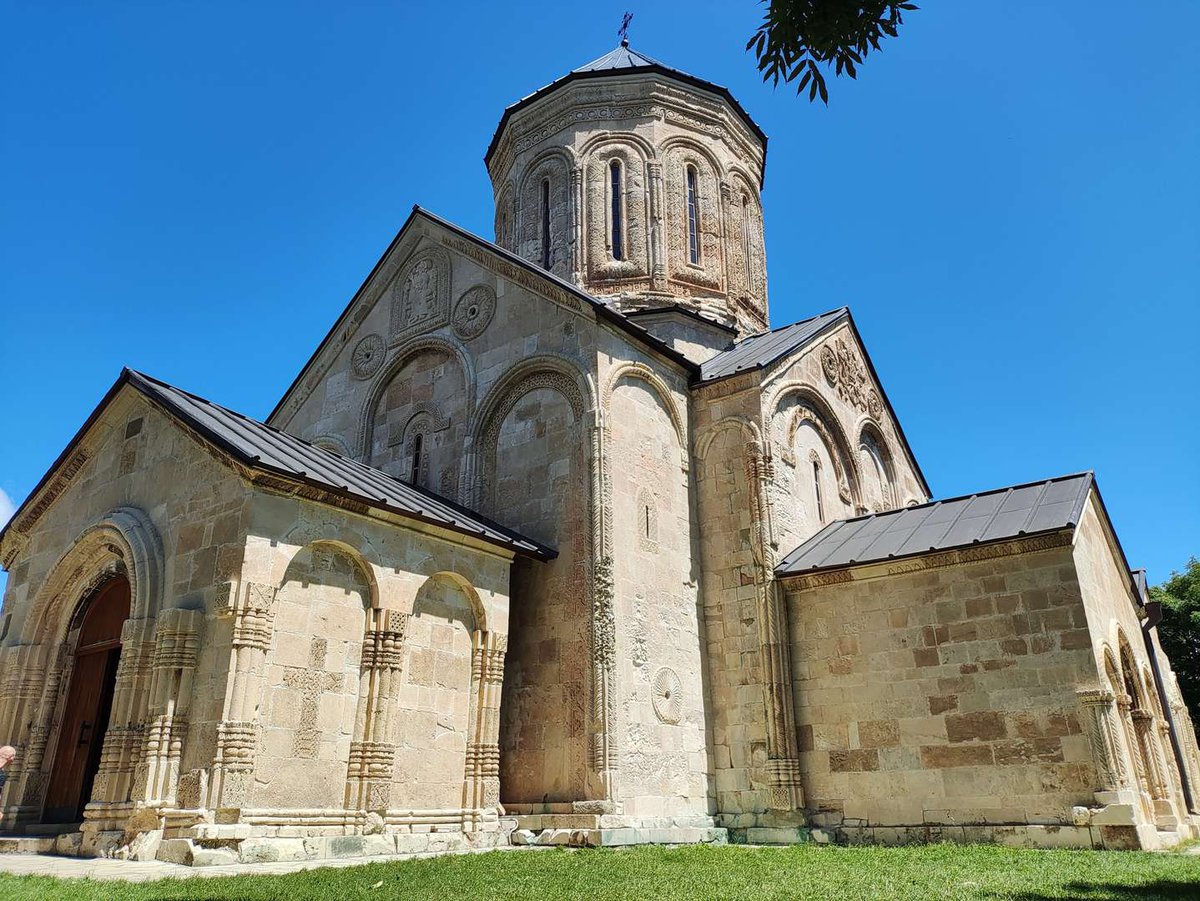
Nikortsminda is one of the most ornate and unusual churches in Georgia, a cathedral of the Georgian Orthodox Church in the historic region of Racha, in the west of the country. It stands in the centre of the village of the same name, about 10-16 km southwest of Ambrolauri (sources vary), north of the Shaori reservoir, at an altitude of around 1,184 metres. For the full listing with coordinates and photos, see the Nikortsminda Cathedral page.
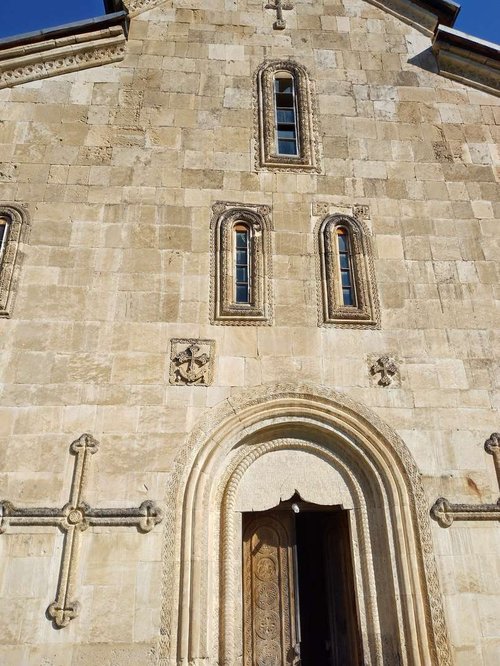
The church is dedicated to St. Nicholas and serves as the seat of the Nikortsminda eparchy. Let's clear up the UNESCO status right away, since there's much confusion around it: Nikortsminda is not on the main World Heritage List, but since 24 October 2007 it has been on the tentative list (that is, a candidate for inscription). This takes nothing away from the cathedral's value, but calling it a "UNESCO site" without that caveat would be inaccurate.
🏛️ When and by Whom It Was Built
The cathedral was built in 1010-1014, by order of Bagrat III, the first king of a unified Georgia, and became the cultural centre of the Racha principality (saeristavo). One of the inscriptions on the facade, carved at the western entrance, records its founding and its consecration in the name of St. Nicholas.
By the mid-16th century the cathedral had fallen into decline, and in 1534 the Imeretian king Bagrat III (a different ruler with the same name) repaired the church and decorated it with frescoes. It's largely these paintings that have survived. The three-storey bell tower beside the cathedral was built later, in the second half of the 19th century. In 1991 the church was damaged in the Racha earthquake and subsequently restored.
📜 A Cathedral That Entered Poetry
For Georgian culture this is more than an architectural monument, it's an image that entered the national poetry. Few village churches in Georgia can claim their own ode from a classic writer.
There's a second curious detail: among the carvings on the facades, alongside Christian scenes, appear motifs going back to pre-Christian folk belief and figures of mythical animals. The stone decoration turned out to be a kind of bridge between two ages of faith.
Stone Carving: The Main Treasure
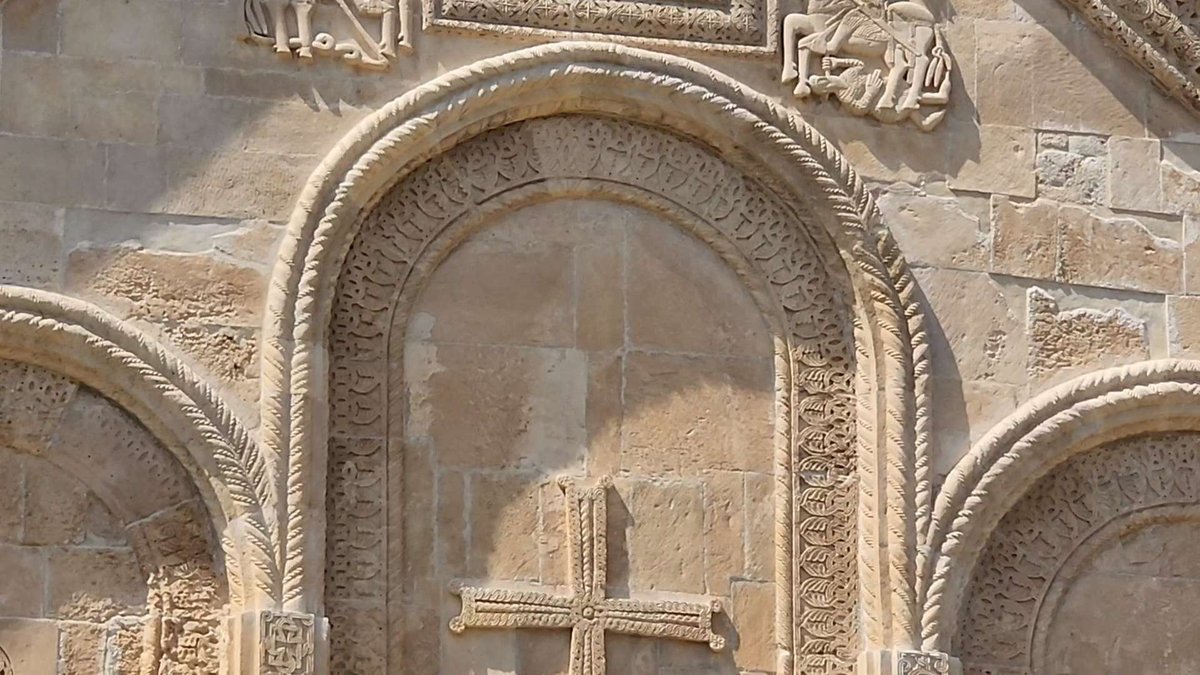
If Nikortsminda has one calling card, it's the carving, and it's what made the cathedral famous across the whole Caucasus. The walls, outside and in, are covered with varied carved ornament, and by many visitors' impression, no Racha pattern repeats twice. Among the carvings are complex multi-figure relief compositions: the Transfiguration, the Judgment Day, the Elevation of the Cross, figures of saints, and both real and mythical animals. These are considered some of the finest bas-relief sculptures of their time anywhere in the Caucasus.
During the 2018 restoration, fragments of an ancient relief were uncovered, with the image of an unknown bishop at its centre, another reminder that the cathedral still holds its mysteries.
🎨 What to Look for in the Cathedral's Decoration
⛪ A Church That Deceives the Eye
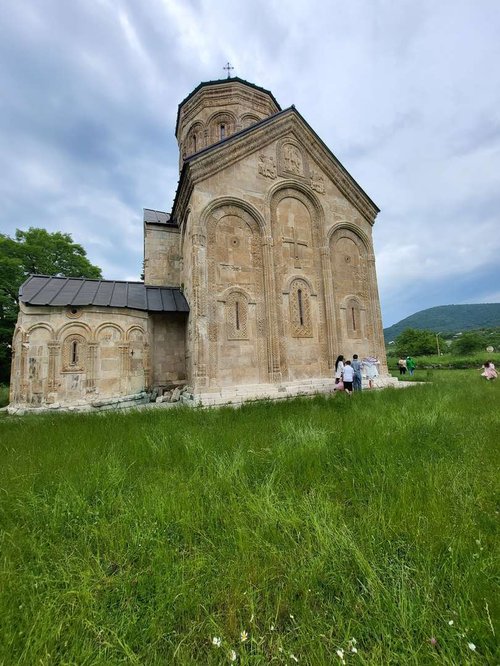
Nikortsminda is often called a puzzle because of the mismatch between its exterior and interior. From the outside the church reads as an elongated cross (the cross-dome type). But inside, the space unfolds differently: a six-conch-within-rectangle plan, with a massive dome on a drum pierced by 12 windows framed by an arcature band. The dome rests on six pendentives, and five apses adjoin the space beneath it. It's this contrast between the "cross" outside and the almost circular, upward-reaching space inside that makes the cathedral so memorable. Stylistically, Nikortsminda is Georgian architecture with features of the Byzantine tradition.
One more detail for history lovers: during the 2012 restoration, the name of the master who painted the frescoes, Javakhadze, was established.
🚗 Getting There
Nikortsminda is in Racha, 10-16 km from the district centre of Ambrolauri, right by the main road, you can hardly drive past it. The route into this mountainous region of western Georgia is scenic but takes time: roughly two hours from Kutaisi and about four hours from Tbilisi. It's most convenient to plan the trip with an overnight in Ambrolauri or nearby.
🧭 Where to Stay and Eat Nearby
Nikortsminda is a village, with little tourist infrastructure of its own. Ambrolauri, the district centre, makes a convenient base: there you'll find places to sleep and eat before the drive to the cathedral.
Have you been to Nikortsminda Cathedral? Leave a review on Madloba: tell us what impressed you more, the carving on the facades or the frescoes inside, and what first-time visitors to Racha should know.
Information is current as of July 2026. Opening hours, service schedules, and road conditions can change, check the details before you go.
❓ Frequently Asked Questions
💬 In the centre of the village of Nikortsminda, in the historic region of Racha, western Georgia, about 10-16 km southwest of Ambrolauri, north of the Shaori reservoir.
💬 In 1010-1014, by order of King Bagrat III, the first king of a unified Georgia. In 1534 the Imeretian king Bagrat III repaired and painted the church.
💬 To St. Nicholas. Nikortsminda serves as the seat of the Nikortsminda eparchy of the Georgian Orthodox Church.
💬 Not on the main list. Since 24 October 2007 the cathedral has been on the UNESCO World Heritage tentative list, meaning it's a candidate for inscription.
💬 Above all its stone carving on the facades, considered among the finest reliefs in the Caucasus of its time, and its well-preserved 17th-century frescoes. Nikortsminda is called a masterpiece of Georgian architecture.
💬 Because of the contrast: from outside the church reads as a cross, while inside it reveals a complex six-conch space beneath a massive dome with 12 windows.
💬 Yes, the grandeur of Nikortsminda inspired Galaktion Tabidze, the king of Georgian poetry, who dedicated the poem "Praise to Nikortsminda" to it.

5 comments
Log in to leave a comment
הצבעים של הפרסקאות, כאילו לקוחים מהחלומות שלי, ואני תוהה... האם מישהו אי פעם באמת ישב שם, שתק, וחשב על איזו רוח יכולה לשבות בין הקירות האלו? או אולי זה הכל כל כך טכני, שאף אחד לא זוכר את הלב הזה?
מה המיקום הכי מרגש לדעתכם לגלות שם?
הייתי רוצה לראות יותר תמונות מהפנים, כי המידע הזה על הציורים חשוב. זה כמו לבקש לראות את הלב של הכנסייה, ולא רק את המעטפת שלה. לא כולם יכולים להגיע לשם, וחשוב לשתף את היופי הזה. כשחושבים על זה, ניקורצ'מינדה היא לא רק מבנה, אלא חלון לעבר, והיכולת שלנו להתחבר אליו היא מתנה.