




🗿 The Colchis Bas-Relief in Kutaisi: Georgia's Stone Chronicle at the Green Market
📍 The “Kolkheti” Relief: Key Facts at a Glance
| What it is | A monumental ceramic relief, “Kolkheti” (Colchis) |
| Artist | Bernard (Franz) Nebieridze |
| Where | At the entrance to the Central (Green) Bazaar, Kutaisi |
| Size | 217 m², the largest relief in the former USSR |
| When | Created in the 1980s, mounted on the market wall in 1995 |
| Entry | Free, accessible around the clock |
| Time needed | About 30 minutes |
📋 Full address, opening hours, photos and visitor reviews are gathered in the listing: the “Kolkheti” relief.
🟦 What This Article Is About
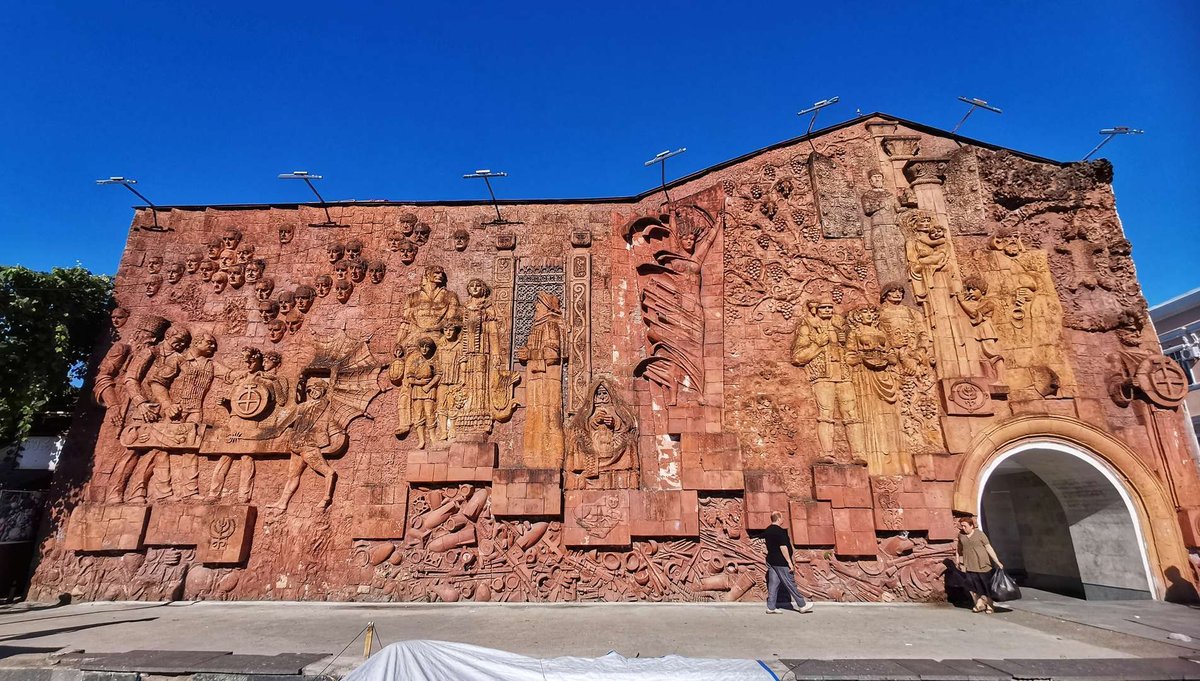
You are walking past the Central Bazaar in Kutaisi, you look up, and your eyes hit a wall covered entirely in figures: horsemen, kings, strange beasts, a golden fleece. No caption, no explanatory plaque. The first thought that comes to mind: what is this, and why is it here, next to an ordinary market?
This is the “Kolkheti” relief, and it is far more than façade decoration. In front of you stands an entire stone chronicle of Georgia: ancient myths, kings, eras and symbols, gathered into one enormous composition. Locals pass by every day, while visitors stop and try to read what the artist encoded here.
In this article we will work through it step by step: what kind of relief this is, who created it and when, which scenes and characters appear on it, what myth lies behind the name “Colchis,” and how to get to the spot. By the end, the wall will no longer be a puzzle but a story you can read.
🗿 What This Relief Is and Where to Find It
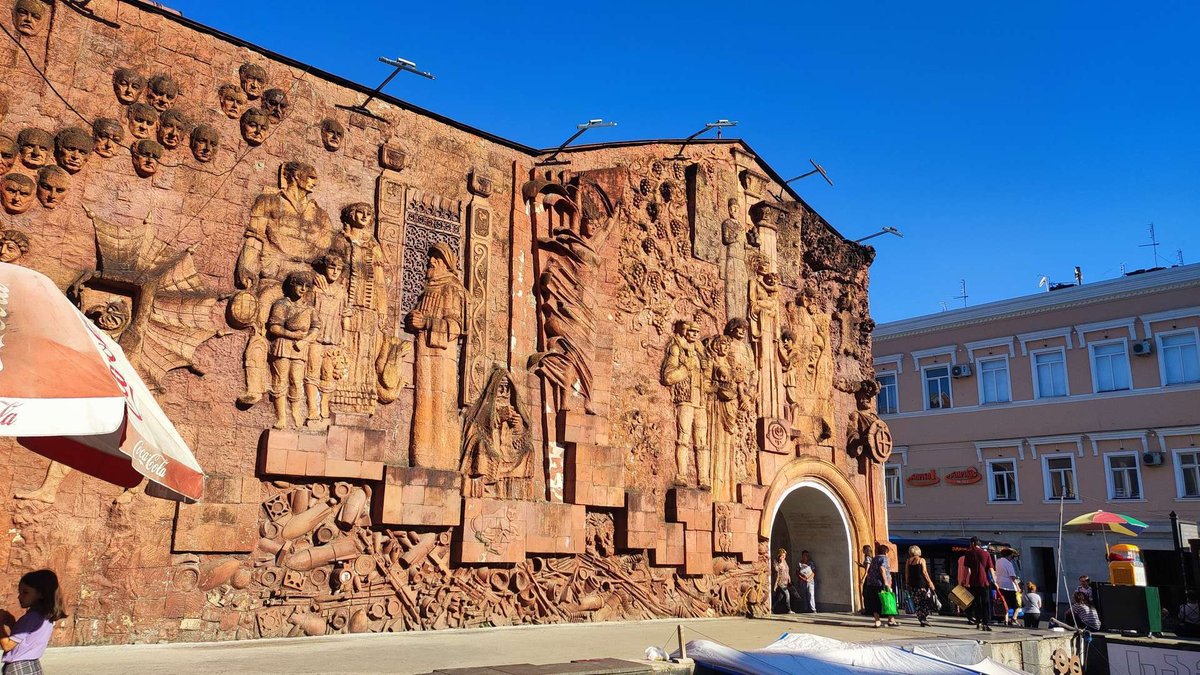
The “Kolkheti” relief is a monumental ceramic artwork that covers the entire side wall of a building at the entrance to the Central Bazaar in Kutaisi (also known as the Green Bazaar). The composition spans 217 square meters, making it the largest relief in the former USSR. The figures project deeply from the wall, casting real shadows, so from a distance the whole surface looks like a crowd frozen in stone.
There is a bit of confusion around the address. On maps and in some directories the relief is sometimes marked as a “bas-relief on the wall of a residential building near the market.” In reality it sits right at the market entrance, on the windowless wall of a building you will pass anyway on your way to the bazaar. So there is no need to search for it separately: head toward the Central Bazaar, and the wall will appear in front of you.
🧭 Where It Is and How to Get There
📍 Landmark: the Central (Green) Bazaar in Kutaisi. The relief is on a building wall right by the entrance, and it is hard to miss.
🚶 This is the city center, within walking distance of the Rioni River embankment and the Colchis Fountain. On your way to the market, the relief will be right along the route.
🗺️ For exact coordinates, directions and up-to-date details, see the “Kolkheti” relief listing.
🎨 Who Created “Kolkheti”: Bernard (Franz) Nebieridze
The relief was created by the Georgian artist Bernard Nebieridze (1939-1987), whom many knew by his second name, Franz. He began work on “Kolkheti” in 1982, and it became the project of the final years of his life. The scale speaks for itself: painting and sculpting 217 square meters of ceramic, building an entire panorama of dozens of figures across a wall, is years of painstaking labor.
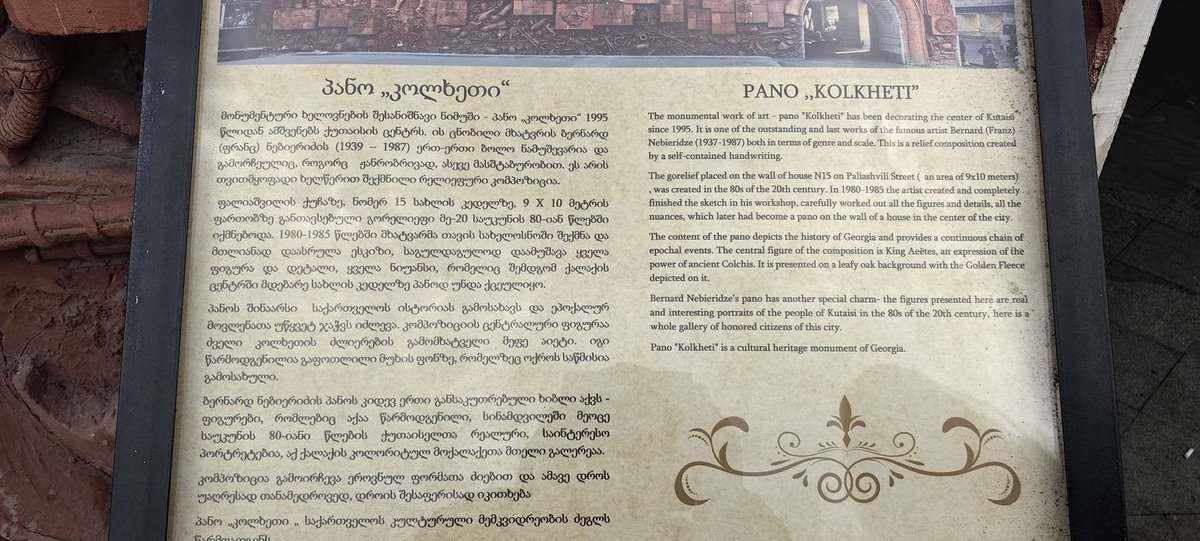
Nebieridze did not manage to finish the relief in his lifetime. He died in 1987, while the composition was still incomplete. The work was brought to completion by his colleagues, Vazha Kutateladze and Temur Zhorzholiani, in 1992. The relief was finally mounted on the market wall only in 1995, eight years after the artist's death. According to some sources, the main part of the composition was ready as early as the mid-1980s, but its journey from the studio to the facade stretched out over nearly a decade.
The relief is sometimes nicknamed “Franz's Panel,” after the artist's nickname. In this way, a single wall by the Kutaisi market forever tied the artist's name to the city for which he created this stone chronicle.
👤 The Person and Connections
| Artist | Bernard (Franz) Nebieridze (1939-1987), Georgian artist |
| Began work | In 1982 |
| Completed by | Vazha Kutateladze and Temur Zhorzholiani, 1992 |
| Mounted on the wall | 1995 |
🏺 Colchis, the Argonauts and the Golden Fleece: The Myth Behind the Name
The name “Kolkheti” (Colchis) refers to an ancient kingdom that lay along the eastern shore of the Black Sea. Kutaisi stands on the site of legendary Aea (Aia), the capital of that kingdom, so the myth of Colchis is no abstraction for the city but part of its own ancestry. By naming the relief after the ancient land, the artist set the tone for the entire composition from the outset.
It was to Colchis, according to Greek legend, that Jason and the Argonauts sailed in search of the Golden Fleece. The fleece was guarded by King Aeetes, and Jason was helped to obtain it by the king's daughter, the sorceress Medea. These are the very figures you will see on the wall: Aeetes in his mantle, the Golden Fleece beside him, Medea. They are gathered together for a reason, as they form the semantic core of the whole panorama.
Colchis and the Caucasus are tied to another great myth as well, that of Prometheus, who was chained to a rock for giving fire to humankind (in the Georgian tradition his counterpart is the hero Amirani). If you want to see how the same Colchian theme resonates in modern Kutaisi, the Colchis Fountain stands nearby, with gilded figures modeled on Colchian archaeological finds. And you can continue the story of Prometheus at the Prometheus Cave near the city.
📜 History and Facts
| Colchis (Kolkheti) | An ancient kingdom on the eastern shore of the Black Sea, the mythical land of the Golden Fleece |
| Aea (Aia) | The legendary capital of Colchis, identified with Kutaisi |
| Golden Fleece | The goal of Jason and the Argonauts' voyage to Colchis |
| Medea | Daughter of King Aeetes, a sorceress, who helped Jason obtain the fleece |
🧱 What Is Depicted: Four Eras of Georgia in Stone
The central idea of the relief is that it is not a set of random figures but a deliberate chronicle, divided into four eras: Georgia BC, Georgia AD, the present day, and the future. The wall reads like a timeline on which ancient myths gradually flow into history, and history into the modern age. That is why a legendary king and a twentieth-century person may stand side by side: for the artist, these are links in a single chain.
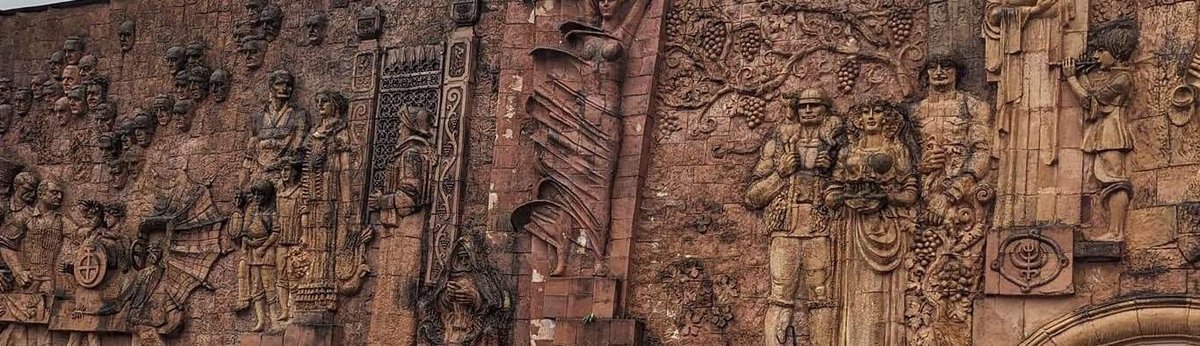
From the mythological part, the wall brings together the heroes of Colchis: King Aeetes in his mantle stands in the right section of the panorama, above the gate, with the Golden Fleece beside him and Medea nearby. Historical Georgia is embodied by King David the Builder, holding in his hands Gelati Monastery, the sacred site he founded near Kutaisi. There is also a reference to Khakhuli, one of Georgia's foremost relics, and a collective image of the Georgian family as the backbone of the nation.
Not every scene is literal. Part of the composition is allegory: the struggle between good and evil, the motif of disarmament and peaceful life. You do not need to identify them by name; it is enough to sense the overall mood. The longer you look, the more details emerge, and that is precisely why both locals and visitors so often pause in front of this wall.
📷 What to See and Photograph
🏛️ Wide shot: the whole wall at once, to capture the scale of 217 square meters in a single frame.
👑 The right section above the gate: King Aeetes in his mantle and the Golden Fleece, the semantic core of the entire composition.
⛪ David the Builder with Gelati Monastery in his hands, a recognizable historical scene.
🔍 Close-ups of the texture: the deep shadows and ceramic surface read well in side lighting.
📐 Scale and Technique: 217 m² of Ceramic High Relief
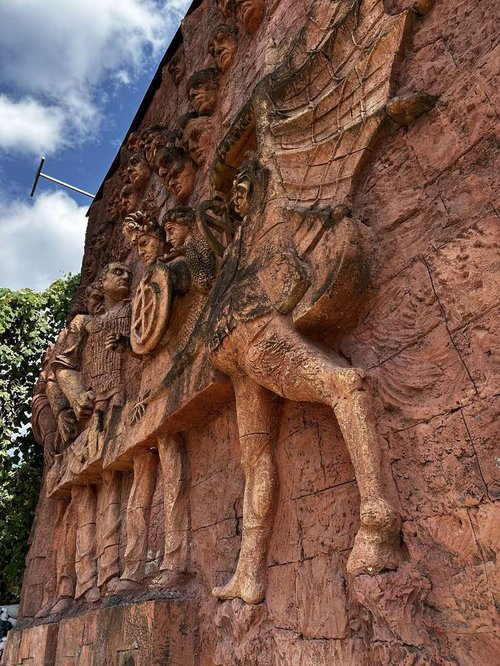
The defining feature of “Kolkheti” is its size. The composition occupies 217 square meters and is considered the largest relief in the former USSR. To picture the scale: it is comparable to the floor area of a spacious two- or three-room apartment, only stood upright against a wall. Because of these dimensions, the relief cannot be taken in at a single glance up close; you have to step back.
Technically, this is a high relief. Unlike a flat bas-relief, where figures project only slightly from the surface, in a high relief they emerge from the wall by more than half, almost like freestanding sculptures. Because of this, the figures cast real shadows and the scene looks three-dimensional and alive. On a sunny day the shadows shift, and the wall literally changes its appearance from morning to evening.
The relief is made of ceramic, and its rusty terracotta color has long become part of its character. The warm brick tone sits well within the urban setting of the market and looks especially striking in soft light. It is the combination of scale, depth and earthy color that makes “Kolkheti” something worth approaching on purpose, rather than just glancing at on the way to do your shopping.
🏗️ Architecture and Appearance
| Area | 217 m², the largest relief in the former USSR |
| Technique | High relief: figures project from the wall by more than half |
| Material | Ceramic |
| Color | Rusty terracotta, a warm brick tone |
🚶 How to Get There and What's Nearby
The relief stands in the center of Kutaisi, so the easiest way to reach it is on foot. There is just one landmark to remember: the Central (Green) Bazaar. Head toward the market, and the wall with the relief will appear right at the entrance, impossible to walk past. For exact coordinates and a ready route, see the listing (link above); we deliberately avoid embedding a map directly in the article so that you rely on up-to-date data.
Conveniently, several of the city's notable sights are clustered nearby, so the relief is easy to fold into a single walk.
📍 Nearby, in Central Kutaisi
🥬 Green Bazaar
A lively Georgian market right by the relief: spices, churchkhela, cheese and local color.
Learn more⛲ Colchis Fountain
The same Colchian theme in gilt: figures modeled on the region's ancient finds.
Learn more📖 Galaktion Tabidze Monument
A monument to one of Georgia's foremost poets, Galaktion Tabidze, in the city center.
Learn more🏺 Historical Museum
The archaeology and history of the region under one roof, for those who want to go deeper.
Learn more⛪ Bagrati Cathedral
The city's foremost sacred site on Ukimerioni Hill, a UNESCO World Heritage monument.
Learn more🎟️ Hours, Entry and Practical Tips
📝 Good to Know Before You Visit
✅ Entry is free. The relief is outdoors, on a wall at the market entrance. There are no tickets or fees.
✅ Accessible at any time. This is an open public object you can view at any hour, though more detail is visible in daylight.
✅ Allow about 30 minutes. That is enough to step back, take in the whole wall at once, and examine individual scenes up close.
✅ The best time for photos is daytime. In side sunlight the figures cast deep shadows and the relief looks especially three-dimensional.
✅ Combine it with the market. The bazaar is liveliest and most colorful in the morning, making it easy to see the relief on your way to shop.
✅ Keep an eye on your belongings. The spot is crowded, especially during trading hours, so keep your bag and phone close, as at any busy market.
❓ Frequently Asked Questions About the “Kolkheti” Relief
💬 It is a monumental ceramic relief called “Kolkheti” on a wall at the entrance to the Central (Green) Bazaar. It spans 217 square meters, making it the largest relief in the former USSR.
💬 The Georgian artist Bernard Nebieridze (1939-1987), known by the name Franz. He began the work in 1982 but did not manage to finish it in his lifetime. The relief was completed by his colleagues Vazha Kutateladze and Temur Zhorzholiani.
💬 Work on the relief took place during the 1980s, and it was finally mounted on the market wall in 1995. According to some sources, the main part of the composition was ready as early as the mid-1980s.
💬 The relief is conceived as a chronicle of Georgia across four eras: BC, AD, the present and the future. Among the figures are King Aeetes and the Golden Fleece, the sorceress Medea, King David the Builder holding Gelati Monastery in his hands, a reference to the Khakhuli relic, and a collective image of the Georgian family.
💬 Colchis (Kolkheti in Georgian) was an ancient kingdom on the eastern shore of the Black Sea, and Kutaisi stands on the site of its legendary capital, Aea. It was here, according to myth, that Jason and the Argonauts sailed for the Golden Fleece, so the name ties the city to its ancient history.
💬 It is in the center of Kutaisi, on a wall at the entrance to the Central (Green) Bazaar. The easiest way to reach it is on foot: head toward the market, and the wall will appear right in front of you. Exact coordinates and directions are in the listing.
💬 Entry is free. The relief is in the open air, so you can see it at any time, though more detail is visible in daylight.
💬 Yes, it is an open public object and you can photograph it freely. The best shots come in side lighting, when the figures cast deep shadows and the relief looks especially three-dimensional.
🧡 The Key Takeaways
The “Kolkheti” relief is exactly the kind of case where a genuine landmark hides beside an ordinary city market. A vast ceramic wall of 217 square meters, the largest relief in the former USSR, has been turned into a stone chronicle of Georgia: from mythical Colchis with its Golden Fleece to King David the Builder and images of the modern age. The artist, Bernard Nebieridze, worked on it during the final years of his life, and the relief was completed by his colleagues.
If you are in Kutaisi, approach this wall on purpose, not in passing. Step back a few paces to take in the whole composition, then examine individual scenes up close: the longer you look, the more details emerge. And since the relief stands right in the center, by the market, it is easy to combine with other places in the city and build an unhurried yet full day around it.
🧡 Read More About Kutaisi
- Colchis Fountain in Kutaisi: The Gold of Ancient Colchis
- David the Builder Monument in Kutaisi
- What to See in Kutaisi in One Day
📌 Save this article so you can visit the relief during your walk around Kutaisi.
🗣️ Now Over to You
Have you seen the “Kolkheti” relief in person?
Did you manage to spot Aeetes with the Golden Fleece, or David the Builder with the church in his hands, or perhaps you noticed a detail we did not mention?
Share your impressions and photos in the reviews: your observations will help other travelers read this stone chronicle more closely and not walk past the wall by the market.
⚠️ The information in this article is for reference only and may change. Before your visit, check the current address, coordinates and details in the “Kolkheti” relief listing.

2 comments
Log in to leave a comment