




Chronicles of Georgia: Tbilisi Stonehenge by Zurab Tsereteli
Chronicle of Georgia in Tbilisi: Complete Guide to Zurab Tsereteli's Monument
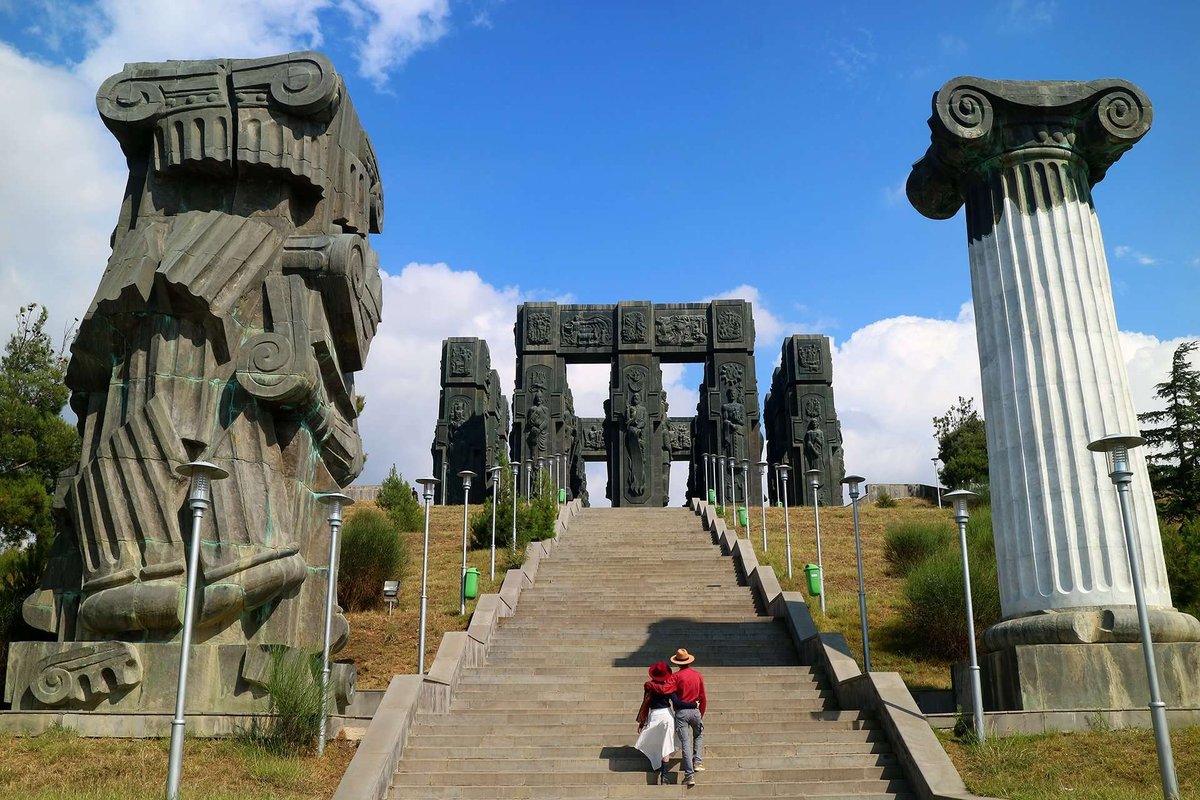
Do you know a place in Tbilisi where the entire history of Georgia is carved into 16 columns standing 35 meters tall? This is the "Chronicle of Georgia" — the unofficial "Georgian Stonehenge," where there are almost no tourists, and the view of Tbilisi Sea is breathtaking. Entry is free, it's open 24/7, and it's the perfect spot for sunset and epic photos.
Why is "Chronicle of Georgia" a must-visit in Tbilisi?
- ✓ Uniqueness: 16 columns 35m tall with reliefs of Georgian history — nowhere else in the world
- ✓ Photo potential: Epic shots where people look tiny against the monument
- ✓ Sunset: Best view of Tbilisi Sea (12 km²) — photographers come specifically for this
- ✓ Quiet: Only 10–20 visitors per day, unlike crowded downtown attractions
- ✓ Free: No entrance fee, open 24/7, no restrictions
What's depicted on the 16 columns?
The monument consists of 16 granite columns 30–35 meters tall, arranged in two rows. Each column is covered with reliefs telling the history of Georgia from biblical times to the present day. The complex was never completed — construction began in 1985, and the last column was installed in 2003.
Lower Level: Biblical Scenes
The lower level features key events from biblical history:
- Palm Sunday — Jesus' entry into Jerusalem
- The Last Supper — Jesus' final meal with his disciples
- Resurrection of Christ — the central scene of Christianity
- Baptism of Georgia — adoption of Christianity in 337 AD
These scenes highlight Georgia's deep connection to Christianity — one of the first nations to adopt this religion.
Middle Level: Kings, Queens, Heroes of Georgia
The middle level is dedicated to prominent figures in Georgian history:
- 13 Assyrian Fathers — monks who arrived in Georgia in the 6th century and spread Christianity
- Queen Tamar — "Golden Age" of Georgia (12th–13th centuries), period of cultural and political flourishing
- St. Nino — enlightener of Georgia, who brought Christianity
- David the Builder — king who united Georgia and freed it from the Seljuks
- Shushanik — first Georgian martyr (5th century)
Each figure is carved with such detail that it's impressive even from a distance.
Upper Level: Everyday Life Scenes
The upper level shows daily life of Georgians over the centuries:
- Grape harvesting — winemaking is part of Georgian identity since ancient times
- Festivals and dances — traditional Georgian celebrations
- Poetry and music — folklore culture
- Family scenes — traditional Georgian family
These scenes make history accessible and relatable for modern visitors.
Why is the monument unfinished?
Construction began in 1985 on Zurab Tsereteli's initiative. However, the collapse of the USSR in 1991 led to financial difficulties and work stoppage. The last of the 16 columns was installed only in 2003, and the complex was never completed as originally planned.
Despite being unfinished, the monument is already one of Georgia's most impressive structures.
How to get to Chronicle of Georgia from downtown Tbilisi
By Public Transport
Bus #360 from Tbilisi railway station or Bus #60 from Freedom Square:
- Travel time: 25–30 minutes
- Cost: 1 lari (card)
- Stop: "Temqa" or "Vedzmini"
- From stop: 15 minutes walk uphill to the monument
By Taxi
Yandex Go or Bolt:
- Travel time: 15–20 minutes from downtown
- Cost: 15–20 lari (one way)
- Instructions: tell driver "Chronicle of Georgia" or "Zurab Tsereteli monument"
By Car
Route: from downtown Tbilisi → toward Tbilisi Sea → follow sign "Temqa/Vedzmini"
- Parking: free at foot of the hill
- GPS coordinates: 41.770409, 44.810694
- Travel time: 15–20 minutes from Freedom Square
On Foot
From Grmageli Metro (red line):
- Travel time: 20 minutes uphill
- Route: exit metro → main street → follow sign to Tbilisi Sea → trail to monument
- Note: uphill climb, comfortable shoes required
📍 Get directions in Google Maps
Church of the Holy Mother of God near the monument
Right at the foot of the monument is the Church of the Holy Mother of God — small but unique:
- Frescoes made of vitreous enamel — rare technique for Georgia
- Built in the 2000s — modern but with traditional elements
- Worth visiting: quiet, cool inside, perfect place to rest before climbing to the monument
- Entry: free, open daily
After viewing the monument, definitely go inside — the frescoes are worth seeing.
✨ Summary: free entry, quiet, stunning photos, 1–2 hours. Perfect spot for sunset and epic shots. Save the address and come for sunset! 🌅
FAQ
No, it's a modern monument built in 1985–2003. However, people call it "Georgian Stonehenge" due to its similar shape — massive stone columns arranged in a row.
Construction began in 1985 on Zurab Tsereteli's initiative. The collapse of the USSR in 1991 led to financial difficulties and work stoppage. The last column was installed in 2003, and the complex was never completed as originally planned.
1–2 hours: 30 minutes for the monument, 30 minutes for the Church of the Holy Mother of God, 30–60 minutes for photos and sunset.
No, there are no restrooms or cafes nearby. Bring water and food with you. The nearest store is 10 minutes walk in Vedzmini village.
Yes, free, allowed everywhere. Tripods are also allowed, but better to check with nearby security guards.
Yes, dogs are allowed, but keep them on a leash.
No elevator, access to the monument is via stairs and trail. Comfortable shoes required. For people with disabilities — challenging but possible with assistance.

42 comments
Log in to leave a comment
Это ведь настоящий музей под открытым небом. Пройтись по этим хроникам замечательный способ познакомиться с культурой, искусством Грузии.