




🏰 Inside Kvatakhevi in Kaspi Municipality: Timur's Invasion, the Martyred Nuns and the Church Itself
🏰 Kvatakhevi: What to Know Before You Go
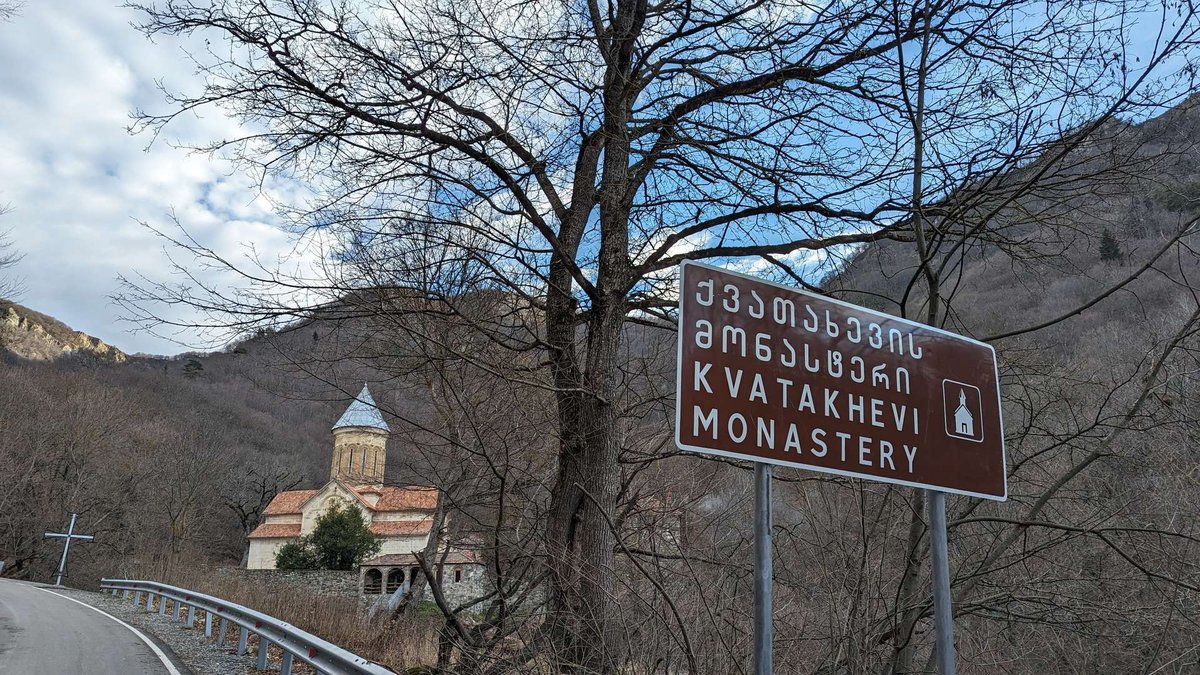
A working monastery of the twelfth and thirteenth centuries in Kaspi Municipality, Shida Kartli, in a gorge south of Kavtiskhevi. For a long time it counted as the principal monastery of Kartli. It is known above all for a tragedy during Timur's invasion, and for a Church of the Dormition regarded as a high point of Georgian domed architecture.
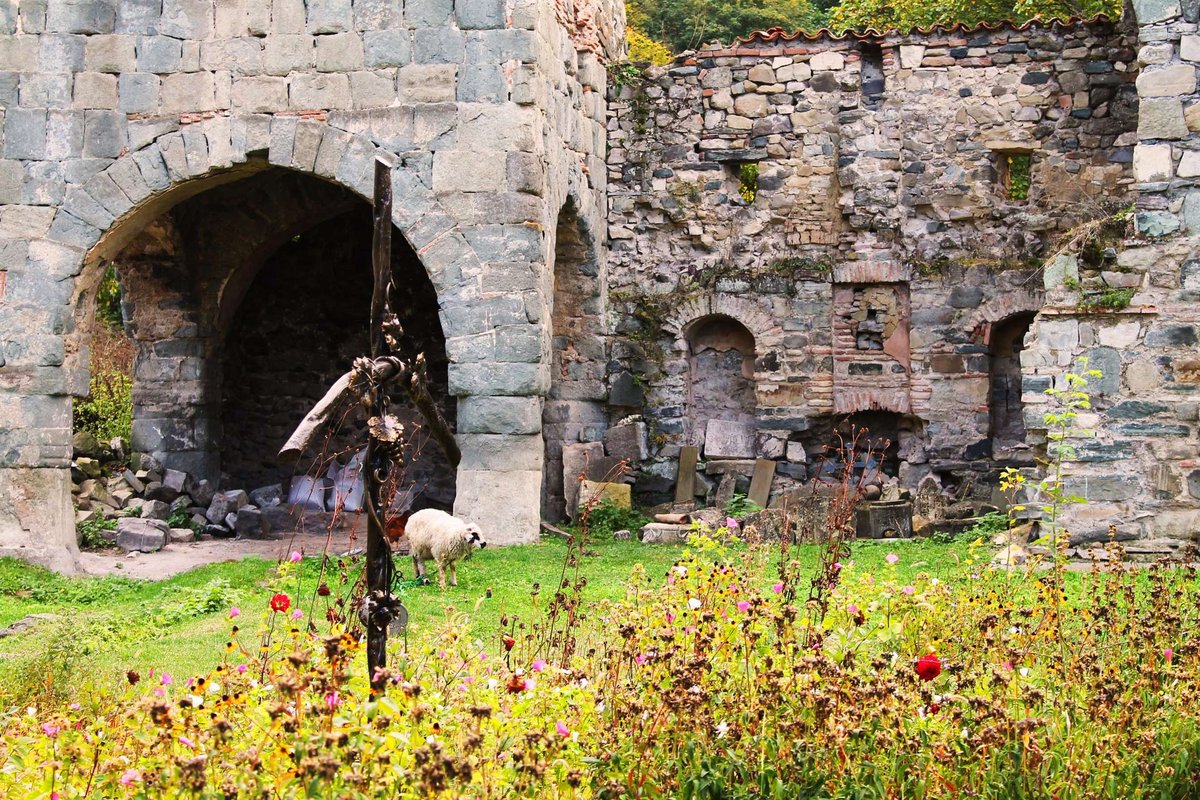
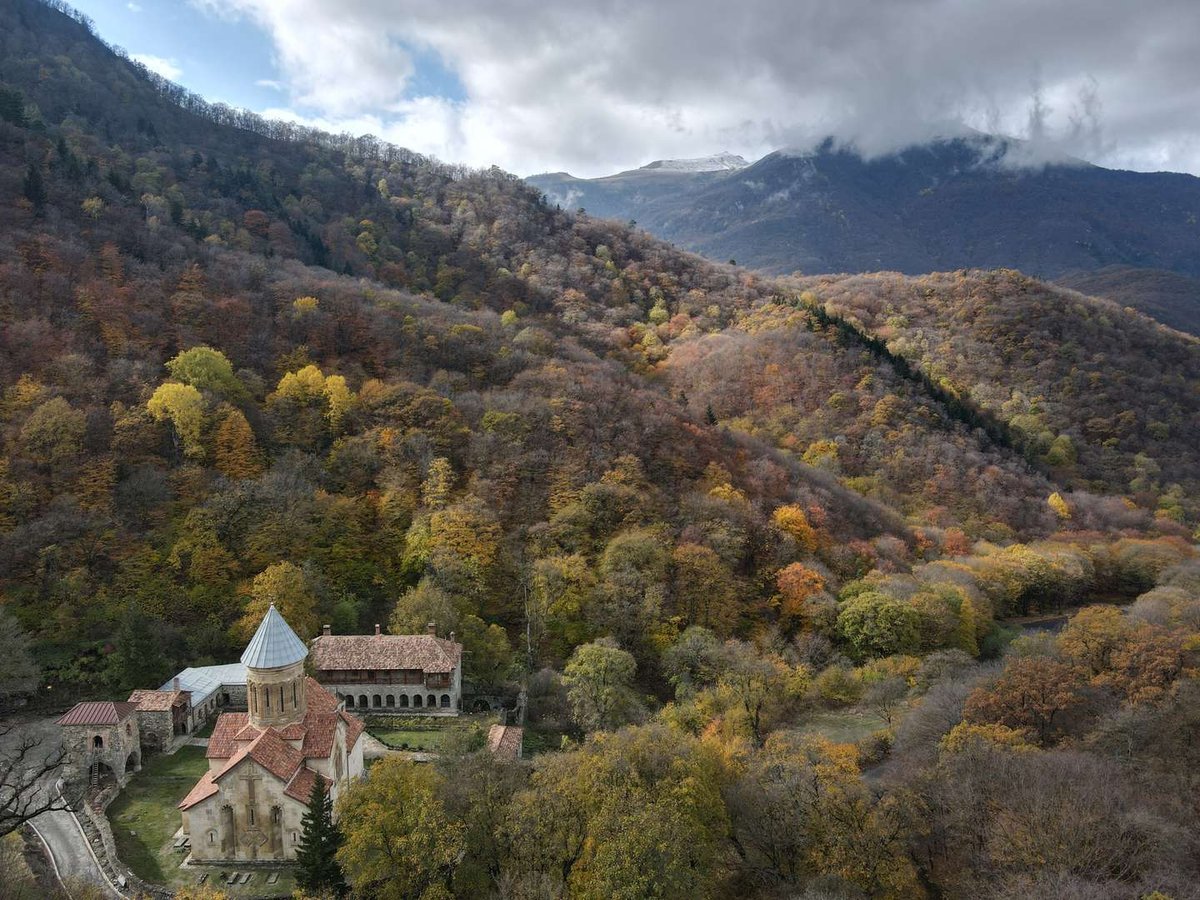
Kvatakhevi is a medieval Orthodox monastery in Kaspi Municipality, Shida Kartli, set in a gorge on the northern slopes of the Trialeti range. The name means 'gorge of stones'.
The monument is dated to the twelfth and thirteenth centuries, but nobody knows when it was founded: no record of it survives, and the scholarly literature is thin. What does survive is something else, the story of one spring day, and that is what brings people here.
🔥 What Happened at Kvatakhevi
This is the thing to know about the place, and the thing most often garbled.
In the spring of 1400, during Timur's sixth invasion of Georgia, his army sacked Kvatakhevi. The nuns serving there were shut inside the church and burned alive. Some sources place the event in 1386, and both datings appear in the literature.
Those who died are venerated by the Georgian Church as the Martyrs of Kvatakhevi.
One version circulating in Russian-language accounts is worth dispelling: that local people themselves shut the nuns in and set the fire, having lost their faith. Georgian sources do not support this; the act was carried out by Timur's army. The local-villagers version looks like a later distortion, and it is not worth repeating.
Traces of that fire are still visible. The wall paintings of the church were lost then, and the walls today are plastered bare. That emptiness is probably reason enough to stand quietly inside for a minute or two.
The monastery was restored in the fifteenth century by King Alexander I the Great, who reigned from 1412 to 1442. Another error creeps in here: some texts call him Alexander the Great of Macedon, who of course has nothing to do with the place.
⛪ The Relics and Why Pilgrims Come
By tradition, a fragment of the Virgin's robe was laid into the foundations of the church at its building, which is where the dedication to the Dormition comes from.
The monastery holds a relic of St John the Baptist, one of the significant relics of the Georgian Church, and a miracle-working icon of the Dormition of the Virgin.
The relics have had a difficult history. Between 1735 and 1740, when the monastery was not functioning, the monks hid them in a place nearby. They were not recovered until 1809, through the efforts of Archimandrite Dositheos, more than half a century later.
A popular belief holds that prayer before these relics helps with childlessness, and some pilgrims come for that reason specifically. It is presented here as a belief because that is what it is; nothing else supports it.
The monastery once ran a psalmody school. Among its pupils was Tarasi (Kandelaki), later Bishop of Tsilkani, the man who in the 1930s baptised the young Irakli Ghudushauri-Shiolashvili, the future Patriarch Ilia II. Kvatakhevi was also a centre of Georgian book learning, and some of its manuscripts have come down to us.
🏛️ The Architecture and Why It Counts as Exemplary
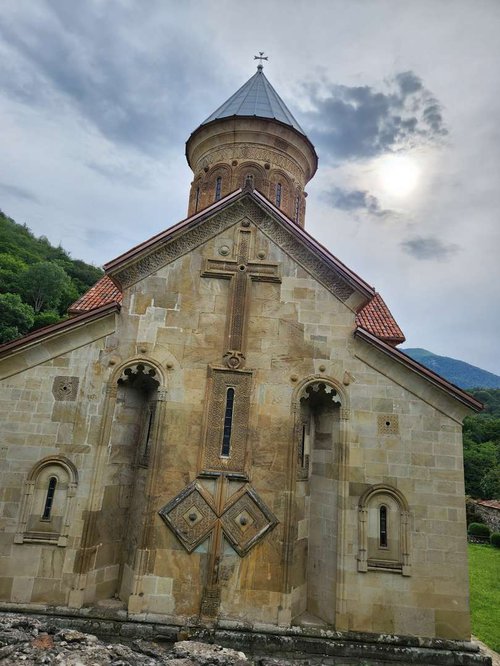
The church at Kvatakhevi belongs to the group of monuments in which the canonical forms of the Georgian domed church were finally settled. In form and ornament it stands close to the church at Betania, and specialists treat the two together.
The type is cross-domed. The façades are faced in dressed stone. The north and south arms are shorter than the west and east, and the transition to the drum is made with pendentives. There are two entrances, from the south and from the west.
Carving is concentrated around the windows, but not only there: the east façade carries squares set on the diagonal and a large cross, and the windows are framed with carved surrounds. The north, west and south façades are richly worked too. The drum of the dome is crowned by a tall carved frieze and a double cornice.
Inside it is another matter entirely. The paintings were lost in the fire, the walls are plastered, and the contrast between the carved exterior and the bare interior is probably the strongest impression the church leaves.
📸 What and When to Photograph
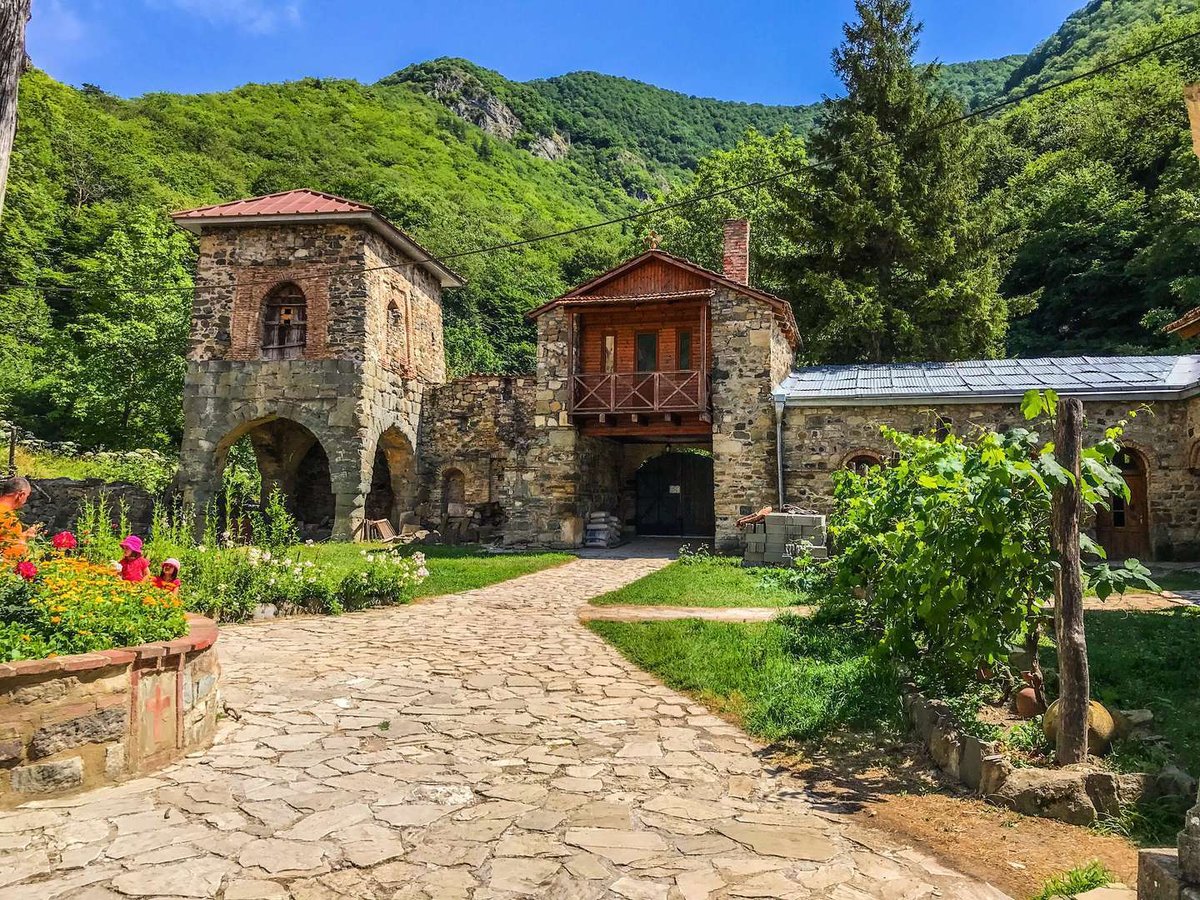
Photographs are what most people are looking for when they search Kvatakhevi. A few practical points.
The carving on the drum works in raking light, which means morning or towards evening. At midday the relief flattens out.
The east façade, with its cross and diagonal squares, is the richest. It makes sense to shoot it first, while the light is still from the east.
The refectory fireplaces are the most underrated shot in the complex. It is dark inside, so you need a long exposure and something to brace against; flash will only ruin it.
The wide view comes out better from below, on the approach, where the complex reads together with its wall and the slope behind.
And the usual rule for a working monastery: photography inside the church and on the grounds is by agreement. Ask before you take the camera out.
🚗 Getting to Kvatakhevi
The monastery stands in a gorge south of the village of Kavtiskhevi, in Kaspi Municipality, about five kilometres from Tsinarekhi. Tarmac takes you most of the way, with a gravel section at the end.
Driving is the practical option: no public transport reaches the monastery. Many people arrive on a day trip from Tbilisi, about an hour away.
The last section is unmade, and after rain its condition is worth judging on the spot. Bring footwear on the assumption that you will be walking part of it.
🙏 What to Expect at a Working Monastery
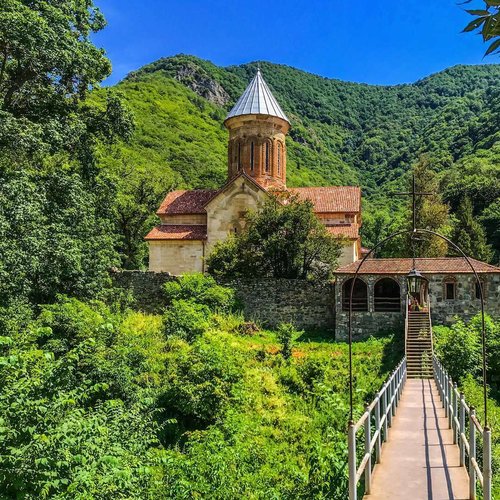
Kvatakhevi is not a museum but a living community, and the conventions here are the usual ones for such places.
Dress covered, with a headscarf for women. Photography by agreement. Access can be restricted during services and on fast days, so if you are travelling any distance, check the schedule in advance.
Tour groups from Tbilisi mostly arrive in the afternoon. If you want the place quiet, come in the morning.
🧭 Where to Stay and What Is Nearby
Kaspi or Gori make sense for the night: both sit by the highway and half an hour from the monastery.
Been to Kvatakhevi? Leave a review on Madloba: tell us what condition the road was in, whether you got inside the church, and whether anyone there told you the story of the martyrs.
Information is current as of July 2026. Access arrangements at a working monastery and the state of the approach road both change, so check before you travel.
❓ Frequently Asked Questions
💬 In the spring of 1400, during Timur's sixth invasion, his army sacked the monastery and shut the nuns serving there inside the church, where they were burned. Some sources place the event in 1386. Those who died are venerated as the Martyrs of Kvatakhevi.
💬 In Georgia, Shida Kartli region, Kaspi Municipality, in a gorge south of the village of Kavtiskhevi, about five kilometres from Tsinarekhi. Roughly an hour by car from Tbilisi.
💬 No. That version appears in some Russian-language accounts, but Georgian sources do not support it: the act was carried out by Timur's army. It appears to be a later distortion.
💬 The monument is dated to the twelfth and thirteenth centuries, but no exact founding date survives. There are no records of it, and the scholarly literature is thin.
💬 A relic of St John the Baptist and a miracle-working icon of the Dormition of the Virgin. By tradition a fragment of the Virgin's robe was laid into the church foundations, hence the dedication. The relics were hidden between 1735 and 1740 and only recovered in 1809.
💬 King Alexander I the Great, in the fifteenth century. Some texts mistakenly name Alexander the Great of Macedon, who has no connection to Kvatakhevi.
💬 It belongs to the group of monuments in which the canonical forms of the Georgian domed church were settled, and in form it stands close to the church at Betania. The façades are faced in dressed stone and covered with carving; the interior paintings were lost in the fire.
💬 The enclosing wall, a stone tower set into it, a refectory with large fireplaces to the northwest, residential cells on the west side, and a bell tower built in 1872.
💬 Photography inside the church and on the grounds is by agreement, so ask in advance. The carving on the façades and the drum reads best in raking light, meaning morning or towards evening.
💬 Driving is the practical option: no public transport reaches it. Many people come on a day trip from Tbilisi. The final stretch is gravel, and after rain its condition is worth judging on the spot.

35 comments
Log in to leave a comment
Ama bu yazıda bazı kısımlar eksik kalmış gibi hissediyorum. Belki de rehberlik eden bir ses, hikayeleri daha derin bir şekilde araştırmak için teşvik edebilirdi. O dönemin atmosferini, belki de bir anlık hayal gücüyle daha canlı bir şekilde aktarabilmek harika olurdu. Yalnızca taşları değil, o çağın insanlarını da hissetmeye çalışmak, bu yeri daha anlamlı kılabilirdi.
Peki, bu manastırda hangi kutsal emanetler var? Duyduğuma göre bazıları oldukça etkileyici.