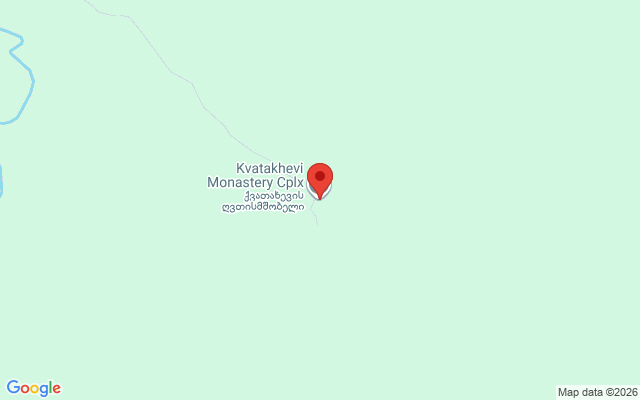




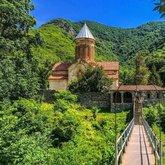




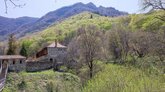

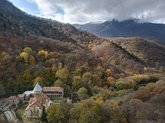



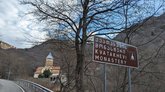

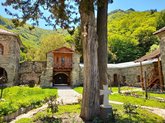

Kvatakhevi Monastery stands near the village of Kavtiskhevi, Kaspi Municipality, in a gorge cut by a stream on the northern slopes of the Trialeti Range, among the churches, cathedrals, monasteries and synagogues of the region. The name translates as "Stony Gorge"; a second name, "Kvabta-Khevi," means "gorge of the pot," as the terrain around the monastery resembles a pot in shape and features an unusually high concentration of stones.
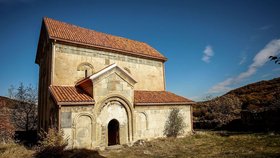
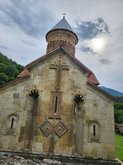
The cross-domed Church of the Dormition of the Most Holy Theotokos dates to the 12th-13th centuries, architecturally close to the monasteries of Betania, Pitareti and Timotesubani. Some historians link its construction to St David IV the Builder, others to Queen Tamar. During its heyday, Kvatakhevi was the principal monastery of Kartli and a literary centre of Eastern Georgia: books were written here and manuscripts translated from Greek into Georgian, some of which are now held in the State Historical Museum in Moscow.
According to tradition, a small piece of the Virgin Mary's robe is laid in the church's foundation, and among the monastery's treasures is a relic of John the Baptist — this legend is widely documented across independent sources. In 1386, during Timur's invasion, nuns took shelter in the church along with villagers who refused to convert to Islam: all were locked inside, and the church was set alight. In the 15th century, King Alexander the Great restored the monastery. Between 1735 and 1740 it was closed, and its relics hidden in a nearby cave, returning to the monastery only at the end of the 18th century. The church's paintings, unfortunately, were completely destroyed by fire: today the walls are simply plastered, with decoration surviving on the facades, richly carved, especially around the windows and the base of the dome.
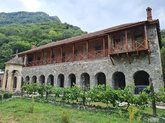
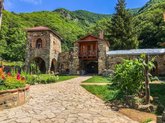
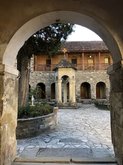
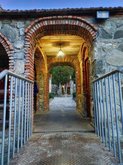
The complex also includes a defensive wall from 2 to 6 metres high, a two-storey tower once used as monks' living quarters, a bell tower built in 1872, a refectory of river stone, and 19th-century monastic cells.
A few practical points are worth noting from reviews. Mobile signal barely reaches the monastery grounds, and there's no public toilet. In June, during school excursion season, queues can form at the entrance, so visiting early or late in the month is advisable. Opinions on the access road's condition vary: some reviews call it excellent, others note that rough patches make the approach harder.