




👑 The Bagrationi Dynasty: The Royal House of Georgia
The Bagrationi were the royal dynasty that ruled the Georgian lands for around a thousand years, from the ninth century to the early nineteenth. Measured by time in power, this is one of the oldest ruling houses in the world. David the Builder, Queen Tamar and Erekle II all came from it, and its rule ended not because the family died out but because the kingdoms themselves were abolished.
📌 In Brief
- A royal house that ruled the Georgian lands for around a thousand years, from the ninth century to the early nineteenth.
- The first ruler of the family in Georgia was Ashot I the Kouropalates; the first king of a united country was Bagrat III.
- Dynastic tradition traces the family to the biblical King David, which is where the sling and the harp on the coat of arms come from.
- The house gave Georgia David the Builder, Queen Tamar, George V the Brilliant and Erekle II.
- Its rule ended in 1801 in Kartli-Kakheti and in 1810 in Imereti.
- The family still exists today, but holds no royal rights.
❓ Who the Bagrationi Were in Simple Terms
Bagrationi is a surname and a dynasty at the same time. The family rose in the south-western Georgian lands at the turn of the eighth and ninth centuries, gradually brought the rest under itself and held the throne for as long as Georgian kingdoms existed. When the kingdoms were abolished the dynasty did not disappear: it stopped ruling.
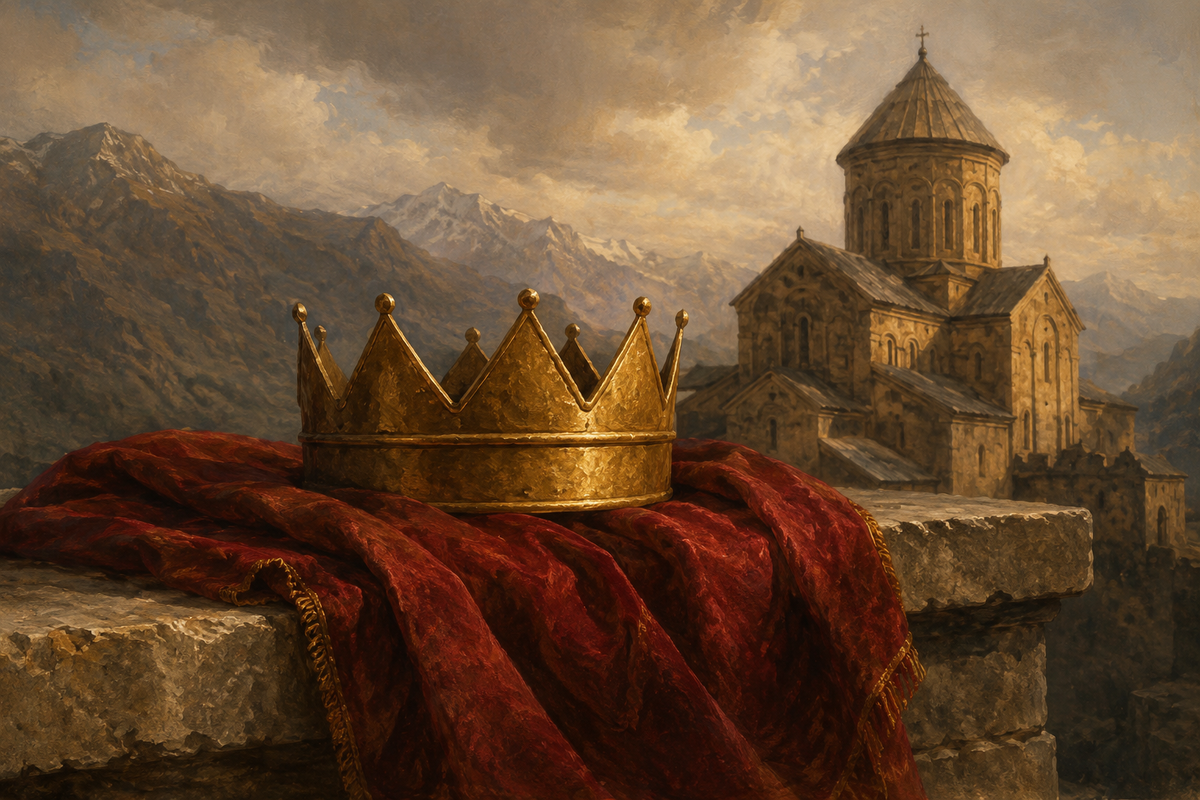
The scale is worth stating precisely, without inflation. The Bagrationi are one of the oldest ruling dynasties in the world, alongside several other houses of comparable antiquity. The phrase the oldest is common but cannot be called correct: everything depends on which ancestor you start counting from, and the earliest generations of any such family cannot be verified from documents.
In English the family appears as Bagrationi, and individual members are often written as Bagration, the form that came through Russian. Older works sometimes use Bagratid, which is also applied to the Armenian house and is therefore best kept for discussions of origin.
| Detail | Value |
|---|---|
| Time in power | From the ninth century to 1801 in Kartli-Kakheti and to 1810 in Imereti: around a thousand years |
| First ruler of the family | Ashot I the Kouropalates, turn of the eighth and ninth centuries, Tao-Klarjeti |
| First king of a united country | Bagrat III: the unification is traditionally dated to 1008 |
| Last kings | George XII in Kartli-Kakheti, Solomon II in Imereti |
| Main branches | Kartlian, Kakhetian, Imeretian; later the Bagration-Mukhraneli and the Bagration-Gruzinsky |
| Status today | The family exists but holds no royal rights |
📜 The Origins of the Bagrationi: Legend and the Views of Historians
The question of where the house came from has two layers, and they should not be mixed.
The first layer is dynastic tradition. Medieval Georgian tradition traces the family to the biblical King David, the shepherd who defeated Goliath and the author of the psalms. For the Middle Ages this was not a genealogical note but a political argument: a ruler descended from an anointed king of Scripture holds power from above rather than from men. The legend became fixed in the writings about the family and in the symbolism of the arms, so it has to be known if the house is to be understood at all.
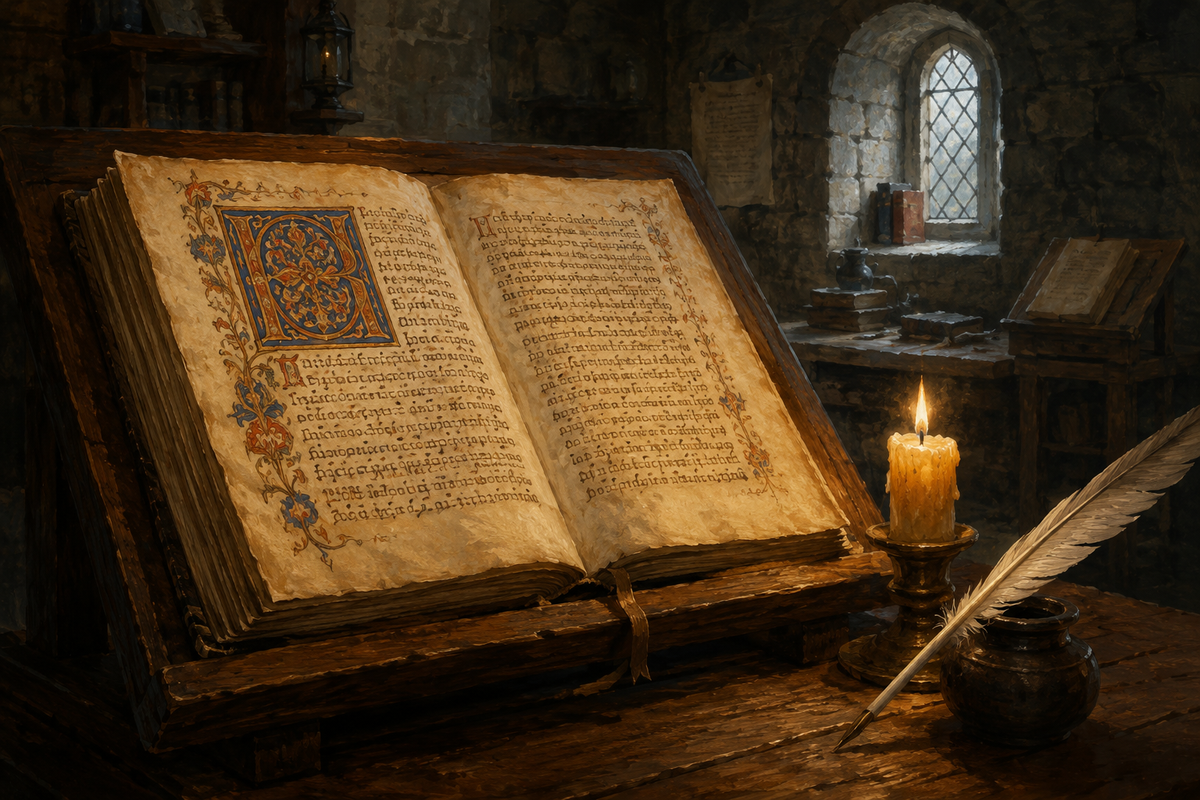
The second layer is the work of historians. What can be traced reliably is the rise of the family in Tao-Klarjeti, the south-western Georgian lands, from the eighth and ninth centuries. Separately there is the question of a connection with the Armenian Bagratids, the Bagratuni: some researchers see a common root and related branches, others insist on an independent origin for the Georgian house. There is no single position, and the subject remains contested, including between Georgian and Armenian historiography. We set out the range of views and do not choose for the reader.
| 📜 Dynastic Tradition | 🔬 What Historians Say |
|---|---|
| The family descends from the biblical King David, the psalmist who defeated Goliath | A line cannot be traced back to biblical times: sources of that depth do not exist |
| The descent explains the right to the throne: the rulers are given by God | The legend took shape in the Middle Ages and worked as a justification of the house’s legitimacy |
| The genealogy is set out in medieval Georgian writings about the Bagrationi | What can be traced reliably is the rise of the family in Tao-Klarjeti from the eighth and ninth centuries |
| The line is presented as unbroken and singular | A connection with the Armenian Bagratids, the Bagratuni, is debated: the question is contested and there is no single position |
👑 The Road to the Throne: Ashot I and the Return of the Royal Title
The starting point of the family’s Georgian history is taken to be Ashot I the Kouropalates, who ruled at the turn of the eighth and ninth centuries. He established the family in Tao-Klarjeti and held the title of kouropalates, a high Byzantine rank: in the Caucasus of that period this meant recognition from the empire and a standing everyone understood.
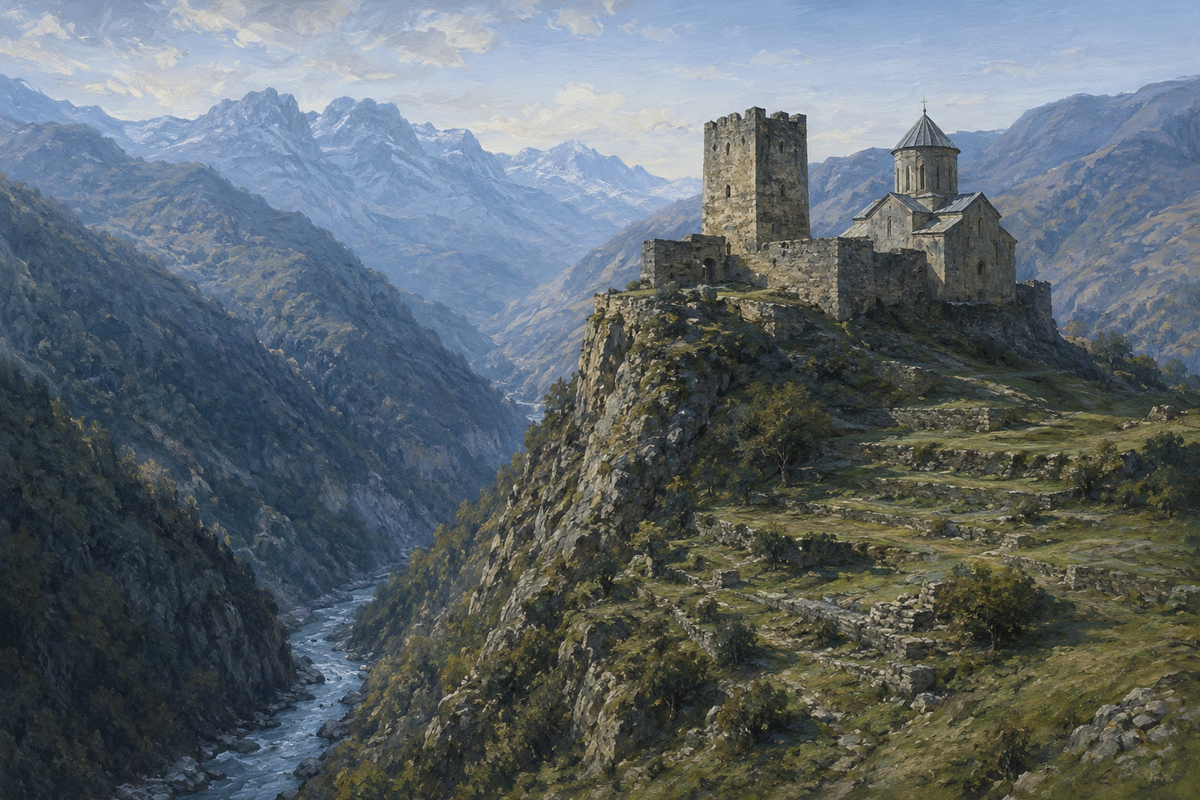
The royal title returned at the end of the ninth century, when Adarnase IV took the style of king of the Kartvelians, traditionally dated to 888. Formally the title was restored, but there was still no united state: that was more than a century away.
It is worth remembering that monarchy in Georgia is older than the Bagrationi. Tradition names Pharnavaz as the first king, and among the rulers of earlier houses stands Vakhtang Gorgasali. The Bagrationi took over an institution that already existed and held it longer than anyone else.
⭐ A Thousand Years on the Throne: The Key Rulers of the House
A full gallery of rulers would fill a book of its own. Below are the five figures the house is known by, each in a single paragraph and each with a link to a fuller account.
Bagrat III: The First Unification
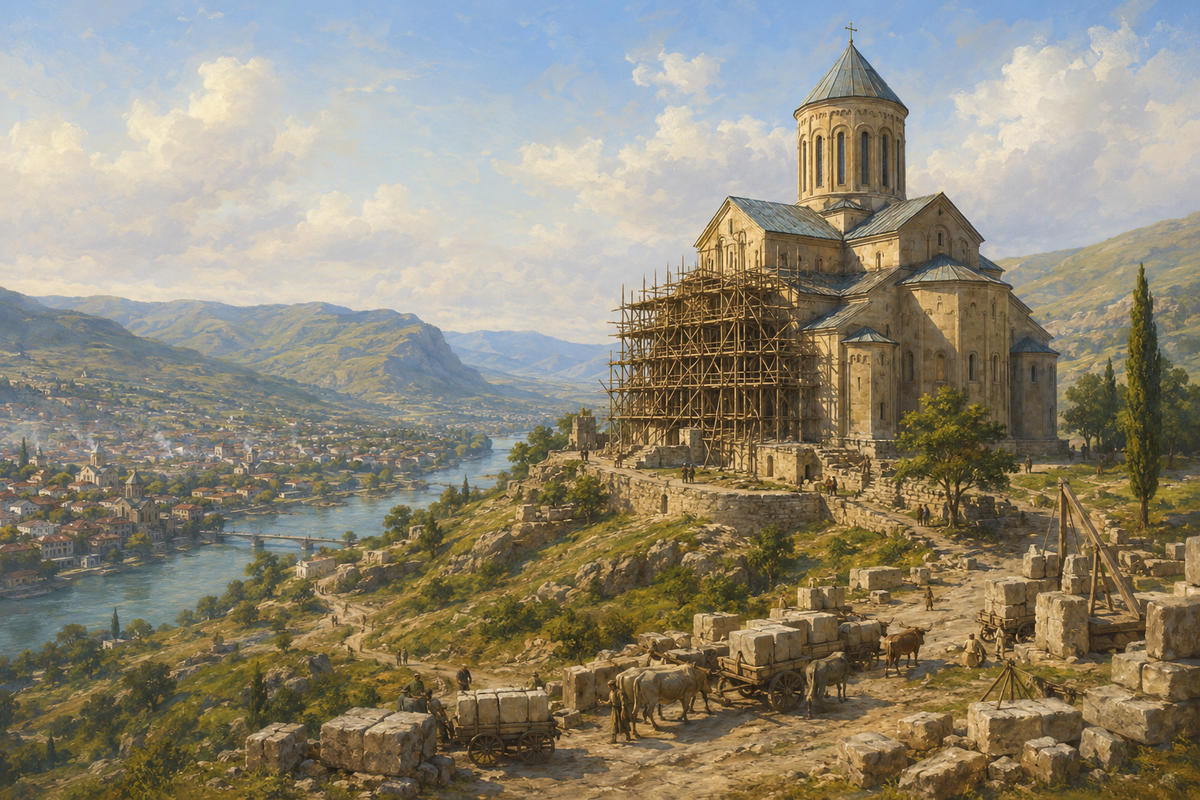
Bagrat III became the first king to bring most of the Georgian lands under a single crown. The unification is traditionally dated to 1008, although the process took several years and some regions joined later. Under him work began in Kutaisi on the cathedral that still carries his name: Bagrati Cathedral stands above the city and remains the chief monument of that age.
David IV the Builder: Gatherer and Reformer
David IV took over a country in a bad way and left it the strongest state in the region. He won the battle of Didgori in 1121, recovered Tbilisi, rebuilt the army and the administration and founded Gelati. His reign is covered in detail in the article on David the Builder.
Queen Tamar: The Height of the Golden Age
Under Tamar the country reached its widest extent and its culture its peak: The Knight in the Panther’s Skin belongs to her time. Her reign became the symbol of that flourishing and left behind more legends than any other. The details are in the article on Queen Tamar, and the age as a whole in the piece on the golden era of the Georgian kingdom.
George V the Brilliant: Recovery After the Mongols
After Mongol domination the country lay fragmented, and George V put it back together: he ended the payment of tribute, brought the lost provinces back under his authority and set the administration in order. The epithet Brilliant, in Georgian Brtskinvale, is exactly what he earned it for.
Erekle II: The Last Great King
Erekle II united Kartli and Kakheti into a single kingdom, won at Aspindza, created a standing army and in 1783 signed the Treaty of Georgievsk with Russia. He was the last ruler to govern Georgia as a sovereign in his own right.
| Ruler | Years | Chief Achievement |
|---|---|---|
| Bagrat III | 978–1014 | Brought most of the Georgian lands under a single crown |
| David IV the Builder | 1089–1125 | Won at Didgori, recovered Tbilisi, founded Gelati |
| Queen Tamar | 1184–1213 | The height of the golden age: the widest borders and a cultural peak |
| George V the Brilliant | 1314–1346 | Rebuilt the country after Mongol domination |
| Erekle II | 1762–1798 | United Kartli and Kakheti, signed the Treaty of Georgievsk |
| George XII | 1798–1800 | The last king of Kartli-Kakheti |
🏰 The Break-Up: Three Kingdoms and the Principalities
The united kingdom lasted about five centuries. By the end of the fifteenth century it had broken into three separate ones, Kartli, Kakheti and Imereti, with principalities alongside them in varying degrees of independence.
Two things brought this about. External pressure after the Mongols and Timur had drained the country’s resources, and inside it there were feuds between branches of the family and the great nobles. For the dynasty itself the break-up meant something paradoxical: the Bagrationi did not lose power, they multiplied across thrones. Each of the three had its own branch of the same house on it, and for the next three hundred years the history of Georgia is the history of three sets of Bagrationi who took turns at war and at peace with one another.
🕯️ The End of the Reign: 1801 and 1810
The kingdom of Kartli-Kakheti was abolished in 1801, shortly after the death of George XII, its last king. The kingdom of Imereti ceased to exist in 1810, its last king being Solomon II. Both territories entered the Russian Empire. How that process ran and what followed is set out in the article on the rulers of Georgia from King David to the Russian Empire.
For the dynasty this was a change of status rather than the end of the family. The royal houses stopped ruling, but the surname survived, and its members went on living as princely families of the empire.
🦅 The Bagrationi After the Throne
In the Russian Empire the Bagrationi received princely rank, and part of the family entered service. The best known member for a Russian-speaking reader is Pyotr Bagration, the general and hero of the war of 1812 who was mortally wounded at Borodino. He came from the Georgian royal family, from a line going back to the kings of Kartli, which made him a distant relative of the Bagrationi who ruled in Georgia.
Two main branches of the house have come down to the present. The Bagration-Mukhraneli, whose name is tied to the Chateau Mukhrani estate, known today chiefly for its winery and its history. And the Bagration-Gruzinsky, descendants of the Kartli-Kakhetian line.
The family still exists. In 2009 members of the two branches married, a match discussed in Georgia as a symbolic reunion of the house. The surname carries no powers of state: Georgia is a republic, and the question of the form of government is not one this article takes up.
🛡️ Symbols of the House: The Bagrationi Coat of Arms
The Bagrationi arms read as a statement about descent. They are traditionally described as containing the Robe of Christ, the sling and the harp of King David, and a set of scales. Different sources describe the elements and their readings a little differently, but the core meaning is stable.
The Robe points to the chief relic of Mtskheta and ties the house to the Christian history of the country. The sling and the harp point to the biblical David. The scales are traditionally read as the symbol of just judgement, one of the central duties of a sovereign.

💡 An Interesting Fact
The sling and the harp on the coat of arms are not decoration but a genealogy in pictures. The sling points to the young shepherd David who brought down Goliath, the harp to David the psalmist. Anyone looking at the arms read the central claim of the house without a word being said: we descend from a biblical king, and our right to the throne comes from above.
🗺️ Where to Touch the History of the Bagrationi
Traces of the house are scattered across the whole country: cathedrals where kings were crowned and buried, monasteries, fortresses and family estates. Below are six places that give a sense of the dynasty without any special preparation.
🗺️ Bagrationi Places on the Map
Base map labels from OpenStreetMap appear in the local language. Tap a marker to open the description.
Kutaisi. Built under the first king of a united Georgia.
Near Kutaisi. The monastery of David the Builder and his burial place.
Mtskheta. The place of coronations and royal burials.
Didgori, near Tbilisi. A memorial to the victory of 1121.
Mukhrani. The estate of the Mukhrani branch of the family.
Telavi. The fortress palace of the Kakhetian branch of the house.
| Place | Where | Link with the House |
|---|---|---|
| Bagrati Cathedral | Kutaisi | A cathedral built under Bagrat III and carrying his name |
| Gelati Monastery | Near Kutaisi | The monastery of David the Builder and his burial place |
| Svetitskhoveli Cathedral | Mtskheta | The place of coronations and burials of the Georgian kings |
| Didgori Monument | Didgori, near Tbilisi | A memorial to the victory of 1121 |
| Chateau Mukhrani | Mukhrani | The estate of the Mukhrani branch of the family |
| Batonis-tsikhe | Telavi | The fortress palace of the Kakhetian branch of the house |
❓ Frequently Asked Questions About the Bagrationi Dynasty
💬 The royal dynasty that ruled the Georgian lands from roughly the ninth century to the early nineteenth. David the Builder, Queen Tamar and Erekle II all came from this house.
💬 Around a thousand years. The count usually begins with the family establishing itself in Tao-Klarjeti at the turn of the eighth and ninth centuries, and the end of the rule is 1801 in Kartli-Kakheti and 1810 in Imereti.
💬 Dynastic tradition traces the family to the biblical King David. Historians reliably trace its rise in Tao-Klarjeti from the eighth and ninth centuries, while the question of a connection with the Armenian Bagratids remains contested, with no single position on it.
💬 The first king of a united country is taken to be Bagrat III, with the unification dated to 1008. The last kings were George XII in Kartli-Kakheti and Solomon II in Imereti.
💬 He came from the Georgian royal family, from a line going back to the kings of Kartli, and was a distant relative of the Bagrationi who ruled in Georgia. In Russia the surname carried princely rank.
💬 Yes. Its main branches are the Bagration-Mukhraneli and the Bagration-Gruzinsky. The surname holds no royal rights: Georgia is a republic.
📌 Key Points in Brief
The history of the Bagrationi is one of those rare cases where a surname outlasts most states. The house rose in the mountain lands of the south-west, recovered the royal title, gathered the country into one, survived its break-up into three kingdoms, gave it its most famous rulers and left the throne not because the line failed but because the kingdoms were abolished. The legend of descent from the biblical David, the arms with the sling and the harp, the coronations at Svetitskhoveli and the tomb at Gelati are all parts of one construction the house built over centuries. The individual biographies from that line are covered elsewhere in the cluster; here we have looked at the house as a whole.
💗 Read Next
- Queen Tamar: The Golden Age of Georgia
- David the Builder: How Georgia Became the Strongest Kingdom in the Caucasus
- Erekle II: The Last Great King of Georgia
- The Golden Era of the Georgian Kingdom
- From King David to the Russian Empire: The Famous Rulers of Georgia
- Pharnavaz I: The First King and the Birth of the Georgian Monarchy
- Vakhtang Gorgasali: Warrior King and Founder of Tbilisi
💬 Now Over to You
- Which of the Bagrationi impressed you most, and why?
- Did you know that Pyotr Bagration was related to the Georgian royal house?
- Which of the places on the list have you already seen, and which would you send someone to first?
- Whose biography from the dynasty should we write next: Bagrat III or George V the Brilliant?
Tell us in the comments: good arguments and corrections make their way into the article.

4 comments
Log in to leave a comment