




☀️ The pagan pantheon of Georgia: the gods before Christianity
The pagan pantheon of Georgia is the system of pre-Christian gods and spirits of the Kartvelian peoples, headed by the sky god Ghmerti. It had two layers: the state gods of ancient Iberia (Armazi and other idols near Mtskheta) and the folk gods of the mountains, patrons of the hunt, the forest, and the home hearth, who survived in Svaneti and Khevsureti almost to our own day. With the coming of Christianity many of these gods did not vanish but, as it were, "dressed up" as Christian saints.
🌿 In brief
Supreme god, Ghmerti (sky and creation). The chief state idol of ancient Iberia, Armazi (elevated by King Pharnavaz I). Folk gods, Dali (the hunt), Ochopintre (the forest), Barbale and Adgilis Deda. With the coming of Christianity part of the cults merged with the saints, for example the lunar Tetri Giorgi with Saint George.
☀️ What the pagan pantheon of Georgia is, in simple terms
Put simply, it is a system of pre-Christian gods and spirits believed in by Georgians and other Kartvelian peoples. The supreme one was Ghmerti, the sky god and creator of the world.
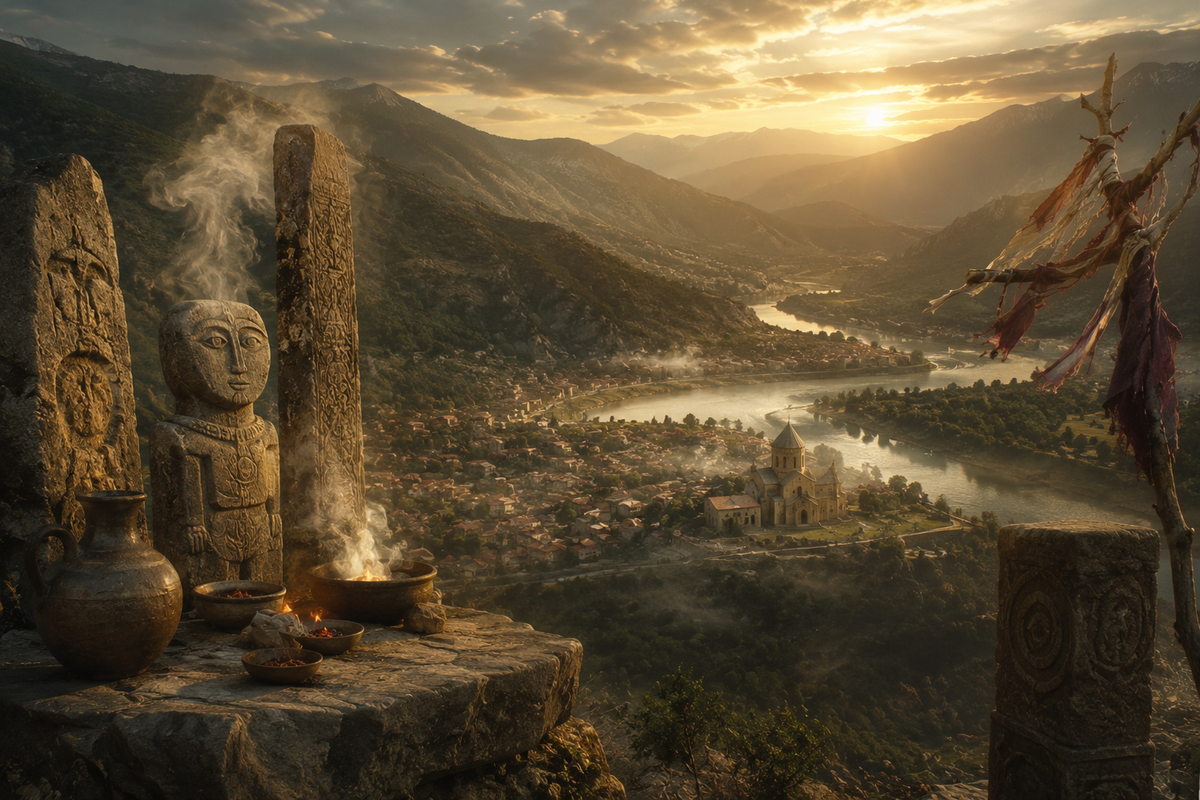
This pantheon can roughly be divided into two layers. The first, the state pantheon of ancient Iberia (Kartli) with the idols of Armazi, Zaden, and others, tied to the kings and the capital. The second, the folk, mountain pantheon: gods of the hunt, the forest, and the hearth, as well as a multitude of spirits of particular places.
The old beliefs held on longest in the mountains, in Khevsureti, Pshavi, Svaneti, and Tusheti, while the written traces of the pantheon survived in the Georgian chronicles and in ancient authors.
👑 Ghmerti and his "children": the supreme god and the khvtishvili
At the head of the pantheon stood Ghmerti, the supreme creator god and lord of the sky, distant and unreachable. Tellingly, after Christianization the very word "ghmerti" became, in the Georgian language, the ordinary word for "God".
In the mountain tradition, above all in Khevsureti and Pshavi, alongside Ghmerti act the khvtishvili, the "children of God". These are divine heroes who mediate between the distant creator and people, defenders of humans against evil forces. Among them are named Kopala and Iakhsari, vanquishers of devs and evil spirits, and Pirkushi, the divine smith who forged weapons against the monsters.
The concept of the khvtishvili belongs above all to the mountain, Khevsur-Pshav tradition, and the make-up of their "family" and their roles vary from one record to another.
🗿 The state pantheon of Iberia: Armazi and King Pharnavaz
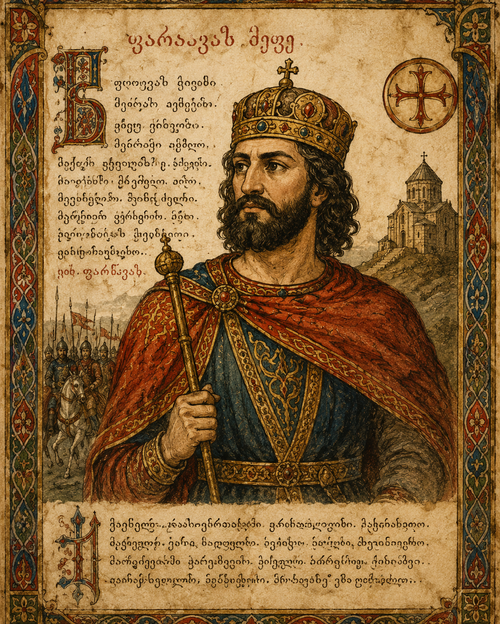
This layer of the pantheon is a direct bridge to real history. The chief deity of pre-Christian Iberia (Kartli) was Armazi. According to the Georgian chronicle, his cult was elevated by King Pharnavaz I, the first king of Iberia, who reigned around the third century BC.
The idol of Armazi was depicted as a warrior in armor; it stood on a mountain near Mtskheta, which is also called Armazi, with other idols beside it. The age of Pharnavaz is the time when the Kingdom of Iberia took shape and the Georgian lands were united, including an alliance with the ruler of Colchis, the neighboring ancient kingdom.
Information about the state idols comes mainly from the chronicle collection "Kartlis Tskhovreba", and the attributions differ across the sources (among the idols Ainina and Danina are also named). The origin of Armazi itself, whether Iranian or Anatolian influence, remains disputed. In general terms, the main idols look like this:
| Idol | Who set it up (per the chronicle) | Note |
|---|---|---|
| Armazi | King Pharnavaz I | Chief deity of Iberia; a warrior idol on a mountain near Mtskheta |
| Zaden | King Pharnajom | Venerated on Mount Zaden near Mtskheta |
| Gatsi and Ga (Gaim) | Set up beside Armazi | Names and attributions vary across the sources |
At the Christianization in the fourth century the idol of Armazi was cast down. We do not retell the full biography of King Pharnavaz I here: a separate historical article is devoted to it, while in this overview Armazi matters as part of the pantheon and a bridge to the history of Iberia.
🌿 Gods of nature and home: Dali, Ochopintre, Barbale
The folk pantheon is closest to nature and everyday life. Its most famous figure, the goddess Dali, mistress of the hunt and wild animals, was especially revered in Svaneti.
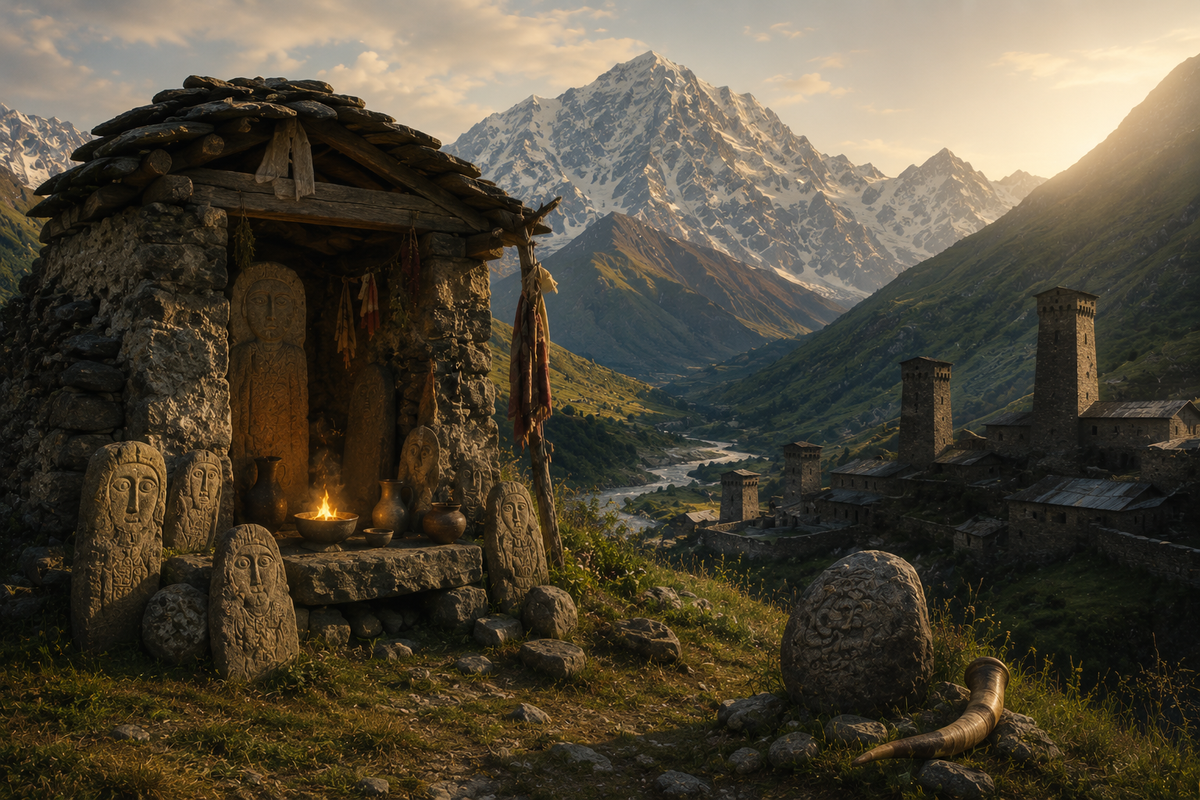
Beside her stands Ochopintre, patron of the forest and the beasts, the Georgian "master of the wild", imagined as half-man, half-goat. In places he competes with hunters, and with Dali herself, for power over the animals.
The female deities were responsible for the sun, fertility, and the home. Barbale, a solar-fertility goddess, was later linked with Saint Barbara (hence the festival of Barbaroba). Adgilis Deda, the "Mother of the Place", protected a particular locality and its fertility; Lamaria was the goddess of the hearth and of women (her image later merged with the Mother of God), while Kviria was regarded as a mediating and judging deity between Ghmerti and people.
| Name | Domain | Note |
|---|---|---|
| Dali | The hunt and wild animals | Especially in Svaneti; has a separate article |
| Ochopintre | The forest and wild animals | "Master of the wild", half-man, half-goat |
| Barbale | The sun and fertility | Later merged with Saint Barbara |
| Adgilis Deda | Protection of a locality | "Mother of the Place", fertility and protection |
| Lamaria | Hearth, women, cattle | Later the image of the Mother of God (Svaneti) |
| Kviria | Mediation and judgment | Mediator between Ghmerti and people |
⛓️ Amirani and the god-fighting heroes
Standing apart in Georgian mythology is Amirani, the main hero of the national epic. He is the son of the goddess Dali and a mortal hunter, the one who gave people fire and was chained to the Caucasus, for which he is often called the Georgian "Prometheus".
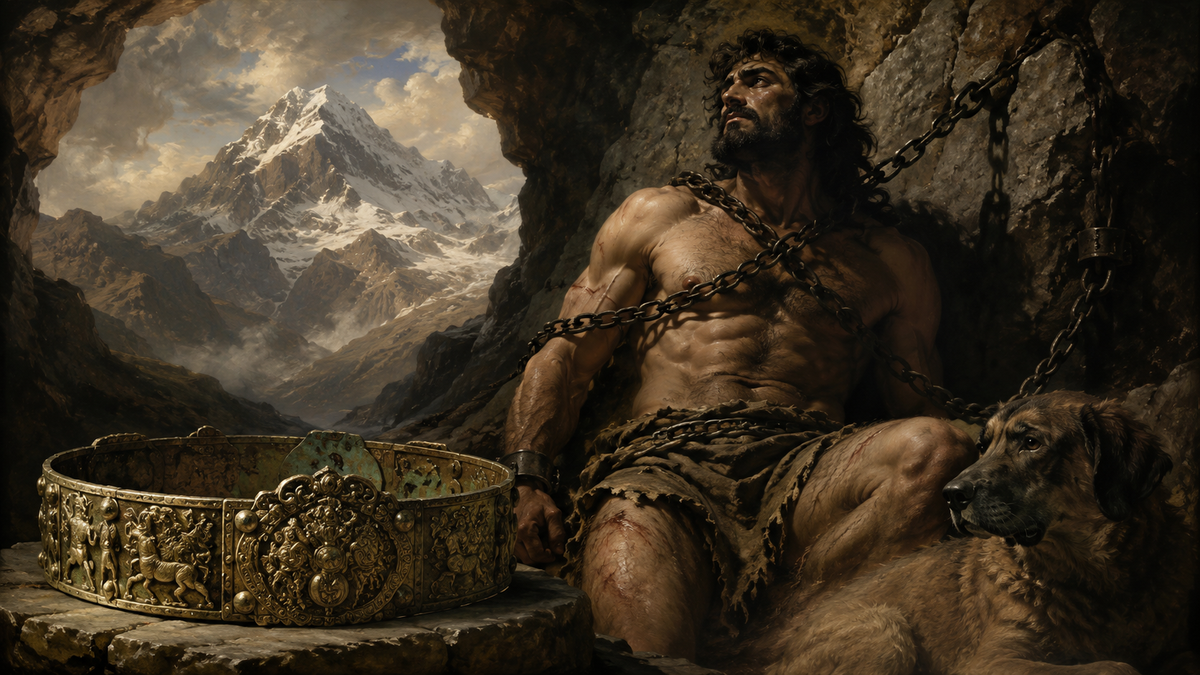
He differs from the khvtishvili in essence: he is not a "child of Ghmerti" but an epic demigod-hero, born of a goddess and a human.
🌙 Tetri Giorgi and the cult of the moon
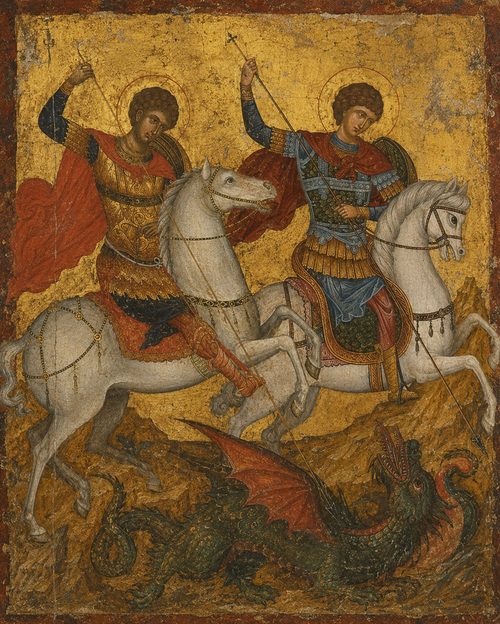
Tetri Giorgi, "White Giorgi", deserves separate attention, a Georgian deity that a number of researchers connect with a pre-Christian cult of the moon, especially in Eastern Georgia.
This matters for understanding why Saint George is venerated so exceptionally strongly in Georgia: his cult largely absorbed ancient beliefs, including, in the opinion of some scholars, lunar ones. At the same time, identifying Tetri Giorgi specifically with a moon deity is a scholarly interpretation, not a proven fact.
⛪ How Christianity replaced the gods: syncretism
Georgia adopted Christianity in the first half of the fourth century, with the mission of Saint Nino in the time of King Mirian III. The state idols, Armazi and others, were cast down, and the official cult became a thing of the past.
However, many folk gods did not disappear but merged with Christian saints, keeping part of their former features. The moon deity and Tetri Giorgi merged with the figure of Saint George; the solar-fertility Barbale was replaced by Saint Barbara; the hearth goddess Lamaria merged with the Mother of God (her name is still borne, for example, by the Svan Lamaria church in Ushguli); and Kviria was reflected in the veneration of Saint Kvirike. These "god, saint" correspondences are fairly stable but still remain an interpretation, so they should be treated without undue certainty.
| Pagan figure | Christian saint |
|---|---|
| Tetri Giorgi (moon deity) | Saint George |
| Barbale (sun, fertility) | Saint Barbara |
| Lamaria (hearth, women) | The Mother of God (Virgin Mary) |
| Kviria (Kvirike) | Saint Kvirike |
❓ Where the pantheon survived to our own day
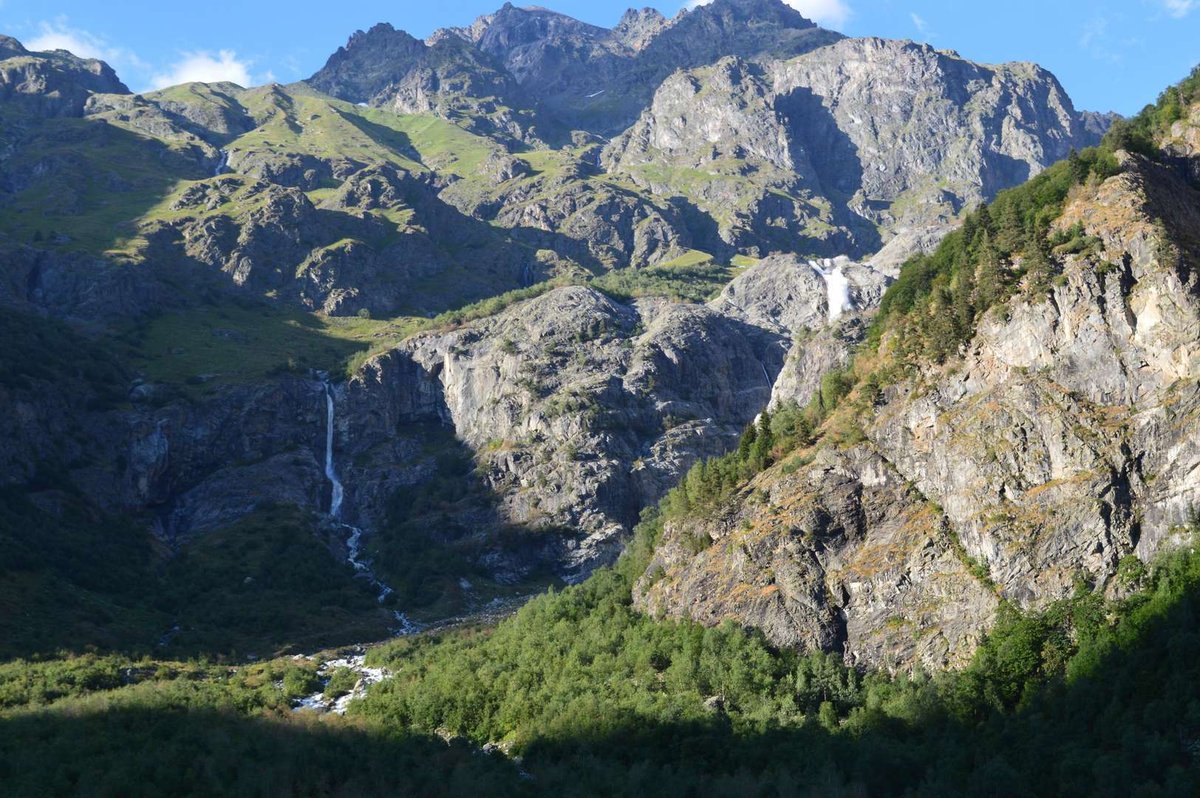
The ancient pantheon survived longest in remote mountain regions. In Khevsureti, Pshavi, Svaneti, and Tusheti pre-Christian rites and shrines (hati and jvari) held on for centuries, and with them the cult of ancestors and of the spirits of place.
The traces of the state pantheon are now sought not in rites but in the ground. These are the surroundings of the ancient capital Mtskheta and the Armaztsikhe-Bagineti site, connected with that very cult of Armazi.
❓ Frequently asked questions about the pagan pantheon
💬 The supreme one was Ghmerti, the sky god and creator. In the state pantheon of Iberia the chief was Armazi, while in folk tradition people revered the hunting goddess Dali, the forest god Ochopintre, the "Mother of the Place" Adgilis Deda, and many others.
💬 The supreme creator god and lord of the sky in Georgian mythology. After the adoption of Christianity his name ("ghmerti") became the Georgian word for God.
💬 The chief deity of pre-Christian Iberia (Kartli). His cult was elevated by King Pharnavaz I, and the idol stood on a mountain near Mtskheta; at Christianization it was cast down.
💬 Yes. The state pantheon with the idols of Armazi, Zaden, and others is known from the Georgian chronicles and is linked with King Pharnavaz I and ancient Iberia.
💬 The goddess of the hunt and mistress of wild animals, especially revered in Svaneti. A separate article is devoted to her.
💬 "White Giorgi", a Georgian deity that a number of researchers connect with a pre-Christian cult of the moon. Later his image merged with Saint George.
💬 Part of the cults disappeared (the idol of Armazi was cast down), and part merged with Christian saints: the moon deity with Tetri Giorgi and Saint George, Barbale with Saint Barbara.
💬 The old beliefs and rites were best preserved in the mountain regions: Khevsureti, Pshavi, Svaneti, and Tusheti.
💗 The key points in brief
The pagan pantheon of Georgia is a rich pre-Christian world of gods and spirits, with the sky god Ghmerti above all. Two principles coexisted in it: the solemn state idols of ancient Iberia, headed by Armazi, whom King Pharnavaz I elevated, and the down-to-earth folk gods of the mountains, the huntress Dali, the forest god Ochopintre, the "Mother of the Place" Adgilis Deda, and many others. With the adoption of Christianity in the fourth century the official idols fell, but the folk deities did not so much disappear as dissolve into the figures of the saints: the lunar Tetri Giorgi into Saint George, Barbale into Saint Barbara, Lamaria into the Mother of God. And longest of all this ancient world breathed in the mountains of Khevsureti, Pshavi, Svaneti, and Tusheti, where its memory is alive to this day.
💗 Read next
- Prometheus and Amirani: the son of Dali and the Georgian "Prometheus".
- The Kingdom of Colchis: the second ancient kingdom beside Iberia.
- The goddess Dali: mistress of the hunt and beasts of Svaneti.
- Creatures of Georgian folklore: devs, spirits, and mountain monsters.
- Myths and legends of Georgia: a general guide to the topic.
🗣️ Now over to you
The pre-Christian gods of Georgia still stir the imagination. What do you think?
- Which of the Georgian gods seemed most interesting to you: the supreme Ghmerti, the fearsome Armazi, or the huntress Dali?
- Have you happened to see old mountain shrines (hati, jvari) in Khevsureti, Svaneti, or Tusheti?
- How do you feel about the idea that many saints "grew out of" ancient gods?
- Do you know of similar pairs of "pagan god, Christian saint" among other peoples?
Share your thoughts in the comments, we are interested in your opinion.

2 comments
Log in to leave a comment