




🌿 Myths and Legends of Georgia: A Guide to the Gods, Heroes and Tales
The myths and legends of Georgia are made of several layers laid down over thousands of years: the pre-Christian gods of the Kartvelian peoples, headed by Gmerti, the god of the sky; the heroic epic of Amirani, the Georgian Prometheus; a crowded bestiary of folklore full of giants and dragons; the Greek myths set in Colchis (the Golden Fleece, Jason, Medea); and the tales attached to particular places, from the founding of Tbilisi to the birth of wine. None of this is museum dust. The stories here are woven into the mountains, into the cities and even into the vine, and people still tell them at the table. This article is a guide to all the layers at once: a map of the themes, with links to a full account of each one.
📌 In Short
- Gods: a pagan pantheon headed by Gmerti, the god of the sky (Armazi, Dali, Ochopintre, Barbale).
- Hero: Amirani, the Georgian Prometheus, chained to the Caucasus for giving people fire.
- Creatures: devis, veshapis, kajis, alis and kudianis, and beside them the kindly Paskunji and the rashi.
- Myths of Colchis: the Golden Fleece, Jason and the Argonauts, Medea.
- Legends of places: the origin of Georgia, the founding of Tbilisi, Surami Fortress, the birth of wine.
🗺️ What Are the Myths and Legends of Georgia, in Plain Terms
Georgian mythology is the system of pre-Christian beliefs held by the Kartvelian peoples, together with the legends and tales that grew out of them, many of which survived the coming of Christianity. At the head of it all stood Gmerti, the supreme creator and lord of the sky, and around him lived a crowd of deities, spirits, heroes and monsters.
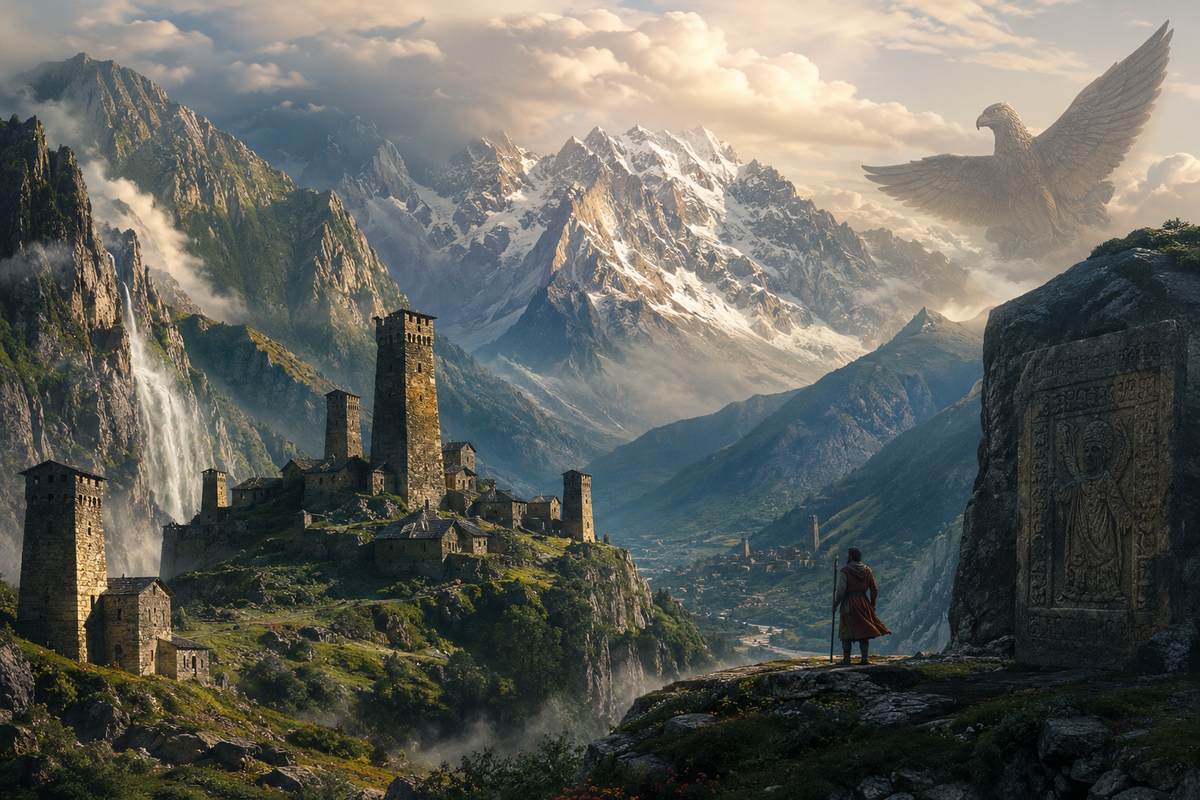
The easiest way to picture this mythology is as five layers laid one on top of another. First, the pagan pantheon. Second, the heroic epic of Amirani. Third, the bestiary of folklore. Fourth, the Greco-Colchian layer: Greek myths that the Greeks themselves set on Georgian soil. Fifth, the legends attached to specific places.
All of it survived in different ways. The old beliefs held on longest in the hard-to-reach mountains: in Khevsureti, Pshavi, Svaneti and Tusheti, where rites and shrines lived on for centuries. The written traces are scattered across the ancient authors (Apollonius of Rhodes, Strabo, Herodotus) and the Georgian chronicles, above all the collection known as Kartlis Tskhovreba. Georgia adopted Christianity in the first half of the fourth century, through the mission of Saint Nino, and at that point many of the gods did not so much vanish as merge with Christian saints.
| Layer | What It Is | Key Names | Where to Read More |
|---|---|---|---|
| ☀️ The Pagan Pantheon | The pre-Christian gods of the Kartvelian peoples, both state and folk | Gmerti, Armazi, Dali, Ochopintre, Barbale, Kviria | The Pagan Pantheon of Georgia |
| ⛓️ The Heroic Epic | A hero who defied the gods, gave people fire and was chained to the Caucasus | Amirani, the goddess Dali, the dog Kursha | Prometheus and Amirani |
| 🐉 Creatures of Folklore | The giants, dragons, sorcerers and spirits of Georgian tales; some of them kindly | Devi, veshapi, kaji, ali, kudiani, Paskunji | Creatures of Georgian Folklore |
| 🏛️ The Greco-Colchian Layer | Greek myths set in Colchis, that is, in Western Georgia | The Golden Fleece, Jason, the Argonauts, Medea, King Aeëtes | The Kingdom of Colchis, The Golden Fleece |
| 🏰 Legends of Places | Tales about the origin of the country, its cities, its fortresses and its wine | Vakhtang Gorgasali, Surami Fortress, the vine | The Origin of Georgia, The Founding of Tbilisi |
❓ What Is the Difference Between a Myth and a Legend
The difference is simple, although in practice the line is not always easy to draw. A myth explains how the world is put together: where the gods came from, and fire, and the animals, and people themselves. It lives outside time and is not pinned to a point on the map. A legend, by contrast, is always about something specific: a city, a fortress, a river, a person. It has an address and, as a rule, a hero of its own.
So the story of how Amirani gave people fire and was chained to a rock for it is a myth. The story of how a king stumbled on a hot spring while hunting and founded Tbilisi on that very spot is a legend. Georgian tradition is rich in both, and this guide follows exactly that order: first the gods, the heroes and the creatures, then the tales of places.
☀️ The Gods of Ancient Georgia: The Pagan Pantheon
At the head of the pantheon stood Gmerti, the supreme creator and lord of the sky, remote and all but unreachable. His trace in the language is permanent: after Christianisation the word gmerti simply became the ordinary Georgian word for God.
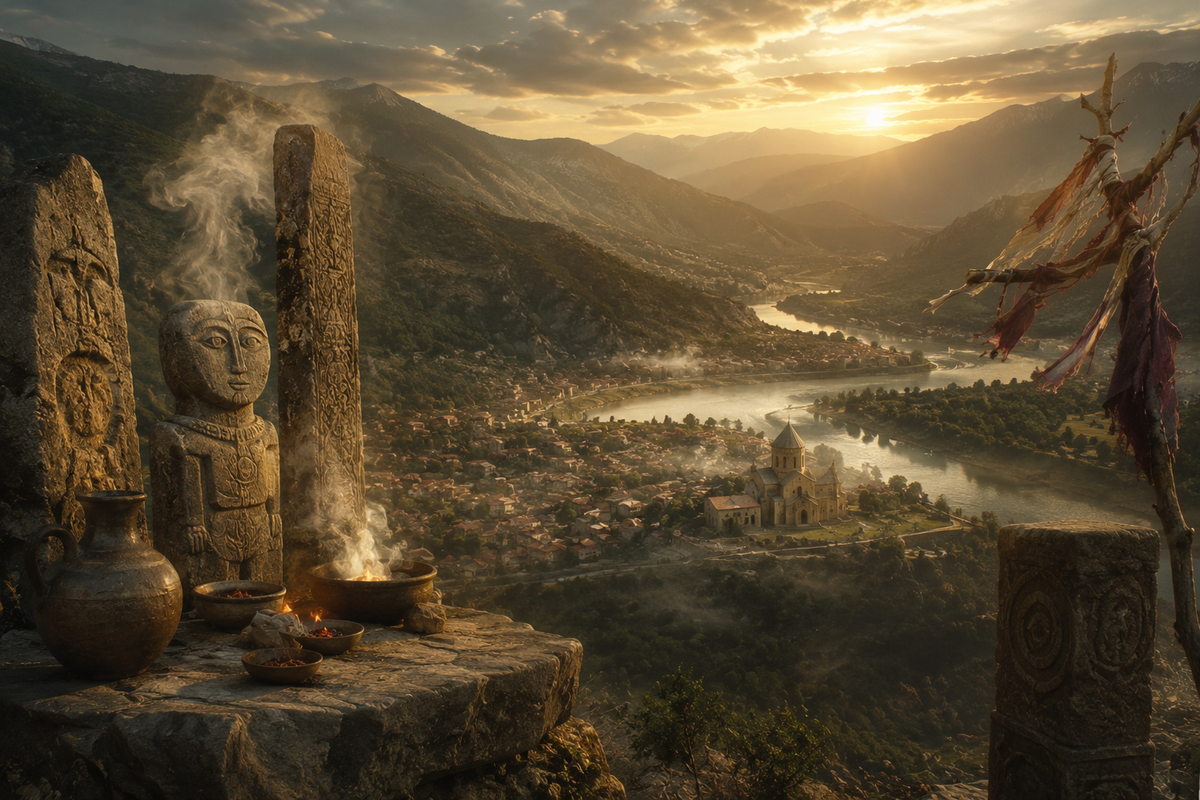
Below him the pantheon splits in two. The first layer, the official one, belongs to the kings of ancient Iberia. Its chief deity was Armazi, whose warrior idol stood on a hill near Mtskheta; according to the Georgian chronicle it was King Pharnavaz the First who raised this cult. The second layer, the folk and mountain one, sits far closer to the ground: Dali, goddess of the hunt; Ochopintre, lord of the forest; Barbale, goddess of the sun and fertility; Adgilis Deda, the “mother of the place”; Lamaria, goddess of the hearth; and Kviria, the mediating deity. In the mountain tradition Gmerti is joined by the khvtishvili, the “children of god”, heroes who stand between a distant creator and human beings.
This pantheon has no single canonical system: different regions described the gods and their roles in their own way. The origin of Armazi himself is disputed too: some see Iranian influence in him, others Anatolian, and there is no clear answer yet.
And when Christianity arrived, many of the gods did not disappear so much as change costume and become saints. The lunar Tetri Giorgi merged with Saint George, Barbale of the sun and the harvest was replaced by Saint Barbara, and Lamaria of the hearth took on the image of the Mother of God. That is part of why Saint George is venerated in Georgia so exceptionally strongly.
| Deity | Domain |
|---|---|
| Gmerti | Supreme creator, lord of the sky and of fate |
| Armazi | Chief deity of ancient Iberia; a warrior idol on a hill near Mtskheta |
| Dali | The hunt and the wild animals of the mountains; mother of Amirani |
| Ochopintre | The forest and everything in it, the “master of the wild” |
| Barbale | Sun and fertility; later merged with Saint Barbara |
| Adgilis Deda | The “mother of the place”, patroness of a particular locality |
| Kviria | Mediator and judge between Gmerti and human beings |
The full account, with the state idols, the khvtishvili and the pairings of pagan god and Christian saint, is in a separate article: The Pagan Pantheon of Georgia. And the brightest figure of the folk pantheon has an article of her own: Dali, goddess of the hunt, mistress of the Svan cliffs.
⛓️ Heroes and God-Defiers: Amirani, the Georgian Prometheus
The central hero of Georgian mythology is Amirani, son of the goddess Dali and a mortal hunter. He gave people fire, taught them metalworking and secret knowledge, and fought dragons and evil spirits. And for his defiance of the supreme god he was chained to a rock inside a mountain of the Caucasus.
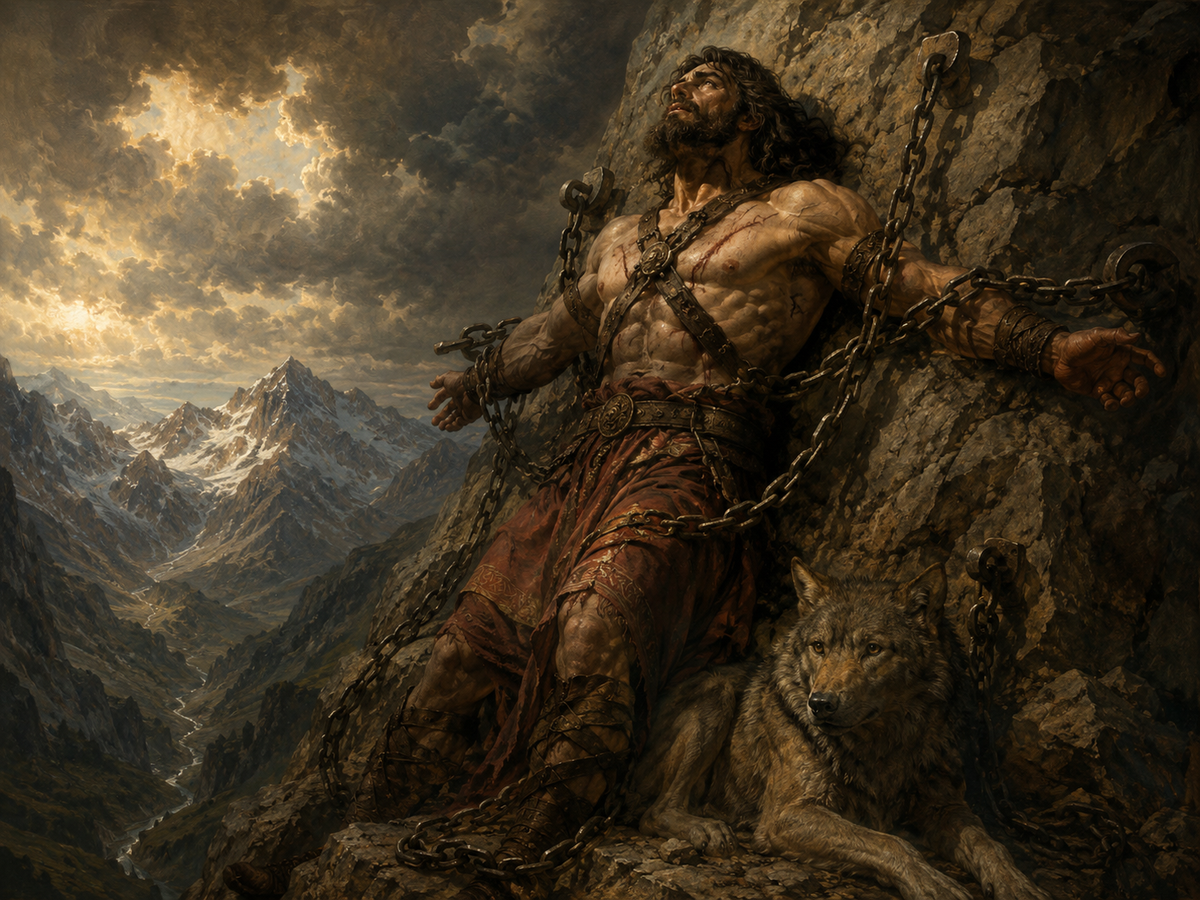
Then comes the part that really lands. An eagle tears at the hero's liver, while his faithful dog Kursha licks the chain, trying to wear it through. But the god's smiths renew the fetters every year, and release never comes. Folk belief has it that once every seven years the cave opens, and Amirani can be glimpsed inside.
The resemblance to the Greek Prometheus is striking: fire for humankind, defiance of the gods, a chain on a Caucasian rock, a bird tormenting the hero. Some researchers go further and see the Caucasian hero as the prototype of the Greek titan; similar stories belong not only to the Georgians but to the Abkhaz (Abrskil) and the Armenians (Mher). This is a scholarly hypothesis rather than a proven fact, and it is best treated as a likely version.
💡 Amirani and Prometheus
Both gave people fire and both are chained to the Caucasus. In all likelihood these myths share a common ancient Caucasian root, and Amirani is the Georgian version of the same story. The difference lies in the detail: Prometheus is chained to an open cliff, Amirani inside a mountain, and unlike the titan he was never set free.
A full comparison of the two heroes, and the story of the Prometheus Cave near Kutaisi, are in the article Prometheus and Amirani.
🐉 Creatures of Georgian Folklore: Who Lives in the Legends
Georgian folk tales are densely populated. Here you will find devis, enormous many-headed giants who guard treasure and carry off beautiful women. Veshapis, also called gveleshapis, the dragons and giant serpents who block the rivers and demand tribute. Kajis, cunning sorcerers and smiths with a magical country of their own, Kajeti, which even turns up in Rustaveli. There are the alis, evil spirits most often in female form, and the kudianis, witches whose name is linked to the Georgian word kudi, meaning tail. And through the forests of Western Georgia roams Ochokochi, the shaggy “wild man” of Megrelian folklore.
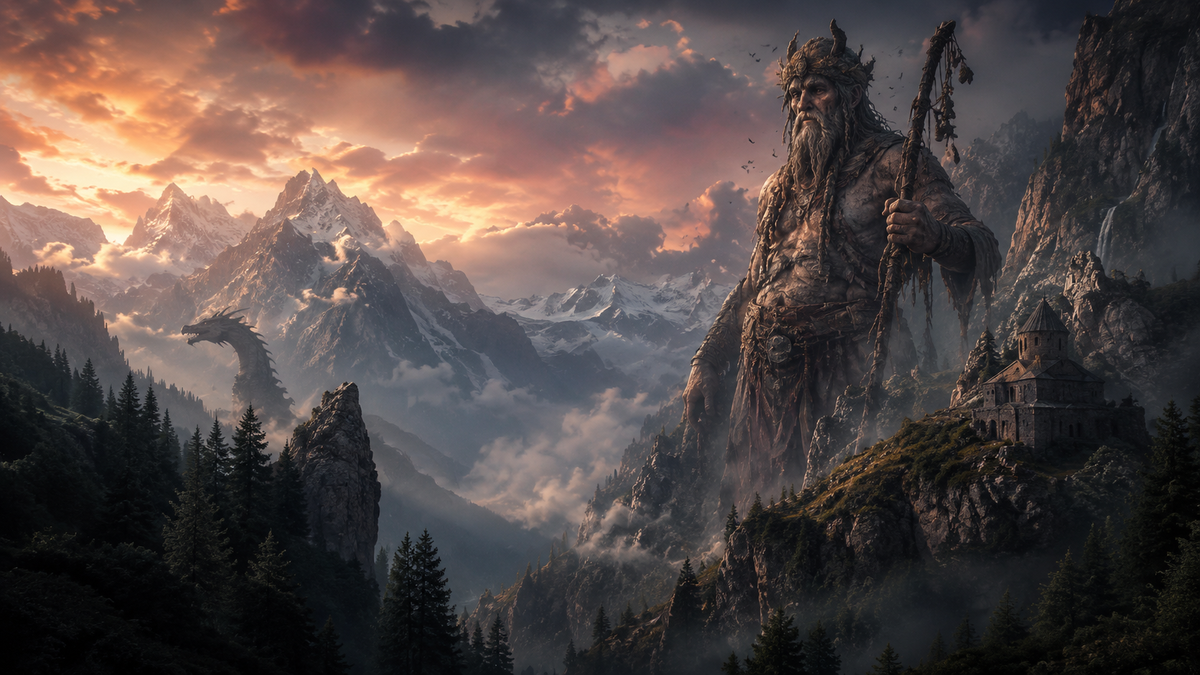
But folklore here is not only about fear, and that matters. Alongside the malevolent creatures live genuinely kind ones: Paskunji, a marvellous bird who carries the hero up out of the underworld and heals his wounds, and the rashi, magical horses who are the loyal companions of heroes. The world of Georgian legend rests not only on dread but on the belief that help will come.
| Creature | Who It Is | Dangerous or Not |
|---|---|---|
| Devi | Many-headed man-eating giant; guards hoards of treasure | Dangerous |
| Veshapi | Dragon and serpent; blocks the water and demands tribute | Dangerous |
| Kaji | Sorcerer and smith, master of enchantment; their land is Kajeti | Dangerous, cunning |
| Ali | Evil spirit, most often female; leads travellers astray | Dangerous |
| Kudiani | Witch, literally “the tailed one”; they gather at sabbaths | Dangerous |
| Paskunji | A marvellous bird: carries the hero out of the underworld and heals him | Kindly |
The full bestiary, with Tkashi-Mapa the queen of the forest, the petty water demons known as chinka and every kind of magical rashi horse, is in the article Creatures of Georgian Folklore.
🏛️ The Greco-Colchian Layer: The Golden Fleece, Medea and Colchis
A separate and very powerful layer arrived from outside: the Greek myths that the Greeks themselves set on the territory of Georgia. The distant land on the eastern shore of the Black Sea, the one the heroes of Hellas sailed towards, was called Colchis, and that is the territory of modern Western Georgia: Imereti, Samegrelo, Svaneti, Guria and Adjara.
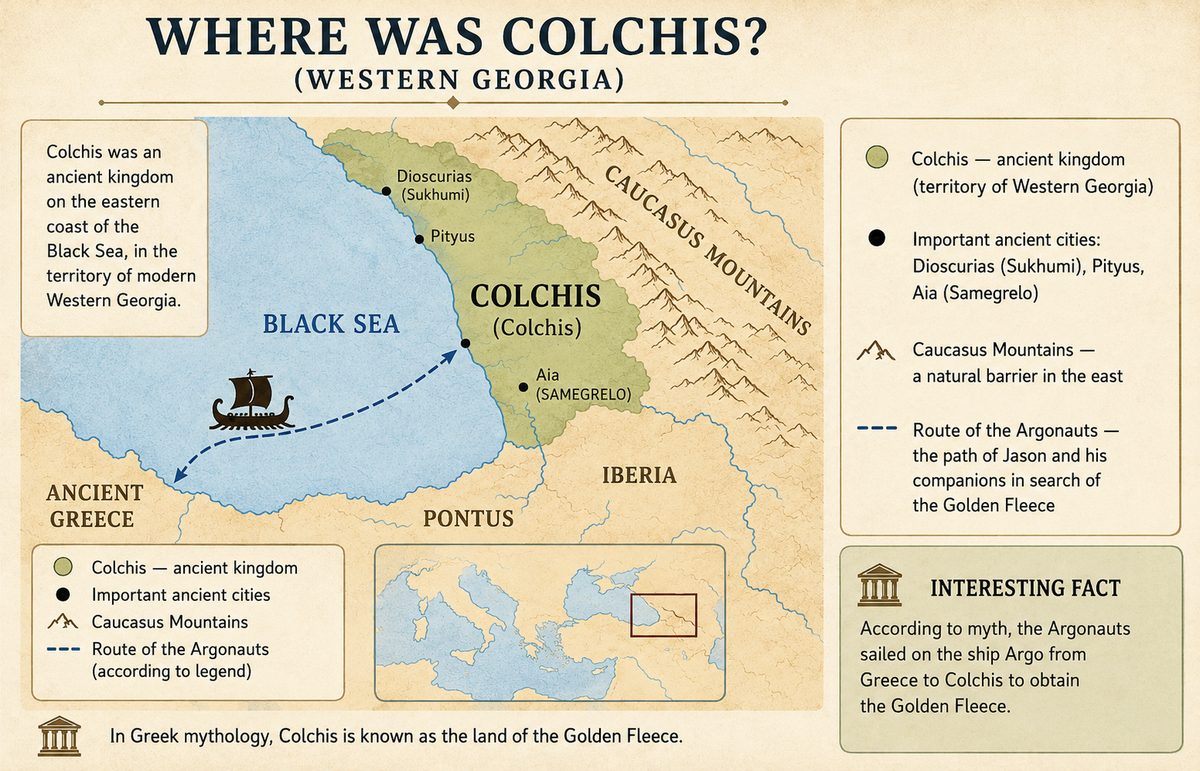
It was here, to the kingdom of Aeëtes, that Jason sailed for the Golden Fleece with fifty Argonauts aboard the Argo. It was here that Medea, the king's daughter and a sorceress, came to his aid, and without her the expedition would simply have failed. And it was here too, on the cliffs of the Caucasus at the edge of Colchis, that myth chained the titan Prometheus.
It is worth being clear whose gaze this is. The Greco-Colchian layer is not Georgian mythology in the strict sense; it is the image of ancient Georgia seen through Greek eyes, a fabulously rich country at the very edge of the known world. But it plays out on Georgian soil, and archaeology has confirmed the picture: the Colchian gold unearthed at Vani turned out to be entirely real.
🗺️ Greek Myths on the Map of Georgia
- The Golden Fleece and Colchis: Western Georgia, the kingdom of King Aeëtes.
- Jason and the Argonauts: the Argo put in at the mouth of the Phasis, today’s Rioni near Poti.
- Medea: the Colchian king’s daughter; her bronze statue holding the fleece stands in Batumi.
- Prometheus: chained to the cliffs of the Caucasus, most often said to be Mount Kazbek.
Each story has an article of its own: what the Golden Fleece actually was and why it was “golden”, how the voyage of the Argonauts unfolded, who Medea really was, and what the real Colchis was like as a state.
🏰 The Legends of Georgian Places
If myths explain the world in general, legends explain the particular: why the country is so beautiful, where a city got its name, why a fortress has stood for centuries, and how wine came to be here. These are the four best known.
❓ How the Georgians Came by Their Land
The best-loved Georgian legend explains the beauty of the country. God was handing out lands to the nations, and the Georgians, bored of waiting in the queue, laid a table to pass the time. They got carried away and arrived when everything had already been given out. Asked where they had been, they answered honestly: they had been drinking to His health and to the prosperity of every nation on earth. The answer pleased God so much that He gave them the one thing He had kept back for Himself, a hidden scrap of land with divine landscapes and fertile valleys. And the Georgians swore to guard that land and to receive guests as family. We tell the legend in full in The Legend of Georgia's Origin.
🦅 The Founding of Tbilisi
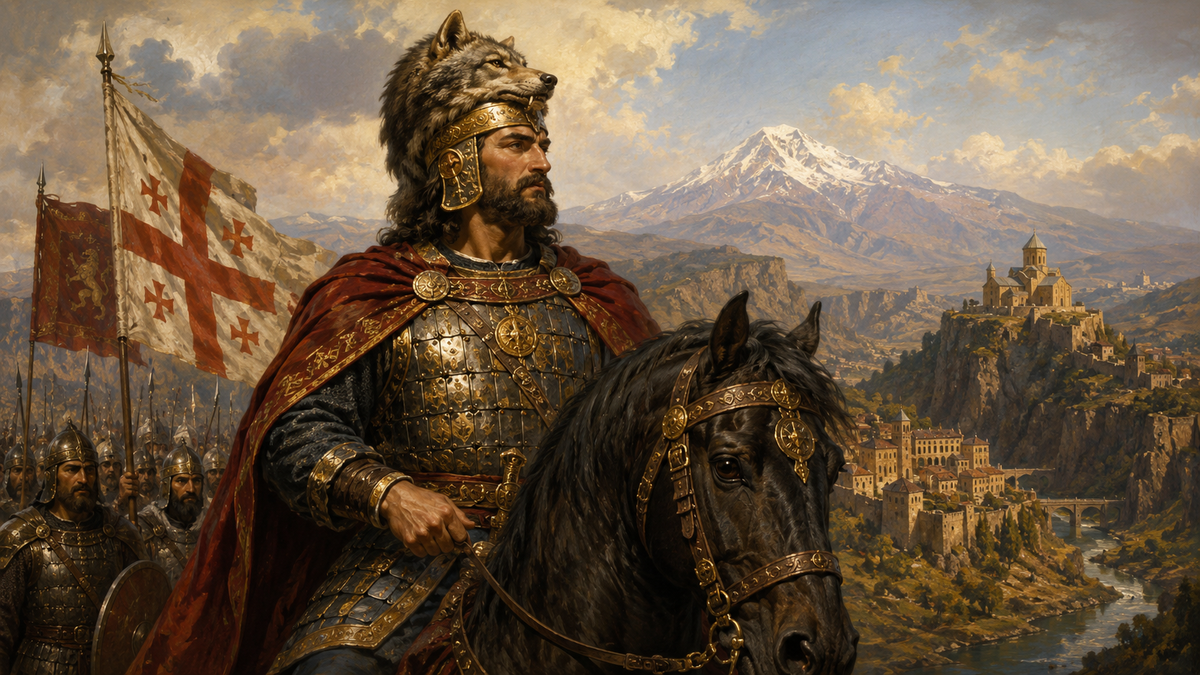
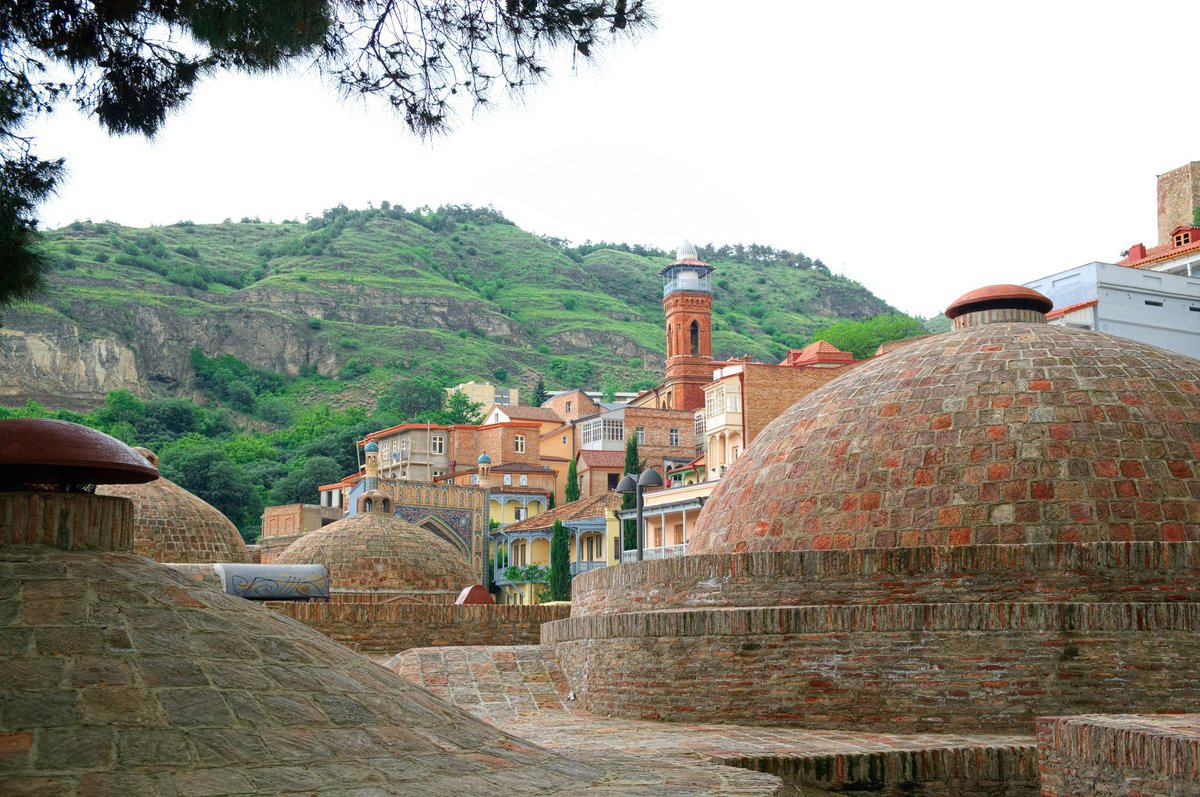
King Vakhtang Gorgasali was hunting in the valley of the Mtkvari when his falcon brought down a pheasant, and both birds fell into a hot spring. Astonished by the find, the king founded a city on the spot, and the waters gave it its name: tbili is Georgian for warm. There is a gentler version too, in which a wounded deer falls into the spring and is healed. The same hot waters still feed the sulphur baths of Abanotubani.
🏰 Surami Fortress
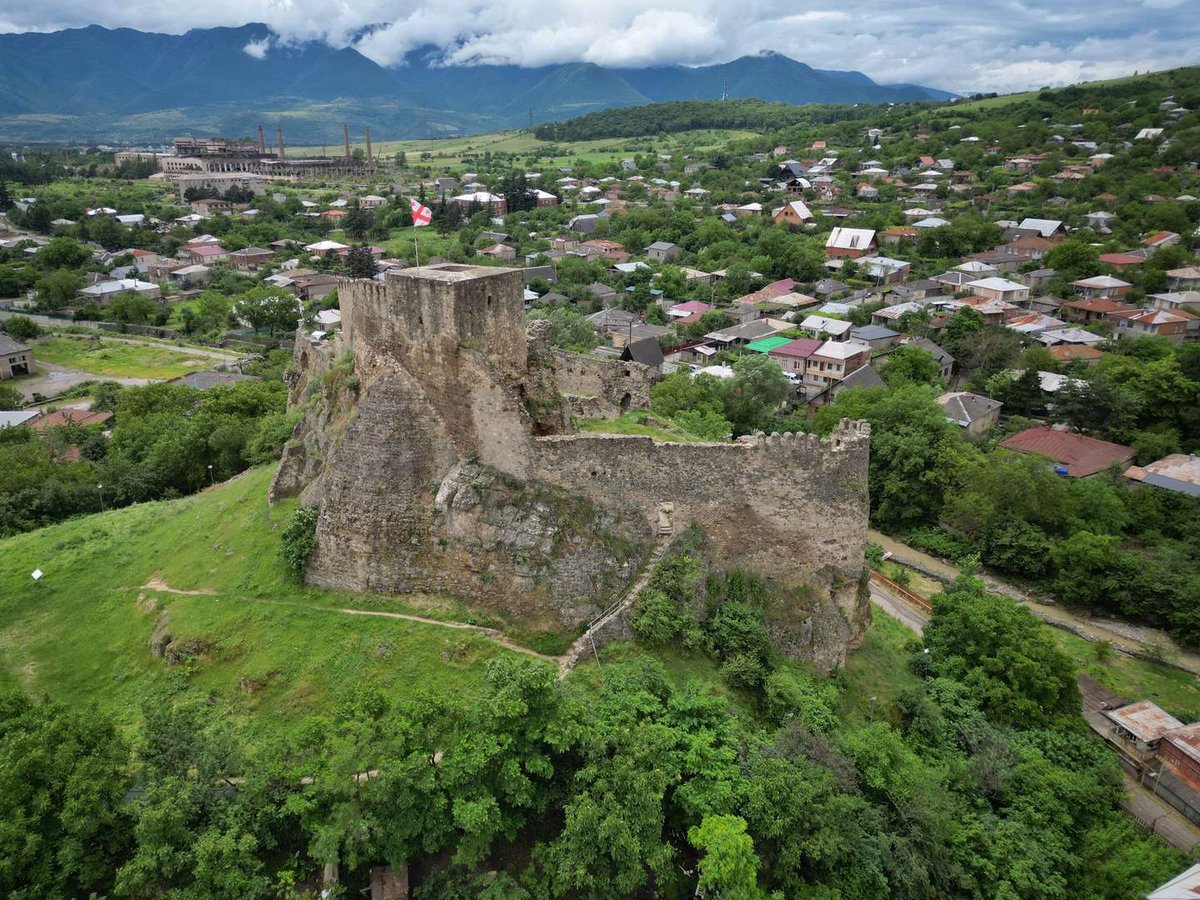
The walls of the fortress refused to stand, and so, the story goes, a young man was walled into the masonry to make them hold. This is a tragedy about the price paid rather than a heroic victory, and it is told with restraint. Behind it lies the ancient folk motif of the building sacrifice, familiar to many peoples from the Caucasus to the Balkans, and the legend owes its wide fame to the novella by Daniel Chonkadze and the film by Sergei Parajanov.
🍇 The Birth of Wine
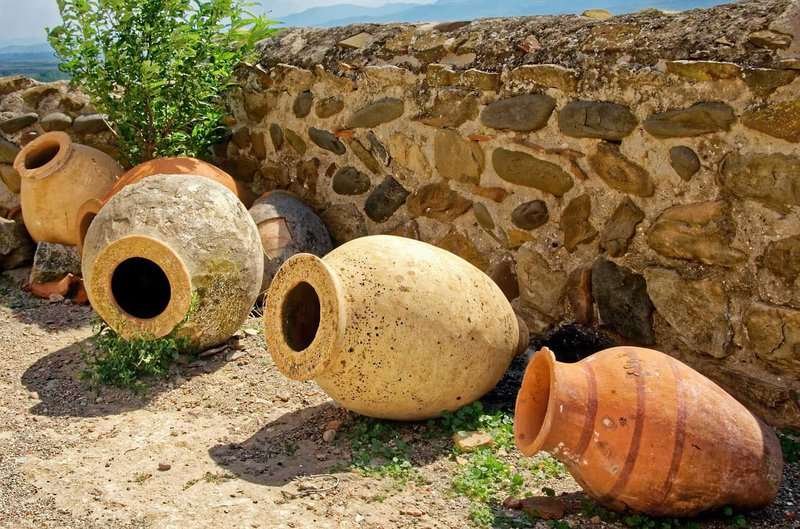
Georgians tell the story of how wine appeared here not with dates but with tales about the vine, which is guarded and honoured as a gift. And the legend sits surprisingly close to the truth: winemaking in Georgia is around eight thousand years old, and the ancient kvevri method is on the UNESCO heritage list. The vine became a double symbol here: by tradition it was Saint Nino who brought the cross of vine wood to the country.
| Place | The Legend in Brief | Where to Read It |
|---|---|---|
| All of Georgia | God gave the Georgians the land He had kept back for Himself | The Origin of Georgia |
| Tbilisi | A falcon and a pheasant fell into a hot spring, and the king founded a city | The Founding of Tbilisi |
| Surami, Shida Kartli | A young man was walled into the fortress so that it would stand | Surami Fortress |
| Kakheti and the whole country | Wine was born together with the vine, which is honoured as a gift | The Birth of Georgian Wine |
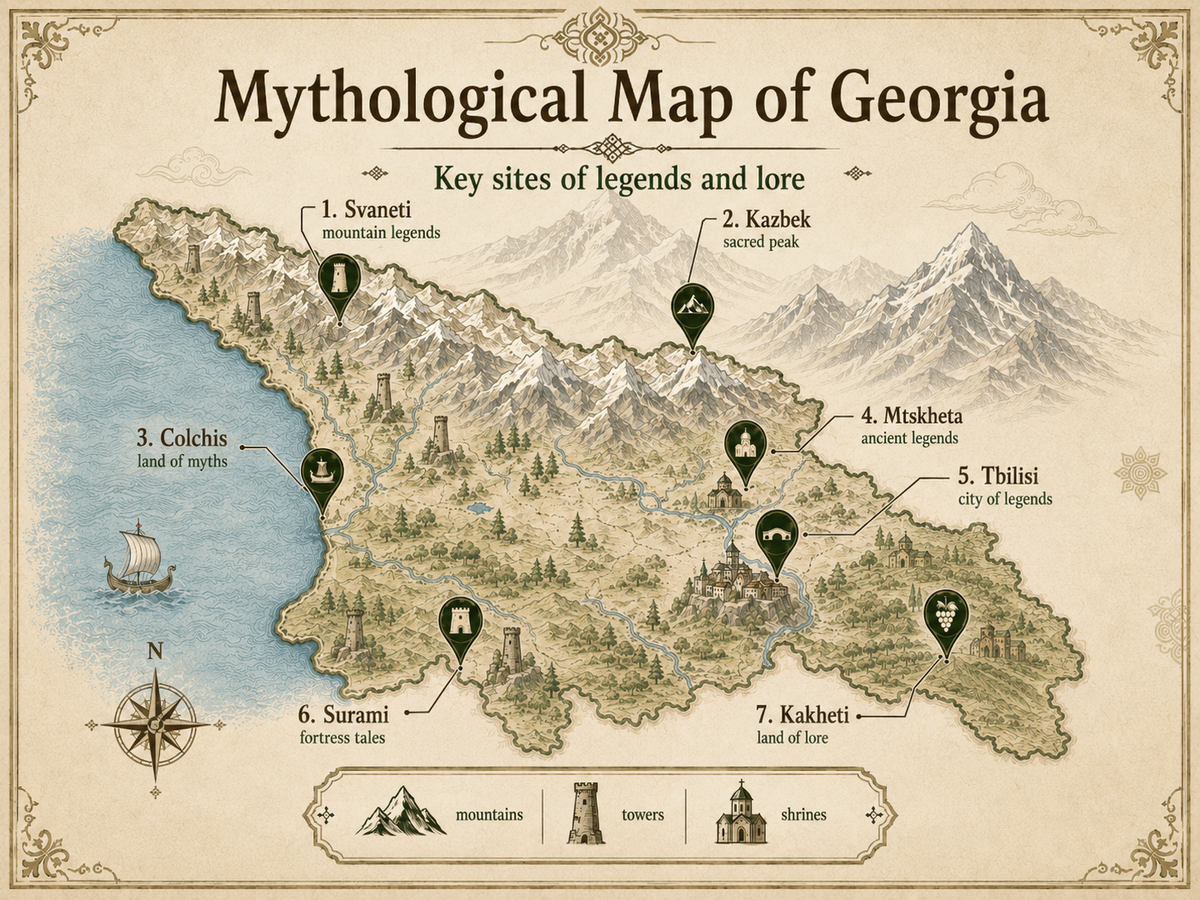
🗺️ A Map of Mythological Georgia: Where Each Myth Lives
The good thing about Georgian mythology is that you can do more than read it, you can travel it. Almost every story has a region of its own, and together they form a map that shows where each one was born. Blue marks the myths, pink the legends of places.
✨ Why the Myths of Georgia Are Still Alive
First, the mythology here stands out in the street. In Batumi, on Europe Square, a bronze Medea rises with the Golden Fleece held up in her hand. In the centre of Kutaisi the Colchis Fountain plays, crowned with gilded figures that are enlarged copies of ancient Colchian jewellery. And in Tbilisi, on the cliff above the Mtkvari beside the church of Metekhi, Vakhtang Gorgasali sits on his horse and looks out over the quarters he is said to have founded himself.
Second, the gods never went away, they simply changed clothes. The merging of pagan cults with Christian saints is still felt in Georgian religious life, and the extraordinary devotion to Saint George is the clearest example.
Third, in the mountains the old stories survived almost into our own day. In Svaneti, Khevsureti and Tusheti the old rites, the hunting taboos and the shrines held on for centuries, coexisting quite calmly with the church calendar.
And fourth, wine. The vine in Kakheti and across the country is a drink, a faith and a feast all at once. The Georgian supra, with its tamada and its long sequence of toasts, is, if you think about it, the living continuation of that very legend about the gift of the land. It all began at the table, after all.
❓ Frequently Asked Questions About the Myths and Legends of Georgia
💬 It is the pre-Christian belief system of the Kartvelian peoples and the tales that grew out of it: gods headed by Gmerti, the hero Amirani, mythical creatures and the legends of particular places. Much of it survived Christianisation and lived on in the mountains.
💬 Gmerti, the supreme creator and lord of the sky. After Christianity was adopted, the word gmerti became the ordinary Georgian word for God.
💬 The hero Amirani. He gave people fire and rose against the supreme god, and for that he was chained to a rock in the Caucasus, just like the Greek titan.
💬 Devis (giants), veshapis (dragons), kajis (sorcerers), alis (evil spirits), kudianis (witches) and Ochokochi of the forest. There are kindly ones too: the bird Paskunji and the magical horses called rashi.
💬 The myth of the Golden Fleece and the voyage of the Argonauts, the story of Medea, and the myth of the chained Prometheus. All of them are set in Colchis, that is, in Western Georgia.
💬 Some of the cults did merge with saints: Tetri Giorgi with Saint George, Barbale with Saint Barbara, Lamaria with the Mother of God. This is a well-established scholarly reading rather than a documented fact.
💬 From the Georgian word tbili, meaning warm. By legend King Vakhtang Gorgasali founded the city beside the hot sulphur springs he came across while hunting.
💬 Best of all in the mountain regions: in Svaneti, Khevsureti, Pshavi and Tusheti, where the old rites and shrines lasted for centuries.
💬 A myth explains how the world and the gods are arranged, while a legend is tied to a particular place, person or event: a city, a fortress, a river. Georgian tradition is rich in both.
💬 The two easiest ways in are the pagan pantheon, if you want to understand the system of gods, and the Golden Fleece, if the Greek trace on Georgian soil appeals to you more.
📌 In Short
Georgian mythology is built out of five layers. There is the pagan pantheon headed by Gmerti, where the stern official Armazi lives alongside the down-to-earth huntress Dali. There is Amirani, the hero who gave people fire and was chained to the Caucasus for it, the Georgian double of Prometheus. There is the crowded bestiary of folklore, from many-headed devis to the kindly bird Paskunji. There is the Greco-Colchian layer, in which the myths of the Golden Fleece, the Argonauts and Medea play out on Georgian ground. And there are the legends of places: how God gave the Georgians the land He was keeping for Himself, how a falcon and a pheasant uncovered the hot springs of Tbilisi, how the fortress at Surami stood only at the price of a human life, and how wine was born here.
The real point, though, is that none of this mythology has gone anywhere. The gods put on the clothes of saints, the heroes stayed in the mountains, and the old tales stand in the streets as monuments and are heard at the table alongside the toasts.
💗 Read Next: The Complete Guide to the Myths of Georgia
Gods and Heroes
- The Pagan Pantheon of Georgia: the gods before Christianity
- Dali, Goddess of the Hunt: mistress of the Svan cliffs and mother of Amirani
- Prometheus and Amirani: the titan chained to the Caucasus
Creatures of Folklore
- Creatures of Georgian Folklore: devis, veshapis, kajis and kudianis
Myths of Colchis
- The Golden Fleece: the myth and the real explanation from Svaneti
- Jason and the Argonauts: the voyage to Colchis for the fleece
- Medea of Colchis: princess, sorceress and the tragedy of the myth
- The Kingdom of Colchis: where myth meets history
- The Statue of Medea in Batumi: who stands on the column and why she holds the fleece
Legends of Places
- The Legend of Georgia’s Origin: the land God kept for Himself
- The Founding of Tbilisi: Vakhtang Gorgasali, the falcon and the warm springs
- Surami Fortress: the legend of the young man walled in
- The Birth of Georgian Wine: the vine, the kvevri and eight thousand years
- Mtskheta: history, legends and the meeting of two rivers
🗣️ Over to You
Georgian mythology is the kind that leaves nobody cold: everyone ends up with a favourite hero or a favourite place. Tell us yours.
- Which layer draws you most: the ancient gods, the hero Amirani, the creatures of folklore, or the Greek myths of Colchis?
- Have you heard the legend of how God gave the Georgians the land He was keeping for Himself, and was it told to you at the table?
- Have you been to the places where myth comes alive: the statue of Medea in Batumi, the Prometheus Cave, or the sulphur baths of Tbilisi?
- Which hero or creature should we look at in more detail next time?
Share your thoughts and stories in the comments. We would love to know what Georgian mythology looks like to you. ❤️

2 comments
Log in to leave a comment