




🗺️ Shrine of Nine Crosses at Nakerala Pass: History, Legends and the Trail
What to know about Tskhrajvari before you go
An open-air mountain shrine at 1,569 m near the Nakerala Pass — not a church, just crosses on bare rock. Pilgrims and hikers come for the legends and one of Georgia's finest panoramas.
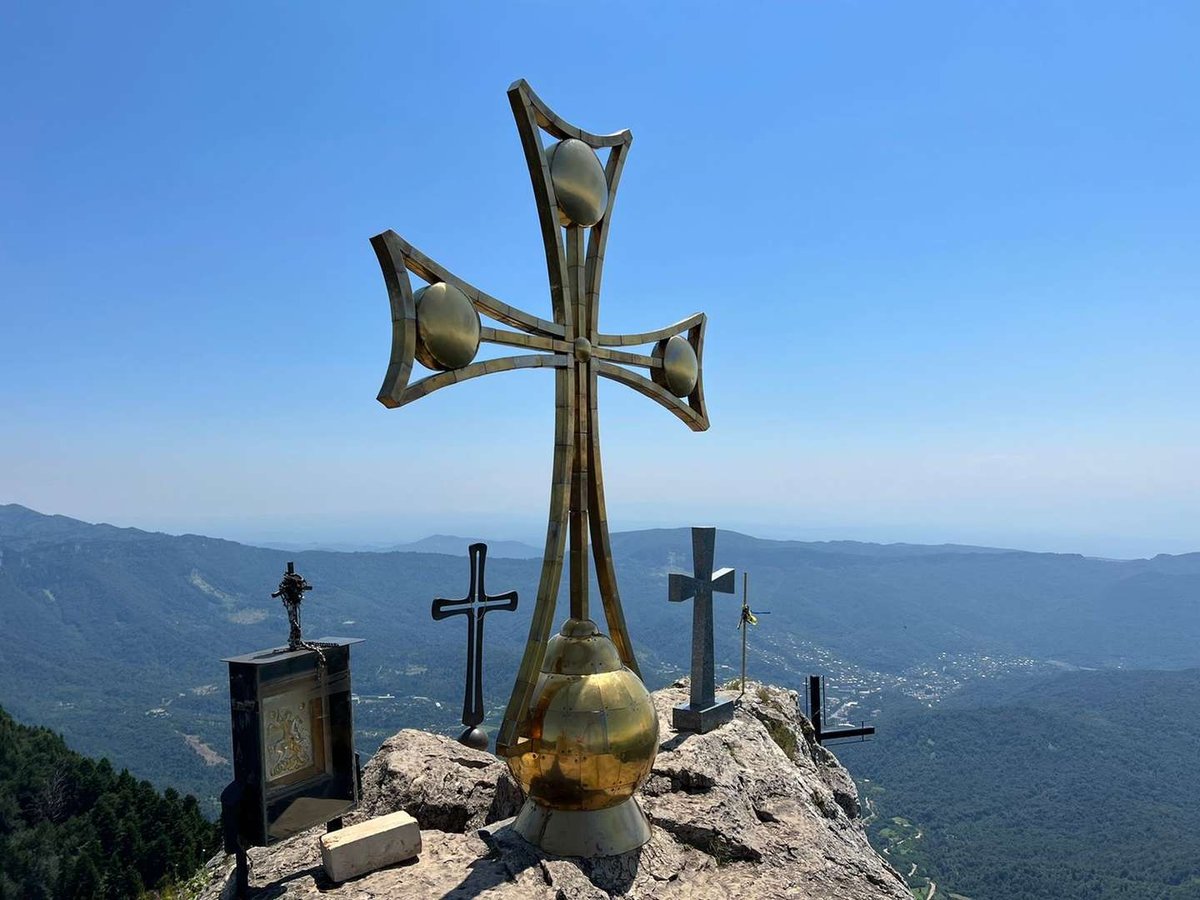
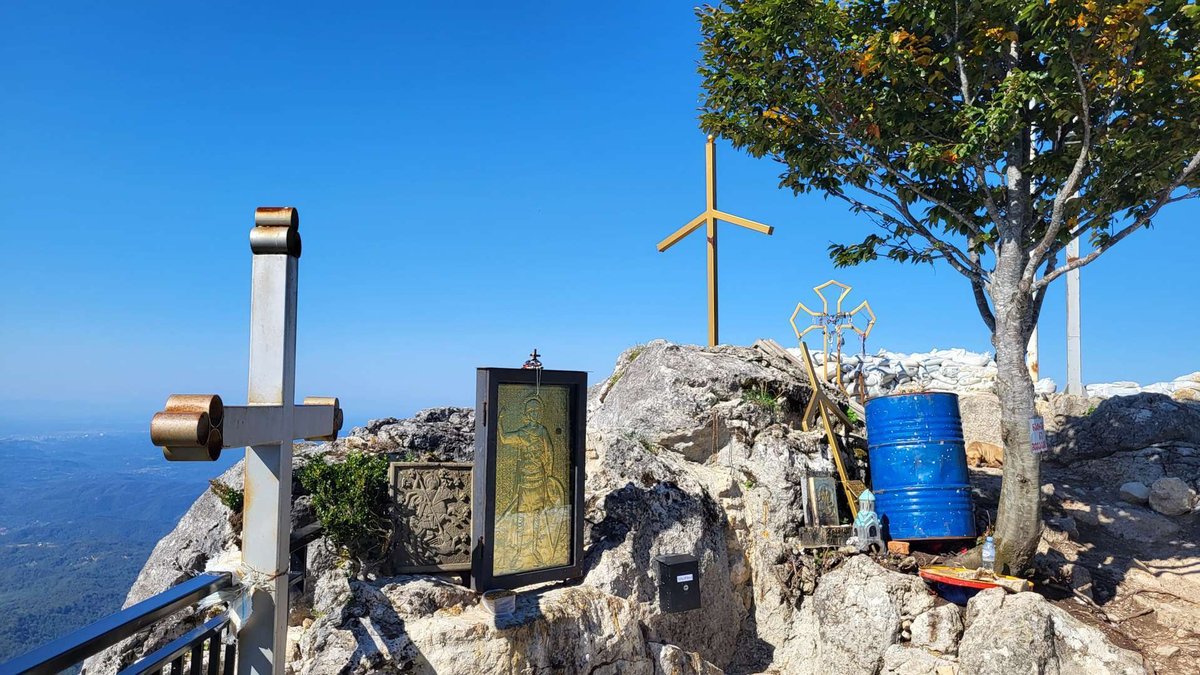
Tskhrajvari means "nine crosses" in Georgian — "tskhra" is nine, "jvari" is cross. It is not a church or monastery. On a bare rock summit at 1,569 metres, a cluster of crosses stands in the open air: the tallest is a large gold cross with lily-shaped ends, a form traditional in Georgian Orthodox practice. There are no walls, no roof — just the crosses, the wind, and on a clear day a panorama stretching from the Greater Caucasus to the Black Sea.
The site sits on the border of Imereti and Racha-Lechkhumi, right at the Nakerala Pass where the road links the mining town of Tkibuli with Ambrolauri. It draws both Orthodox pilgrims — the shrine is dedicated to Saint George — and hikers after one of Georgia's finest viewpoints. Before your visit, check the Tskhrajvari listing on Madloba for photos, coordinates and a directions button.
📍 Getting There
Tskhrajvari is in Imereti, about 50 km north of Kutaisi. The landmark at the car park is the abandoned Soviet-era upper cable car station — a large concrete block you cannot miss.
🚗 By car: about one hour from Kutaisi via Tkibuli. Approaching the Nakerala Pass from Tkibuli, turn left at the sign. The road is sealed but rockfalls are possible; drive slowly.
🚌 By public transport: minibuses run from Kutaisi to Tkibuli. From there, take a taxi or arrange a lift. There is no direct public transport to the car park.
🥾 The Trail
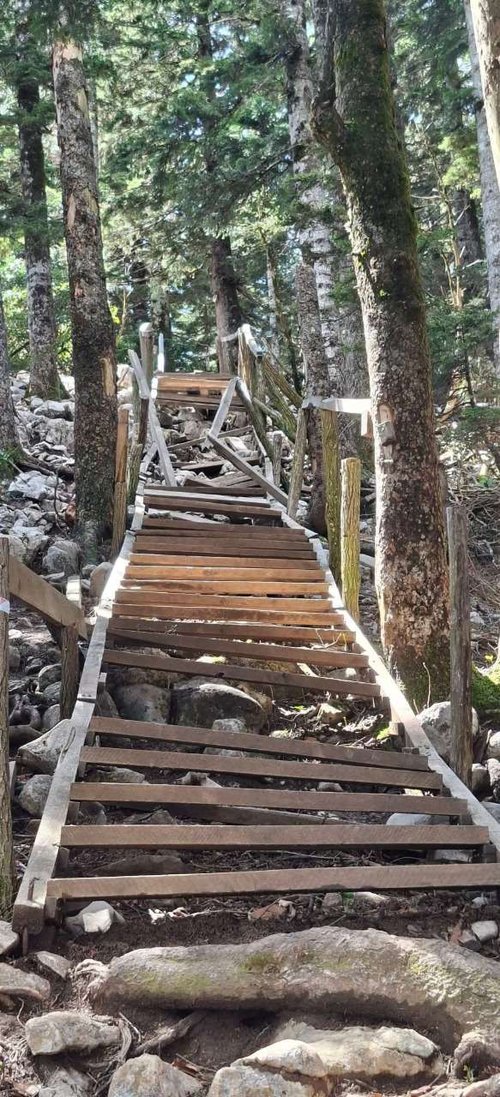
From the car park to the summit is about 2 km: roughly a kilometre of dirt track followed by a moderate hiking trail that runs along a cliff edge. Total elevation gain is around 73 metres. Allow 30–60 minutes one way.
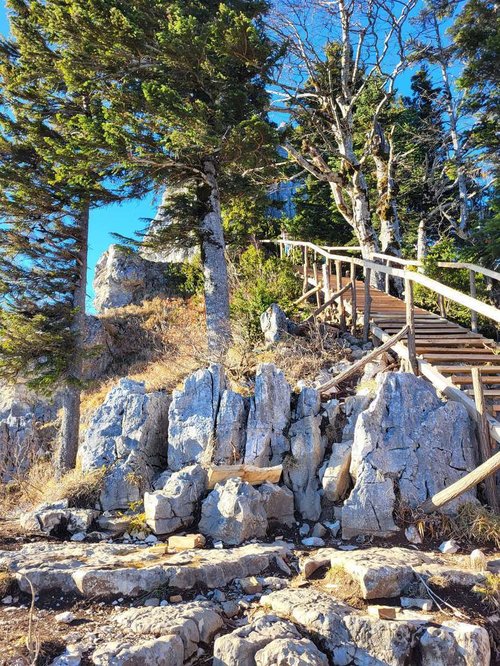
Until 2022, reaching the summit required pulling yourself up iron chains, via ferrata style. A set of wooden stairs and railings was installed at the steepest sections that year. The stairs have since been damaged in several places — some sections are broken or missing, forcing you to scramble over the rock beside them. Wear proper hiking boots with grip. Do not rely on the stairs being intact.
Weather is the main factor. The area is frequently in cloud. In fog or after rain, the cliff-edge section becomes genuinely dangerous. The best conditions are a clear morning between June and October. If visibility is poor when you arrive, it is worth waiting or coming back another day.
🏔️ The View from the Top
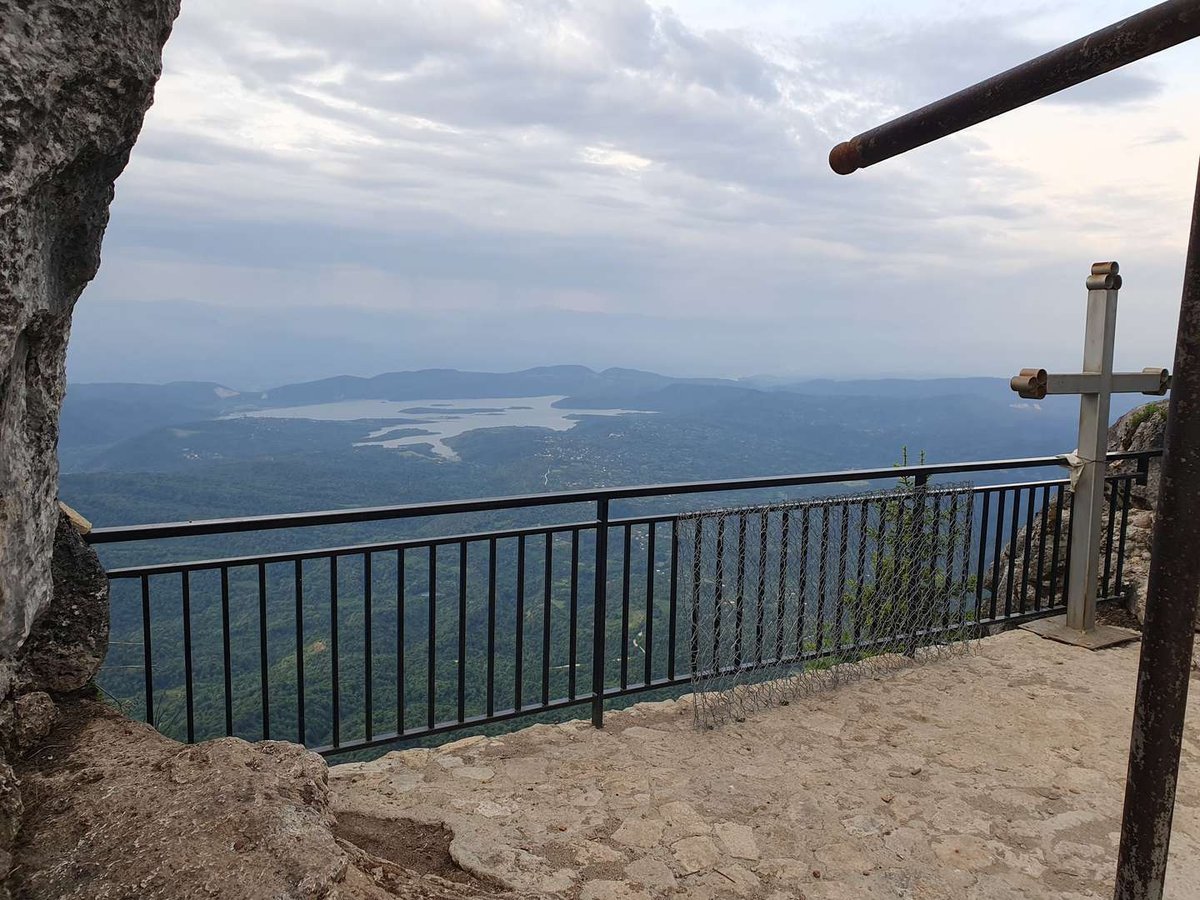
On a clear day, Tskhrajvari offers one of the widest panoramas in Georgia. To the north, the peaks of the Greater Caucasus stretch across the horizon, with the twin summits of Ushba clearly visible above Svaneti. To the north-east, Shaori Reservoir glints through the forest. South-east, Tkibuli and its reservoir lie far below. To the south-west, the Colchic lowlands spread towards the coast — on exceptional days, the Black Sea is a thin line on the horizon.
The view is a full 360 degrees from the summit.
📜 Two Legends
Two separate stories explain how the nine crosses came to be here. Both are oral tradition; neither has a documentary source.
The father and his nine sons. Nine sons from one family were sent to war. Their father prayed every day for their safe return. At some point he made a vow: he carried nine crosses on his shoulders up the mountain, one for each son, and set them on the summit. All nine came home alive. Most versions of the story place this during the Second World War, though the family name and village are not recorded anywhere.
The Sopromiani brothers. In Svaneti, a group of brothers killed a nobleman and fled to escape blood revenge. They settled in Okriba, changed their name to Sopromadze, and started families. But all the boys born to the clan died in childhood. One day they released a dove as a prayer — the bird flew up and landed on this mountain peak. The Sopromadze men carried stones by hand up the slope and built a small shrine. On the day they finished, they held a feast, drank heavily, quarrelled, and wounded each other with the bones of slaughtered animals. When they sobered up, they fell to their knees and begged for forgiveness. Since then, on the last Saturday of May, the descendants of that family gather here and eat no meat.
Neither legend can be verified. They may both be true, or neither. What they share is a sense of the mountain as a place where a debt is paid.
🏗️ The Shrine Today
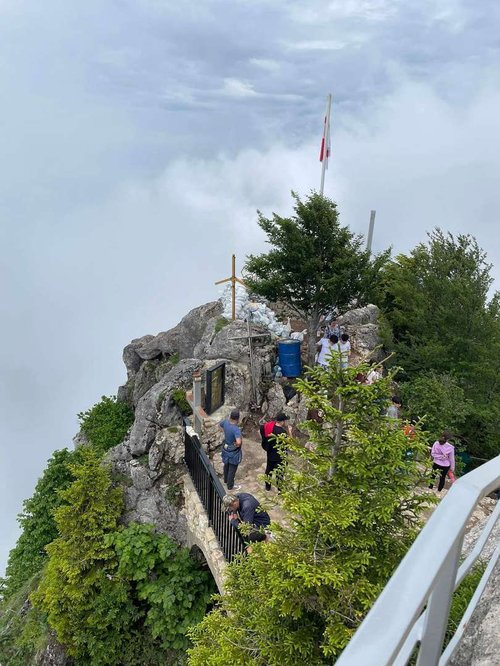
Tskhrajvari is an open-air complex. The centrepiece is a large gold cross with lily-shaped ends — a form characteristic of Georgian Orthodox tradition. Several other crosses of different sizes stand nearby. At the time of recent visits, a small stone chapel was under construction at the summit.
At the car park stands the abandoned upper station of the Tkibuli–Tskhrajvari ropeway. The cable car opened on 21 October 1984 and ran 3,644 metres — the second longest aerial tramway in Georgia and the Soviet Union at the time. It was built to connect the mining city below with the mountain. The station has been empty and deteriorating for decades; the wagons were manufactured at the Tbilisi Aviation Factory. It is an unlikely monument to Soviet ambition in a place that now draws pilgrims rather than mine workers.
A cave was recently discovered near the trail — not yet developed for visitors, but worth noting.
🎉 Tskhrajvaroba
Every year on the last Saturday of May, hundreds of people climb to the shrine for Tskhrajvaroba. It is both a religious pilgrimage and a popular village festival: communities from Tkibuli municipality gather at the summit to pray, then hold communal feasts in the villages below. If you want to see the mountain at its most alive, this is the day. If you prefer solitude, avoid it.
🗺️ Nearby
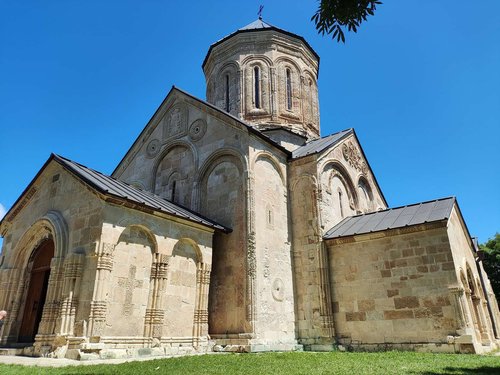
Nikortsminda Cathedral. A masterpiece of 11th-century Georgian stone carving, 20–30 minutes' drive north-east in Racha. The exterior reliefs and 16th–17th century frescoes inside are among the finest in the country. On UNESCO's Tentative List since 2007.
Shaori Reservoir. A 7 km artificial lake 10–15 minutes from Tskhrajvari, ringed by pine and deciduous forest. Quiet and good for a break.
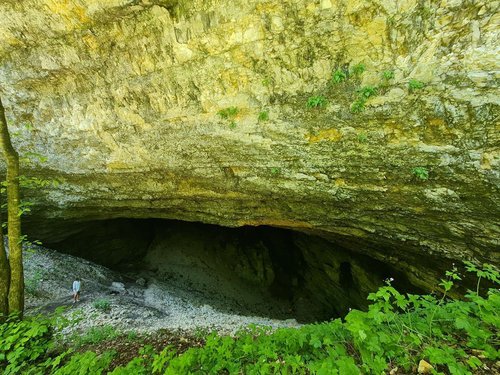
Sakinule Cave. A natural cave near Nikortsminda where ice stalactites and stalagmites form year-round — the name means "freezer" in Georgian.
All three pair naturally with Tskhrajvari on a day trip from Kutaisi. More sights across the region are listed on the Imereti pages of Madloba.
Have you hiked to Tskhrajvari? Leave a review on Madloba — let others know the current state of the stairs, the weather you encountered and what you could see from the top.
Information current as of June 2026. Trail and road conditions change seasonally — check before you go.
❓ Frequently Asked Questions
Tskhrajvari means "nine crosses" in Georgian. It is an open-air Orthodox shrine dedicated to Saint George, set on a rock summit at 1,569 metres near the Nakerala Pass, on the border of Imereti and Racha. Not a church or monastery — crosses on bare rock with panoramic mountain views.
Moderate. About 2 km from the car park, with around 73 metres of elevation gain, taking 30–60 minutes one way. The wooden stairs installed in 2022 are damaged in places — hiking boots with grip are essential.
June–October on a clear day. The site is frequently in cloud, and fog makes the cliff-edge section of the trail dangerous. A clear morning is the ideal window; if it is misty on arrival, waiting or returning another day is a sensible choice.
About one hour by car via Tkibuli. At the Nakerala Pass, turn left towards the car park at the abandoned cable car station. Minibuses run from Kutaisi to Tkibuli; from there you need a taxi.
On a clear day: the Greater Caucasus and Ushba to the north, Shaori and Tkibuli reservoirs, the Colchic lowlands, and — on exceptional days — the Black Sea.
Two oral legends. In the more widely told one, a father carried nine crosses up the mountain during the Second World War, praying for his nine sons' safe return — and they all came home. The second involves the Sopromadze clan, who built a shrine here as an act of atonement after a killing in Svaneti.
The annual feast day on the last Saturday of May. Pilgrims and locals climb to the shrine, pray together and hold communal feasts in the villages below.
Nikortsminda Cathedral (11th century, 20–30 min), Shaori Reservoir (10–15 min), Sakinule Cave with year-round ice formations. All three combine well in a single day from Kutaisi.

3 comments
Log in to leave a comment