




🏰 The Sadgeri Church in the Borjomi Gorge: What Is Carved on Its Walls and Why People Hid Here
🏰 The Church at Sadgeri: The Essentials
A hall church of the fourteenth or fifteenth century in the village of Sadgeri, Borjomi Municipality, above the river Borjomula. It stands wedged between a high cliff and a deep ravine, approachable only from the south. It is known for the reliefs on its façades: a dragon, a stag, a Caucasian tur in chains and clusters of grapes.
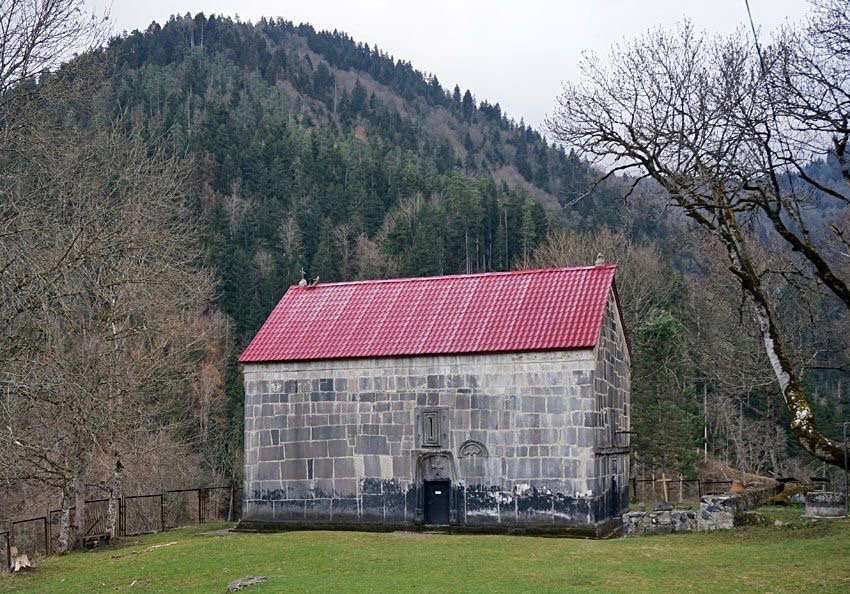
The Church of St George at Sadgeri stands in the village of Sadgeri, Borjomi Municipality, seven kilometres from the town, above the river Borjomula. It is dated to the fourteenth or fifteenth century.
The church is small and by Georgian standards not especially old. But it has something most of its neighbours lack: detailed carving on the façades with scenes that read as separate stories.
🐉 What is carved on the walls
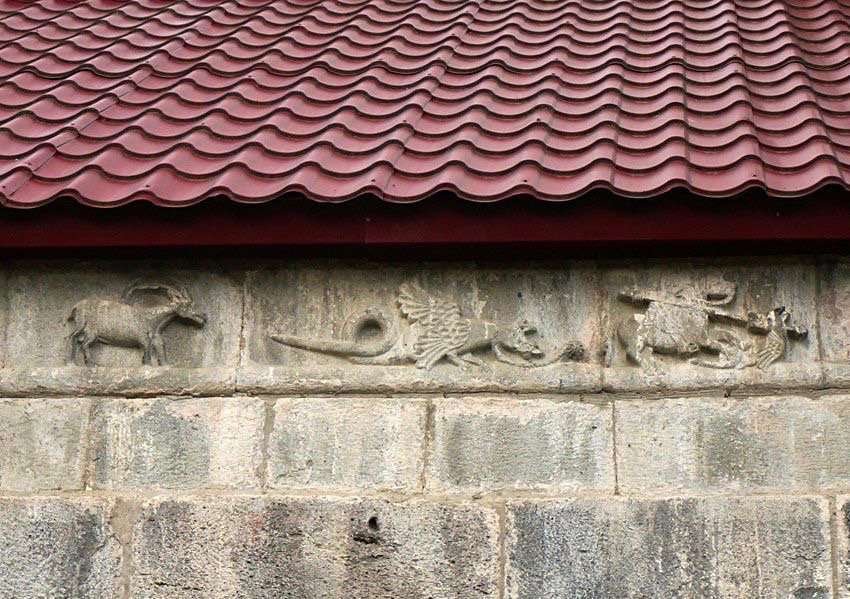
The sculpted images are scattered across the façades with no strict order, and it pays to walk round slowly or you will miss half of them.
By the north entrance, in a semicircular twisted frame, is St George defeating the dragon. Beside it is the scene of St Eustace handing his bow to the stag. That is an unusual choice: Eustace is normally shown at the moment of his vision, whereas here a different episode is taken.
On the west wall are reliefs of a Caucasian tur bound in a dragon's chains, and another image of St George's feat. The tur in chains is a strange motif, and no single explanation for it exists.
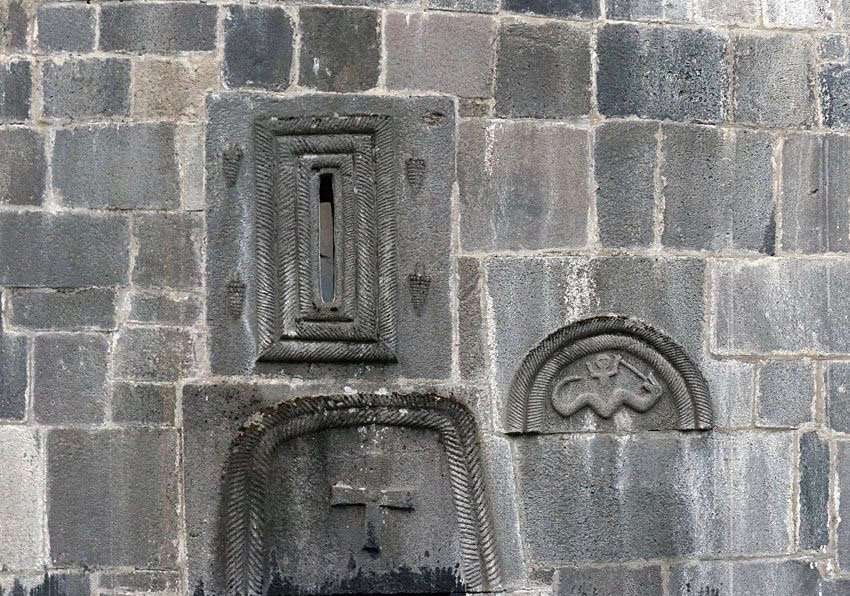
The windows are rectangular, framed by a triple twisted moulding and decorated with clusters of grapes. The east windows are treated the same way. The remaining openings are arched and undecorated.
The portals. There are two entrances, west and north, both with a double curved moulding and undulating outlines. A cross is carved in each opening.
The surrounds on the façades and openings are of curved form, made of twisted mouldings. The masonry is dressed grey stone, and the joints are covered with a thick layer of mortar, which gives each block something like a frame around it.
🛡️ Why the church stands in such an awkward spot
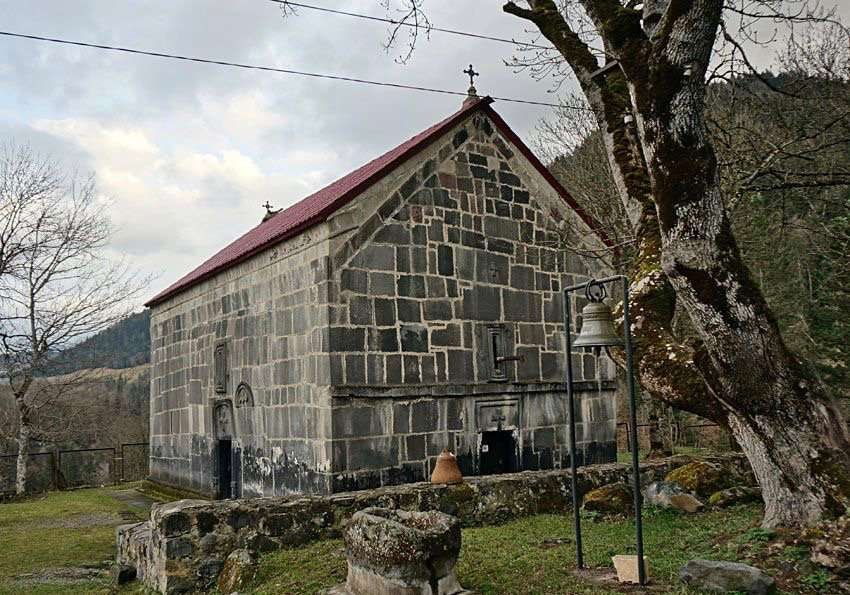
This explains everything else. The church is wedged between a high cliff and a deep ravine, and can only be approached from the south.
That southern side was in its time fortified with a wall and a tower. The wall, of the same stone as the building and with gates, survives today.
In dangerous times the village took shelter here. Not figuratively: the church served as a refuge, and hiding places were cut into the rock alongside it.
Later Erekle II strengthened the Sadgeri fort with cannon. Along the eastern edge of the village runs the foundation of a stone wall, also his work. So the site remained a defensive point in the eighteenth century, three hundred years after the church was built.
The awkward position, then, was not an accident but a calculation: it is hard to reach, and that is its chief merit.
🙏 Giorgoba twice a year and healing for the mentally ill
Sadgeri had a tradition of its own that set it apart from neighbouring parishes.
Giorgoba was kept here twice a year, in April and November, and the feast drew great numbers of pilgrims. They spent the night at the church, made offerings to St George and asked for the healing of the mentally ill.
That last point is what made Sadgeri a particular place: people came for specific help rather than simply for a patronal feast.
Monastic life at the church began with the blessing of Bishop Serapime of Borjomi and Bakuriani, and the community is active today.
One detail for anyone interested in relics: the Sadgeri Gold Cross was once kept here. It is now in the gold collection in Tbilisi, so you will not see it on site.
🧱 What is visible inside and what has been rebuilt
The church is of hall type, without an apsidal projection, with a semicircular vault of uneven outline. It stands on a three-stepped plinth.
The interior walls are divided by pilasters and the vault by transverse arches. But the inside has been heavily altered: the walls and vaults are plastered, which changed the proportions and left the interior wider and lower than it originally was.
The roof has been renewed too, though the original pitch can still be read. The cornices are the old ones.
In short, the exterior is closer to the original than the interior. The carving on the façades is precisely what has come down almost untouched, and it is what makes the trip worthwhile.
🚗 Getting there
Your reference point is Borjomi, seven kilometres from Sadgeri. A paved road runs to the village, so nothing special is required of the car.
The village lies on the right bank of the Borjomula, and the climb to the church is the last part of the way.
From Tbilisi it is about two and a half hours to Borjomi, on the highway through Gori and Khashuri. From Bakuriani, if you are coming down from the ski resort, roughly half an hour down the gorge.
🙏 What to expect at a working monastery
The conventions are the usual ones: covered clothing, a headscarf for women, photography by agreement.
If you are hoping to catch Giorgoba, check the dates in advance: it is kept here twice a year, and the April feast is less widely known than the November one.
🧭 Where to stay and what is nearby
Borjomi serves as the base; Sadgeri is under half an hour away.
Been to Sadgeri? Leave a review on Madloba: tell us whether you found all the reliefs, whether you got inside, and whether you caught Giorgoba.
Information is current as of August 2026. Visiting arrangements at a working monastery and the dates of patronal feasts both change, so check locally before you travel.

28 comments
Log in to leave a comment