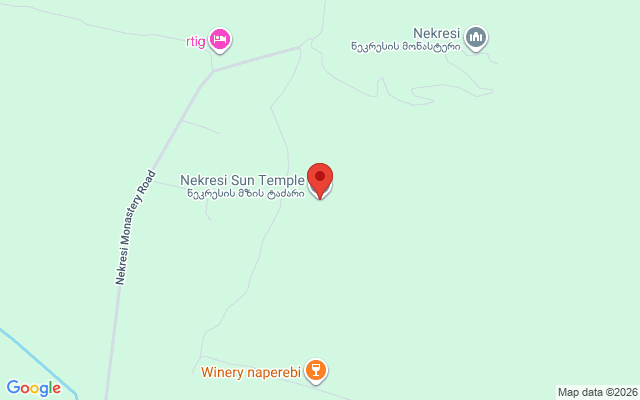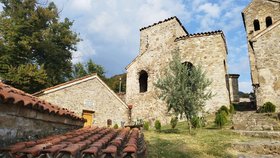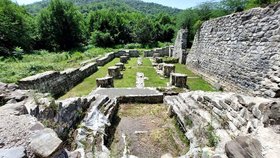




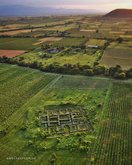

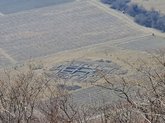

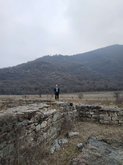

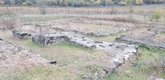

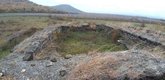

The Nekresi Sun Temple, sometimes called the Large Square for the shape of its perimeter, is a set of foundation-level ruins from a pre-Christian sanctuary dating to the 2nd-3rd century AD. It lies in the lowland fields south of Nekresi hill, in Kvareli Municipality, separate from the Christian Nekresi Monastery on the same hill's summit. The temple predates the monastery by roughly 700-900 years.
Excavations by the Georgian National Museum between 1984 and 1993, led by archaeologist Levan Chilashvili, uncovered a square-shaped complex measuring around 50 metres per side: seven separate buildings linked by corridors in a cross-shaped layout. Three-nave apse halls occupy the north and south sides, four-chamber structures the east and west. Only the foundations survive today.
The building's exact purpose remains debated: theories include a Zoroastrian fire temple, a sun temple, and a Manichean shrine. One academic hypothesis, based on a 2004 archaeoastronomical study, links the structure's orientation to the summer and winter solstices.
Entry is free; there is no visitor infrastructure. The site is best combined with a visit to Nekresi Monastery, a 20-30 minute round trip on foot from the monastery itself. All churches and monasteries in Kakheti are in the Madloba catalogue.