



🏛️ Rustaveli and Samtskhe: What Links the Poet to Akhaltsikhe and Where His Monument Stands
🏛️ The Rustaveli Monument in Akhaltsikhe: The Essentials
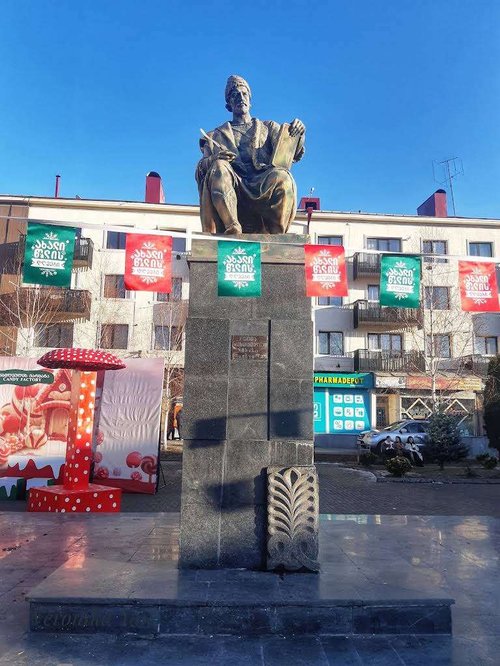
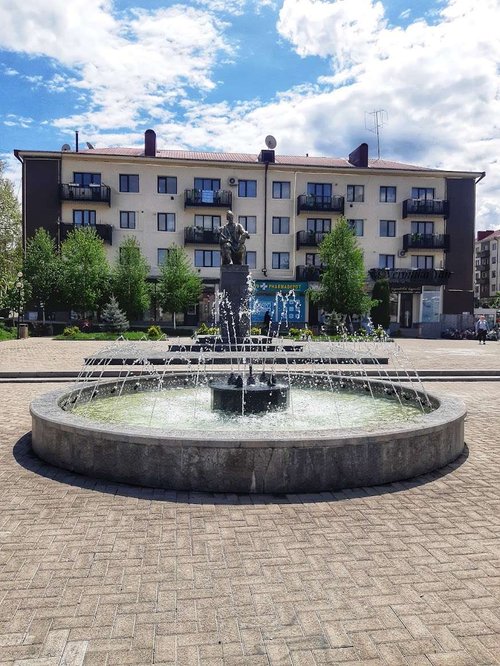
A monument to Shota Rustaveli in the centre of Akhaltsikhe, the administrative centre of Samtskhe-Javakheti. One of the older monuments in town. It does not stand here by accident: by one account the poet's byname derives from the Meskhetian Rustavi, a settlement on the road to Aspindza, half an hour from here.
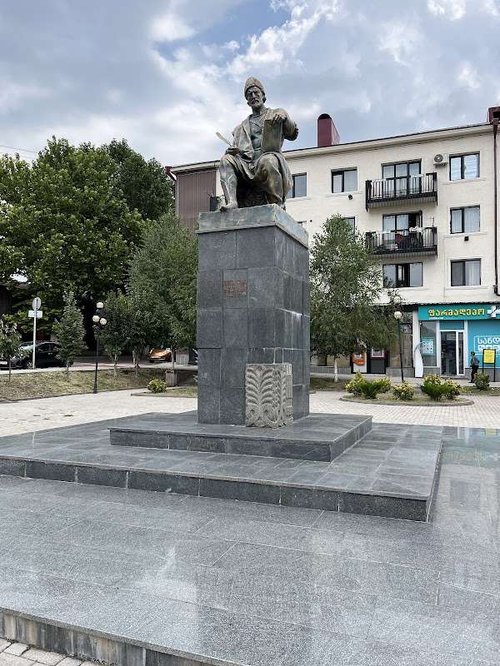
The monument to Shota Rustaveli stands in the centre of Akhaltsikhe and counts among the older monuments of the town. It is not a destination in its own right: a stop on a walk rather than somewhere people travel to see.
More interesting is the question that occurs to almost every visitor almost at once: why does a monument to Georgia's principal poet stand here, rather than in Tbilisi or Rustavi? The answer also explains half of what is known about Rustaveli himself.
🧭 Meskhetian Rustavi: the theory that explains the monument
The byname Rustaveli means 'of Rustavi'. The difficulty is that Georgia has more than one Rustavi.
Everyone knows the industrial city of Rustavi in Kvemo Kartli, itself named after the poet. But there is also a Meskhetian Rustavi, a settlement near the Akhaltsikhe to Aspindza highway. Georgian reference works allow that the poet's byname derives from that one.
The theory is unproven and remains one of several. But it does explain why the monument stands in Akhaltsikhe: this is the administrative centre of the province where Rustaveli may actually have been born.
For a trip this produces an unexpected story. The road from Akhaltsikhe to Vardzia, which almost every visitor to Samtskhe-Javakheti takes, passes the place where the author of The Knight in the Panther's Skin may have been born. Hardly anyone knows this, including the people driving past.
📜 What is actually known about Rustaveli
Not much, and it is worth saying so plainly.
Almost nothing has come down to us about the poet's life and career. Everything known has been reconstructed from historical, literary and folkloric sources, and several versions exist.
The most widely held has him as a senior figure at the royal court, a vizier, close to Queen Tamar. He appears to have been responsible for work on Georgian religious monuments.
Even his dates are unsettled: he is placed at the turn of the twelfth and thirteenth centuries, during the height of the Georgian kingdom.
With so little established, monuments to Rustaveli across the country are in effect monuments to the poem rather than to a life. The Knight in the Panther's Skin is known in exhaustive detail; its author is barely known at all.
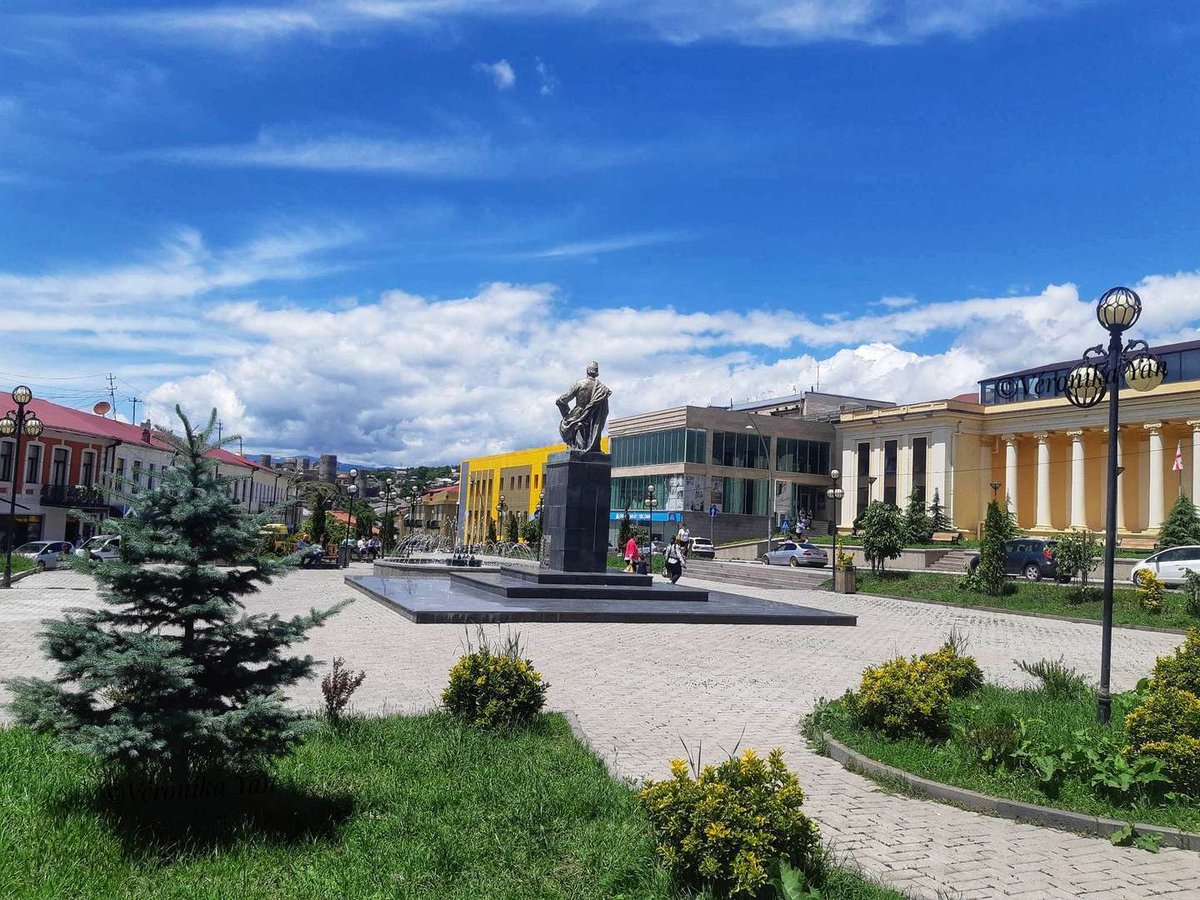
🏙️ Akhaltsikhe around the monument
Since the monument is seen in passing, it helps to know what surrounds it.
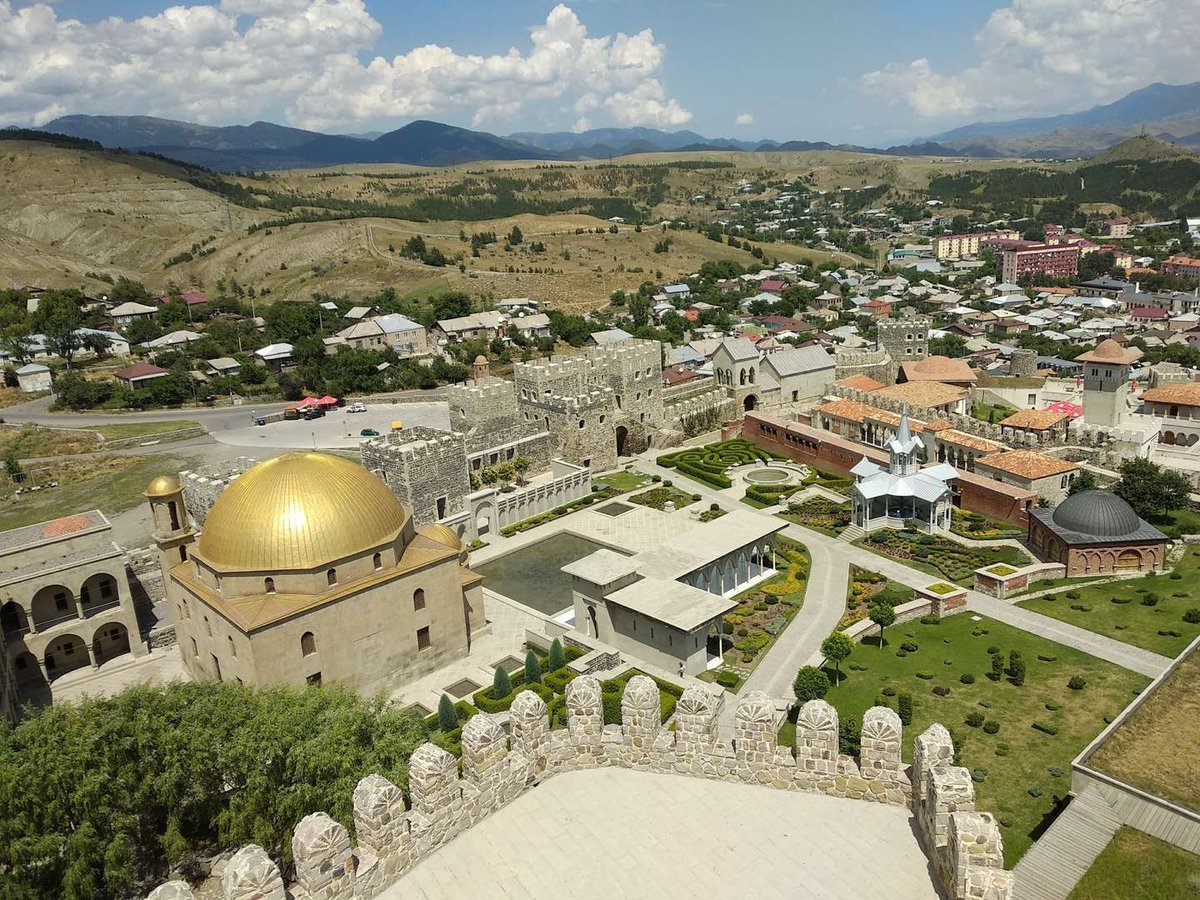
The town's history begins in the ninth century. It was originally called Lomsia. In the twelfth century, after the settlement was restored by the atabegs of Samtskhe, the Jaqeli family, the name Akhaltsikhe took hold, meaning 'new fortress'. A fuller account of the town is in a separate piece, Akhaltsikhe.
Rabati Fortress, the town's principal site and one of the most visited in Georgia, stands on both banks of the Potskhovi. It is about ten minutes on foot from the monument. Within the complex is the Samtskhe-Javakheti History Museum, named after Ivane Javakhishvili, with a collection of more than 25,000 items.
The Church of St Marina was rebuilt in 1865, with the carved stones of the older building set into the walls of the new one. Alongside it, an Armenian church and a synagogue survive in the town, evidence that Akhaltsikhe was multi-ethnic for centuries. All of them appear in the churches of Samtskhe-Javakheti section.
Of the domestic architecture, several Meskhetian darbazi survive, among the finest examples of the type.
🗿 Monuments to Rustaveli across the country
The Akhaltsikhe monument is not the only one. Statues of the poet stand throughout Georgia, which is telling in itself.
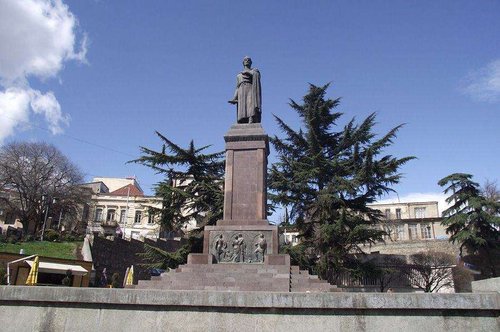
In Tbilisi, on Rustaveli Square at the head of the avenue that bears his name. A small garden surrounds it, a fountain decorated with reliefs of lions' heads stands in front, and the metro entrance is behind.
In Rustavi, the city named after the poet, where the monument serves as the main civic symbol.
In Akhaltsikhe, the subject of this piece.
There are monuments outside Georgia too, including one in Rome.
Of the three, the Akhaltsikhe one is the most modest in scale and the only one standing near the poet's possible birthplace. A strange asymmetry, and a fair description of how Georgia has handled the memory of Rustaveli: the poem is known by heart, the author scarcely at all.
🚗 Getting there
The monument stands in central Akhaltsikhe, where all the roads of Samtskhe-Javakheti converge.
From Tbilisi, about three hours on the highway through Gori, Khashuri and Borjomi. Marshrutkas run from Didube station.
From Borjomi, roughly an hour, following the Mtkvari gorge.
From Vardzia, about an hour, and it is on this stretch that the road passes the Meskhetian Rustavi.
Within the town everything is walkable: ten minutes from the monument to Rabati, a little more to the bus station.
🧭 Where to stay and what is nearby
Akhaltsikhe is the main base for the whole province: Vardzia, Khertvisi and Sapara are all reached from here.
Been to Akhaltsikhe? Leave a review on Madloba: tell us whether the monument was easy to find and what else in town deserves attention besides Rabati.
Information is current as of August 2026. The theory of Rustaveli's Meskhetian origins remains one of several and has no direct confirmation.
❓ FAQ
💬 In the centre of Akhaltsikhe, the administrative centre of Samtskhe-Javakheti. It is about ten minutes' walk from the monument to Rabati Fortress.
💬 By one account the byname Rustaveli, meaning 'of Rustavi', refers not to the city in Kvemo Kartli but to the Meskhetian Rustavi, a settlement on the Akhaltsikhe to Aspindza road. If the theory holds, the monument stands in the poet's home country.
💬 Almost nothing. No direct evidence survives; the biography is reconstructed from historical, literary and folkloric sources, and several versions exist. The common account has him as a vizier and a figure close to Queen Tamar, responsible for work on religious monuments.
💬 His dates are unsettled. He is placed at the turn of the twelfth and thirteenth centuries, during the height of the Georgian kingdom under Queen Tamar.
💬 Neither the sculptor's name nor the year of installation appears in open sources. All that is recorded is that it counts among the older monuments of Akhaltsikhe.
💬 The administrative centre of Samtskhe-Javakheti. Its history begins in the ninth century, when it was called Lomsia. In the twelfth century, after the settlement was restored by the atabegs of Samtskhe, the Jaqeli family, the name Akhaltsikhe took hold.
💬 In Tbilisi on Rustaveli Square, at the head of the avenue named after him, with a garden and a fountain decorated with lions' heads. In Rustavi, the city named after the poet. There are monuments outside Georgia too, including one in Rome.
💬 About three hours from Tbilisi by marshrutka from Didube station, through Gori, Khashuri and Borjomi. Roughly an hour from Borjomi along the Mtkvari gorge, and about an hour from Vardzia.

2 comments
Log in to leave a comment
ან როგორ ფიქრობთ, რა სიახლეები შეიძლება იყოს მის ძეგლთან ან ქალაქში?