




🏰 Estates of the Dadiani Princes: The Zugdidi Palace Complex, the Summer Residence at Salkhino and the Murat Legacy
🏰 The Dadiani Estates: The Essentials
The Dadiani family ruled Samegrelo from the twelfth century until 1866 and left behind not one palace but a network of residences. Two are accessible today: the formal complex in central Zugdidi with its museum and botanical garden, and the summer residence in the village of Salkhino, Martvili Municipality, where Ojaleshi wine is still made.
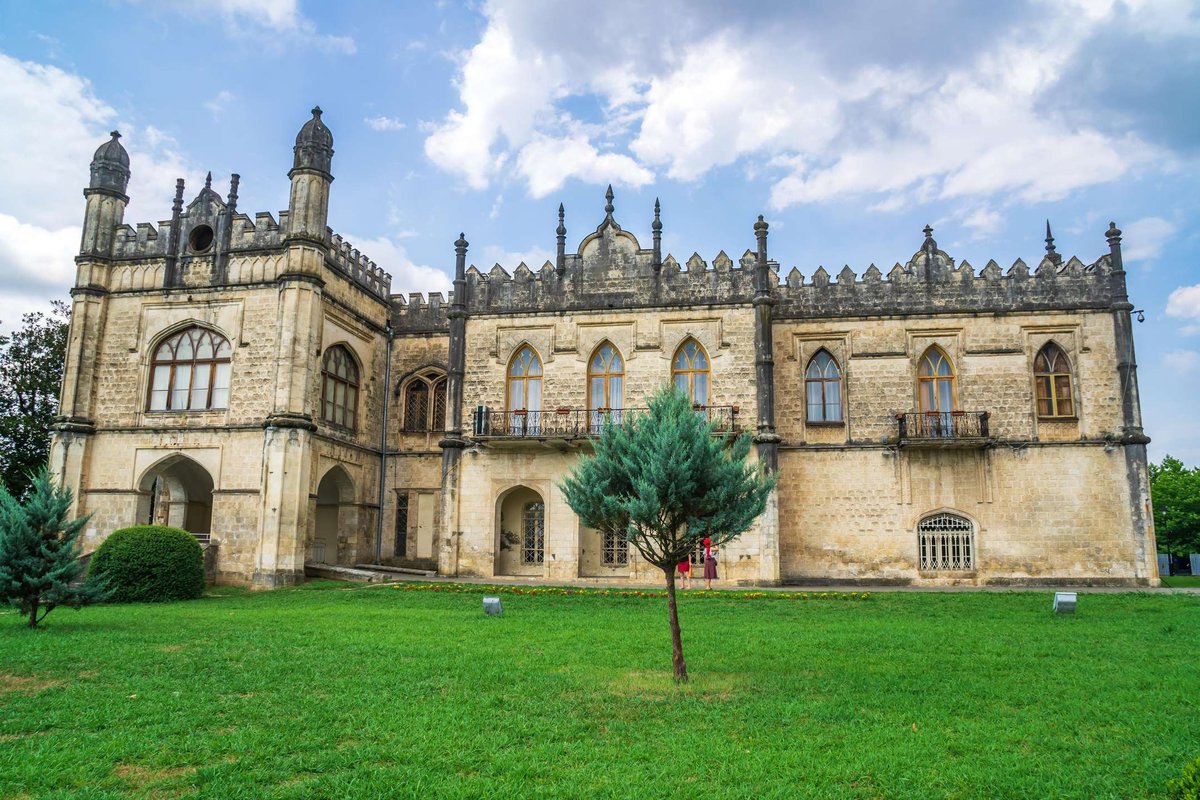
Dadiani Palace is the residence of the rulers of Samegrelo in central Zugdidi, and today a museum of history and architecture. But the family's story does not end with one building: the Dadianis held a whole network of estates, and the second accessible one, the summer residence at Salkhino, stands sixty kilometres to the east.
The Italian missionary Arcangelo Lamberti, who travelled in seventeenth-century Georgia, counted more than fifty palaces belonging to the prince and singled out the Zugdidi one: good stone, interiors finished in the Persian manner. Little of those fifty survives, which is why the sensible thing is to look at the pair rather than at a single site.
👑 Who the Dadianis Were
The family ruled Samegrelo, also known as Mingrelia, from the twelfth century until 1866. That is seven hundred years of unbroken authority over the western part of the country, a span rare even in Georgian history.
Levan II Dadiani (1611-1657), ruler of Odishi, set about building castles across his territory. Lamberti's tally of some fifty palaces belongs to his period.
Levan V, who ruled from 1804 to 1840, saw Mingrelia absorbed into the Russian Empire and rebuilt the summer residence at Salkhino, replacing a wooden oda with a stone house.
David Dadiani, his son, founded a private museum in Zugdidi with archaeological, numismatic, military and ethnographic cabinets. Sources date this to either 1839 or 1849; either way it makes one of the oldest museums in Georgia.
Ekaterine Chavchavadze, David's wife, was the sister of Nina Chavchavadze, Griboyedov's widow. The complex took its present shape under her, and the botanical garden grew up around it.
Niko Dadiani, their son, was the last ruler of Mingrelia. The principality was abolished in 1866, Niko abdicated, and seven centuries of family rule ended there.
🏰 The Palace in Zugdidi: What Stands in the Town Centre
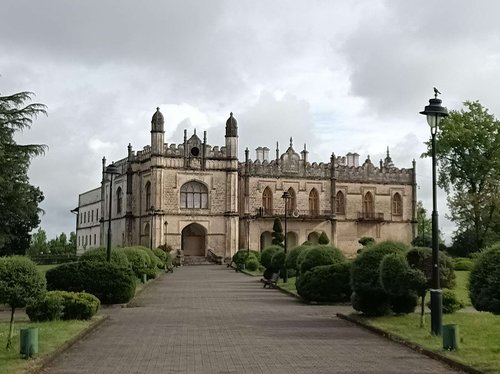
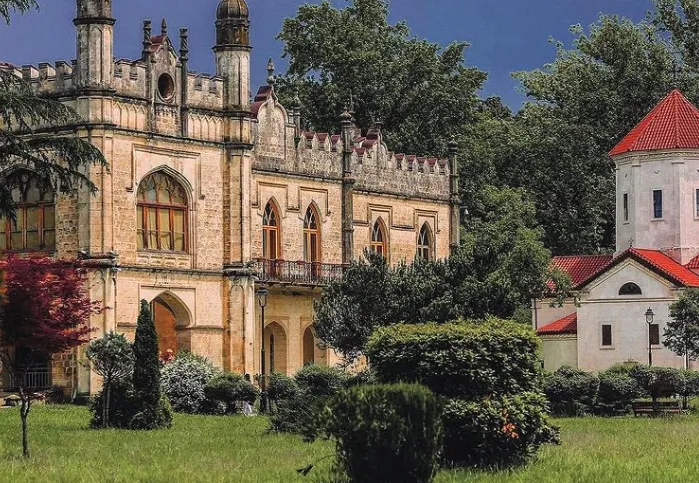
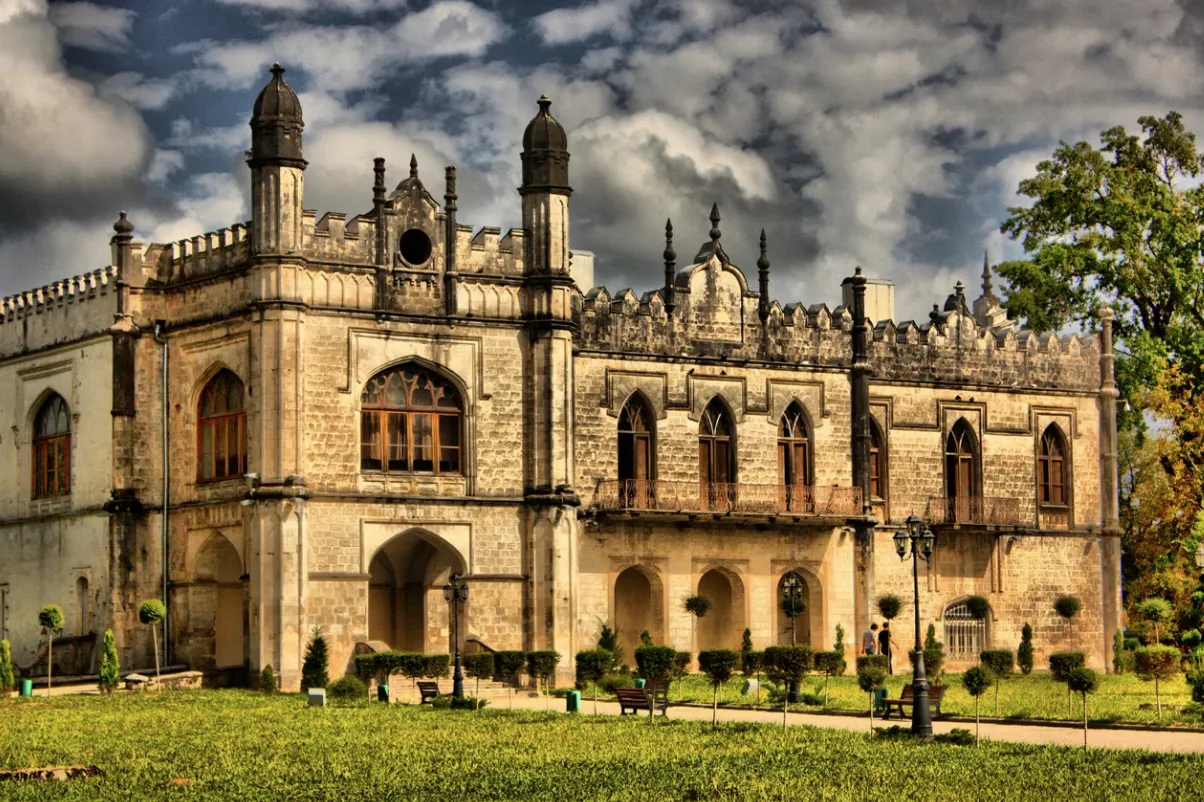
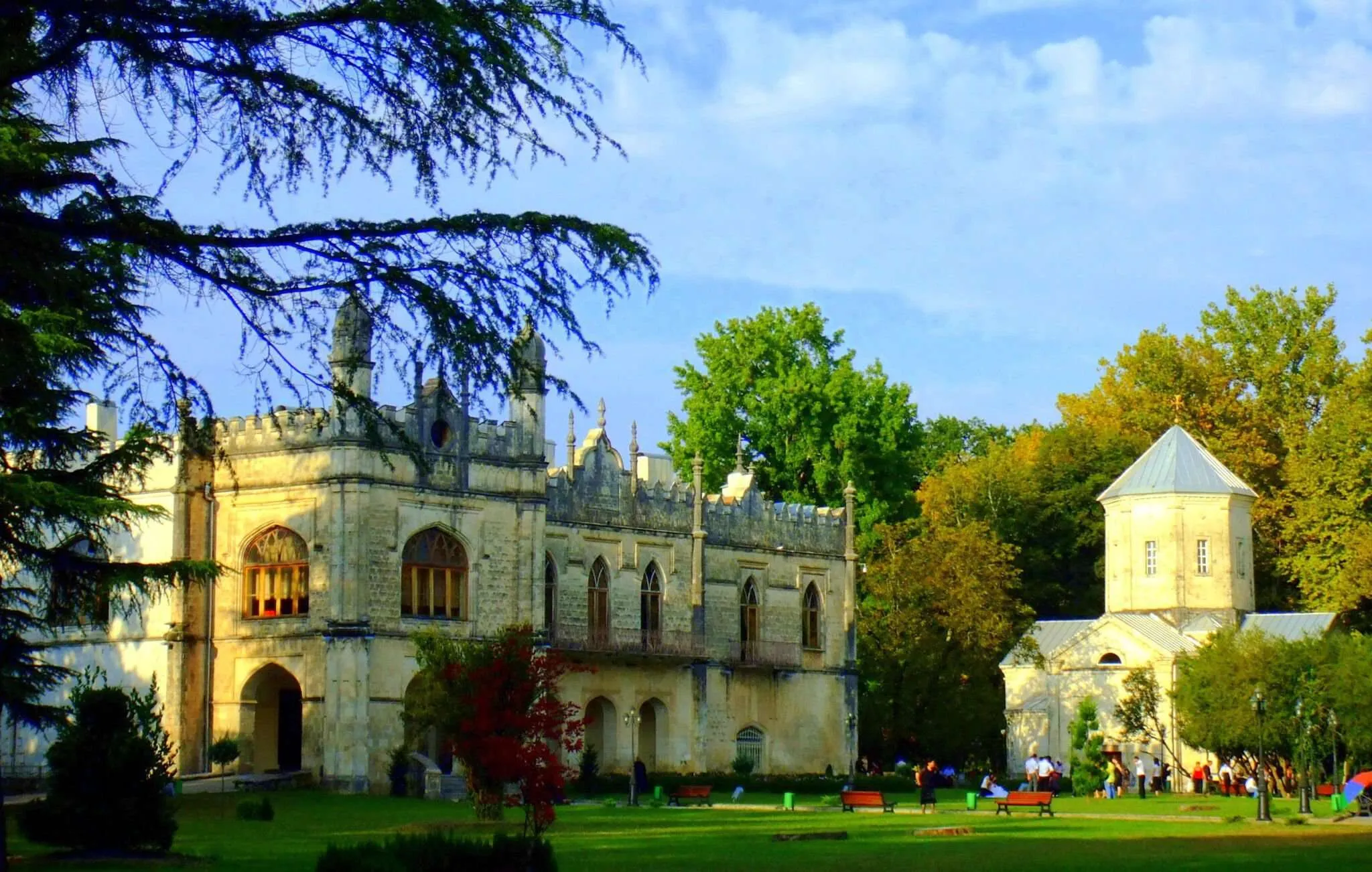
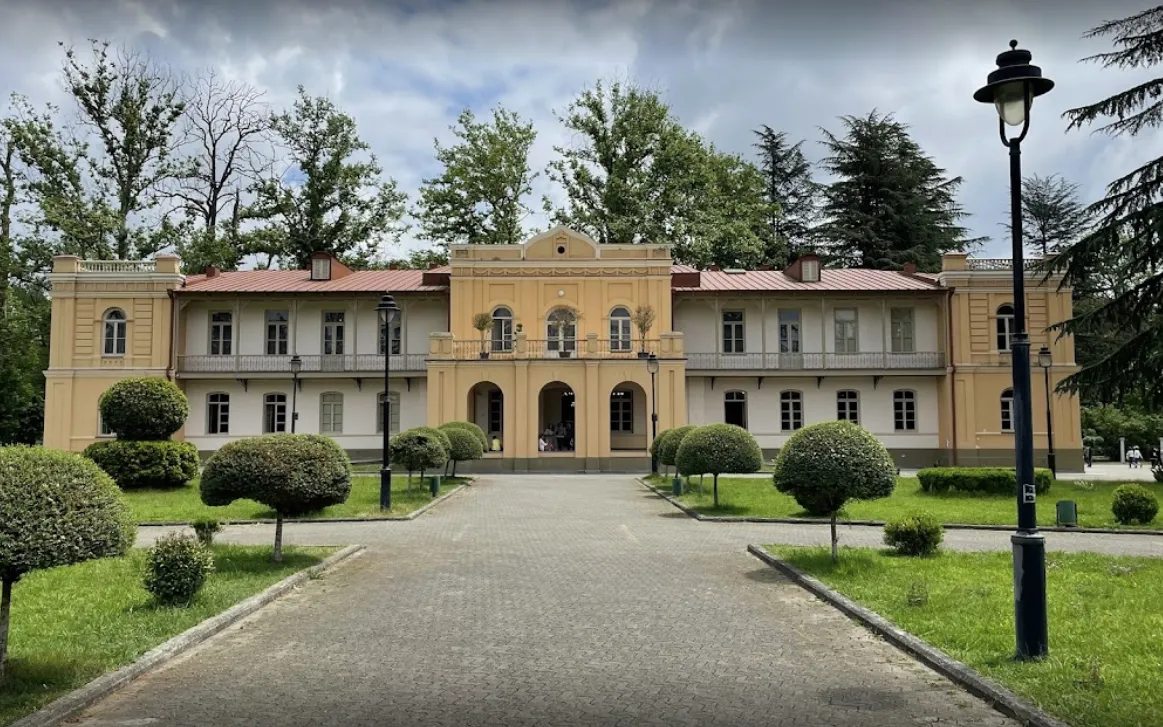
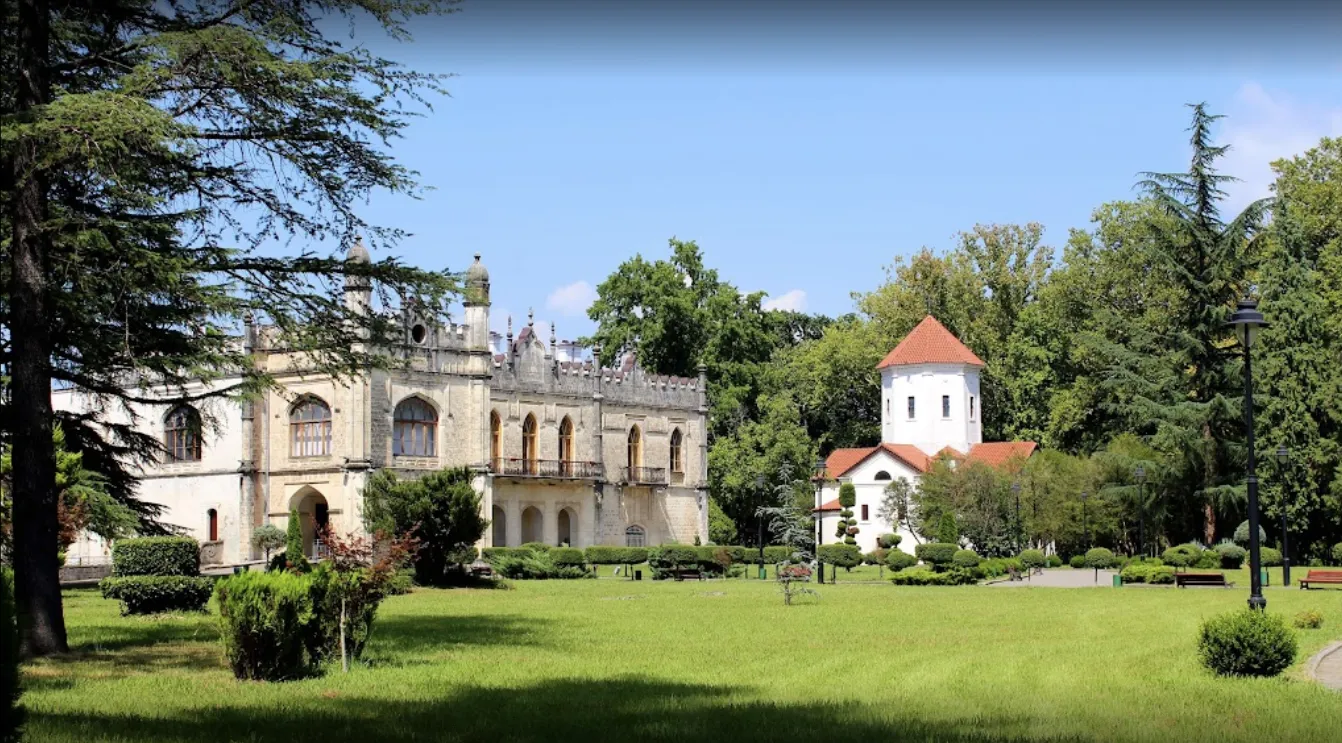
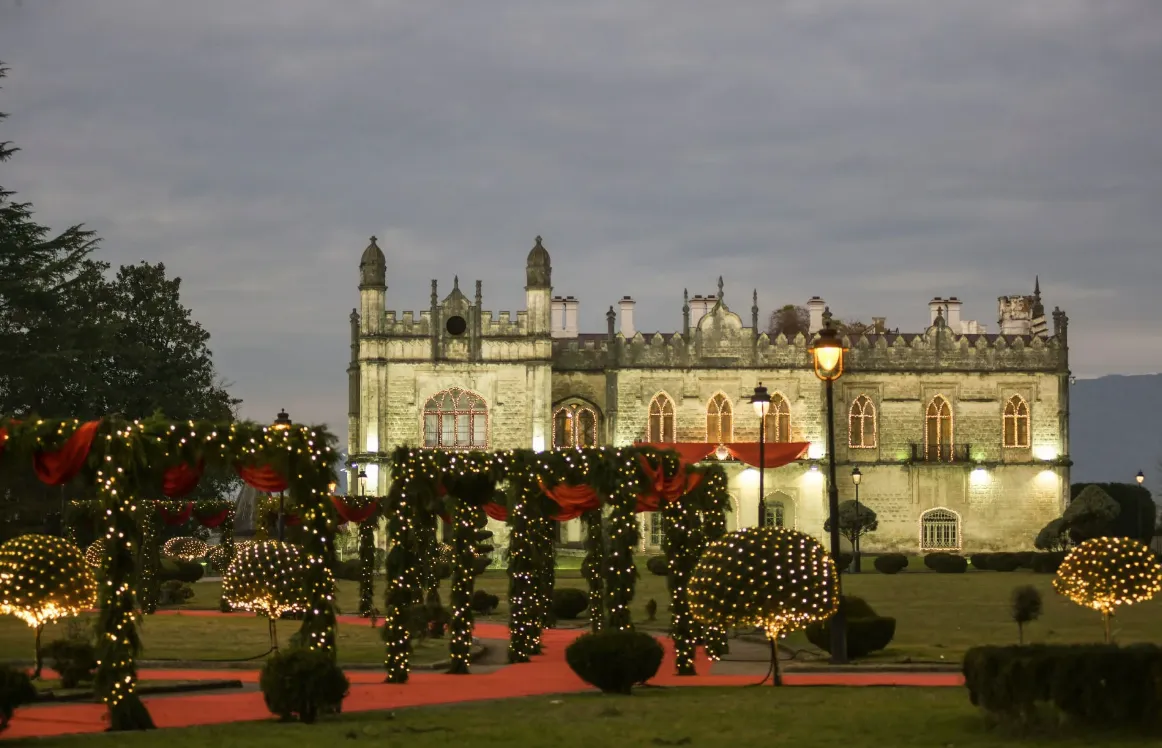
The complex takes in two palaces, a court church and the botanical garden around them.
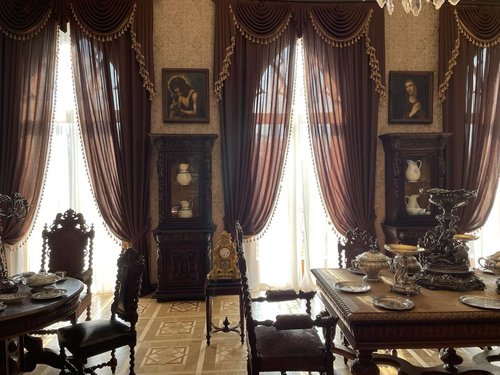
The main palace. Built for Princess Ekaterine. The architect Edgar J. Rice took the Vorontsov Palace in Crimea as his starting point, and the resemblance registers at first glance: the same Gothic line, the same crenellated finishes. Dates vary between sources: some give 1873-78, others place the work in the 1860s. Arched openings, mouldings and the original window frames articulate the façade, while the inner apartments were finished in the Persian manner Lamberti had described two centuries earlier.
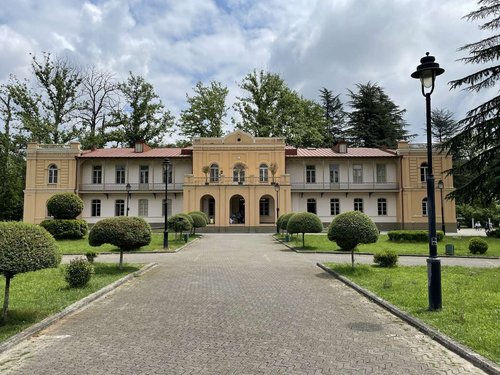
Niko Dadiani's palace. A two-storey building put up for the princess's son by the Russian architect Vasilyev in the 1880s. It stands beside the main palace and forms part of the same complex.
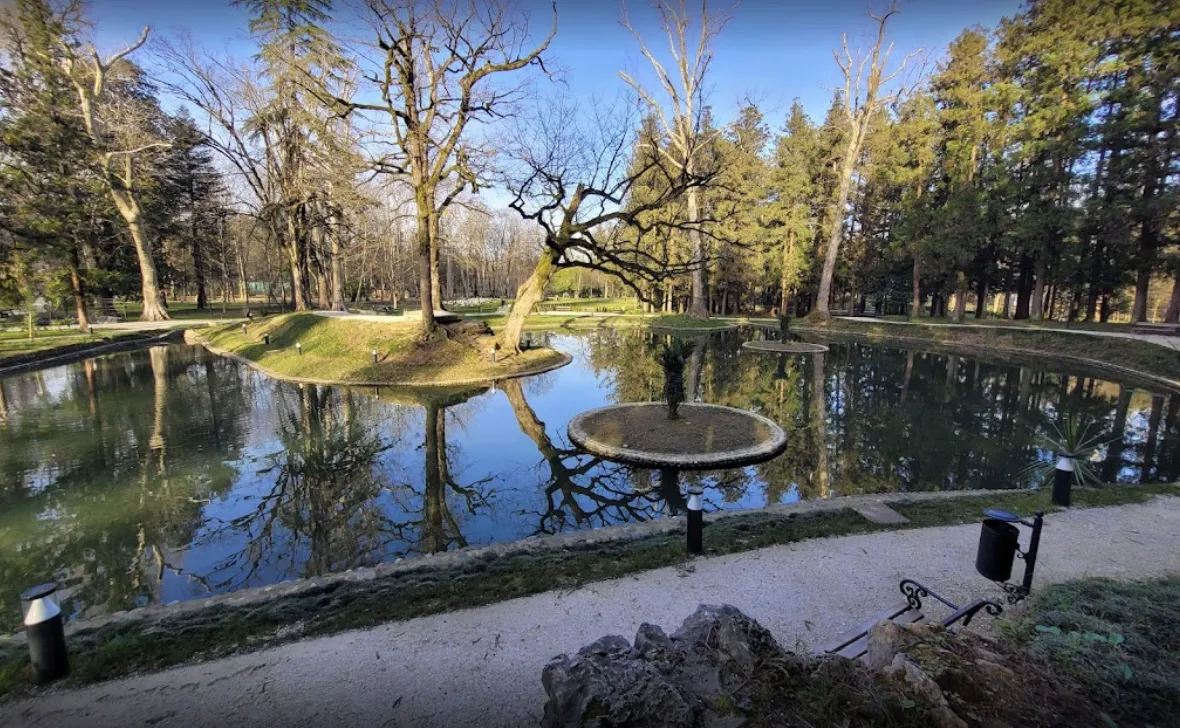
The botanical garden. 26.4 hectares surrounding the palaces. Ekaterine Chavchavadze brought gardeners from Europe and assembled, in short order, a collection that now runs to more than eighty species from Southeast Asia, India, Japan, the Mediterranean and the Americas. It is not an adjunct to the palace but a reason to come in its own right.
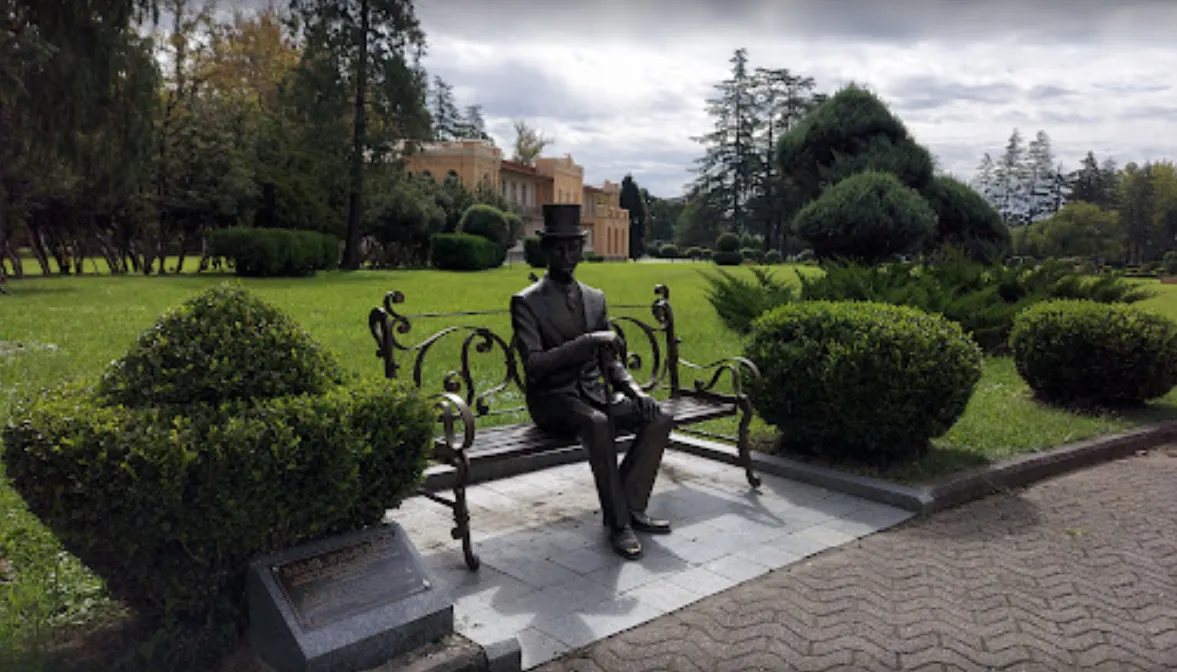
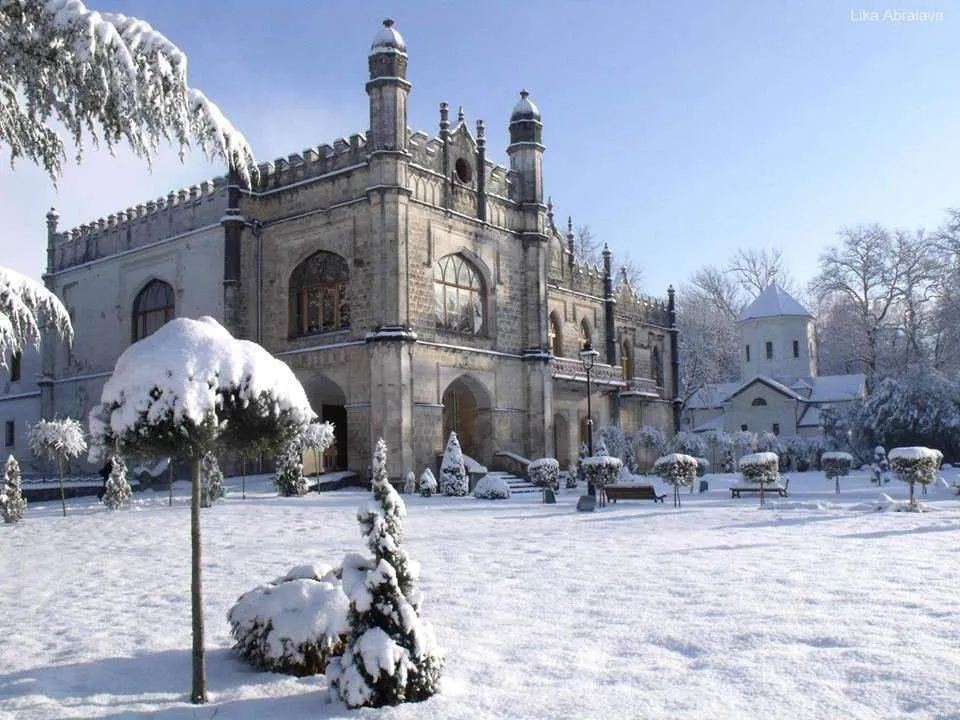
🖼️ The Museum: Forty Thousand Items and Four Cabinets
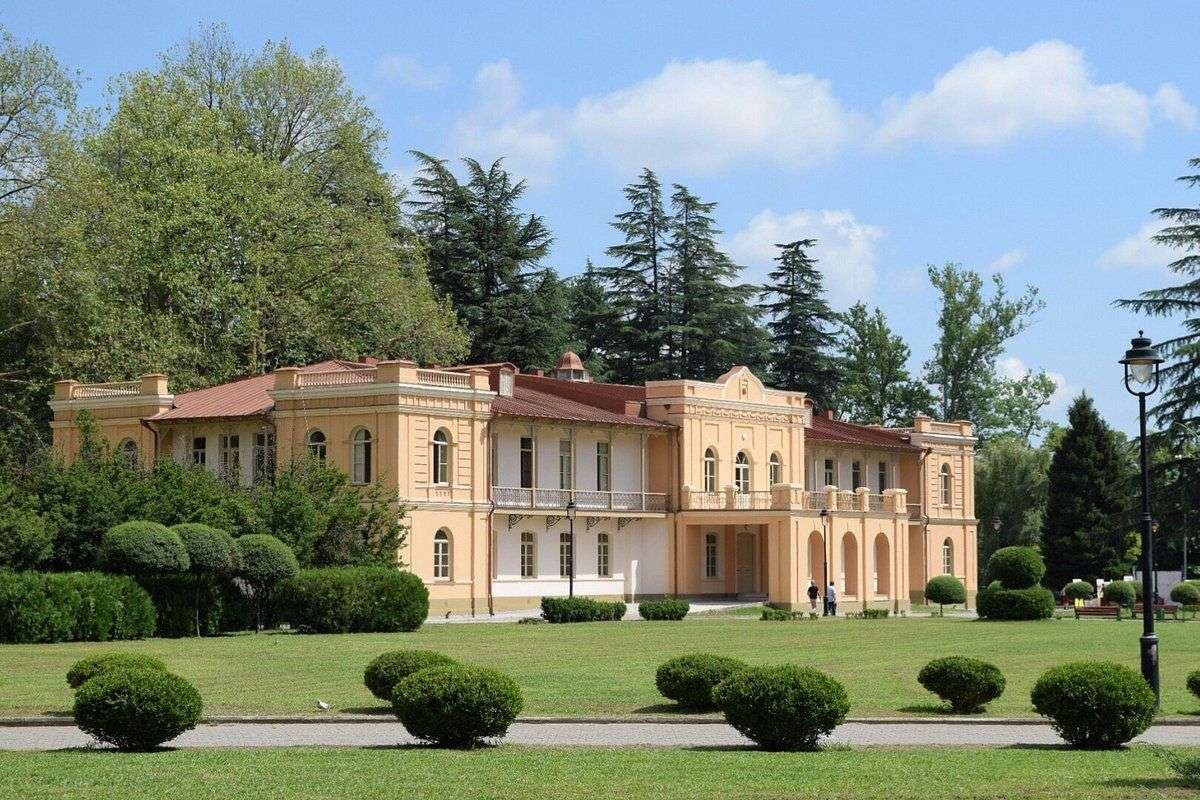
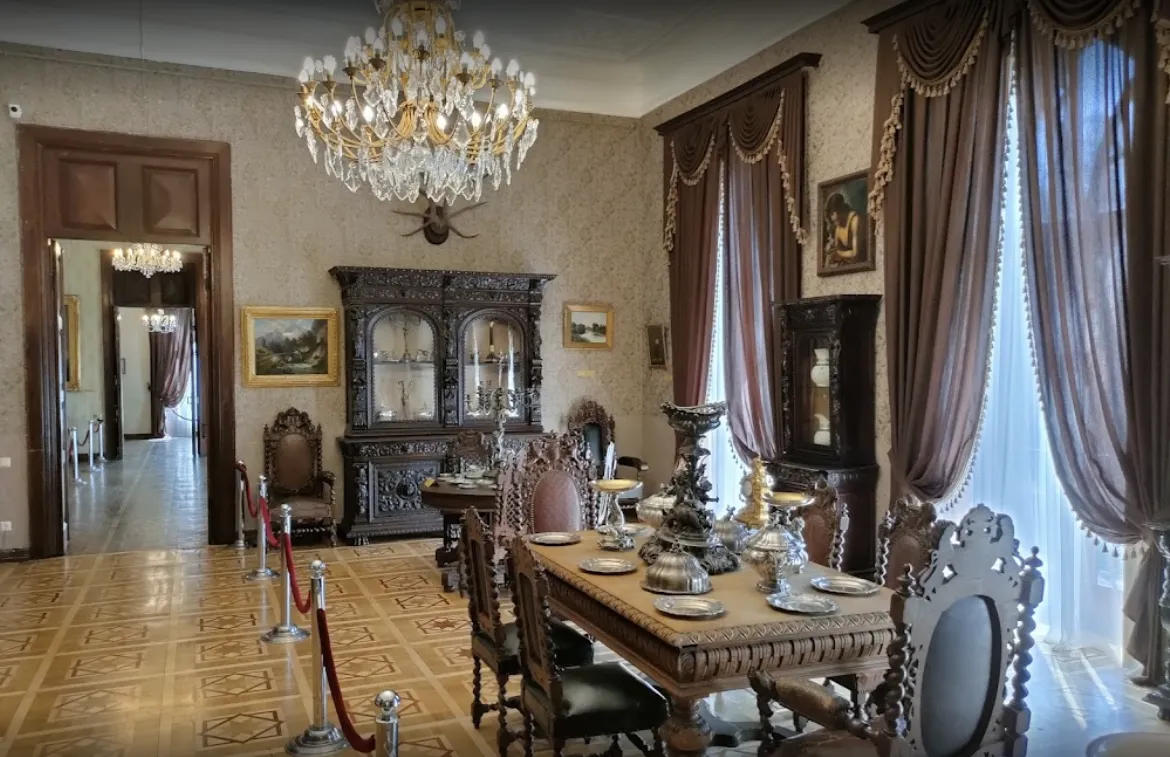
David Dadiani's collection was originally divided into archaeological, numismatic, military and ethnographic cabinets. The complex became a state museum in 1921, by which time the principality had ceased to exist.
The holdings now come to around forty thousand items. Among them are the Robe of the Virgin, Shamil's sabre, a collection of European and Georgian painting from the eighteenth to the twentieth century, and antique and medieval jewellery in the gold fund.
From the nineteenth-century interiors, gilded furniture and handmade carpets survive; among the paintings are works by Ivan Tyurin, Vasily Vereshchagin and Vladimir Moshkov.
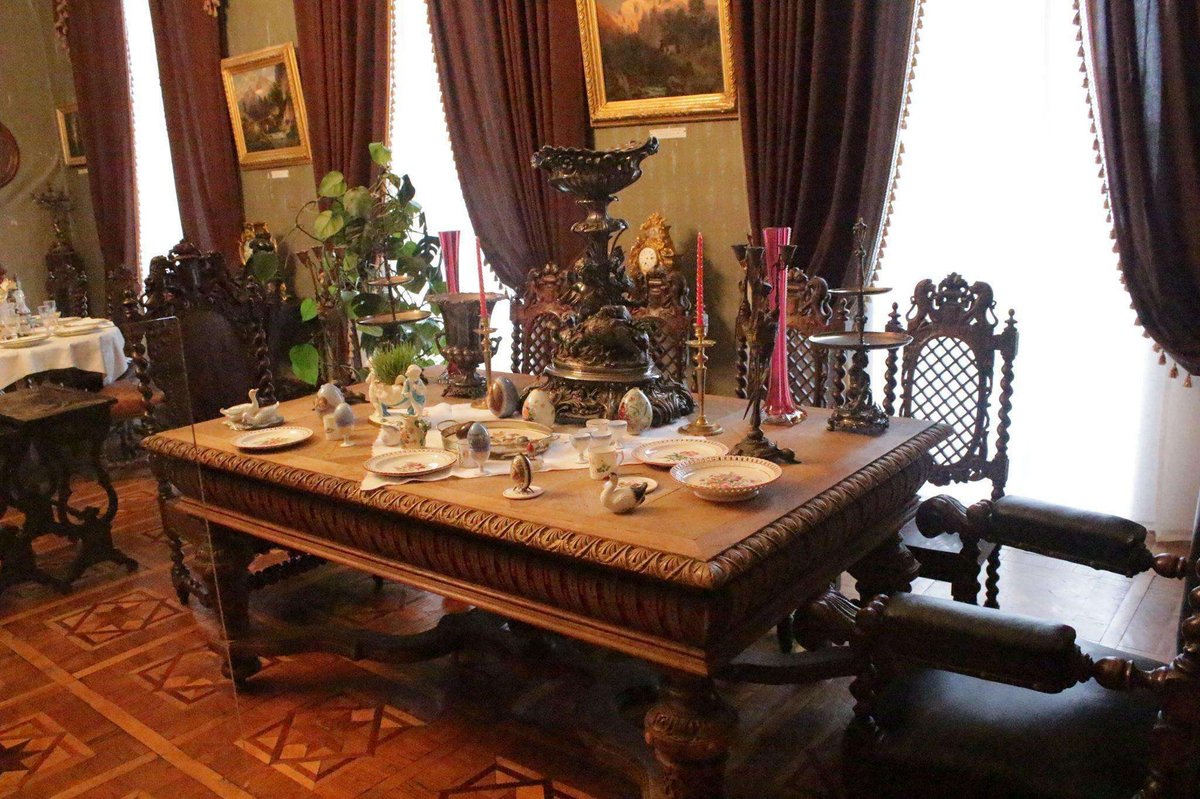
But the most talked-about exhibit deserves its own section.
🎭 Why Napoleon's Death Mask Is in Zugdidi
The question is a fair one: how did a bronze mask of the French emperor end up in a Mingrelian town?
The answer is a marriage. Salome Dadiani, daughter of David and Ekaterine, married Achille Murat, grandson of Joachim Murat, Napoleon's marshal and King of Naples. Part of the Murat family's inheritance came to Zugdidi through that union, the mask included.
The mask itself was cast in bronze in 1833 and is reckoned one of four in existence. For a museum in western Georgia it is an unexpected holding, and it is what a fair share of visitors come for.
The Murat connection explains one more thing. It was under Salome that the summer residence at Salkhino, discussed below, took its final form. The French marriage left its mark on both estates.
⛪ The Blachernae Church and Its Relics
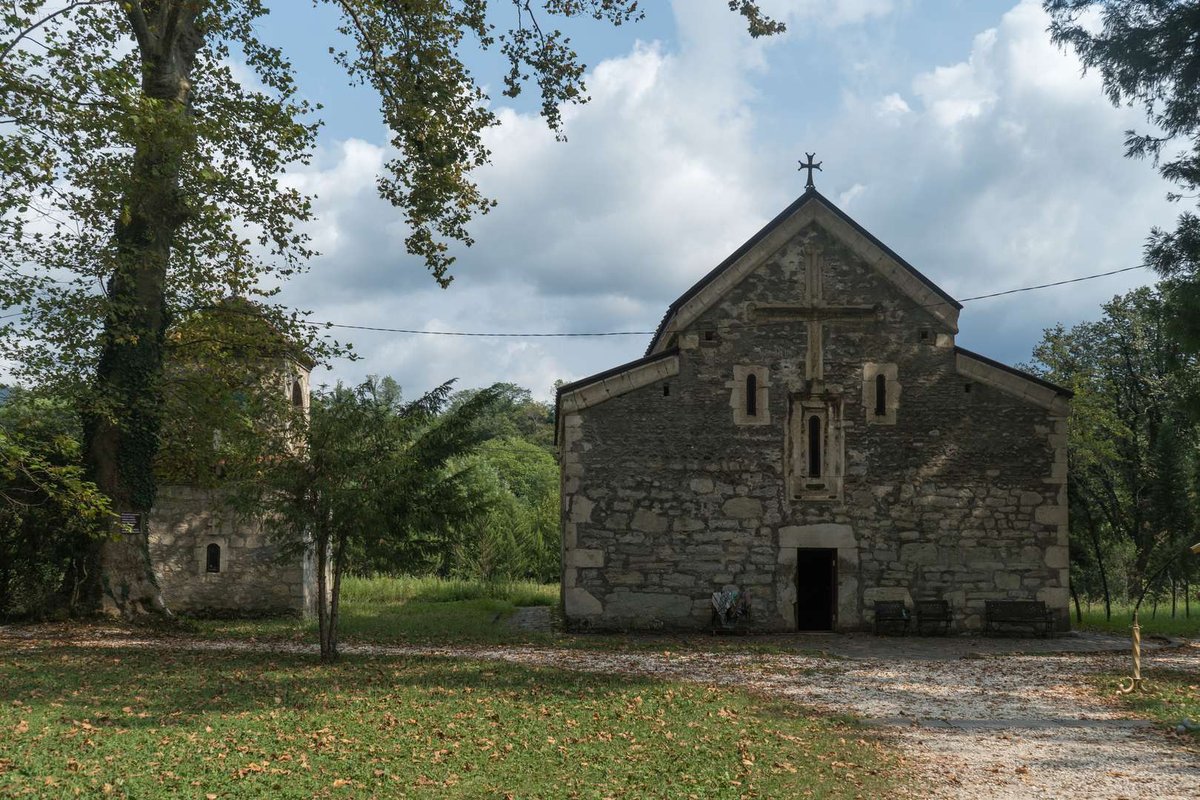
A church of the Blachernae Mother of God stands within the complex. In form it is a sixteenth-century cross-domed church: a clear composition, severe proportions, heavy massing without decorative excess.
It holds part of the robe and part of the belt of the Holy Virgin, and, by church tradition, the hand of St Marina and relics of St George and St John. For pilgrims that is reason enough to come to Zugdidi, museum or no museum.
The Blachernae dedication points to the church in Constantinople where, by tradition, the Virgin's garments were kept. How the relics reached Mingrelia is explained in various ways, and no single account is settled.
🍇 Salkhino: The Summer Residence and the Home of Ojaleshi
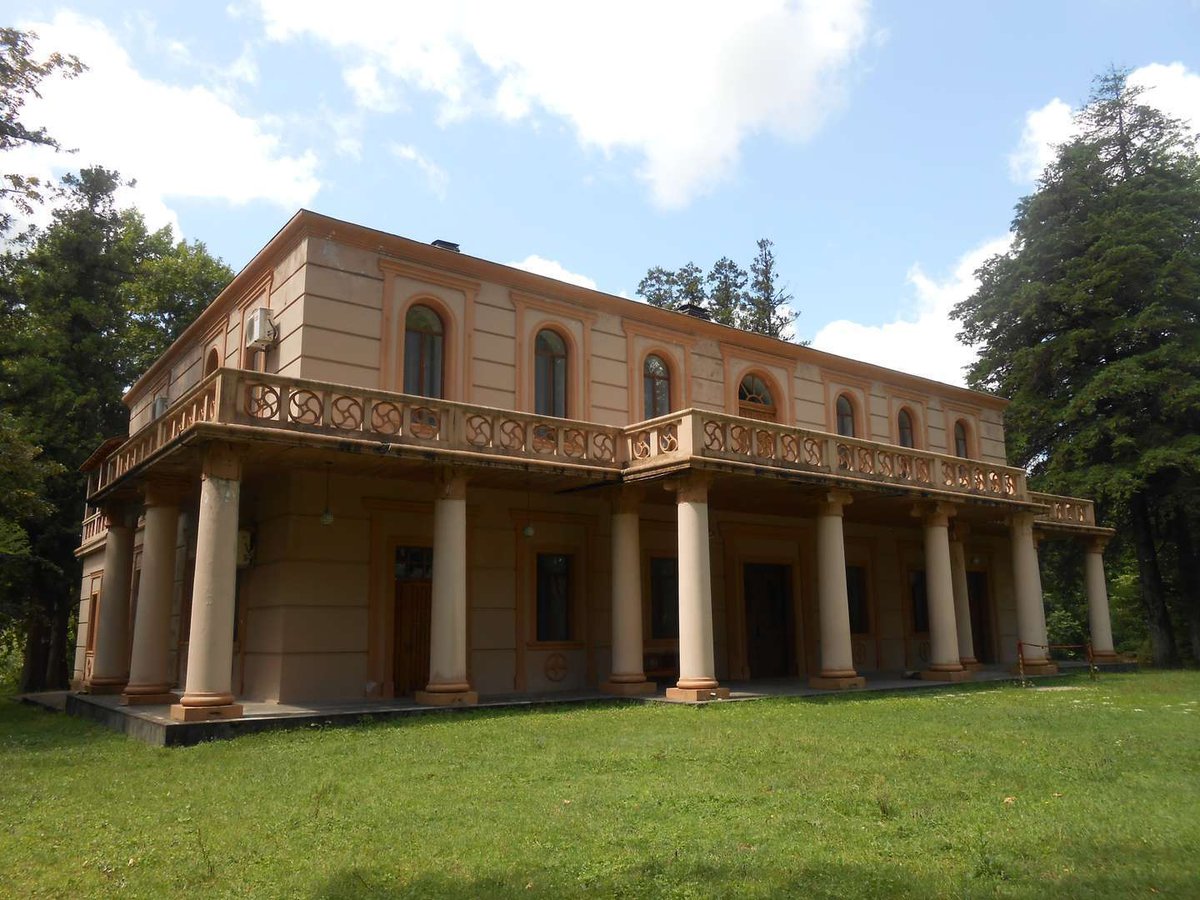
The second site stands in the village of Salkhino, Martvili Municipality, on the bank of the Tsachkhura river. The name translates as 'a place of merrymaking', which for a summer residence is close to literal.
By standing, Salkhino came third among the family's estates, after Zugdidi and Gordi in Khoni Municipality. Guidebooks barely mention Gordi, although it was the second most important Dadiani residence.
Salkhino originally held a plain wooden oda. Levan V built the two-storey stone palace, and the building took its final form under his granddaughter Salome, the one who married into the Murat family.
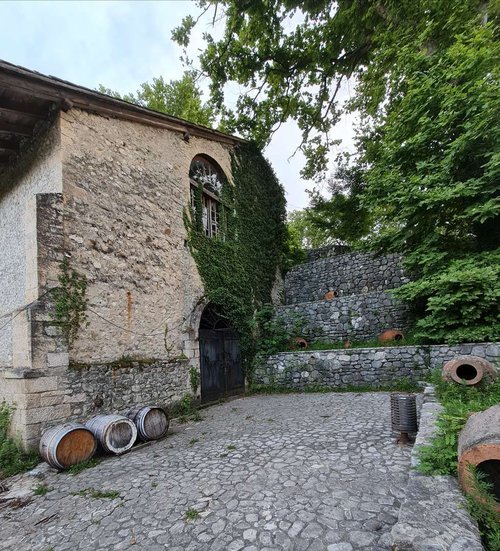
What to see on site. A kvevri is set into the floor of the great hall on the ground storey, and a statue of Bacchus sits above the fireplace. The walls are panelled in oak and chestnut. Alongside stand a wine cellar thirty-five metres long and ten wide, the court church of St George, an avenue of plane trees and stands of box.
Wine. Salkhino was for centuries a centre of Mingrelian viticulture, and the tradition did not lapse. This is the home of Ojaleshi, a grape picked later than any other, once the harvest has finished everywhere else. It is made into a dry wine and aged in that same historic cellar.
A church residence operates on the grounds today, so access indoors depends on the schedule. Check locally or in advance.
| Residence | Where | Known for | Access |
|---|---|---|---|
| Zugdidi | Town centre, Samegrelo | The formal complex, museum and botanical garden | Museum open to visitors |
| Gordi | Khoni Municipality | The second summer residence by importance | Condition and access to be checked separately |
| Salkhino | Martvili Municipality | Wine cellar, Ojaleshi, the church of St George | A church residence operates here |
🚗 Getting There and Building a Route

Zugdidi. The town sits on the road to Svaneti, and everyone heading for Mestia passes through it. Marshrutkas and a night train run from Tbilisi, taking most of a day or a night. The palace is in the centre: the bus station is across the road, the railway station not far off.
Salkhino. The village lies about sixty kilometres east of Zugdidi, near Martvili. Public transport reaches the village rarely, so you need a car or a taxi from Martvili.
Combining the two. The sensible shape of the day is Zugdidi in the morning for the museum and garden, then the drive east, and after that a choice. Martvili Monastery, one of the oldest in western Georgia, stands near Salkhino, as does Martvili Canyon with its turquoise water. The reverse order works too if you are coming from Kutaisi.
🧭 Where to Stay and What Is Nearby
Zugdidi works well as a base: the town lies on the road to Svaneti, and many people stop here for the night before the climb into the mountains.
Been to the Dadiani estates? Leave a review on Madloba: tell us whether you took a guide at the museum, whether you got inside at Salkhino, and whether the two are worth combining in one day.
Information is current as of July 2026. Museum hours, ticket prices and access at Salkhino change, so check the current conditions before you travel.
❓ Frequently asked questions: myths and truth about the museum
💬 In the centre of Zugdidi, the administrative centre of Samegrelo in western Georgia. The bus station is across the road and the railway station is close by. The summer residence at Salkhino stands about sixty kilometres east, in Martvili Municipality.
💬 A princely family that ruled Samegrelo from the twelfth century until 1866. The last ruler was Niko Dadiani, who abdicated after the principality was abolished.
💬 Sources disagree. Some place construction in 1873-78, others describe a rebuilding in the 1860s. It was raised for Princess Ekaterine, and the architect Edgar J. Rice took the Vorontsov Palace in Crimea as his model.
💬 Through a marriage. Salome Dadiani married Achille Murat, grandson of Napoleon's marshal Joachim Murat, and part of the family's inheritance came to Mingrelia. The mask was cast in bronze in 1833 and is reckoned one of four in existence.
💬 Around forty thousand items: the Robe of the Virgin, Shamil's sabre, European and Georgian painting from the eighteenth to the twentieth century, a gold fund of antique and medieval jewellery, and gilded furniture and carpets from the nineteenth century.
💬 A garden of 26.4 hectares laid out by Ekaterine Chavchavadze, sister of Nina Chavchavadze, Griboyedov's widow. She brought gardeners from Europe, and the collection now runs to more than eighty species from Asia, the Mediterranean and the Americas.
💬 Part of the robe and part of the belt of the Holy Virgin. By church tradition, the hand of St Marina and relics of St George and St John are kept here as well.
💬 The Dadiani summer residence on the bank of the Tsachkhura river. A kvevri is set into the floor of the ground-floor hall and a statue of Bacchus sits above the fireplace; alongside stand a thirty-five-metre wine cellar and the church of St George. Salkhino is the home of the Ojaleshi grape.
💬 A Mingrelian grape variety picked later than any other, once the harvest is finished everywhere else. It is made into a dry wine and aged in the historic cellar at Salkhino.
💬 Yes, they are about sixty kilometres apart. A sensible order is Zugdidi in the morning for the museum and garden, then east to Salkhino, Martvili Monastery and the canyon. Public transport to Salkhino is scarce, so a car or a taxi from Martvili is needed.

40 comments
Log in to leave a comment
Дворцовый комплекс, конечно, выглядит впечатляюще, но не кажется ли вам, что вся эта помпезность порой лишь прикрывает серую реальность? Это всё прекрасно, но где же прячется настоящая душа? Разве люди, которые живут там сейчас, чувствуют эту же магию, или остаются лишь свидетелями прошлого?
А как вам подача информации? Кажется ли вам, что её можно было бы подать с более "жарким" акцентом на текущую жизнь в этих святых для истории местах?