

📌 Georgia in 2026: New Entry Rules and What Travellers Should Know
📌 Two genuine changes this year
Since 1 January a medical policy is required on entry, and that applies to everyone. On 26 May, after a six-year gap, trains started running again between Tbilisi and Baku. Everything else, the visa-free regime, passport rules and the state of card payments, stayed the same.
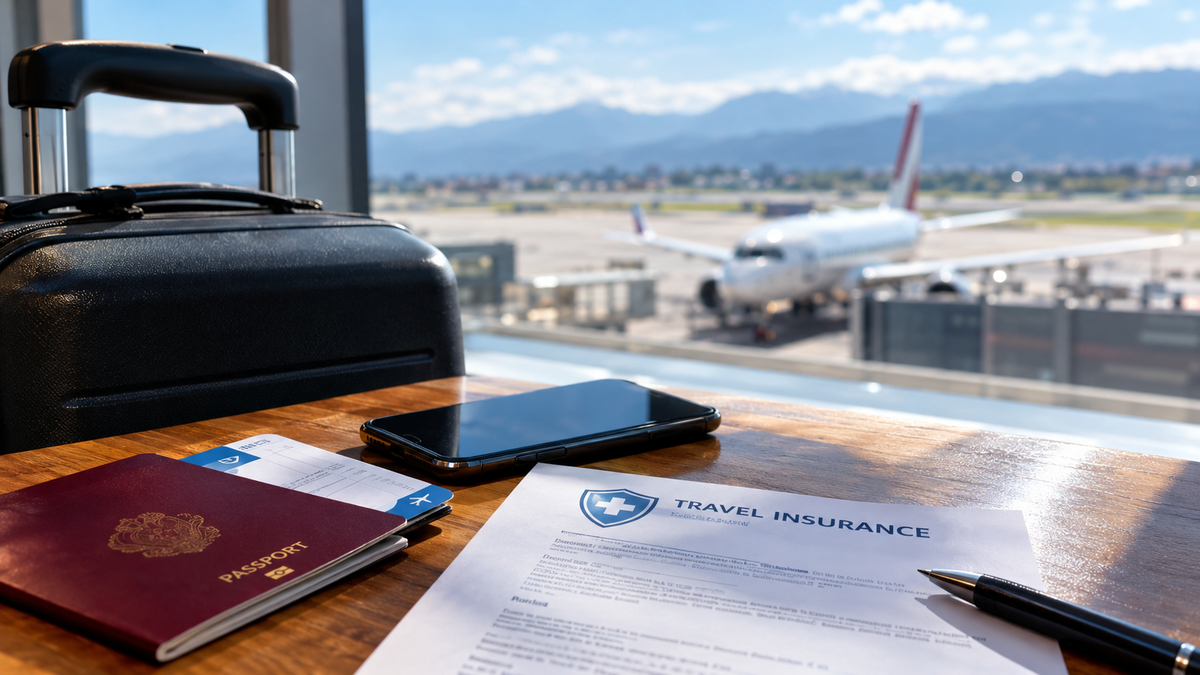
Nothing to panic about: for a tourist, exactly two things changed in 2026. One adds a document to your packing list. The other opens up a new way to arrive.
Below is a breakdown by topic, including what did not change but still causes confusion.
🛡️ Insurance became mandatory
The one change this year that applies to absolutely everyone entering the country.

What happened. Since 1 January 2026, every foreign tourist must hold a valid health and accident insurance policy on entry. The requirement comes from the Law of Georgia on Tourism, Article 12, and Government Decree No. 602.
What the policy must contain. Cover of at least 30,000 GEL, roughly eleven thousand US dollars. It must be valid for the whole stay, from the date of entry to the date of departure. The language must be Georgian or English. Any format works, paper or electronic. It can be issued by a Georgian or any foreign insurer.
Who is exempt. Holders of diplomatic, service and special passports, accredited diplomatic representatives and their families, persons covered by international treaties, and international transport drivers. The list is closed.
What happens without one. Officially confirmed: border police may check for a policy, and entry may be refused without one. Legal practitioners and media report a fine of 300 GEL, but that figure does not appear on the Ministry's official page.
What happens in practice. Airlines have started checking policies at check-in and at the gate.
A fuller breakdown with exemptions and a list of insurers is in insurance to enter Georgia.
🚆 The Tbilisi–Baku train is back after six years

The year's other big story, and one that changes the logistics for anyone routing through the South Caucasus.
What happened. On 26 May 2026, Georgia's Independence Day, daily passenger rail service resumed between the two capitals. The gap had lasted six years: service was suspended in March 2020 because of the pandemic.
The schedule. An overnight train, running daily. Departure from Baku at 23:10, arrival in Tbilisi at 08:41. Return departure from Tbilisi at 21:00, arrival in Baku at 06:24. The journey takes around nine and a half hours, of which roughly two go on customs and border procedures.
Stops in Georgia: Gardabani and Tbilisi railway station. On the Azerbaijani side: Baku railway station, Baladzhary, Yevlakh, Ganja, Agstafa and Boyuk-Kesik.
The rolling stock. A Stadler train owned by Azerbaijan Railways runs the route.
Why it matters. Azerbaijan's share of Georgia's tourist arrivals fell from fifteen per cent in 2019 to four per cent in 2025, and closed land borders were the main reason. Analysts at Galt & Taggart estimate the reopening will add around two hundred million dollars in tourism revenue in the second half of 2026.
What this means for a traveller. There is now a convenient way into Georgia via Azerbaijan: fly to Baku, take the overnight train into Tbilisi. For anyone piecing together a South Caucasus itinerary, this simplifies things considerably.
On fares. Per Azerbaijan Railways, in May 2026: Baku to Tbilisi from 81 manat one way, roughly 48 US dollars. From Ganja 62 manat, around 36 dollars. From Agstafa 57 manat, around 34 dollars. The overall minimum on the route starts from 51 manat, roughly 30 dollars, depending on distance and class.
✈️ The rest of transport: unchanged
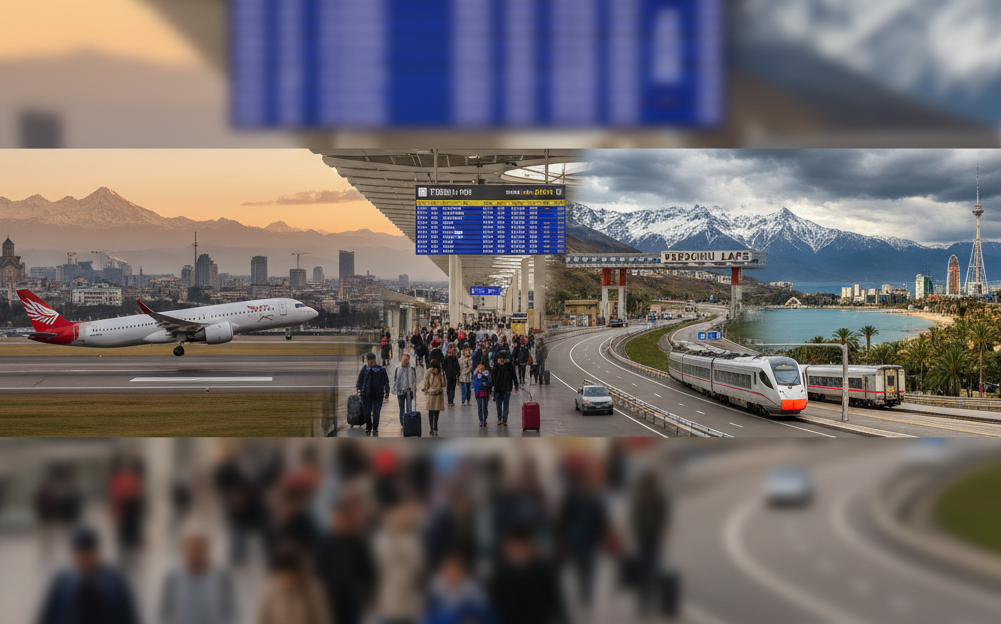
Direct flights from Russia exist and continue to operate. Air links were restored in May 2023, and three airlines fly the route: Russia's Azimuth and Red Wings, and Georgia's own Georgian Airways. Flights serve all three of Georgia's international airports, Tbilisi, Kutaisi and Batumi, daily.
There is no train between Russia and Georgia. This is a persistent misconception worth stating plainly.
Connecting routes. Via Istanbul, which has flights to both Tbilisi and Batumi. Via Yerevan with an overland transfer. And now via Baku with the train.
The Upper Lars land crossing on the Russia–Georgia border operates, but closes in winter during severe weather and sees queues in the high season. Check conditions on the day you travel.
On volumes. In the first quarter of 2026, passenger traffic through Georgia's airports rose by 4.3 per cent to 1.6 million people, with the number of flights up 20.8 per cent. The busiest crossing points: Tbilisi airport, the land posts at Sarpi, Kazbegi and Sadakhlo, and the airports of Kutaisi and Batumi.
🛂 Entry rules: unchanged

There is a lot of confusion online, so this is worth stating clearly.
A visa is still not required for most nationalities, including Russia, Ukraine, Belarus and Kazakhstan. The visa-free regime was not altered in 2026.
The permitted stay is up to one year from the date of entry, one of the most generous visa-free arrangements anywhere. Staying longer means leaving and re-entering, or applying for a residence permit.
Passport requirements. The validity just needs to cover the trip. There is no "six months beyond entry" rule here, unlike in some other countries.
On children. A child may have their own passport or be listed in a parent's. Travelling with one parent does not require the other's consent.
Return tickets are not formally on the list of required documents, but border staff sometimes ask to see them.
Details are in visa requirements for Georgia.
💳 Payments: what works and what does not
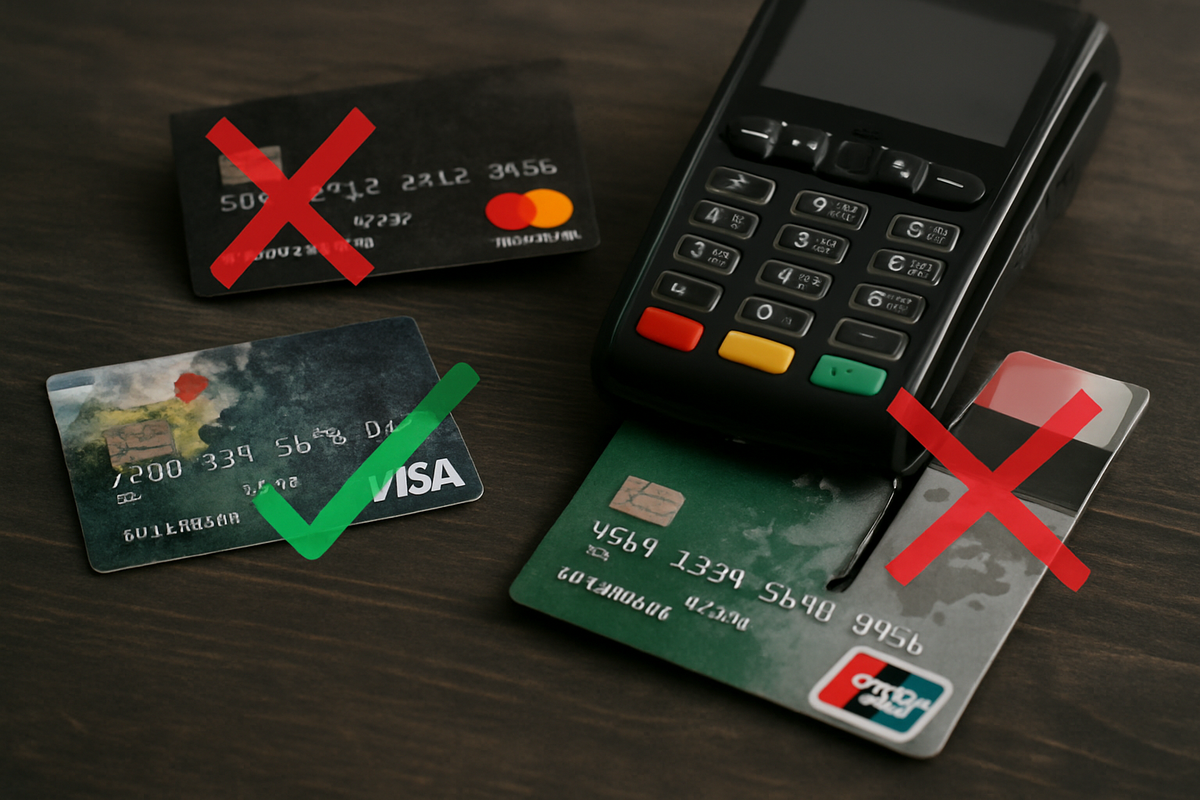
The picture here has been settled for a few years now.
Mir cards do not work anywhere in Georgia. Not in shops, not in cafés, not at ATMs. There is no point bringing one.
Russian-issued Visa and Mastercard have not worked abroad since 2022, and Georgia is no exception. Adding the card to Apple Pay or Google Pay changes nothing: it is the card that works, not the phone.
Russian UnionPay occasionally goes through at some banks, but relying on it as your only source of money is risky.
Foreign-issued Visa and Mastercard work normally. Cards issued in Armenia, Kazakhstan, the UAE or anywhere else are accepted in roughly nine out of ten places in the cities and at every ATM. There are plenty of ATMs: TBC, Bank of Georgia and Liberty are on nearly every corner. Withdrawal limits per transaction usually run 2,000-3,000 GEL.
Cash. Exchange offices deal in dollars and euros. Rubles are accepted rarely and at a poor rate.
If you want to open a Georgian card

No remote option. Georgian banks only open accounts in person, and you sign the application on the spot.
The most accommodating are Bank of Georgia and Credo, with the highest approval rates.
Application fees run around 50 GEL at most banks, and it is not refunded if you are turned down.
What you need: a passport and a local SIM for bank notifications.
Accounts are usually multi-currency: GEL, USD and EUR on one account.
For a short trip. Bring cash dollars or euros and a card issued outside Russia. Opening an account for a week's holiday is not worth the trouble. Branch locations are in the directory: insurance and banking companies in Tbilisi and Batumi.
📱 Connectivity and the internet
Mobile data in Georgia is among the cheapest in Europe, and for once this is a section with no complications.
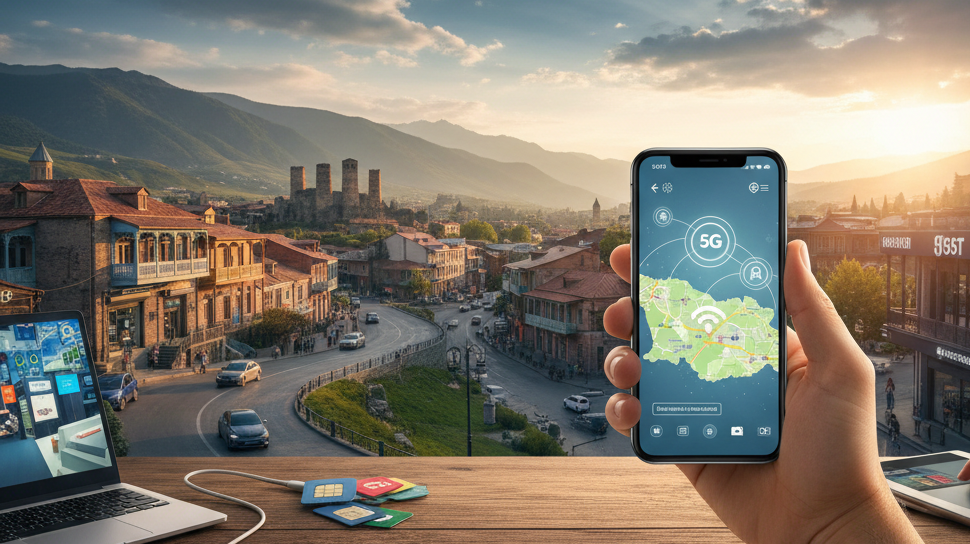
Three operators: Magti, Silknet (formerly Geocell) and Cellfie (formerly Beeline Georgia). SIM cards are sold at the airports in Tbilisi, Kutaisi and Batumi, and at city shops, on presentation of a passport, taking about ten minutes.
Which one to choose. Magti gives the most reliable coverage outside the cities: mountain roads, Kazbegi, Svaneti, the road up to Gudauri. Silknet is strong in the cities and was first to launch 5G in central Tbilisi. Cellfie is the cheapest, but coverage can be patchy beyond Tbilisi and Batumi.
Price guide, September 2026. A SIM card itself costs 4-10 GEL. Tourist packages start around 15 GEL for 4-5 GB over fifteen days. Operators change tariffs, so check their sites before you travel.
eSIM is supported by all three operators, plus international providers work here too. It activates remotely, with no office visit or queue, and works from the moment you land.
Tethering is allowed by every operator.
Practical point. A local SIM is useful beyond just data: you will need one to open a bank account, and for taxi apps, delivery and anything sending verification codes.
Where coverage drops. 4G reaches nearly everywhere people live, but it disappears in the remote mountains. Bear this in mind planning routes through Svaneti, Tusheti and Khevsureti.
⚖️ Local rules worth knowing
Smoking and vaping
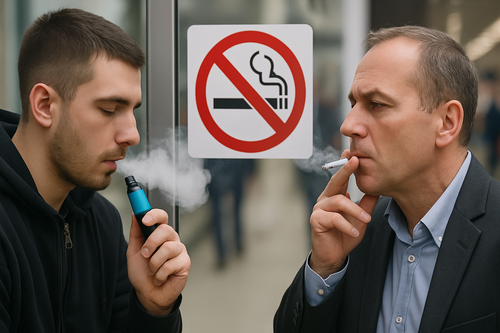
The anti-tobacco law has been in force since 2017 and treats e-cigarettes the same as regular ones. Smoking or vaping indoors in public is banned: cafés, restaurants, bars, offices, public transport.
The ban later extended to taxis, cable cars and waterborne transport, with a fine of 200 GEL. Smoking in a private car with a minor present carries a separate fine of 50 GEL. Fines double on a repeat offence within the year.
Vaping itself is legal. Bringing devices for personal use is fine, and you can buy them locally too. The same rule applies as for cigarettes: outdoors and in designated areas, yes, indoors, no.
On the road
You cannot even hold a phone while driving. Cameras catch this.
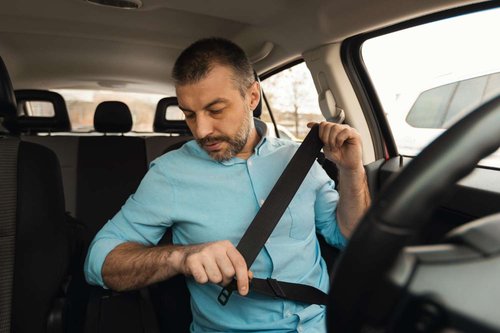
Seatbelts. Front-seat passengers must buckle up; rear passengers are optional.
Children. Under 12 must ride in the back seat. Under 3 need a car seat or must sit on the lap of a belted adult in the back. A child under 6 cannot be left alone in the car.
Alcohol. The approach is strict. A Georgian feast and a rental car do not mix, in any quantity.
The occupied territories
Entering Abkhazia or South Ossetia from anywhere other than Georgia is treated as a violation of the law on occupied territories. This is the one item on the list where the consequences run well beyond a fine.
More on what surprises visitors is in things not to do in Georgia.
💰 On prices and the exchange rate: why there are no figures here
Readers expect specifics, so this needs explaining.
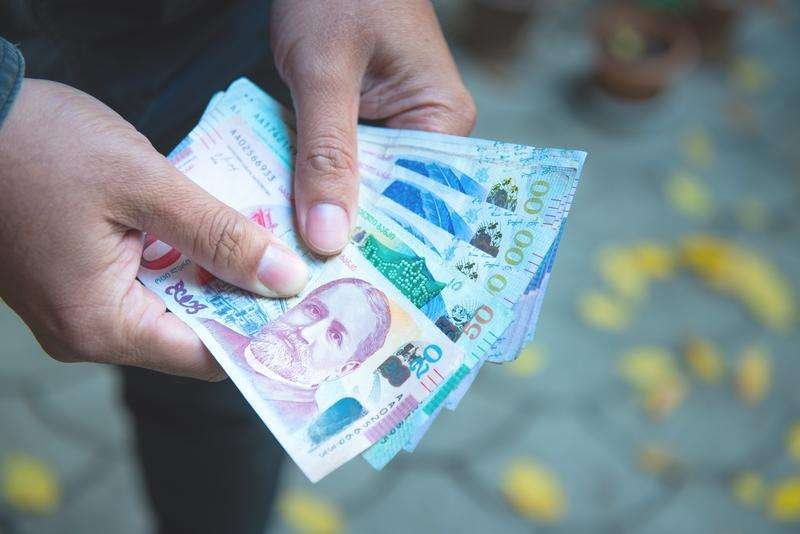
The lari rate changes daily. Any figure in this article would be out of date by the time you read it. Check the current rate from the National Bank of Georgia on the day you travel.
Year-on-year price changes. No reliable, comparable open data exists on Georgia's tourist price basket over two years, so we do not give percentages.
What can honestly be said. Season affects your budget far more than the year does. Coastal accommodation in August versus October differs several times over. Food and transport carry no seasonal markup at all: khachapuri, marshrutkas and taxis cost the same in February as in July.
Our position. It is better to say "check this yourself, and here is where" than to give a tidy figure that turns out wrong in three months.
The most common mistake this year is not forgetting to get insurance, but getting it in the wrong language. Cover can be three times the minimum required and the document will still not formally qualify if it is only in Russian.
What to do. Write to your insurer and ask for an English-language certificate. Most issue one free of charge in a couple of minutes. People usually think of this only at the check-in desk, when it is too late.
🗓️ What is next: planning the trip
By season. All twelve months are covered in when to visit Georgia, plus detailed guides to September and October.
By route. Seven ready-made trips from one to four days are in autumn routes in Georgia.
By event. A dated calendar is in autumn 2026 holidays and events.
What to pack, beyond the documents, is in ten things to bring to Georgia.

Been to Georgia in 2026? Leave a review on Madloba: tell us whether your policy was checked at the border or at the gate, whether you used the new Baku train, and whether you ran into anything not covered here.
Information checked in September 2026. Insurance requirements are cross-checked against the official publication from Georgia's Ministry of Foreign Affairs at geoconsul.gov.ge. Rail data comes from the Georgian and Azerbaijani economy ministries and from Azerbaijan Railways. The lari rate, flight prices and operator tariffs change throughout the year; check current figures with the primary sources. The fine for lacking insurance is reported by legal practitioners and media rather than confirmed officially.
❓ Frequently asked questions
💬 Most nationalities, including Russia, Ukraine, Belarus and Kazakhstan, do not need one. The visa-free regime was not changed in 2026, and you can stay for up to a year from the date of entry.
💬 Yes, mandatory since 1 January 2026. Cover of at least 30,000 GEL, valid for your whole stay, the document in Georgian or English.
💬 Yes. Daily passenger service between Tbilisi and Baku resumed on 26 May 2026 after a six-year gap. Departure from Baku is at 23:10, arriving in Tbilisi at 08:41. The return departs Tbilisi at 21:00, arriving in Baku at 06:24.
💬 Yes, air links were restored in May 2023. Azimuth, Red Wings and Georgian Airways fly the route, serving all three international airports daily. There is no train between Russia and Georgia.
💬 Magti for travelling around the country and mountain routes, Silknet for the cities, Cellfie if the lowest price matters most and you are staying in Tbilisi and Batumi. eSIM is supported by all three operators and is easy to set up before you arrive.
💬 No reliable comparable data exists across two years, so we do not give percentages. Season affects your budget far more than the year does: coastal accommodation in August versus October differs several times over, while food and transport carry no seasonal markup.
💬 Not indoors in public places; e-cigarettes are treated the same as regular ones since 2017. The ban also covers taxis, cable cars and waterborne transport, with a 200 GEL fine.
💬 Whenever a confirmed change appears. The last check date is noted just before the "Read next" block.

0 comments
Log in to leave a comment