




🔌 Owning an EV in Georgia: Where to Charge, What You Pay and Who Benefits
The cost per kilometer depends on where you charge: at home it is several times cheaper than at a fast station. On import, a left-hand-drive EV pays no excise, while a petrol car older than 6 years has become very expensive since 2026.
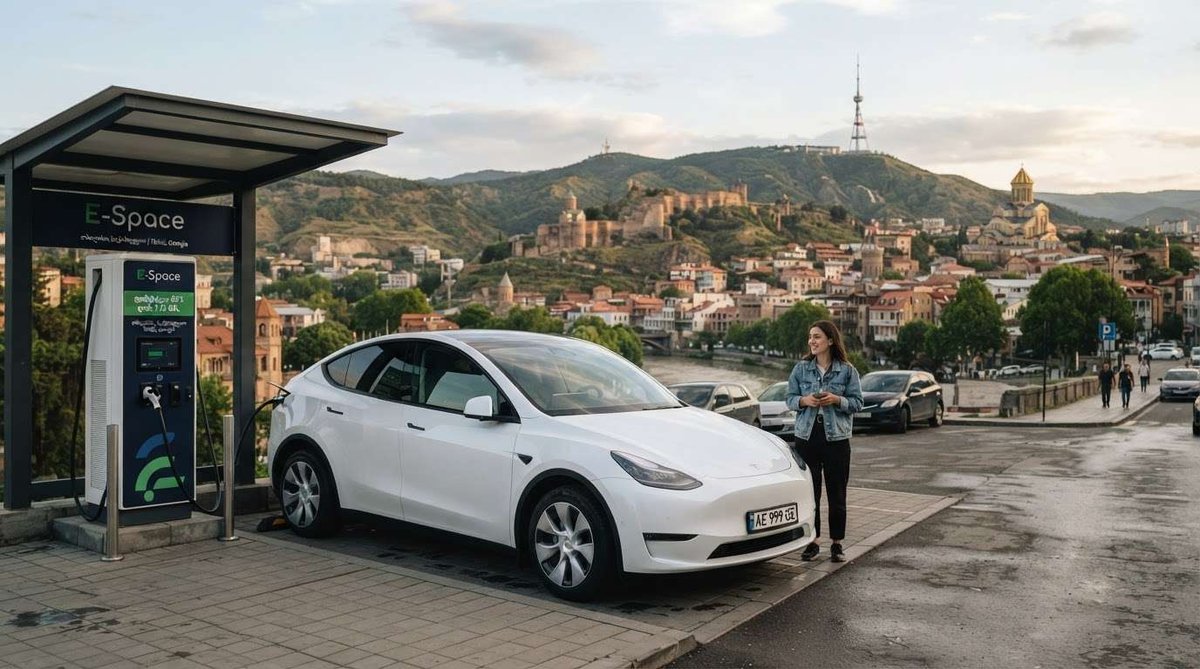
Electric cars in Georgia become more common every month. In the first half of 2026 the country imported 6,087 battery-electric cars, 64% more than a year earlier, and together with hybrids electrified vehicles made up 29% of all imports. The reason is simple: charging is cheaper than petrol, there is no excise on import, and the station network has grown to several hundred points. You can find the nearest ones in the catalog of gas and charging stations in Tbilisi. Below is everything in order: charging prices, where to charge in cities and in the mountains, what import costs, which benefits exist and who an EV really suits.
⚡ How Much It Costs to Charge an Electric Car in Georgia
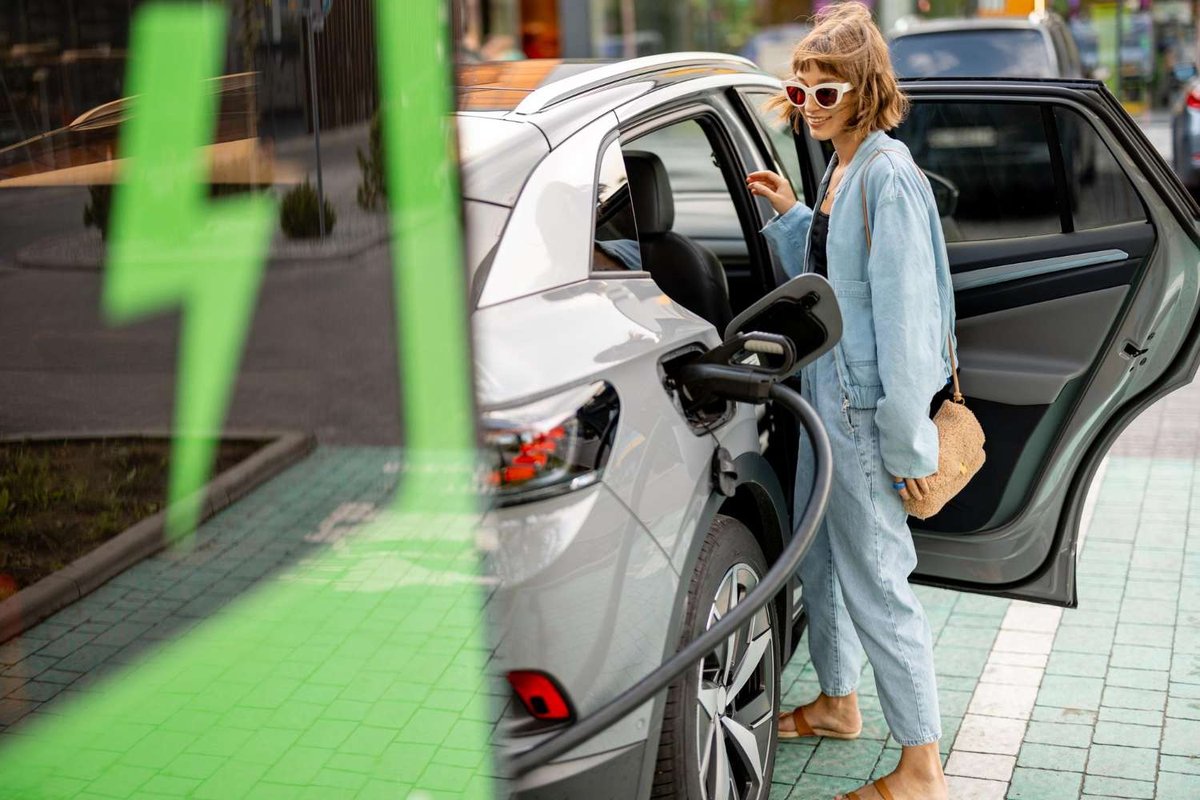
More than ten charging networks operate in Georgia, and each has its own tariff. Prices are quoted per kilowatt-hour, and slow charging (AC, alternating current) is almost always cheaper than fast charging (DC, direct current). As of October 2026 the country has about 670 public stations, and roughly three quarters of them have a published tariff. The rest are usually at hotels, malls and restaurants, where charging is free for guests or the price is shown on site.
Data as of October 13, 2026. Operators change tariffs every few months, and the network's app shows the exact price.
Calculated for a consumption of 17 kWh per 100 km and petrol at about 4 GEL per liter. In winter and in the mountains an EV uses more, as the section below shows.
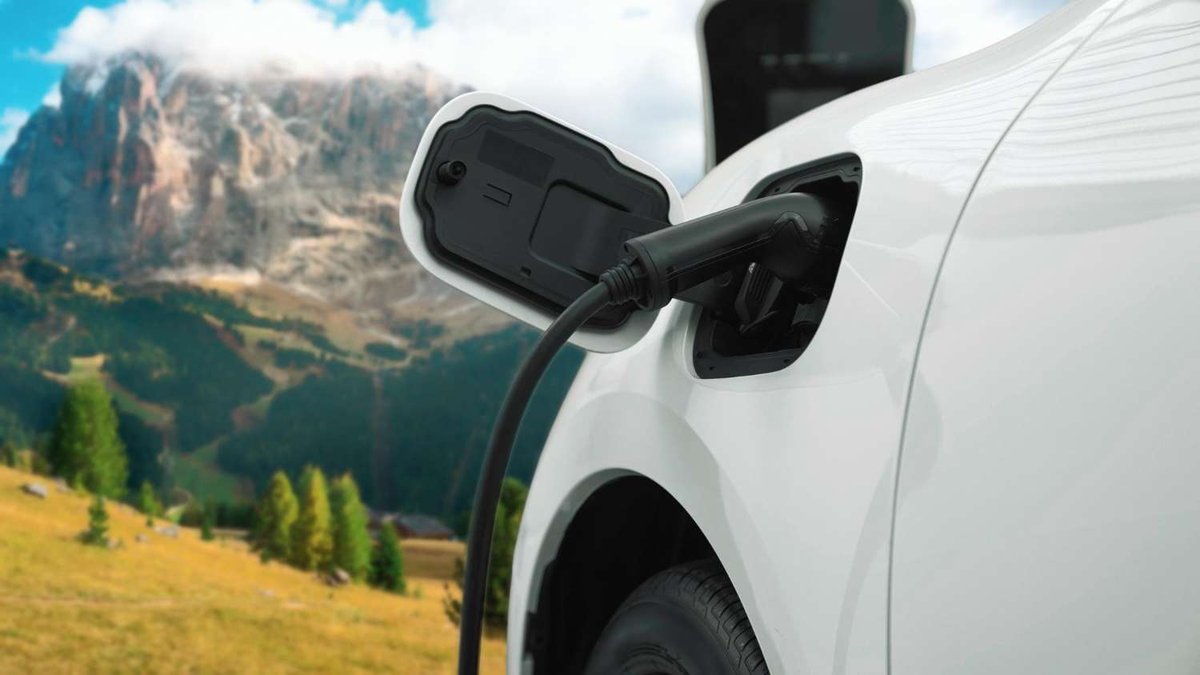
Most stations use standard European connectors: Type 2 for slow charging and CCS2 for fast charging. Many cars brought from China are built for the Chinese domestic market and have a GB/T connector. The owner of such a car needs an adapter, otherwise it cannot plug into a fast station at all. Ask the seller about this before buying.
Payment goes through the network’s app or a card, and some networks add an idle fee if the car stays at the station after charging ends. Standing in a charging bay without a plugged-in cable can also bring a fine, so free the spot promptly.
🗺 Where to Charge an Electric Car: Cities, Highways and Mountains

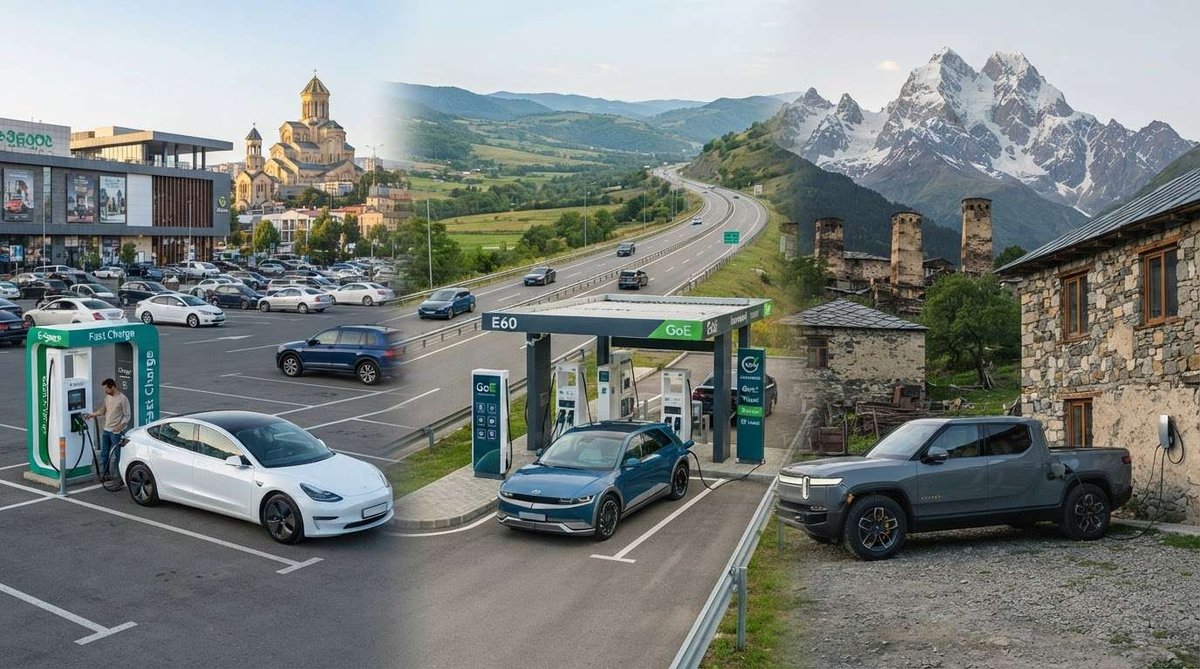
Tbilisi and Batumi have the best coverage. Fast stations are at malls, gas stations and large parking lots, and Tbilisi City Hall has announced another 200 city chargers, which the winning auction companies must install at their own expense. Many malls let you charge for free while you shop.
The Tbilisi–Batumi highway is easy to drive: there are fast stations along the east–west highway, including the Argveti section, where one of the largest charging sites in the country operates. If you travel this route, also read our guide to getting from Tbilisi to Batumi by car.
Kakheti and the south are developed too: there are fast stations in Telavi, Kvareli, Sighnaghi and Akhaltsikhe. Gudauri and Kazbegi are reachable, with several networks in Gudauri and slow chargers in Stepantsminda.
Svaneti remains the hardest direction: there are practically no chargers, and the road from Zugdidi to Mestia climbs almost all the way. Charge to 100% in Zugdidi and arrange with your guesthouse in advance to use an outlet overnight.
To see all networks on one map, use PlugShare or the aggregator geocharge.ge. But you will still start a session from the specific network’s app, so install the apps of two or three large operators beforehand.
🧾 Importing and Clearing an Electric Car in 2026
The main advantage of an EV on import: no excise is paid on a left-hand-drive electric car. Since April 2, 2026, new excise rates for passenger cars have been in force in Georgia, and clearing a petrol car older than 6 years has become several times more expensive.
Excise rates since April 2, 2026. The example is for a 2.0 L engine, and the exact amount for a specific car is calculated by the Revenue Service of Georgia calculator.
Customs calculates VAT not from the price on your invoice but from the car’s value in its own database, so the final amount may differ from what you worked out yourself. Before buying, check the specific car by VIN in the customs clearance calculator on the Revenue Service of Georgia site (rs.ge).
The average customs value of an imported electric car in the first half of 2026 fell to about $14,600, down from $17,200 a year earlier, while hybrids, on the contrary, became more expensive. If you do not want to import a car yourself, EVs are also sold by local car dealerships in Tbilisi, usually already cleared. If you plan to arrive in your own car from Russia, first read how to drive to Georgia from Russia.
🅿️ Benefits for Electric Cars: Parking and Taxes
There is no annual vehicle tax for individuals in Georgia, either for electric cars or petrol ones. So after clearance and registration, the owner’s main costs are insurance, servicing and energy.
Parking. In 2017 Tbilisi City Hall began exempting EV owners from parking fees on written application with copies of a passport and vehicle registration certificate. We found no confirmation that this benefit still applies in 2026. Before leaving a car in a paid zone without paying, check the status in the city parking app or at City Hall. General rules, tariffs and fines are collected in our article on parking in Georgia.
Free charging. City Hall chargers in Tbilisi are free, but there are few of them and they are slow. You can also charge for free at some malls and hotels.
🏠 Charging at Home: Apartment, House and Tariffs
A household outlet gives the cheapest kilometer. Since April 1, 2026, electricity for apartments in Tbilisi is billed in tiers:
- up to 101 kWh per month, about 20 tetri per kWh;
- up to 301 kWh, about 24 tetri;
- above 301 kWh, about 28.5 tetri.

Keep in mind that an EV quickly pushes an apartment into the top tier. At 1,500 km a month the car uses about 250 kWh, and together with the apartment’s normal use you will almost certainly end up on the 28.5 tetri rate. Even so, 100 km costs about 5 GEL. More about utility bills is in the section how much electricity, gas and utilities cost in Georgia.
In a private house it is simplest: you can install a 7 kW wall unit that fills the car overnight. In an apartment block everything depends on the parking: an outlet in an underground garage must be agreed with the management company or homeowners’ association, and charging through an extension cord from a window is dangerous and prohibited. An ordinary household outlet gives about 2–3 kW, which is enough for about 100–150 km overnight.
❄️ An Electric Car in the Mountains and in Winter
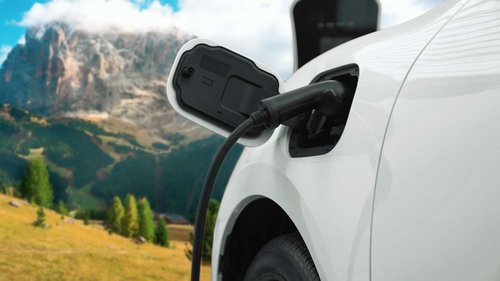
Georgia is a mountainous country, and this has to be taken into account. On climbs consumption rises noticeably: the road to Gudauri and the Cross Pass (2,379 m) uses more charge than the same distance on flat ground. In return, on the descent the car recovers some energy through regenerative braking, and you often arrive in Tbilisi with a reserve.
In winter frost cuts the range by about 20%, and in severe cold a car that covers 300 km in summer may manage 180–200. Warm up the cabin while the car is still plugged in, use seat heaters instead of the heater, and do not let the charge drop below 20% before a pass. In snow the Cross Pass is periodically closed, and waiting in a queue with an almost empty battery is unpleasant.
🔧 Service, Parts and Resale
Servicing an EV in Georgia is possible, but there are fewer specialists than for petrol cars. Workshops that handle EVs and hybrids are in the catalogs of auto services in Tbilisi and auto services in Batumi. Parts for popular models are found quickly, while for rare Chinese brands they often have to be ordered and waited for.
Resale is a special case. Georgia traditionally re-exports cars to neighboring countries, but EVs rarely leave the country: in the first half of 2026 only about 7.6% of imported electric cars were exported, against 48% of petrol and diesel ones. So you will most likely sell an EV on the local market, where their prices are falling.
🤔 Is It Worth Buying an Electric Car in Georgia
- you have a private house or a parking space with an outlet
- you mostly drive in Tbilisi, Batumi and on the highway between them
- you drive 1,000 km a month or more, so fuel savings add up fast
- you plan to import the car: left-hand drive pays no excise
- you plan to live in Georgia for several years
- you live in an apartment block with no access to an outlet
- you often travel to Svaneti, Tusheti and other mountain areas
- you are considering a right-hand-drive car
- you want to sell the car abroad later
- you are choosing a rare Chinese model with no service in Georgia
In short, an electric car in Georgia pays off for those who charge at home and drive mostly in the city and on the main highways. Then 100 km costs about 4–5 GEL instead of 25–30 GEL on petrol, and no excise is paid on import. If you can only charge at fast stations, the savings roughly halve, though they still remain noticeable.
Before buying an EV, take a similar model through car sharing or a rental for a couple of days and drive your usual routes: home, work, a trip out of town. It will immediately become clear whether the range is enough and where charging is convenient for you. And if you are bringing a car from China, buy a GB/T to CCS2 adapter in advance: without it, fast stations in Georgia will be useless to you.
Do you drive an EV in Georgia? Tell us in the comments which model you have, where you charge and how much you pay per 100 km: we update prices and the station list based on your messages.
Last updated: October 2026. Charging network tariffs and excise rates are given as of this date, and operators change prices every few months. Before buying or importing a car, check the clearance amount by VIN on the Revenue Service of Georgia website.
❓ Frequently Asked Questions About Electric Cars in Georgia
💬 At home about 20–28.5 tetri per kWh, at city AC stations 0.45–0.70 GEL, at fast DC stations 0.55–1.00 GEL. In terms of distance that is about 4–5 GEL per 100 km when charging at home and 10–14 GEL at public stations.
💬 No excise is paid on a left-hand-drive electric car. For a right-hand-drive electric car the excise is fixed at 3,000 GEL. In both cases 18% VAT and clearance and registration fees are added.
💬 There is no excise, so the main costs are 18% VAT on the car’s customs value including delivery and fees of about 270–480 GEL. For example, a 2020 Nissan Leaf from the US with delivery and clearance costs about $14,400 turnkey.
💬 As of October 2026 about 670 public stations, with the most in the mart EV and E-Space networks. The network is growing: Tbilisi City Hall has announced another 200 city chargers.
💬 Yes, there are fast stations along the main highway, including around Argveti and Kutaisi. Most modern EVs need only one stop of 20–40 minutes.
💬 Several networks operate in Gudauri, and Stepantsminda has slow chargers. Svaneti has practically no stations, so charge to 100% in Zugdidi and arrange an outlet at your guesthouse.
💬 In 2017 City Hall began exempting EVs from parking fees on application. Whether this benefit works now is not officially confirmed, so check the status at City Hall or in the city parking app.
💬 Type 2 for slow charging and CCS2 for fast charging. If a car was brought from China with a GB/T connector, you will need an adapter.
💬 By about 20% in frost. A car that covers 300 km in summer may manage 180–200 km in severe cold, especially on mountain climbs.
💬 In energy costs, yes: 100 km in an EV charged at home costs about 4–5 GEL, in a hybrid about 20 GEL. On import a hybrid up to 6 years old pays excise with a 60% reduction, while a left-hand-drive EV pays no excise at all. But a hybrid does not depend on chargers and is easier to sell abroad.

Read also
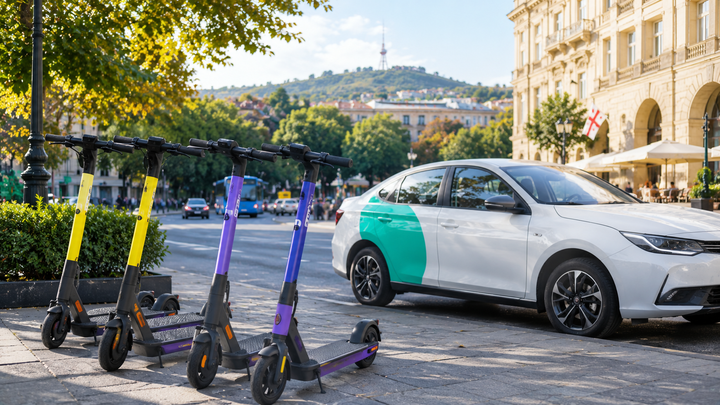
🛴 E-Scooters and Car Sharing in Tbilisi in 2026: Prices, Apps and Rules
🚗 Getmancar from 0.19 GEL a minute and Bolt, Jet, Scroll scooters: what a ride in Tbilisi costs, which licence you need and when renting a car is cheaper.

🚌 Georgia–Armenia Border: Sadakhlo Checkpoint, Queues, Minibuses and the Train
🚌 How to cross the Georgia–Armenia border: Sadakhlo, Guguti and Ninotsminda checkpoints, queues, minibuses, the Tbilisi–Yerevan train, documents and prices
TIR Parks in Georgia: Where Trucks Wait, Queue and Fees
Before 9 Georgian border checkpoints, trucks must stop at a TIR park, with set exceptions. Parks for each crossing, the rs.ge queue and the 80 lari cap.

🚆 Train Tickets in Georgia: Where to Buy and Why Your Card Fails
🚌 railway.ge, tkt.ge and the station ticket office: where to buy, and why your foreign card gets declined.
🚗 A Year From Entry: What to Know About Driving Licences in Georgia
🚗 A foreign licence is valid for a year from entry. How to exchange it for a Georgian one with no exam required.

Stavropol to Tbilisi: Distance and Route by Car
🗺️ A trip by car to Tbilisi from Stavropol. The distance is 437 km, but by road - 612 km or 380 miles.
0 comments
Log in to leave a comment