


🏰 Khujabi Monastery: A Georgian Church Caught on the Armenian Border
The Short Version
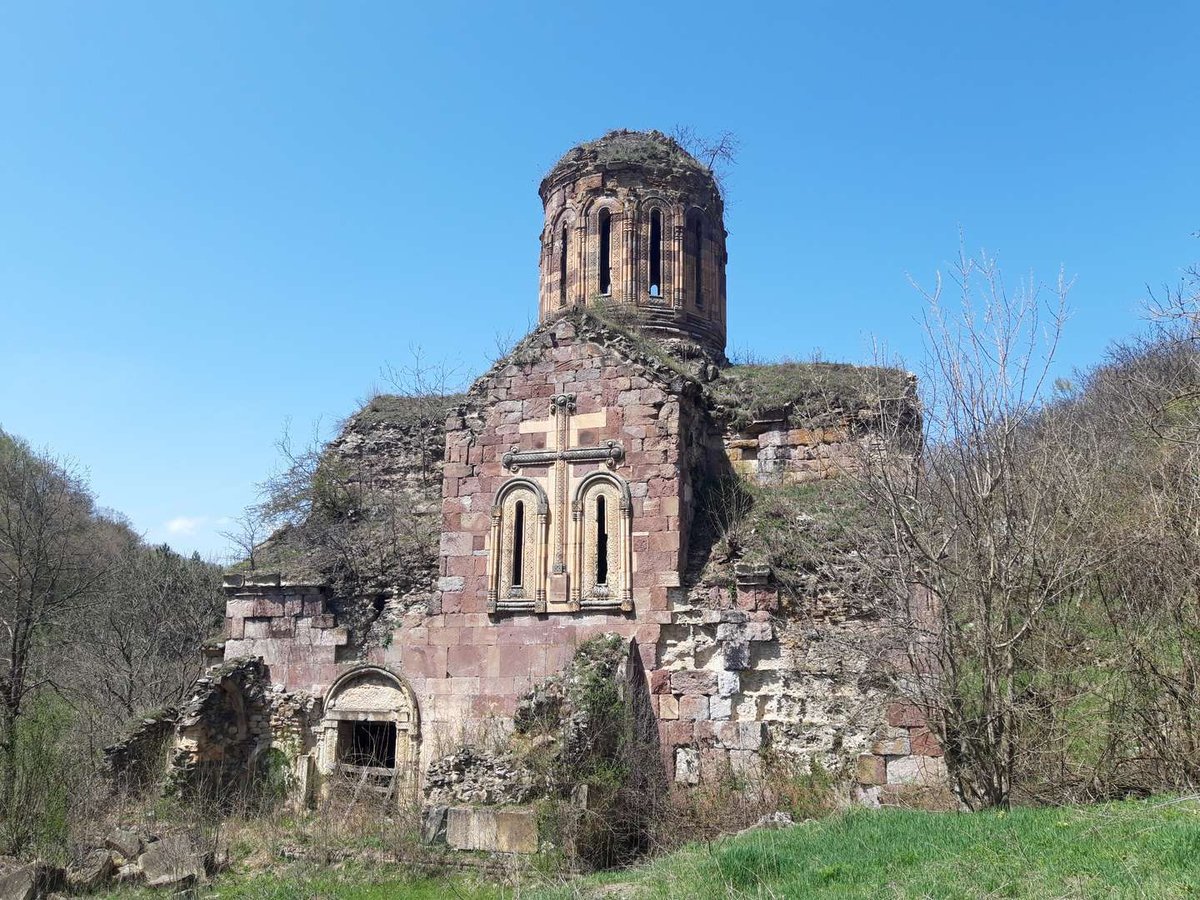
Khujabi Monastery stands in Kvemo Kartli, right on the border with Armenia, near the village of Akhkerpi. It is a cross-domed church from the turn of the 12th to the 13th century, one of the monuments from Georgia's architectural golden age, and it has been abandoned and revived more than once over its history. Today it sits on a stretch of land whose status the two countries describe differently.
Little gets written about it, not for lack of interest, but because reaching it, or even establishing what is currently happening there, is genuinely difficult.
🔤 Where the Name Comes From
There is no single accepted origin for the name. One reading traces "Khujabi" to an Arabic word for a keeper or steward at a ruler's court. Another points to the Armenian name for the site, "Khuchap," linking it to a word meaning haste or commotion. Both versions appear in the scholarly literature, and no consensus has settled the question.
📜 What Is Known About Its Construction and Early Centuries
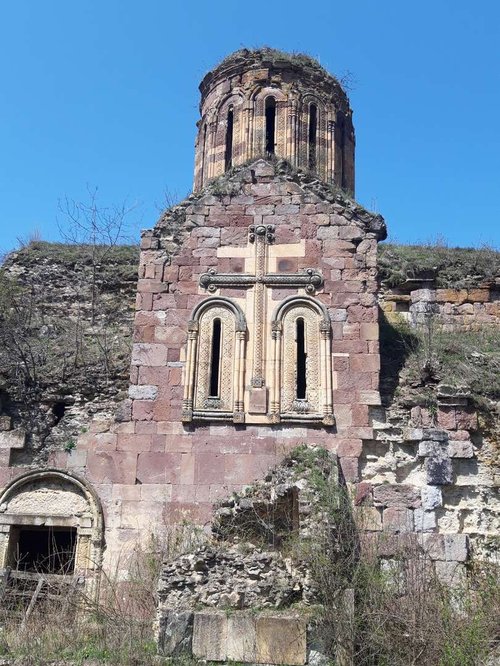
Architectural historians place the main church at the turn of the 12th to the 13th century, a period regarded as the high point of Georgian ecclesiastical architecture. Pinning down an exact date is difficult: an inscription on the walls, which may have recorded the founders' names and a date, was damaged and lost in the 19th century.
The first written mention comes from a 1721 land survey, which lists two Georgian villages near what is now Akhkerpi, Hujabi and Upper Hujabi, both belonging to the noble Eliarashvili family. When Vakhushti Bagrationi described Kartli in the 1740s, he already recorded the monastery as abandoned. It had most likely emptied out during one of the enemy incursions the sources mention without giving a precise date.
✝️ An Early 20th-Century Convent
In 1905, a Russian Orthodox convent was founded in the abandoned complex. It operated until 1935, when Soviet authorities shut it down and expelled the nuns. The exact circumstances of the expulsion are poorly documented, though according to the convent's own mother superior, the sisters found temporary shelter in Akhkerpi and set up a small chapel there.
The Timeline, Without the Gaps
🏛️ What the Church Itself Looks Like
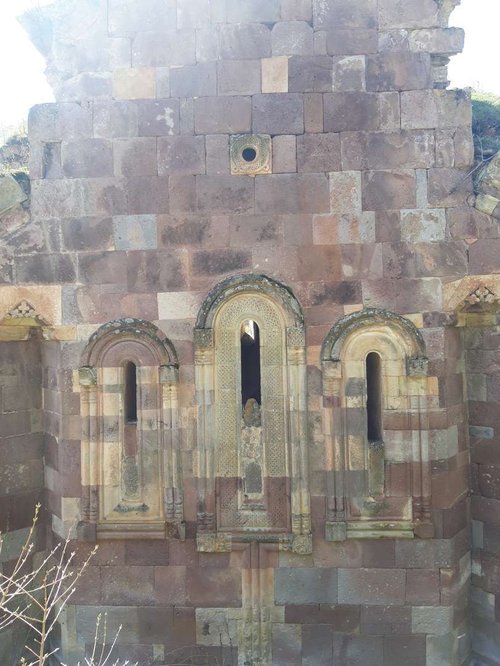
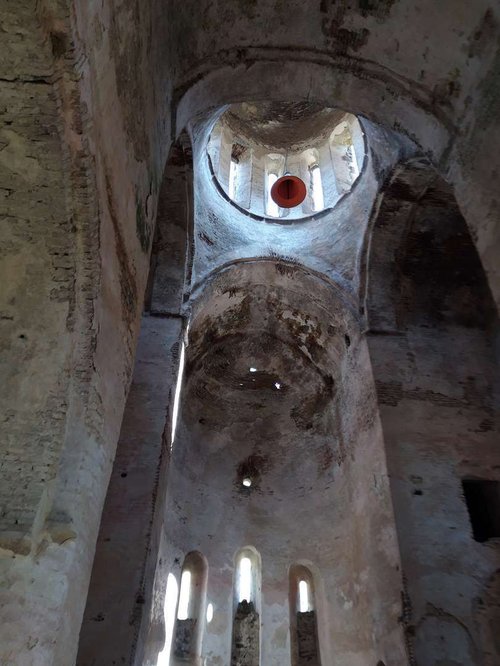
The cross-domed building rests on an artificial platform. Its eastern facade retains triangular niches with scalloped arches and three windows set between them, while the southern wall carries a cross worked in pale stone. There are three entrances, from the west, north and south, with the western and southern ones decorated and the northern one left plain. A three-part arched gate once stood in front of the western facade. The drum of the dome is pierced by twelve arched windows, and relief carvings survive between the cornice and the arches.
Traces of a hall church and outbuildings remain near the main structure, which suggests that in better times this was not a lone church but a small monastic complex.
🗺️ Why the Territory Is Considered Disputed
Both positions need to be laid out here without favouring either, since no international ruling has settled this stretch of the border.
Georgia's position. During the Soviet period, the monastery fell administratively within the Georgian SSR, a claim supported by a 1959 register of protected monuments and a 1964 geographic atlas of the Georgian SSR. After the Soviet collapse, according to Georgian sources, the border line in this area shifted by several hundred metres toward Georgia, placing the monastery in a zone that Georgia considers temporarily held rather than legitimately transferred.
The situation on the ground today. The nearest inhabited settlement to the monastery, the village of Privolnoye, falls administratively within Armenia's Lori Province, and Armenian sources list the complex within its borders. Demarcation of the Georgia-Armenia border in this exact stretch has not been completed, and neither side has formally settled the status of this particular piece of land in a bilateral agreement.
The 2005 incident. According to media reports from the time, a Georgian television crew attempted to approach the monastery to film it, which drew warning fire from Armenian border guards. No regular reports of safe access for pilgrims or researchers have surfaced since.
🇬🇪 Georgia's Position
Soviet-era registers placed the monastery within the Georgian SSR. After 1991 the border line shifted, and the territory is treated as temporarily held.
📍 Situation on the Ground
The nearest village, Privolnoye, is administered as part of Armenia's Lori Province. Demarcation of the border along this stretch has not been formally completed.
🏗️ The Building's Current Condition
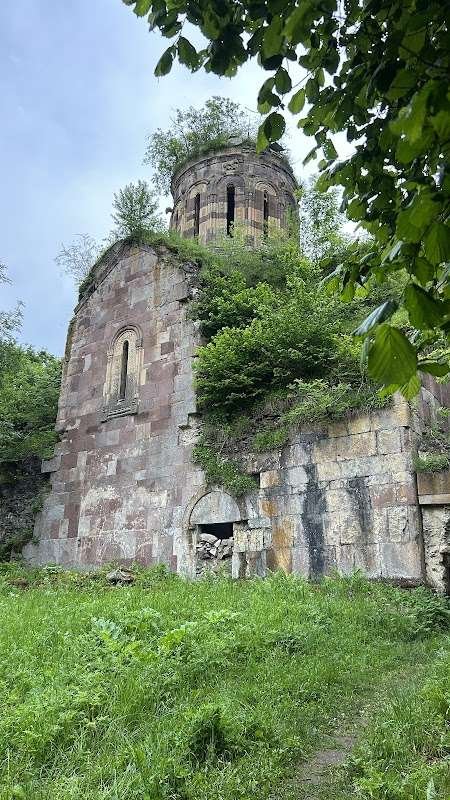
Independent accounts from recent years describe the structure as being in poor shape. Trees have overtaken the dome and part of the roof, roots are working their way between the stones and damaging the masonry, sections of the stone carving are flaking away, and the surviving reliefs are at risk of being lost. No restoration or regular maintenance appears to have taken place in recent decades, which follows logically from the territory's unresolved status: nobody is really in a position to repair a building that cannot be safely reached.
🚫 Can You Visit Khujabi Monastery Today
To be direct about it: there is no organised tourist access to Khujabi Monastery at present. The site sits in an unresolved border zone, and neither side publishes current information on who, if anyone, is permitted to approach it. This article deliberately does not include a route, GPS coordinates, or step-by-step directions: trying to reach the border on your own in this area could be not just pointless but genuinely dangerous.
If you need verified information about the territory's current status, it makes more sense to check with official channels, such as Georgia's border service, the Diocese of Marneuli and Khujabi, or the local administration of Marneuli Municipality, rather than relying on travel forums or outdated route descriptions.
If you have documented history of the monastery, family accounts of the early 20th-century convent, or up-to-date information on its present status, share it with Madloba. Material like that helps us write more accurately about places that cannot be freely visited.
Information is current as of July 2026. The border's status and any conditions of access may change, so check official Georgian and Armenian sources before drawing conclusions about the present situation.
❓ Questions and answers
💬 In Kvemo Kartli, in Marneuli Municipality, on the border with Armenia, near the village of Akhkerpi. The nearest settlement on the Armenian side, Privolnoye, lies in Lori Province.
💬 Architectural historians place the main church at the turn of the 12th to the 13th century. An exact date cannot be confirmed, since the inscription that may have recorded it was damaged in the 19th century.
💬 Yes, a Russian Orthodox convent operated in the complex from 1905 to 1935. Soviet authorities closed it in 1935 and expelled the nuns.
💬 There is no clear-cut answer. Georgia treats the territory as temporarily held and points to Soviet-era administrative records, while the nearest village is administered as part of Armenia's Lori Province. Demarcation along this stretch of the border has not been completed.
💬 There is no organised tourist access. The site lies in an unresolved border zone, and neither side publishes current information on who is permitted to approach it.
💬 According to media reports from the time, a Georgian television crew tried to approach the monastery to film it, which drew warning fire from Armenian border guards. No regular reports of safe access have followed since.
💬 Independent accounts describe it as being in poor condition. The dome and roof are overgrown with trees, roots are damaging the masonry, and parts of the stone carving are deteriorating.
💬 There is no single agreed origin. One version traces it to an Arabic word for a keeper at a ruler's court, another links it to the Armenian name "Khuchap," meaning haste or commotion.

2 comments
Log in to leave a comment