


🗿 Batumi Sculptures and Monuments: Heroes, Myths and Public Art Under Open Sky
Monuments, sculptures & fountains — by category
Batumi has over a hundred monuments, sculptures and fountains spread across its boulevard, squares and parks, nearly all outdoors, free and open around the clock. Sculpture here is not a museum piece behind glass; it is part of the city fabric, appearing at every junction along the seafront. This guide organises Batumi's sculptures by type so a walk becomes a coherent route rather than a random sequence of photo stops. The full list with addresses, coordinates and reviews is in the Batumi monuments catalogue.
💑 Literature and Myth: the City's Main Symbols
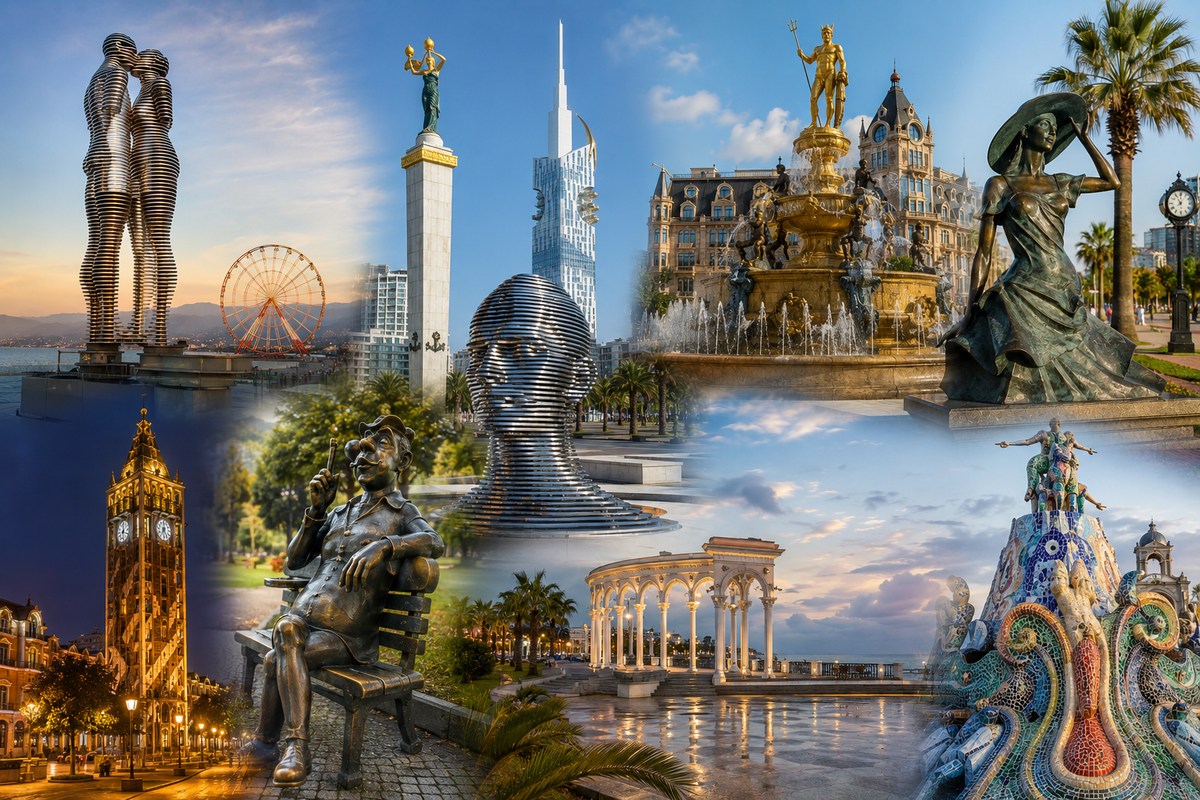
The most recognisable sculptures in Batumi draw not on specific historical figures but on legends and literature. They became the visual symbols that define the city internationally.
Ali and Nino: the Kinetic Sculpture of Love
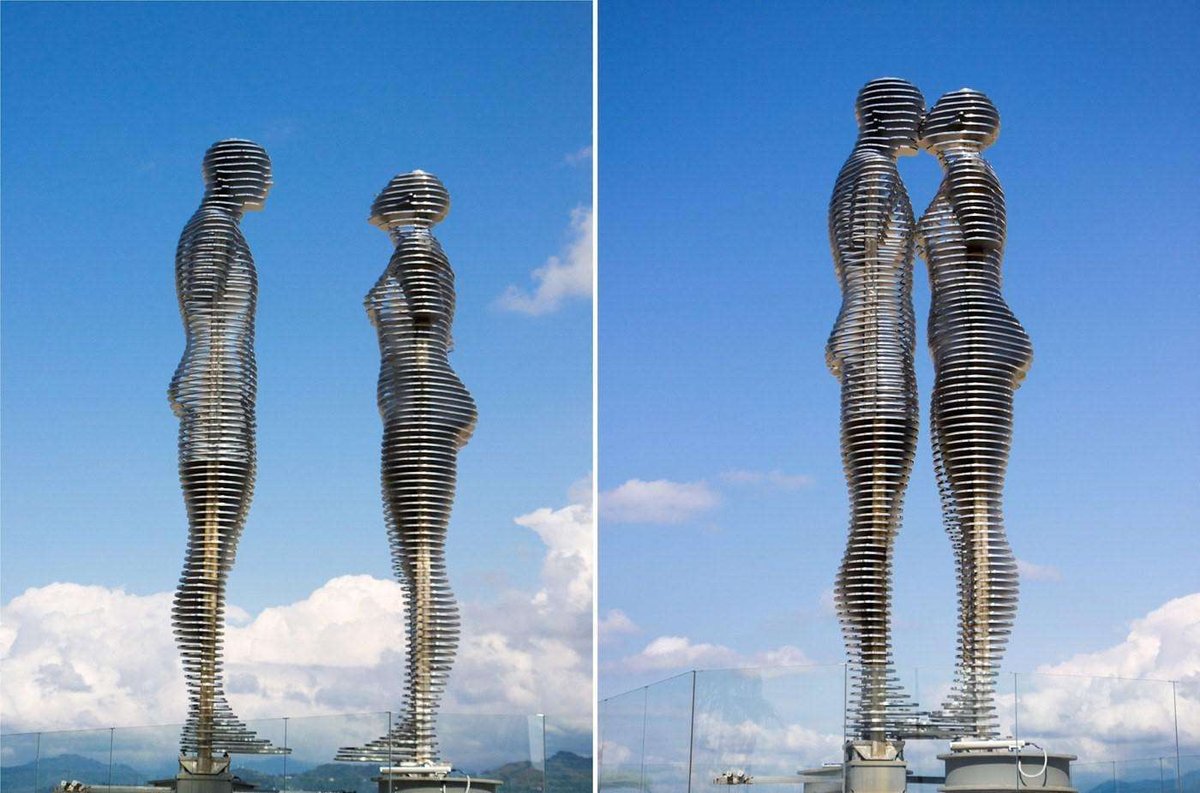
A kinetic installation approximately 8 metres tall, set on the seafront in 2011. Created by Georgian artist Tamara Kvesitadze, originally titled simply "Man and Woman". Two semi-transparent metal figures slowly move toward each other, pass through one another and part again, never quite touching. This enacts the plot of the novel "Ali and Nino" by Kurban Said: the story of a Muslim Azerbaijani man and a Christian Georgian woman whose love ends in tragedy against the upheaval of early 20th-century history.
The movement begins around 7 pm each evening, accompanied by neon illumination; the full cycle lasts about ten minutes. During the day the statues stand still and often seem smaller than visitors expect from photographs. In motion and lit up, the sculpture fully reveals itself. It is a rare example of public kinetic art where movement, not form alone, carries the meaning. The literary and historical background of the novel is explored in a dedicated blog article on Ali and Nino.
Medea at Europe Square
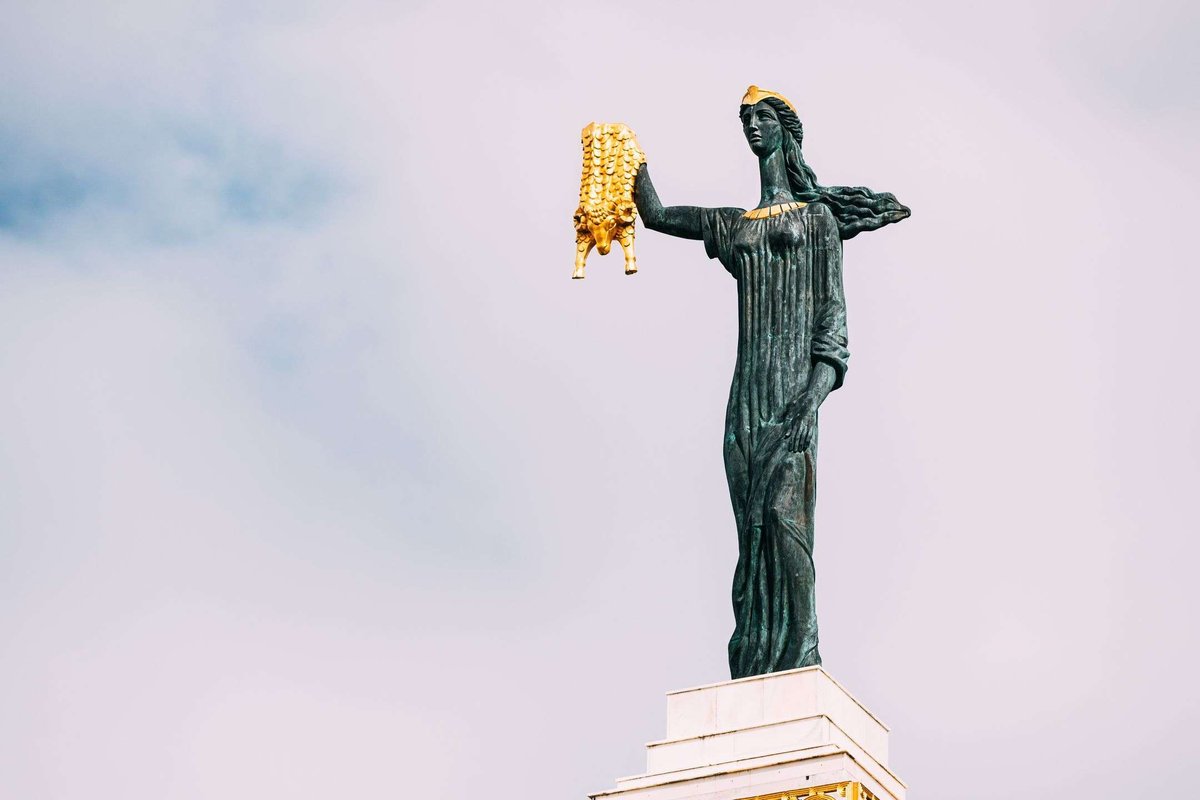
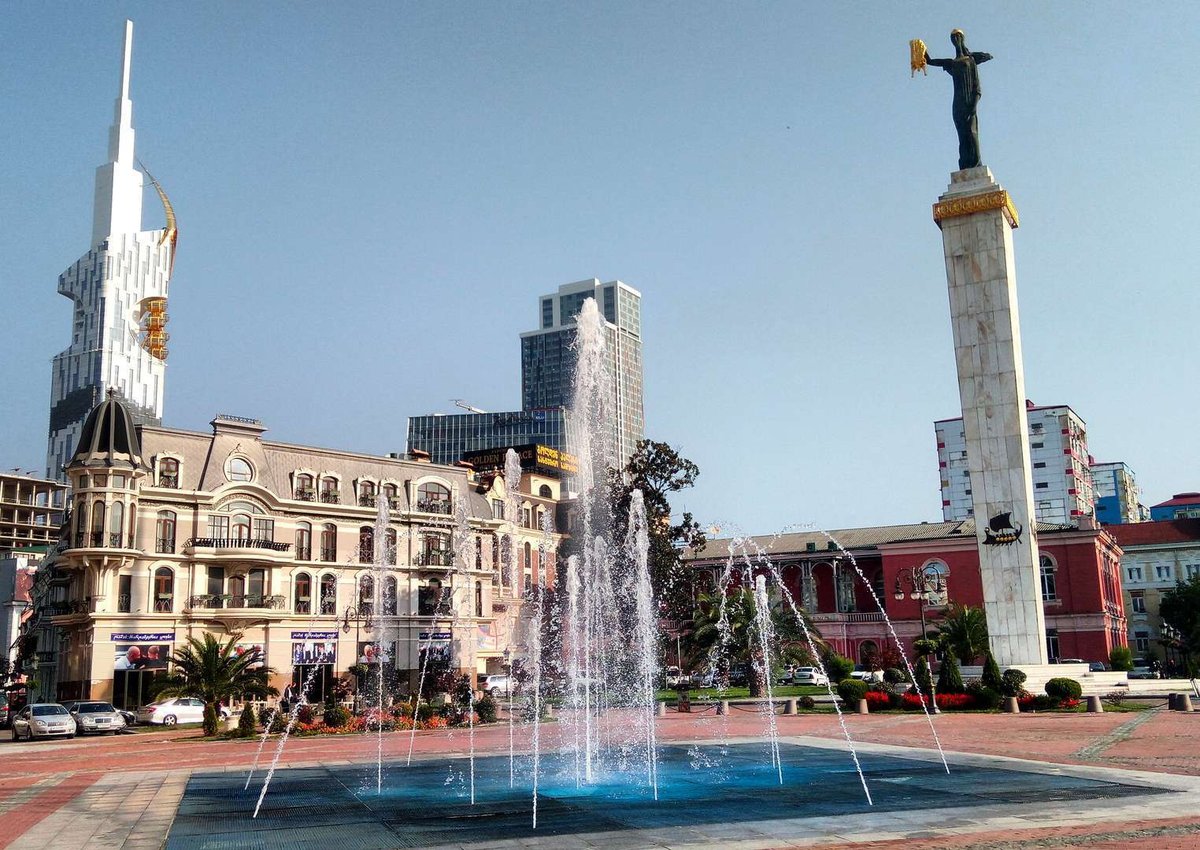
A bronze statue of the Colchian princess holding the Golden Fleece, on a tall column at the centre of Europe Square. Sculptor Davit Khmaladze; unveiled in 2007 by President Saakashvili as part of the programme to rebrand Batumi as a Black Sea tourist destination.
The choice of Medea is deliberate. Ancient Colchis occupied the territory of present-day western Georgia. By placing Medea at the heart of the city, Batumi claimed its connection to Greek mythology and the legend of the Argonauts, positioning itself within a classical Mediterranean narrative rather than a purely Soviet or imperial one. Europe Square around the statue is one of the city's main gathering points. The square was formerly named after the Argonauts, continuing the same mythological thread.
First Love
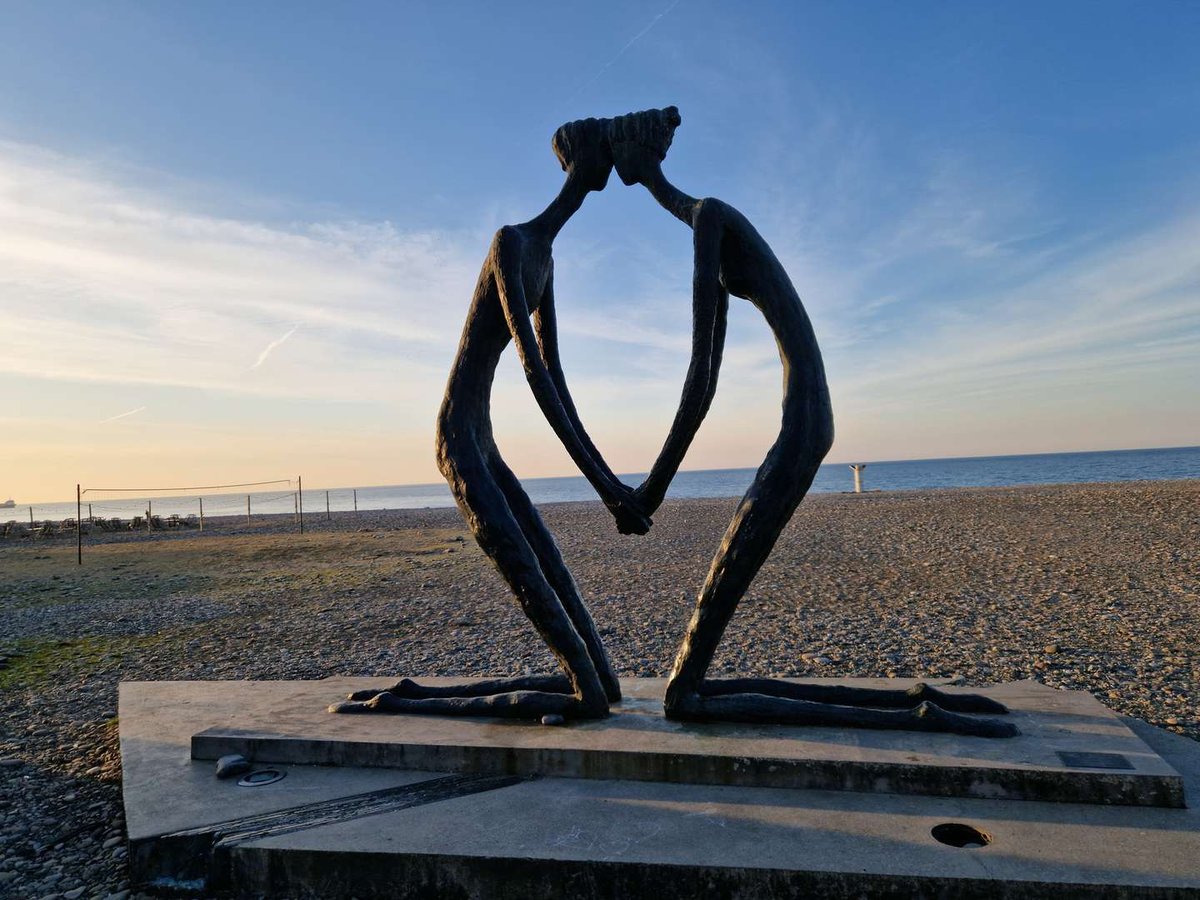
A lyrical small sculpture evoking the feeling of first love. A popular spot for romantic encounters and photographs, occasionally the site of marriage proposals. Located on the boulevard near the @ Monument. Together with Ali and Nino it forms a natural romantic circuit along the seafront.
🎖️ Historical Figures: Memory and Identity
These monuments speak less to tourists than to local residents. They anchor specific names to the city's public space and reflect the cultural and historical identity of Georgia and Adjara.
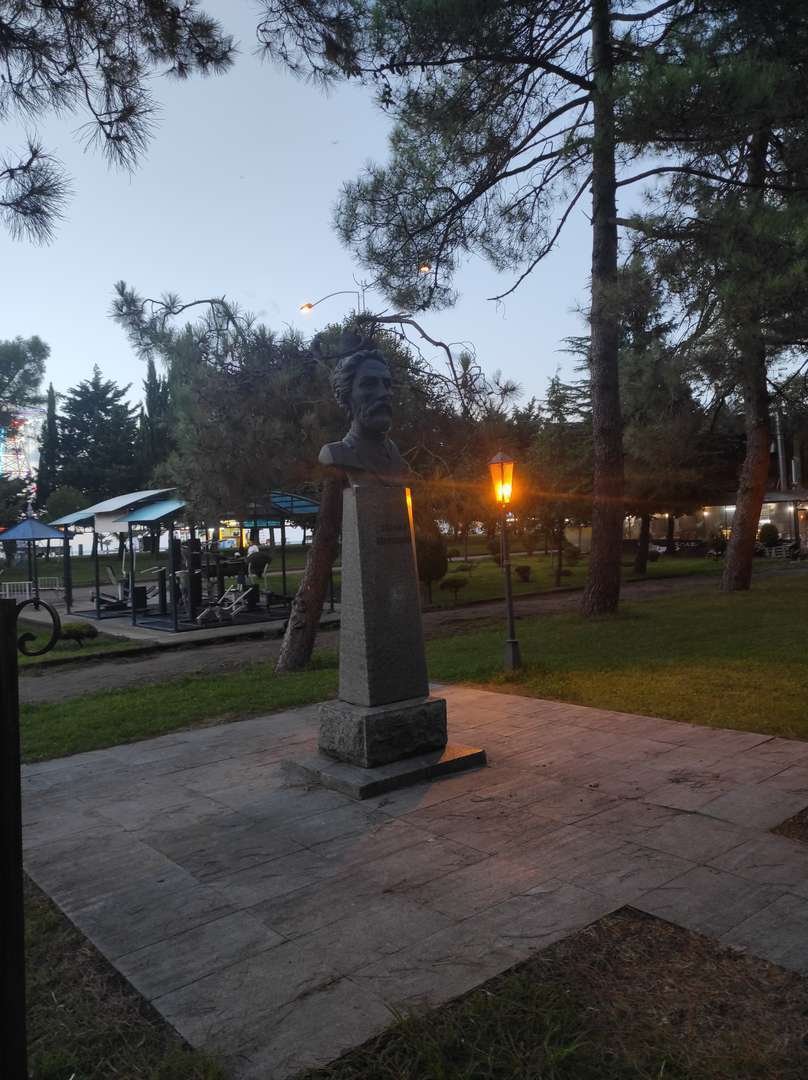
Monument to Egnate Ninoshvili
Egnate Ninoshvili was a late 19th-century Georgian prose writer whose work documented the social life of Guria and Adjara, his home region. His name is carried by one of the city's central streets. The monument stands on the Batumi boulevard among other monuments to writers and cultural figures.
Monument to Fadiko Gogitidze: Adjara's First Female Aviator
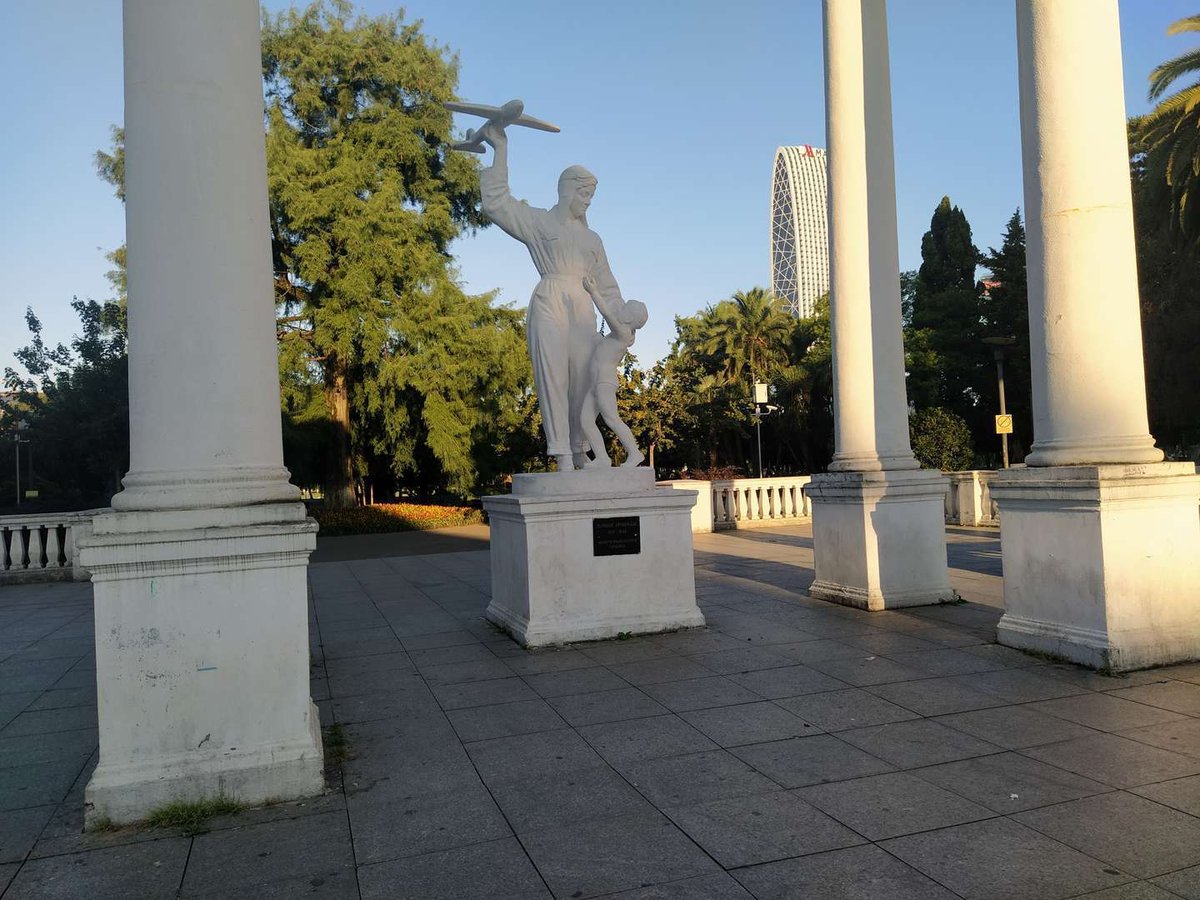
In May 6 Park stands a monument to Fadiko Gogitidze (1916–1940), pilot and instructor at the Batumi Aeroclub, who died at 24 in a test flight. The monument was long neglected; in 2019 it was restored and an inscription added. The story is both tragic and inspiring. It is an example of the city returning to public memory a name that could easily have been lost.
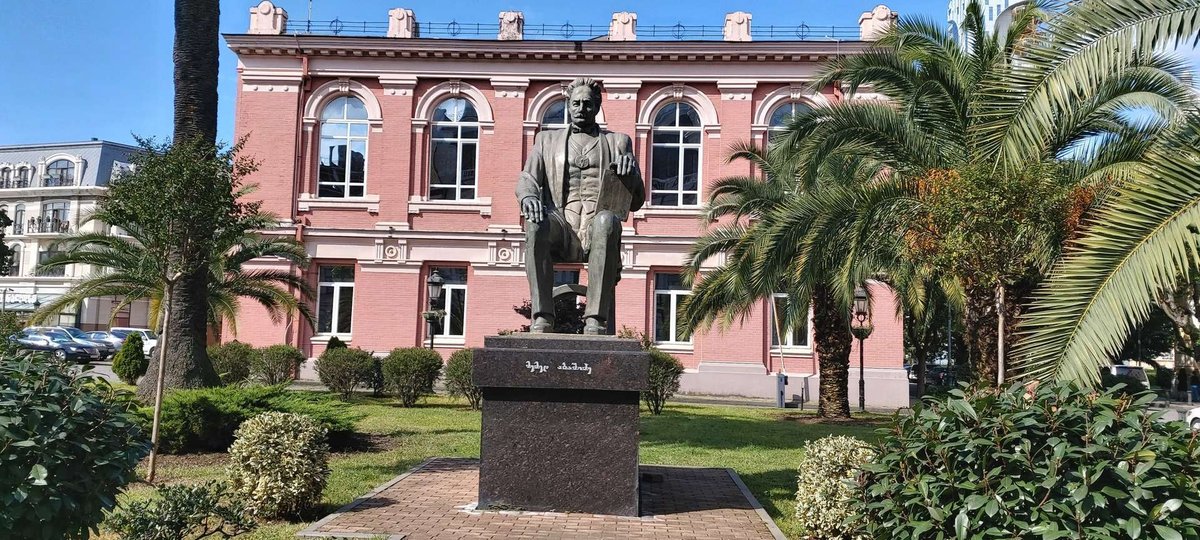
Monument to Ilia Chavchavadze near the Drama Theatre
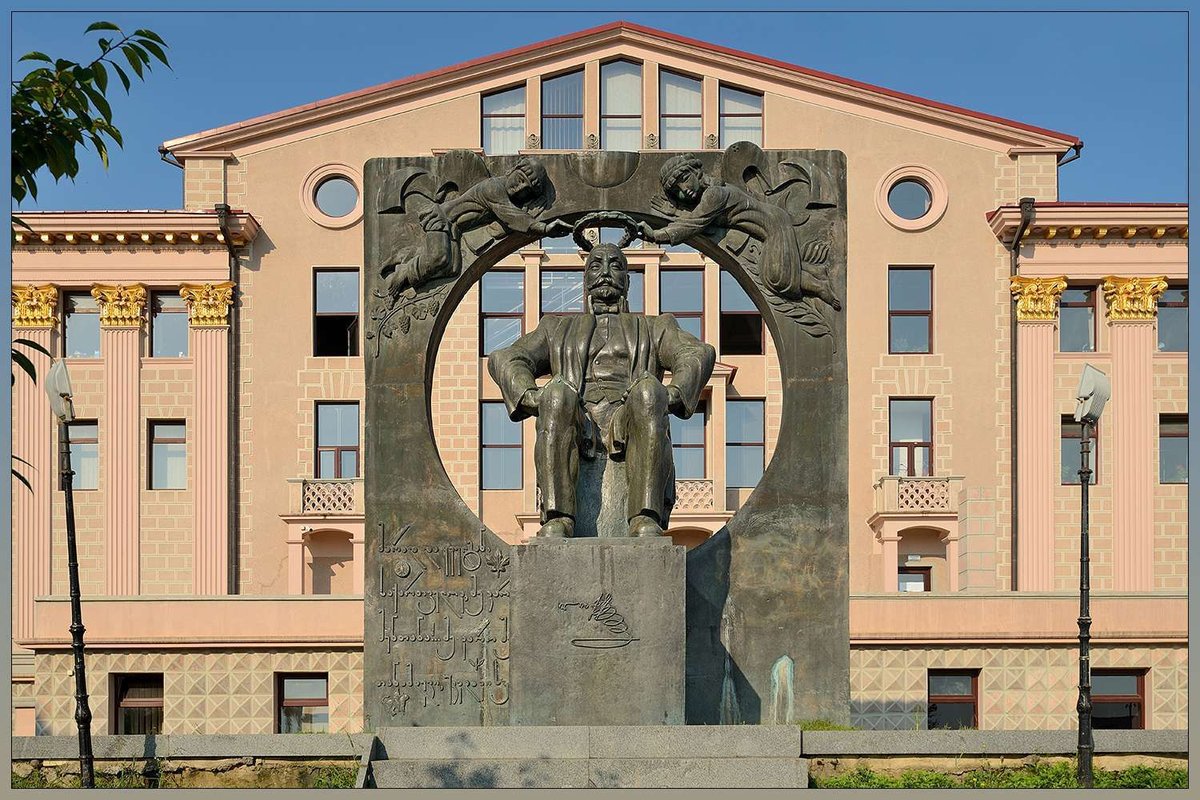
Ilia Chavchavadze, the central figure of Georgia's 19th-century national revival, stands near the Batumi Drama Theatre that bears his name. Notably, the monument was previously situated on Theatre Square, where the Neptune Fountain now stands. A literal case of the city moving its memory from one location to another.
Monument to Jiuli Shartava on the Alley of Heroes
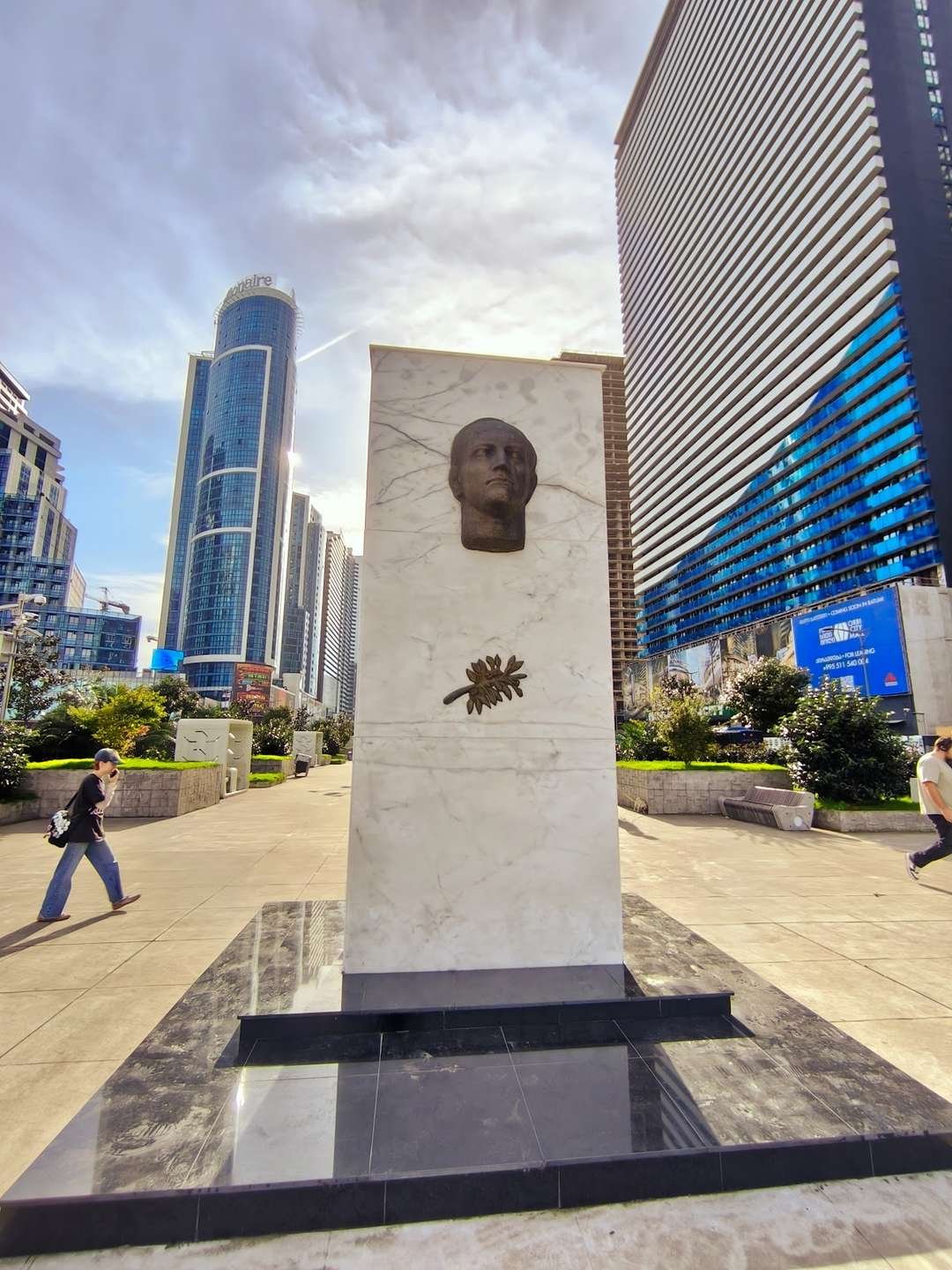
Shartava is connected to the tragic events of the 1990s in Abkhazia and is a symbol of duty and sacrifice for Georgia. The Alley of Heroes combines these memorials with contemporary art objects nearby: the "Frozen Fountain" stele and the marble "Crumpled Bottle" sculpture, creating an unusual juxtaposition of memorial and modern art.
🌊 Fountains
Neptune Fountain at Theatre Square
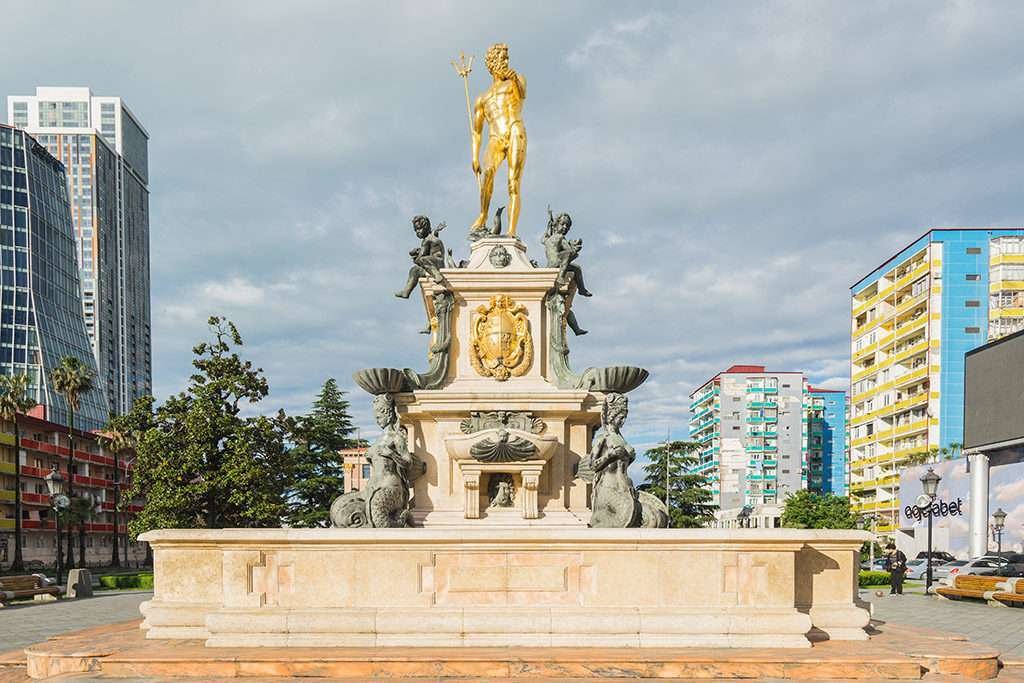
A gilded figure of Neptune surrounded by four mermaids, behind the drama theatre. It is a copy of Giambologna's 16th-century Neptune Fountain in Bologna, Italy. The figure and heraldic shields were gilded in 2011. The square previously held a monument to Ilia Chavchavadze, yet another instance of Batumi's monuments being physically relocated.
The choice of the Bologna original fits a pattern: the city's 2000s renovation borrowed European references extensively (the Italian-style Piazza Square, Venetian motifs, now a Bolognese fountain). In the evening the jets rise higher and the fountain is illuminated. A popular photography spot after theatre visits.
Singing Fountains at Lake Ardagani
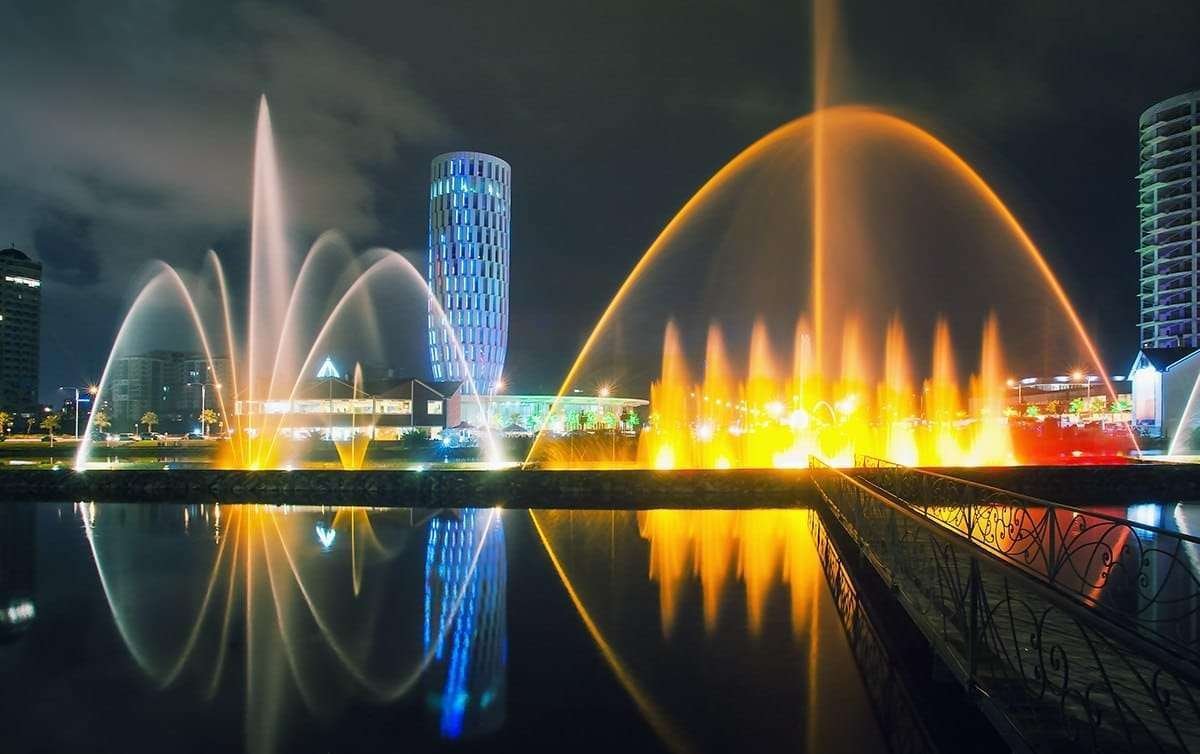
A light-and-music fountain show on the lake at the centre of the city. Water, colour and sound synchronise in evening performances, running from May to September. One of Batumi's main free evening attractions, alongside the Ali and Nino movement.
🌀 Contemporary Art and Public Sculpture
Rotation near the Alley of Heroes
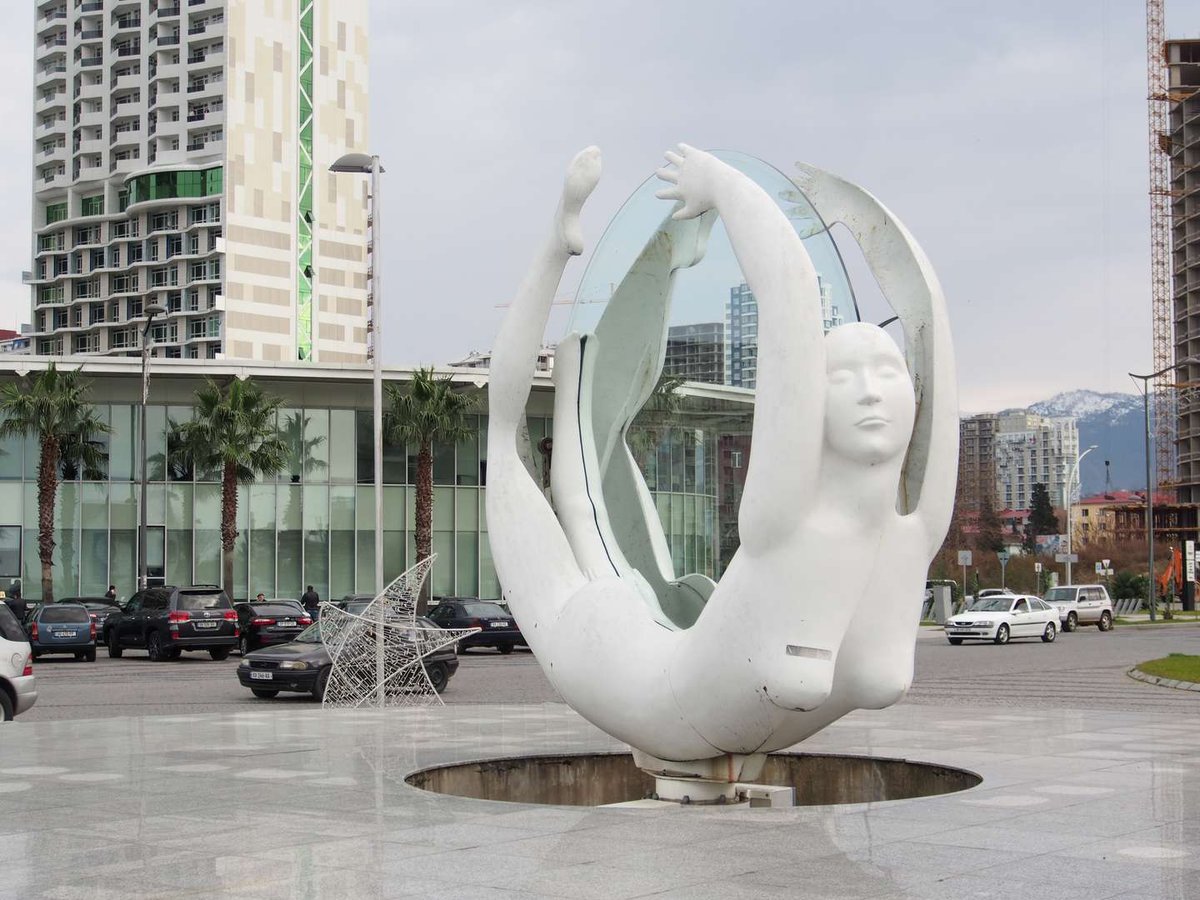
Before its installation in Batumi, this abstract work was exhibited at the 2010 Venice Biennale, one of the world's main contemporary art platforms. It is one of the few Batumi objects with a serious international exhibition history. Reviews are mixed, which is itself part of its value as a conversation piece.
@ Monument
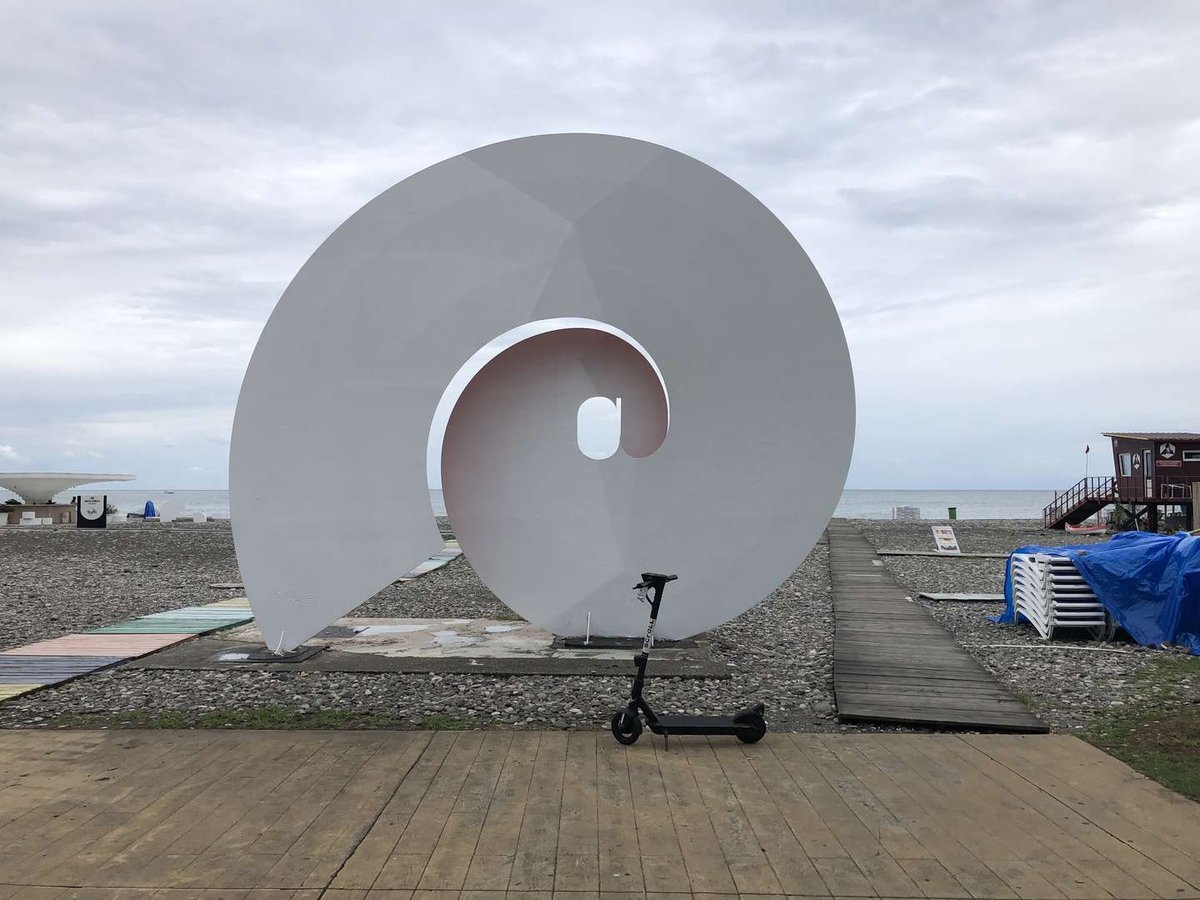
A sculpture in the form of the @ symbol, also read as a sea shell. The double reading, internet symbol or marine form, adds playfulness typical of Batumi's public art. Monuments to the @ symbol are rare worldwide. Batumi's choice signals an ambition to be seen as a city open to the contemporary and the digital.
Dolphins at the Colonnade
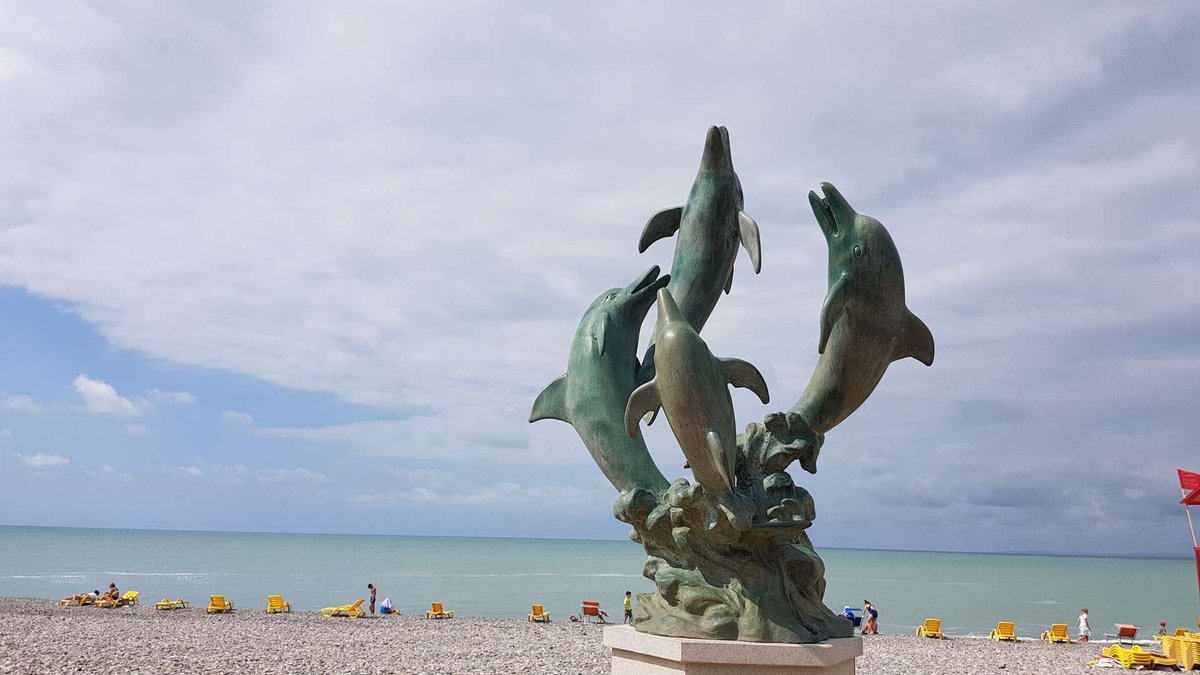
Three metal dolphins near the Colonnade on the boulevard. The material and relief waves echo the sea setting. Dolphins are actually spotted in the Black Sea off Batumi's coast, which gives the sculpture an additional layer of connection to its surroundings.
Genre Sculptures Along the Boulevard
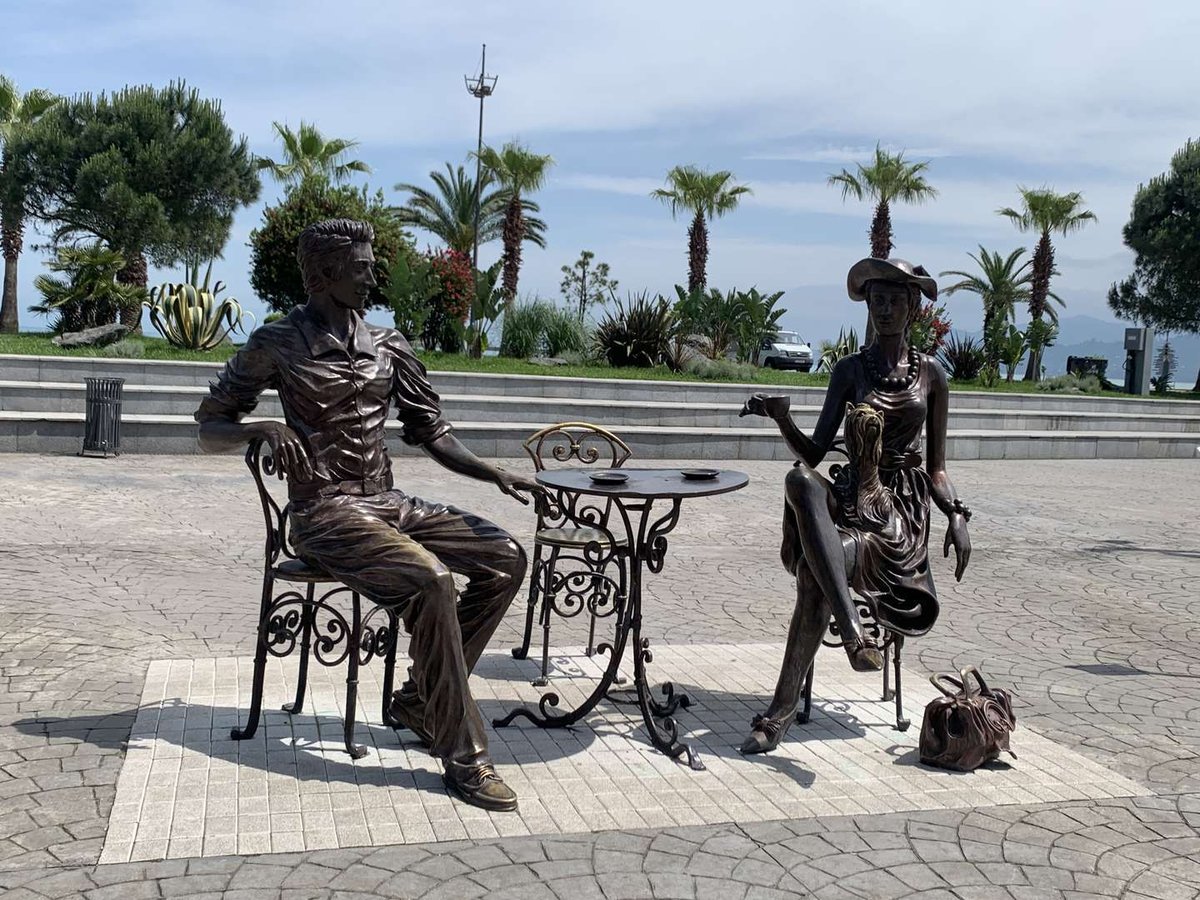
The boulevard is scattered with small figurative works: "Tea Party" near the Alphabet Tower (a nod to Georgian hospitality culture), "Lady with a Dog on a Bicycle" (a retro fountain composition), "Explorer" (interactive sculpture at the intersection of art and technology), and "WHERE" in Kaczynski Park. These works are not planned visits; they are pleasant encounters in passing.
🕯️ Memorials
April 9 Memorial and Alley of Heroes
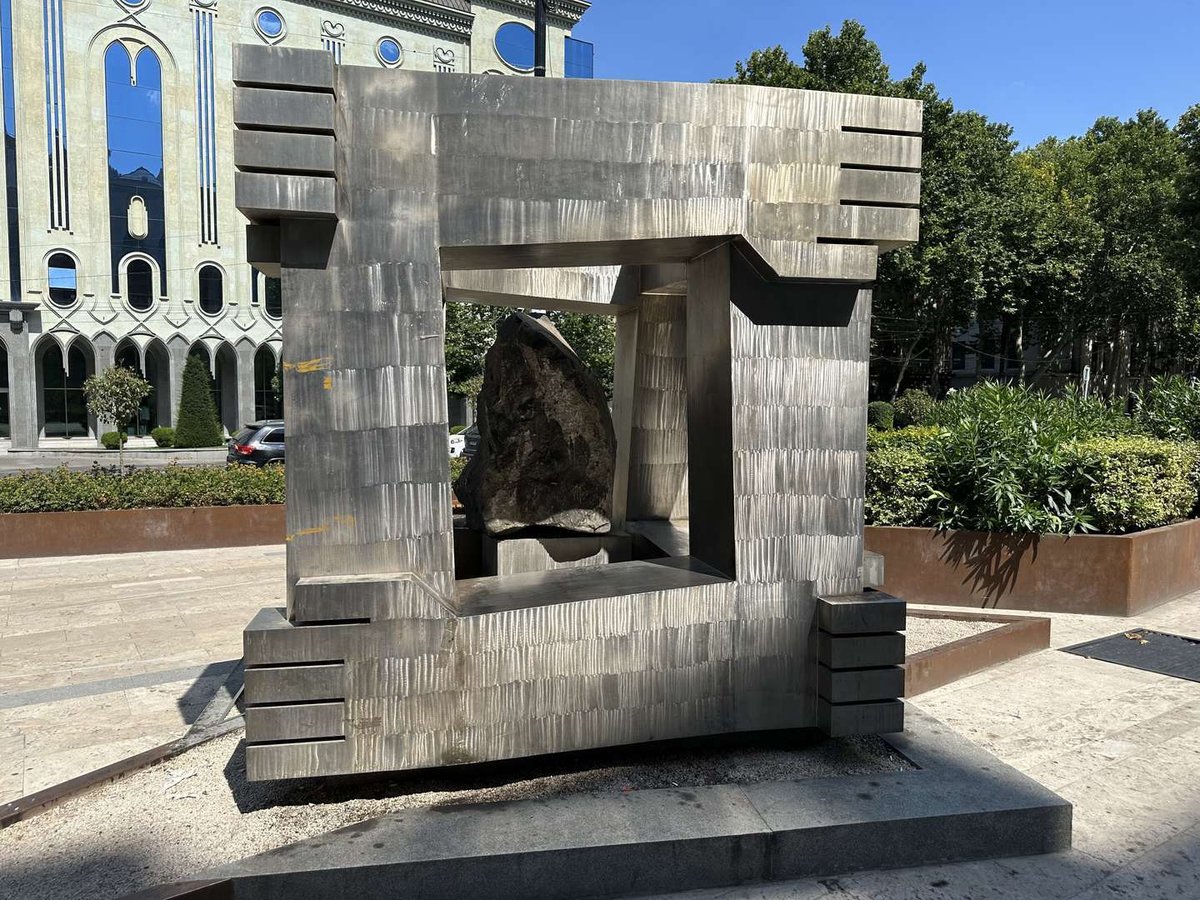
The April 9 Memorial commemorates the victims of the 1989 events in Tbilisi, part of Georgia's path to independence. The Alley of Heroes brings together monuments to state figures alongside art objects, an unusual proximity of grief and contemporary sculpture.
A key historical detail: Freedom Square once held a Soviet-era Lenin statue, removed after independence. Before that, the square was dominated by the Aziziye mosque, demolished in the Soviet period. Three successive eras, three different objects on the same ground. The square's successive names, Aziziye, Lenin Square, Freedom Square, document the same shifts. Near the square a mass grave of Georgian soldiers who died in March 1921 was discovered. Every monument removed or installed is a marker of what the city decides its history is.
🎭 Three Waves of Batumi Sculpture
Batumi's sculptures settle into three distinct historical layers.
The pre-revolutionary period produced busts and commemorative markers of cultural figures. Most did not survive the Soviet era.
The Soviet period brought ideological monuments, Lenin the most prominent of them. Most were removed after independence. What survived were memorials less tied to ideology and monuments to real individuals, such as Fadiko Gogitidze.
The post-Soviet wave of the 2000s is the most visible layer: Medea (2007), Ali and Nino (2011), Neptune, Rotation, the @ Monument, dozens of fountains and sculptural scenes. This wave defined the city's current sculptural identity. Understanding it means reading a deliberate shift: from a single ideological narrative to multiple coexisting stories, where ancient Medea, literary Ali and Nino and an ironic monument to the internet occupy the same city without contradiction.
🗂️ More Objects from the Catalogue
All 102 objects in the Batumi monuments catalogue include addresses, coordinates and visitor reviews. A practical note on timing: Ali and Nino's movement and the Singing Fountains operate in the evenings during the warm season; in winter some fountains are switched off. Morning light suits photography; evening illumination reveals a different city.
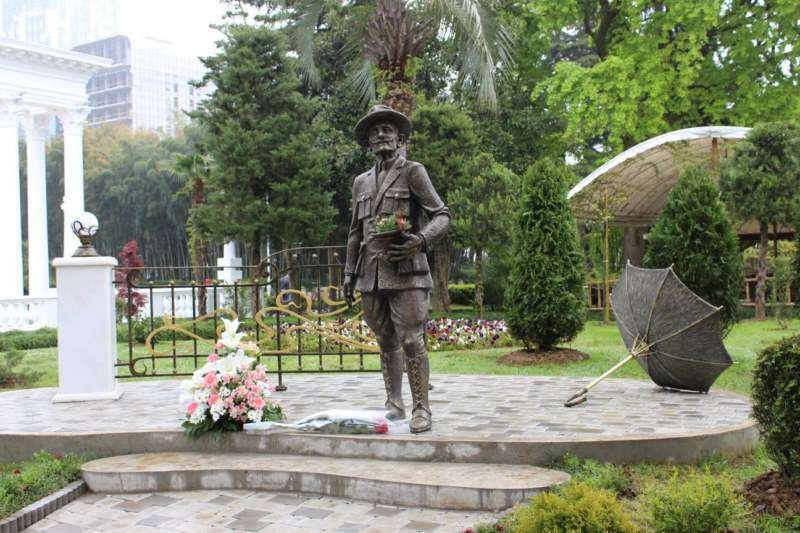
Among objects not covered in detail above: the monument to landscape designer Iason Gordeziani with his umbrella, the "Frozen Fountain" stele, the marble "Crumpled Bottle" and numerous busts in parks and squares. For most visitors a dozen key objects from the sections above is enough; the others are for those who want to move off the main circuit or build an unusual photographic collection.
🏛️ Why Does Batumi Have So Many Sculptures?
The sculptural abundance follows from the 2000s development programme. Under President Saakashvili, Batumi was being remade as a showcase for the new Georgia. Sculptures are cheaper than buildings, instantly create a city's visual identity and work as photo destinations. Within a few years the city had dozens of new objects, each a piece of free advertising for the resort.
At the same time, sculpture performed ideological work: Soviet monuments were replaced by symbols of a different identity, ancient Colchis, Georgian literature and cultural figures. The critics of this programme argue that Batumi accumulated photogenic but shallow objects with no deep connection to place. The defenders say exactly this density made Batumi stand out among Black Sea resorts. Both are right. Either way, Batumi's sculptural landscape is a cast of a specific era and its ambitions, and that is its documentary value. For the architectural context of the same period, see the Batumi architecture guide.
🔍 Reading Batumi's Sculptures
Each major sculpture in Batumi answers a question the city poses to itself: "Who are we?"
Medea says: we are part of ancient civilisation; our roots are in classical mythology; we are Colchis. A declaration of belonging to the large Mediterranean history, not merely a Soviet or post-Soviet city.
Ali and Nino says: we are a place where cultures cross. Islam and Christianity, Azerbaijan and Georgia, East and West. A sculpture about love that cannot fully merge became the symbol of a city standing at the boundary of worlds.
Neptune says: we look toward Europe and want to be part of it. A copy of a 16th-century Italian fountain in a Caucasian city is a cultural declaration through borrowed reference.
The Rotation from the Venice Biennale says: we follow contemporary art and want to be part of the international conversation.
The @ Monument says: we are modern, tech-open, facing the future.
Read together, these sculptures tell you what Batumi wanted to project in the 2000s. Batumi is one of those cities that says a great deal about itself through public space, persistently and everywhere you walk.
🏛️ Why These Specific Symbols?
The choice of each major symbol was deliberate.
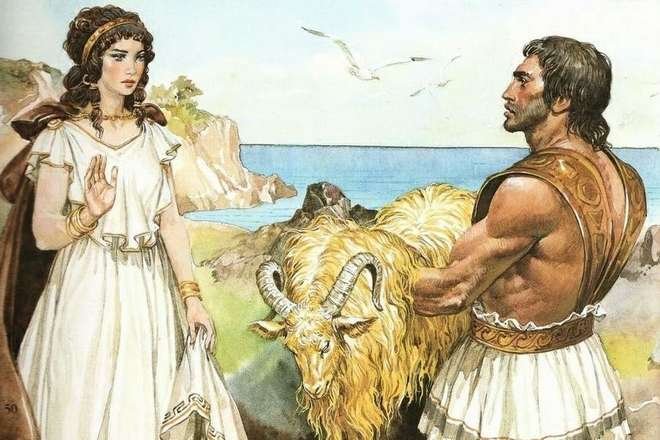
Why Medea and not a Georgian historical figure? Medea connects Georgia to classical antiquity: Colchis, the land of the Golden Fleece, was located in western Georgia. Placing Medea at the centre of the city in 2007 was a cultural-political declaration addressed to an international audience: "We are part of the same history as Greece and Rome." It worked: Medea is now one of the most recognisable images associated with Batumi.
Why Ali and Nino and not Georgian mythology? The novel "Ali and Nino" is not actually set in Batumi (the action takes place in Baku and Tbilisi), and its author was likely not Georgian. Yet the sculpture became the symbol of precisely this city, because Batumi genuinely is a place where cultures cross. Its historic population included Georgians, Armenians, Jews, Greeks and Turks. The intersection named in the novel matches the real history of the city.
Why a copy of the Bologna Neptune rather than an original work? Borrowing an Italian model rather than commissioning something new was itself a statement: Batumi wanted to be a recognisable European city quickly, prioritising effect over originality. Speed and impact over uniqueness: that was the logic of the 2000s. When several major European resorts already had their signature public sculptures, Batumi acquired several in quick succession.
Knowing these decisions makes the sculptural walk richer. You see not only objects but a city having a conversation with itself about what it wants to be. You see not only objects but a discussion about what this city should be.
🎯 Key Facts Before You Walk
A few key points that will make the Batumi sculpture walk more meaningful.
All the main sculptures appeared in the same decade, the 2000s, as part of a state development programme. This is not a collection built over centuries but the result of a deliberate project.
Most objects are free and accessible around the clock. The only variable that matters is the time of day: evening reveals a quite different Batumi.
The route covering all key points takes around two hours. For those who want to understand rather than simply pass through, add another hour for stops, reading the plaques and taking in details.
🗨️ Over to you! Which sculpture in Batumi stayed with you longest, the moving Ali and Nino, mythological Medea, or something unexpected? Share in the comments.
ℹ️ Updated June 2026. Fountain operating hours and evening illumination schedules may vary; check locally before your visit.
❓ FAQ
The Ali and Nino sculpture by Tamara Kvesitadze (2011). Two metal figures approximately 8 metres tall slowly move toward each other, pass through and separate. Based on the novel "Ali and Nino" about a doomed love story between a Muslim Azerbaijani man and a Christian Georgian woman.
Around 7 pm each evening, with neon illumination. The full cycle lasts about ten minutes. During the day the figures are still. Evening is the best time to visit.
Medea is a princess of ancient Colchis in Greek mythology who helped Jason obtain the Golden Fleece. Ancient Colchis was located in present-day western Georgia. The statue, unveiled in 2007 at Europe Square, connects Batumi to the classical myth of the Argonauts.
The Neptune Fountain is at Theatre Square, behind the Chavchavadze Drama Theatre. It is a gilded copy of Giambologna's 16th-century fountain from Bologna. Illuminated in the evenings.
Rotation (Venice Biennale 2010), the @ Monument, Dolphins at the Colonnade, and the genre scenes of "Tea Party" and "Lady with a Dog on a Bicycle". Most date from the public art wave of the 2000s.
A practical route: Europe Square (Medea) → Theatre Square (Neptune) → boulevard (Dolphins, @, First Love) → Alley of Heroes (Rotation) → Miracle Park (Ali and Nino at sunset). Around two hours on foot, all in the city centre.
No. All outdoor sculptures and fountains are free and accessible at any hour.
The 2000s development programme under President Saakashvili: sculptures were cheap, immediately visible and worked as tourist photo destinations. They also replaced Soviet ideological monuments with symbols of Georgian cultural identity.
The boulevard, Europe Square, Theatre Square and the Alley of Heroes. All in the city centre, connected by a two-hour walk.
2 comments
Log in to leave a comment