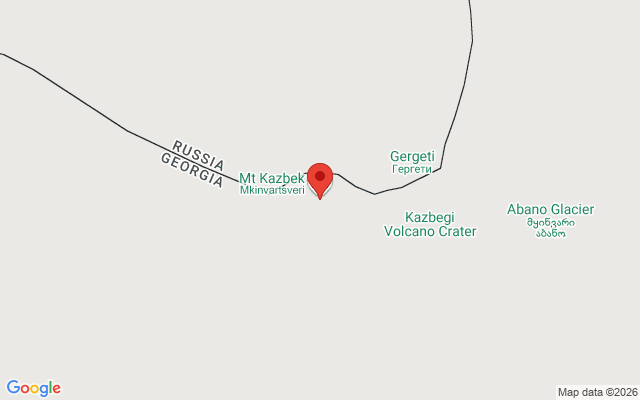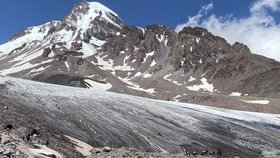





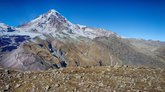

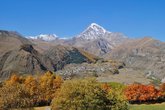

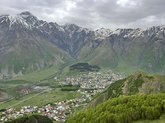

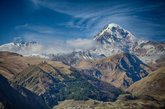

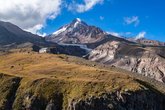

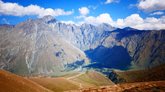

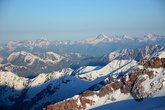

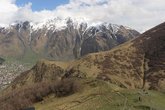

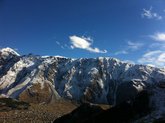

The mountain is located in Kazbegi Municipality, Mtskheta-Mtianeti, among the natural attractions of the region. Mkinvartsveri, better known by its Russian name Kazbek, is a dormant stratovolcano rising to 5,054 metres, Georgia's third-highest peak after Shkhara and Janga. The name translates roughly as "ice peak" and describes the mountain's year-round glacier cover, rather than naming a single glacier.
For more on the mountain's climbing history and legends, see the article on Mkinvartsveri (Kazbek).
The mountain has a double-cone shape built of trachyte and andesite lava flows; its last eruption occurred around 750 BC. Glaciers on Kazbek's slopes cover roughly 135 square kilometres in total, with the best-known, the Gergeti Glacier, serving as the main route for modern climbing expeditions. At around 4,000 metres elevation stands Betlemi Cave, once used by monks as a high-altitude hermitage.
In Georgian mythology, Mkinvartsveri is linked to the legend of Amirani, the Georgian Prometheus, chained to the mountain by the gods for giving fire to humanity. At the mountain's base, at 2,170 metres, stands the famous Gergeti Trinity Church, one of Georgia's most recognisable symbols.
The standard south route from Stepantsminda involves glacier travel, crevasse risk and a final 30-40 degree snow and ice slope: a serious technical climb requiring crampon and ice-axe experience, not fitness alone. The safest climbing season runs from midsummer through late September, when snow partially recedes and crevasse risk drops, though weather on the mountain remains unpredictable year-round. Necessary gear can be rented in Stepantsminda.