




Juma Mosque in Tbilisi: The City's Only Mosque
🕌 Active mosque · ⏱️ 30–60 minutes · 📍 Abanotubani, at the foot of Narikala
🕌 Before you visit
| 📍 Address | Abanotubani, Old Tbilisi. At the foot of Narikala fortress |
| 🕌 Status | The only active mosque in the capital of Georgia |
| 📅 History | Built by Ottomans in 1723–1735. Rebuilt by Italian architect in 1846–1851 |
| 🎨 Architecture | Neo-Gothic + Islamic elements. Octagonal minaret. Mosaic façade |
| 🤲 For whom | Open to all believers — Sunni and Shia pray together without division |
| 🚶 Getting there | 5 min walk from Meidani Square. Next to the Abanotubani sulphur baths |
| 💰 Entry | Free. Modest dress required; shoes off at the entrance |
🧭 Who this article is for
The Juma Mosque is one of those places in Tbilisi that everyone walks past but few actually understand. From the outside it's a red brick building with mosaics — and that alone stops people. Inside is three centuries of history: two architects, two branches of Islam, and a city that eventually brought them under the same roof without a dividing curtain. This article is for those who want to know what to look at and why the place matters.
📜 Three centuries in one building
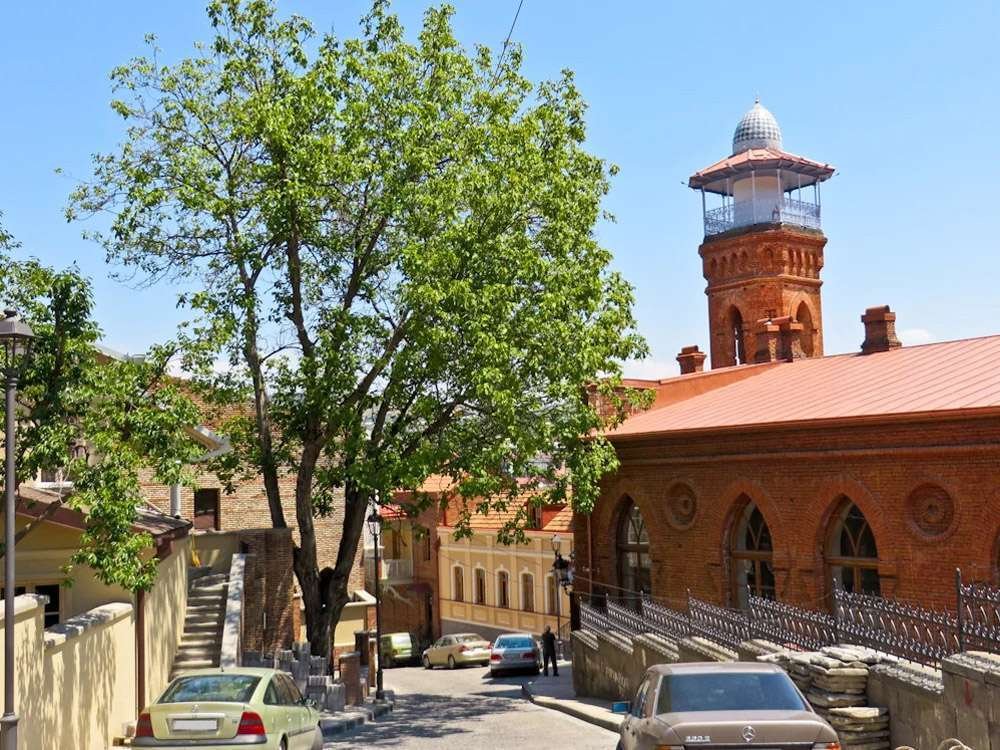
The first mosque on this site was built in 1723–1735 — by the Ottomans. The location was not straightforward: a sheer rocky cliff in the Abanotubani quarter at the foot of Narikala. In the 1740s Persian forces attacked the city — and the mosque was left in ruins.
About a hundred years passed. In 1846–1851 the building was reconstructed almost from scratch by Italian architect Giovanni Scudieri. This is where the unusual combination appears: Scudieri brought neo-Gothic elements that sit unexpectedly alongside the Islamic tradition. The result was arched windows and a character unlike any other mosque in the region.
In 1895 Azerbaijani industrialist from Baku G. Taghiyev paid for a full renovation — substantially changing the eastern-facing section of the façade, which faces towards Mecca.
🏛️ What makes it unusual
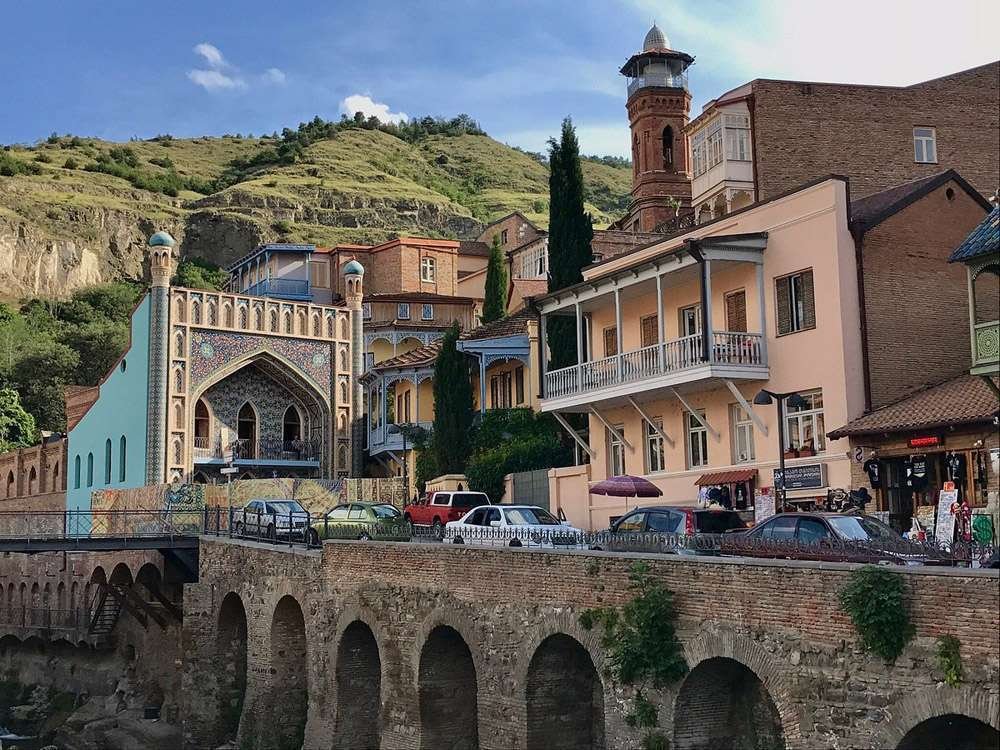
- The site. The building stands on a sheer rocky cliff. That's not a figure of speech — the mosque is literally constructed on the edge of a rock face. How exactly a massive brick structure came to stand there is a question everyone asks when they look at it from below.
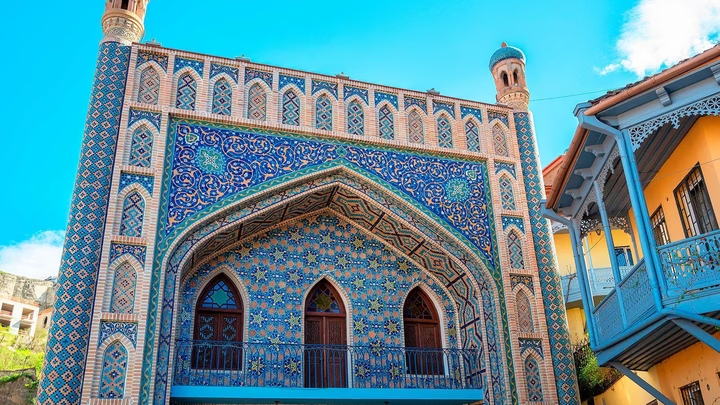
- Architecture. Juma Mosque is not the typical dome-and-arches you might expect. Scudieri mixed neo-Gothic with Islamic tradition: arched windows, specific façade proportions, brick construction. The minaret is octagonal, not round — immediately noticeable and unusual. The façade mosaic is what catches the eye first for most tourists who don't yet know they're looking at a mosque. It repays careful attention.
- The story of Sunnis and Shia. Until the mid-20th century Tbilisi had two mosques. The Juma was Sunni. The Shia "Blue Mosque" stood separately — until it was demolished for the construction of the Metekhi Bridge. After that, Shia Muslims had nowhere to go, and the Tbilisi mosque took them in. At first the prayer hall was divided by a black curtain — one side for each branch of Islam. Gradually the curtain came down. Now the hall is undivided and open to all believers.
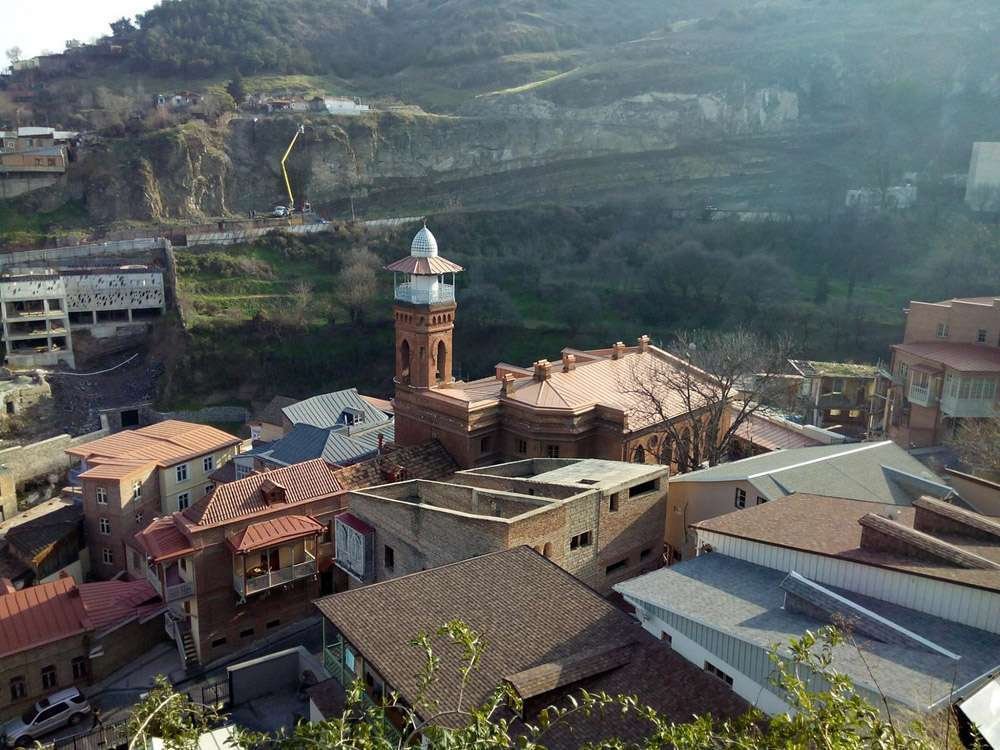
Approach the mosque from two directions: first from below to see how it sits on the cliff, then up close to study the mosaic and the brickwork. If you want to go inside, bring a headscarf (women) and be ready to remove your shoes at the entrance. For the exterior, morning light falling on the mosaic façade is the best time.
🗺️ How to fit the mosque into your route
1️⃣ Start at Meidani Square — the mosque is 5 minutes through the Abanotubani quarter.
2️⃣ Approach from below — look at how the building stands on the rocky slope.
3️⃣ Walk up to the mosque and examine the mosaic on the façade — the main detail outside.
4️⃣ Notice the octagonal minaret — it stands out clearly from any standard design.
5️⃣ Go inside if time and dress allow. The interior is calm — carpets, quiet, a different atmosphere.
6️⃣ Nearby: the Abanotubani sulphur baths and the Botanical Garden. Easy to combine in one route.
🏁 What stays with you
The Juma Mosque is a small place with a dense history. Three centuries, two destructions, an Italian architect with neo-Gothic instincts and two branches of Islam that eventually stopped dividing their shared prayer hall with a black curtain. You can feel all of that by simply standing there — provided you know what you're looking at.
ℹ️ The mosque is an active place of worship. Visiting hours for tourists may vary; check in advance. Modest dress is required; shoes must be removed at the entrance. Information is current at the time of publication.
🏛️ Nearby attractions


Have you been to the Juma Mosque? What caught your eye first — the mosaic, the minaret, or the cliff itself? Tell us — we read every comment ❤️
❓ Questions people ask most often
💬 Yes. It is currently the only active mosque in Georgia's capital. A second mosque — the "Blue Mosque" for Shia Muslims — existed until it was demolished for the construction of the Metekhi Bridge in the 20th century.
💬 Generally yes — the mosque is open to visitors outside prayer times. Women need a headscarf; everyone must remove their shoes. Check the visiting hours before you go.
💬 In the Old Town, in the Abanotubani quarter, at the foot of Narikala fortress. About 5 minutes on foot from Meidani Square. The red brick building with the mosaic façade is easy to spot.
💬 When Italian architect Giovanni Scudieri rebuilt the mosque in 1846–1851, he brought in neo-Gothic elements popular in European architecture at the time. The result is an unusual combination: an Islamic mosque with European-style arched windows and proportions.
💬 This was a design choice during the 19th-century reconstruction. An octagonal minaret is rare for mosques and has become one of the Juma's most distinctive features.
💬 No. Originally it was a Sunni mosque, but after the Blue Mosque (Shia) was demolished, the Juma opened to all Muslims. Today there is no division inside — both Sunnis and Shia pray here.
💬 Outside — in the morning, when the light falls on the mosaic façade. Inside — between prayer times. On Fridays during Jumu'ah (the Friday prayer, from which the mosque takes its name) the building is full of worshippers — bear that in mind if you prefer a quieter visit.

32 comments
Log in to leave a comment
Тоді я приходила з родиною: бабуся, зачарована красою, поцілувала стіну мечеті. Всі ми відчули, що ця архітектура більше, ніж просто цегла - вона дихає історією. Важливо пам’ятати, що це активна мечеть, і до неї слід ставитися з шаною. Цікаво, чи можна дізнатися більше про історію будівлі на місці, щоб зрозуміти її душу?
Тим не менш, заходити всередину було цікаво - архітектура сама по собі дивовижна, а кольори просто вражають. І все ж, думаємо про те, як поєднуються різні культури в одному місті. Заходив би знову? Напевно, так. Але куди краще податися в Тбілісі після візиту?
С другой стороны, Грузия явно заботиться о своих достопримечательностях, находятся люди, которые ремонтируют, реставрируют, так что сегодня мы вполне можем увидеть красоту и связенность мечети!