


🎨 Tbilisi Street Art: Murals, Mosaics, and Graffiti on the Map
🎨 Street art Tbilisi: quick reference
| 🖼️ Total objects | 96 murals, mosaics, and art objects in the catalog madloba.info/tbilisi/street-art/ |
| 🗺️ Where are they concentrated? | Saburtalo, Vera, Agmashenebeli Avenue - center; Varketili is a separate cluster on the outskirts. |
| 🏆 Main Festival | NIKO Street Art Movement: an annual festival that has created most of the city's large murals. |
| 🏛️ Soviet Heritage | 8 monumental mosaics from the 1960s-80s at Expo Georgia, in the metro, and on building facades |
| 💰 Entrance | All sites are free and accessible 24/7. Fabrika — free entry to the courtyard. |
Who is this article for?
Tbilisi is one of the most densely populated cities in the Caucasus in terms of street art. Three distinct traditions coexist here: contemporary festival murals by international and Georgian artists, Soviet monumental mosaics from the 1960s-80s, and spontaneous graffiti in underground passages.
This article is suitable for those looking for specific addresses with navigation, wanting to understand the context (who painted them, what they mean, when they appeared), or planning a themed route through the city. All 96 objects in the catalog are listed—the most significant ones in detail, the rest in summary tables by category.
🎨 NIKO Street Art Movement: Who's Painting Tbilisi
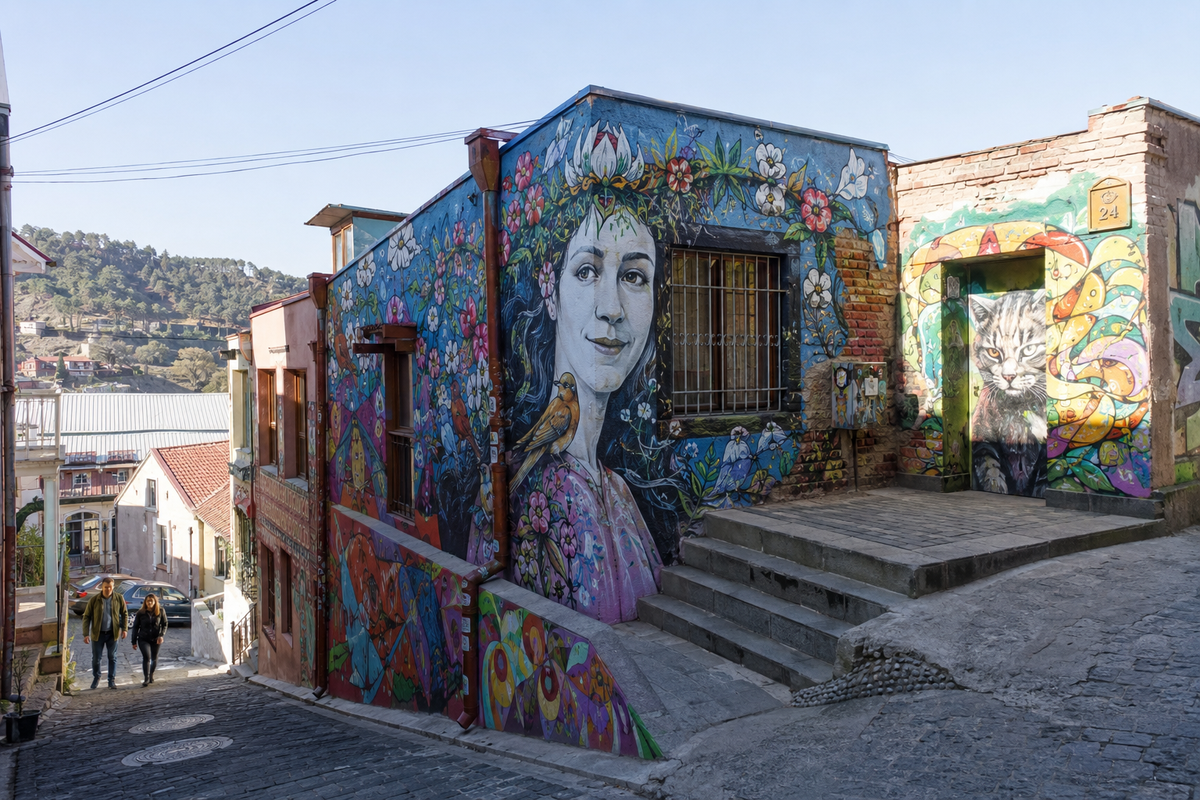
Most of the large murals in Tbilisi are the result of a single project: NIKO Street Art Movement, an annual festival that has been inviting artists from around the world and local artists to paint facades in various parts of the city since the early 2010s.
NIKO operates on a principle familiar from European festivals (Nuart in Stavanger, FAME in Vatinari): artists live and work in the city, interacting with residents during the process, and the results remain on the walls forever. NIKO murals are recognizable by their high level of execution, large formats (some occupy the sides of nine-story buildings), and often by the artist's signature in the corner of the wall. The artists include the German duo Innerfields (works covering the entire façade), Dutch artist Collin van der Sluijs, Argentinian artist Telmo Miel, Spanish artist Lapiz, and Georgian artists Tina Chertova, David Samkharadze, and Mishiko Sulakauri. Some artists have worked under pseudonyms: Dante, Masholand, Gamez, Kelber, Lamb, Snyder, and Case Maclaim.
Alongside NIKO, Tbilisi also hosts the ART UP space on the grounds of Fabrika Tbilisi—an open-air street gallery where works change more frequently and the artists are more experimental.
🎨 Main murals of Tbilisi on the map
Open in Google Maps🏛️ Georgian history and folklore on walls
Some of Tbilisi's murals read like a short course in Georgian culture. Portraits of historical figures, motifs from the national epic, images from Georgian painting—this category is of interest to tourists who want to understand not just "beautiful walls," but what they represent.
🎨 Pirosmani
📍 Mikheil Bukhaidze Street, 23
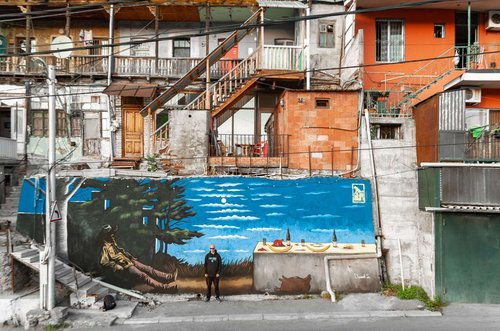
The mural on Bukhaidze Street, created by David Samkharadze (NIKO Street Art), transfers the style of Pirosmaniev's portraits to a monumental format: the same expressive gaze, the same flat chiaroscuro, the same sense of a living person peering through time. The wall is perfect for a photo—the contrast between the façade of a Soviet-era five-story building and the artist's face is striking in itself. Thus, contemporary street art transforms an ordinary residential neighborhood into a space for a silent dialogue between eras.
🎨 Queen Tamara
📍 st. Ivana Javakhishvili, 104
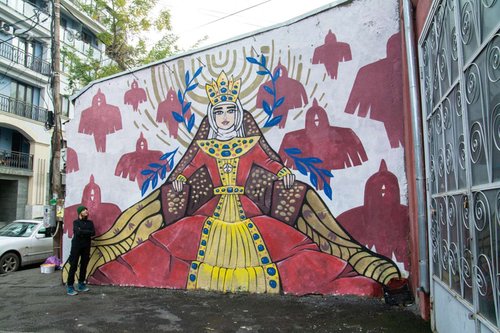
Tamar the Great (1160-1213) was the queen of the Georgian Golden Age, during whose reign Georgia reached its greatest territorial and cultural prosperity. Her image in the Georgian consciousness is not simply a historical figure, but a national archetype of a wise and just ruler. The mural was created by artist Tina Chertova (NIKO Street Art) and is executed in a style close to medieval Georgian miniatures: golden tones, ornamental details, and a direct gaze.
🎨 Sakartvelo Independence Act
📍 Sulkhan Tsintsadze Street, 39
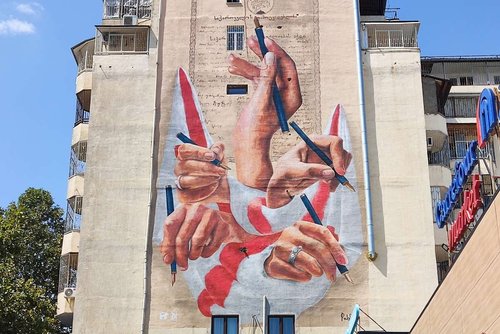
The mural is dedicated to the declaration of independence of Georgia on May 26, 1918—the first, which the country lost in 1921 due to Soviet occupation, and the second, which it regained in 1991. May 26 is the country's national holiday. The artist Lap1z created the work. It contains text, calligraphy, and imagery referencing the 1918 document—one of the few murals in the city where the semantic layer is so tightly tied to a specific historical event.
🎨 Tbilisi Legend
📍 Ikalto Mountain, Tbilisi
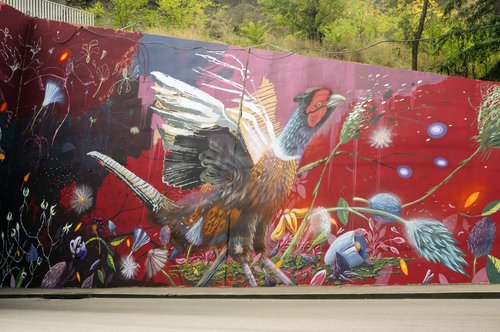
A mural by Dutch artist Collin van der Sluijs on the slope of Ikalto Mountain. The work depicts a scene from a Tbilisi urban legend, interpreted by the artist, who spent several weeks exploring the city before painting it. A detail that appeals to those who discover this mural: it's off the beaten path, requiring an uphill hike to reach it—which is part of the experience. But this hidden magic is worth every step.
👤 Portraits and Narrative Scenes
The largest category in the catalog—31 objects. These murals feature human figures in a wide range of moods: from lyrical female portraits to grotesque urban scenes. Most of them are works by NIKO Street Art from various years, scattered throughout the city.
🎨 Serafit
📍 20 Griboyedov Street
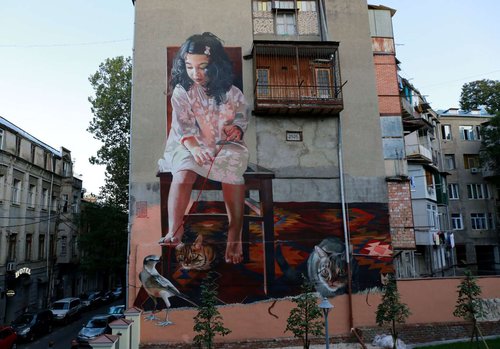
One of the most talked-about works by German artist Case Maclaim in Tbilisi is a hyperrealistic female portrait on the side of a building in the city center—a detail so precise that the initial impression of "this is a photograph" lingers for several seconds. Case Maclaim specializes in monochrome hyperrealism with an almost photographic precision in capturing the textures of skin, fabric, and gaze. Serafit stands on a street lined with cafes—she is noticed by chance while walking along Griboyedov Street, which makes this work especially memorable.
| Name | Address | Card |
|---|---|---|
| Jump | Vazha-Pshavela 1st Block | View |
| Escape | Vasili Petriashvili St | View |
| Olechka | 70/1 David Guramishvili Ave | View |
| Apkhe | 1 Zaza Panaskertel-Tsitsishvili St | View |
| Rugby Girl | 42 Vazha-Pshavela Ave | View |
| Lovers | Zaza Panaskertel-Tsitsishvili St | View |
| Air | Saburtalo District | View |
| Hands | 27 Nino Ramishvili St | View |
| Fisherman | 41 Dimitri Uznadze St | View |
🎨 Flying Artist
📍 Kote Marjanishvili Street, 9
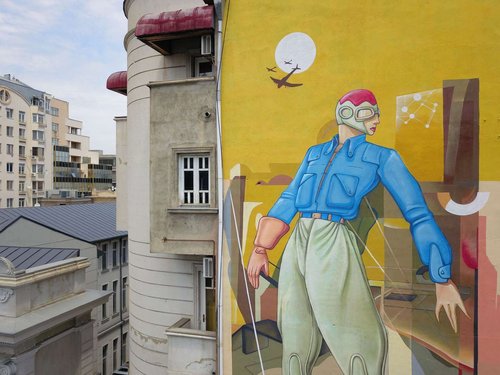
The mural by Dilk and Ferosone (NIKO Street Art) depicts the artist in a moment of creative flight—literally hovering above the city, brush in hand. Situated in a bustling neighborhood, it's one of the most easily discovered. Dynamic lines and a vibrant palette instantly lift passersby from the daily hustle and bustle, compelling them to slow down and look up. This work perfectly conveys the idea that amidst the bustling metropolis, there's always room for inspiration and inner freedom.
| Title | Address | Card |
|---|---|---|
| The Last Bell | 36 Lado Asatiani St | View |
| Supportive Girls | 2 Korneli Kekelidze St | View |
| Big Face | Vazisubani 2nd Micro-district | View |
| Champions | Gldani 5th Block | View |
| Hold Me Tight | 7 Tornike Eristavi St | View |
| Rebel | Nutsubidze 3rd Micro-district, Block 2, 13B | View |
| Gangster Feast | 3/5 Cholokashvili Ave | View |
| My Moon (Monkey) | 68 Irakli Abashidze St | View |
| One Mother | 1 Archil Tsagareli St | View |
🎨 Girl in a Dream
📍 16 Vakhushti Bagrationi St.
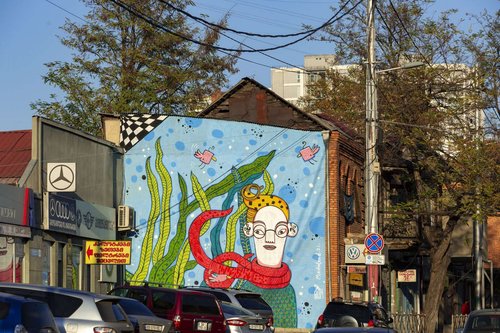
The work by artist Masholand (NIKO Street Art) is a large portrait of a girl with closed eyes, executed in a warm, surreal style. Masholand is one of the most consistent artists in the series: his works in Tbilisi are united by a female image conveyed through a soft color scheme and a sense of inner space, inaccessible to the viewer. Amidst the bustling city, this mural feels like an island of absolute peace.
| Title | Address | Card |
|---|---|---|
| Feast (Prazdnik) | 1 Zaza Bendeliani St | View |
| Untitled (Luka Japaridze, V45) | 11B Bolo Agmarti St, Sololaki | View |
| Untitled (Giorgi Maskharashvili) | 182 David Agmashenebeli Ave | View |
| Girl with a Toy Rabbit | 182 David Agmashenebeli Ave | View |
| Girl with Crystal | 73 Giorgi Chubinashvili St | View |
| Keep Going | 10 Tevdore Mgvdeli St | View |
| Feast (Supra) | 164 David Agmashenebeli Ave | View |
| Wanted | 4 Lermontov St | View |
| As You Sow, So Shall You Reap | Titsian Tabidze St | View |
| Girl with Flowers | 96 B. Zhgenti St | View |
🐾 Animals and Nature
Animal murals are a distinct and popular form of Tbilisi street art. They're easy to find with children and easy to spot using landmarks, and the artistic range is wide: from a realistic rhinoceros to abstract swans.
🎨 Shiva the Cat
📍 Betlemi Street, 26
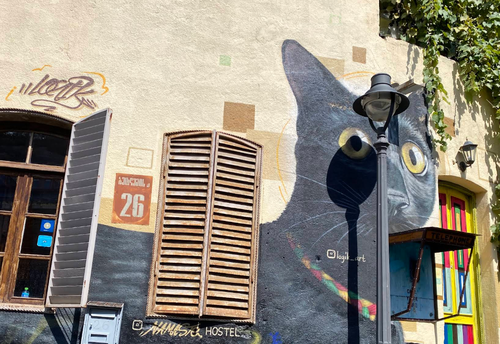
A small mural by Tbilisi standards in the Old Town—a portrait of a cat with an unusual name. It's located in the Betlemi neighborhood, home to many tourist cafes and the steps leading to the Narikala Fortress. This is why Shiva the Cat is included in the list of Tbilisi's must-see camera traps: it's hard to miss while walking along this route. This vibrant, charismatic character fits perfectly into the atmosphere of Tbilisi, which has long been renowned for its love of stray cats. This colorful, furry guardian of the neighborhood invites passersby to pause and capture its enigmatic gaze.
🎨 The last male northern white rhinoceros
📍 31 Giorgi Mazniashvili Street
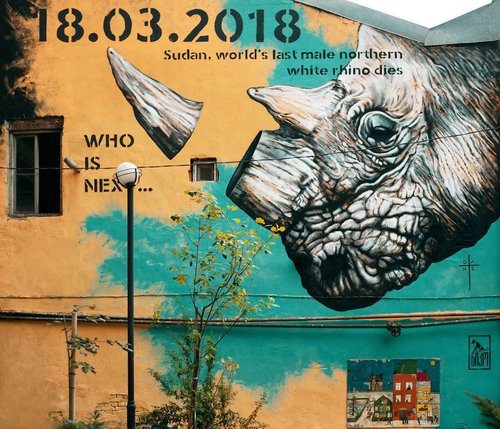
This mural is dedicated to Sudan, the last male northern white rhinoceros, who died in 2018. Artist Rasca1's work was created in response to a real event: with Sudan's death, the subspecies effectively became extinct. The rhinoceros is depicted full-length on the side of a building, with black and white skin detailing—one of the most ecologically charged works in the city. The enormous silhouette of this silent giant compels passersby to reflect on humanity's responsibility to nature. This tragic image transforms a blank city wall into a powerful manifesto, reminding us of the irreparable losses of our planet.
🎨 Zebras
📍 Andrey and Meliton Balanchivadze Street, 39
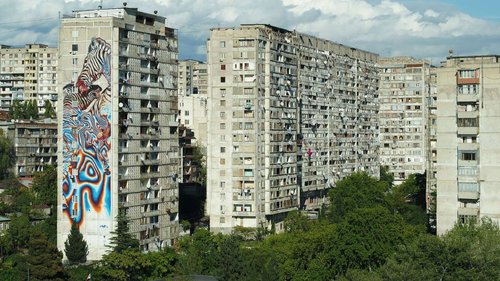
Artist Snyder (NIKO Street Art) depicted a herd of zebras in motion—a dynamic, almost kinetic work that's easily read from a distance. The zebras occupy almost the entire façade of a residential building. There's nothing particularly touristy nearby, but the coordinates are precise—it's worth a detour. In person, this running herd in the middle of an ordinary residential neighborhood looks very impressive.
✊ Social and Civic Statements
Some of Tbilisi's murals aren't decorations, but rather statements of opinion. They address ecology, war, women's rights, and the country's territorial integrity. Such works attract an audience that values not only the visual effect but also the meaning.
🎨 End of War
📍 1st Lane, Gabriel Salosi, 2
This work by Brazilian artist Dinho Bento (NIKO Street Art) is a large-scale scene depicting a soldier holding a woman in his arms. The title alludes to the end of the war, but the image is more about separation and reunion: the interpretation is up to the viewer. Situated in a residential area, not in a tourist area, the mural itself is worth visiting. The soft colors and vivid emotions of the subjects make this complex subject relatable and relatable. In person, this enormous work leaves a very positive impression.
🏙️ Urban Motifs and Art Spaces
Murals about the city itself, its architecture, history, and spirit—plus permanent art spaces where street art becomes part of the infrastructure.
🎨 ART UP - Street Gallery at Fabrika
📍 Ignat Ninoshvili St., 2
![ART UP - Street Gallery - [Fabrika Tbilisi]](/media/images/ART_UP_-_Street_Gallery_08.width-500.jpg)
Fabrika Tbilisi is a converted Soviet-era clothing factory that has become one of the city's main hubs for youth culture. Inside the courtyard is a permanent gallery, ART UP, where the walls are dedicated to street art. Unlike murals on residential buildings, the works here change more frequently, the artists are more experimental, and the public comes specifically for the street art. Admission to the space is free. It's pleasant to simply stroll around the courtyard and admire the new artworks over a cup of coffee.
🎨 David Agmashenebeli
📍 Anton Purtseladze St., 17
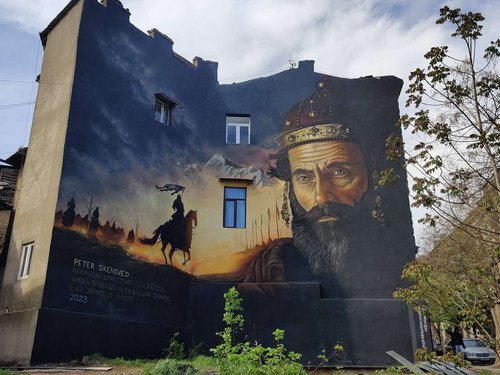
A portrait of King David IV, the builder king who led Georgia in liberation from the Seljuk conquerors in the 12th century and saw its political and cultural blossoming. The mural by artists Vaska Shuradze and Gaga Maisuradze (NIKO Street Art) is executed in a monumental style with a nod to medieval iconography. David Aghmashenebeli Avenue, which gave the artists their name, runs nearby—a street rich in historical architecture. This large-scale portrait immediately draws attention and makes a perfect addition to a stroll through the area.
🖤 Abstract Murals
Four works in the catalog are purely abstract—no figures, no narrative. For lovers of contemporary art, this is definitely something to be on the lookout for.
🚇 Underground Passages with Graffiti
Two underground passages in Tbilisi have been transformed into spontaneous graffiti galleries—without curation or festival organization, simply urban self-expression in a cumulative format. Both are centrally located, both are easily accessible.
The most convenient way to find a specific mural is to open its page on Madloba, copy the address into Google Maps, and switch to Street View. For most artworks, you can preview the scale and the exact side of the building before leaving home.
🏛️ Soviet Mosaics and Bas-Reliefs in Tbilisi
A special chapter in Tbilisi's urban art is the monumental mosaics of the Soviet era. Unlike festival murals, they were not conceived as street art in the modern sense: they were government commissions from the 1960s-80s, part of a program to decorate public buildings. Today, they have become a distinct tourist attraction—some researchers believe that Georgian Soviet mosaics have a special artistic value, as Georgian artists often incorporated national imagery and non-linear compositions into their state-commissioned projects, uncharacteristic of the Soviet mainstream.
Several Tbilisi mosaics were created by Zurab Tsereteli (bas-relief on the House of Political Education, 1978; "Man, Labor" on the façade of the Palace of Trade Unions, 550 sq.m.), Guram Kalandadze, and Leonardo Shengelia (Expo Georgia pavilions, 1960s).
🏛 Soviet Mosaics of Tbilisi on the Map
Open in Google Maps🎨 Bas-relief with mosaic at the House of Political Education
📍 David Agmashenebeli Avenue, 61
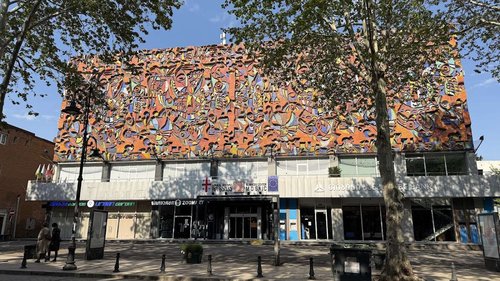
A 1978 façade mosaic by Zurab Tsereteli on a building that served as the House of Political Education during the Soviet era. Abstract in form, with decorative reliefs and colored fragments, it is atypical of Soviet realism and representative of the Georgian version of monumental art of that era. The building is currently used for other purposes, but the mosaic on the façade remains.
🎨 Mosaics at Expo Georgia (three pavilions)
📍 118 Akaki Tsereteli Avenue
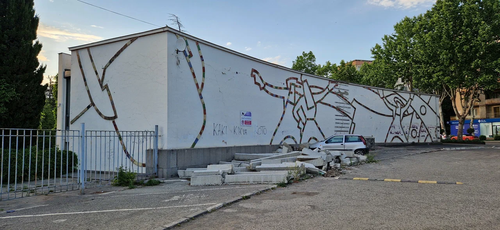
Three pavilions with mosaics from the 1960s remain on the Expo Georgia grounds. "Industrial Production" was designed by architect Mamaladze, "Construction and Architecture" by artist Guram Kalandadze, and "Mechanical Engineering, Instrumentation, and Transport" by artist Leonardo Shengelia. All three are located on the same site.
🎨 Man, Labor—the Meaning and Beauty of Existence
📍 43 Vazha Pshaveli Avenue
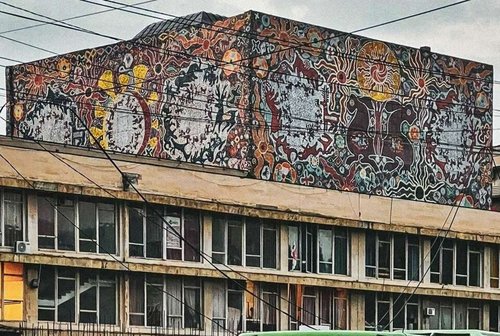
Zurab Tsereteli's monumental bas-relief on the façade of the Palace of Trade Unions is 550 square meters of abstract symbolic rhythms. It's one of the artist's largest works in Tbilisi. For scale, the surface area of this bas-relief is comparable to a tennis court. It's best to view this enormous relief from a distance so the entire composition fits within the frame. Up close, it's fascinating to examine individual small details and the texture of the material.
| Title | Address | Card |
|---|---|---|
| Bas-relief at Technical University Station | Technical University Metro Station | View |
| Bas-relief with Mosaic at Laguna Vere | 34 Merab Kostava St | View |
| Fire in Reliable Hands | 34 Vakhtang Gorgasali St | View |
| Construction and Architecture | 118 Akaki Tsereteli Ave | View |
| Mechanical Engineering, Instrumentation, Transport | 118 Akaki Tsereteli Ave | View |
Soviet Mosaic Route: Technical University Metro Station (bas-relief right at the station) → 5-minute walk to Laguna Vere (34 Kostava Street) → taxi to Expo Georgia (118 Tsereteli Avenue, ~15 minutes) → from there take public transportation to the Palace of Trade Unions (43 Vazha Pshavela Avenue) → optionally, to 34 Gorgasali Street (fire station with a 1979 mosaic).
🏘️ Varketili Art District: A Separate Trip
The Varketili neighborhood in eastern Tbilisi is a typical Soviet-era development from the 1970s and 1980s, which the NIKO Street Art festival has transformed into an open-air street art museum. Ten works by international artists are located on the side walls of residential buildings within a 600-800 meter radius—the entire area can be walked in an hour and a half.
Getting there: From the city center, take the metro to Ortachala station, then take a minibus or taxi (approximately 20 minutes). Alternatively, take a direct taxi from the city center—approximately 30-40 minutes, depending on traffic.
🏘 Varketili Art District — Mural Map
Open in Google MapsIn practice, there are no landmarks in Varketili that are too obvious to miss. It's best to save the coordinates of several points in offline maps in advance—the courtyards between the buildings are similar, and the address "block 3A, building 318" doesn't work well without GPS.
| Title | Address | Card |
|---|---|---|
| Joestar SOW IV YTBG | Microdistrict 3A, Bldg 318 | View |
| Urban Cowboy | Quarter 2, Bldg 39 | View |
| Girl Against the Dragon | Quarter 4, Bldg 412 | View |
| The War Will End | Quarter 2, Bldg 2A | View |
| Autumn Guide | Quarter 2, Bldg 1A | View |
| Urban Garden | Microdistrict 3A, Bldg 334 | View |
| The Wind Blows | Microdistrict 3A, Bldg 319A | View |
| Abstract (Dr. Kartelović) | Quarter 2 | View |
| Abstract #2 (Kera1) | Quarter 4, Bldg 410 | View |
🗺️ Itinerary: Tbilisi Street Art in One Day
The itinerary is designed for a walking tour of the city center with several stops. Varketili and the Soviet mosaics are separate excursions.
First Half of the Day (Old Town and Vera)
1️⃣ Start at Shiva the Cat (26 Betlemi Street) in the Old Town, on the way to the sulfur baths.
2️⃣ Descending to the river, go to David Agmashenebeli Avenue – there are several murals here: "Untitled" (Maskharashvili) and "Girl with a Toy Hare" near building 182, and "Holiday (Supra)" near building 164.
3️⃣ The underpass near Baratashvili Square – uncurated graffiti, unique in its own right.
4️⃣ Serafit on St. Griboyedova, 20 — hyperrealistic female portrait by Case Maclaim.
Afternoon (Saburtalo and Vera)
5️⃣ Changing a Light Bulb on Rustaveli Avenue — visible from anywhere on the avenue.
6️⃣ Flying Artist at the Marjanishvili Metro Station (Kote Marjanishvili Street, 9).
7️⃣ Ninoshvili Street area — several works in a row: ART UP at Fabrika (Bldg. 2), "Ode to Street Art" (Bldg. 40), Abstract No. 1 Kera1 (Bldg. 53).
8️⃣ ART UP / Fabrika — end the day in a space where street art merges with cafes and coworking spaces.
💬 What visitors say
"The mural with the rhinoceros is one of the few that really kept me on the spot. Not just beautiful, but also thought-provoking."
"Varketili is worth visiting for the contrast alone: huge international murals on the nine-story panel buildings of the Soviet district—a very Tbilisi story."
"ART UP at Fabrika is the best place if you want street art and coffee in one place."
"The Soviet mosaics at VDNKh (Expo Georgia) are underrated. There are three different pavilions, each with its own distinct style. Tourists hardly know about this place."
🏁 Before You Go
Tbilisi's street art scene is several different cities in one: the center with its festival murals, the outskirts of Varketili with a separate cluster of international works, and the Soviet layer of mosaics that have been on buildings since the 1960s. No single route covers everything at once—and this is perhaps the main feature of the theme.
A complete catalog of all 96 objects with addresses and links.
See also: Tbilisi attractions and Tbilisi observation decks
ℹ️ Outdoor murals are open 24 hours a day. Some works may be updated or painted over. Please check the current status of the murals using the cards in the catalog before your visit.
Tbilisi's street art is alive and constantly evolving. If you've spotted a mural that isn't in our catalog, let us know in the comments: title (if any), address, and a photo. We'll add it to the database.
❓ Frequently Asked Questions
💬 The madloba.info/tbilisi/street-art/ catalogue lists 96 objects: murals, Soviet mosaics, bas-reliefs, graffiti passages and art spaces. The actual number is higher — NIKO and other festivals continue to add new works every year.
💬 An annual street art festival that since the early 2010s has invited international and Georgian artists to paint facades across Tbilisi. Most large-scale murals in the city are NIKO works. Artists range from German hyperrealists to Brazilian muralists and Georgian painters.
💬 Take the metro to Ortachala, then a minibus or taxi (about 20 minutes). By taxi from the centre: 30-40 minutes. All 10 cluster objects are walkable from each other. Save GPS coordinates in advance — address navigation is difficult without a pin in this district.
💬 Three mosaics on the Expo Georgia grounds (118 Akaki Tsereteli Ave), bas-relief at Technical University metro station, Tsereteli's monumental work on the Palace of Trade Unions (43 Vazha Pshavela Ave), mosaic on the House of Political Education (61 Agmashenebeli Ave) — eight objects across different parts of the city.
💬 Several local guides offer street art tours through GetYourGuide and Viator. Some guides specialise in Soviet architectural heritage and include mosaics. The self-guided route in this article is a free alternative.
💬 Morning or overcast days — direct midday sun creates harsh shadows and overexposed patches on large flat surfaces. Most murals face west or north, so soft evening light also works. Varketili is the exception: building orientations vary throughout the district.
💬 Murals in public space fall under freedom of panorama in most countries — photographing and sharing for non-commercial purposes is generally permitted. For commercial use, seek permission from the artist. Author names for most works appear in the Madloba catalogue listings.

5 comments
Log in to leave a comment
Eure Vorstellung der Street Art lässt einen wirklich spüren, wie viel Seele in dieser Stadt steckt. Ich hab’s selbst erlebt: Einmal stand ich vor einem riesigen grauen Betonblock, der mit fröhlichen Farben belebt wurde - das hat mich einfach angezogen. Aber die Frage bleibt: Wo findet man die verstecktesten Kunstwerke in den weniger belebten Straßen?