




Tmogvi Fortress in Samtskhe-Javakheti: History, Architecture
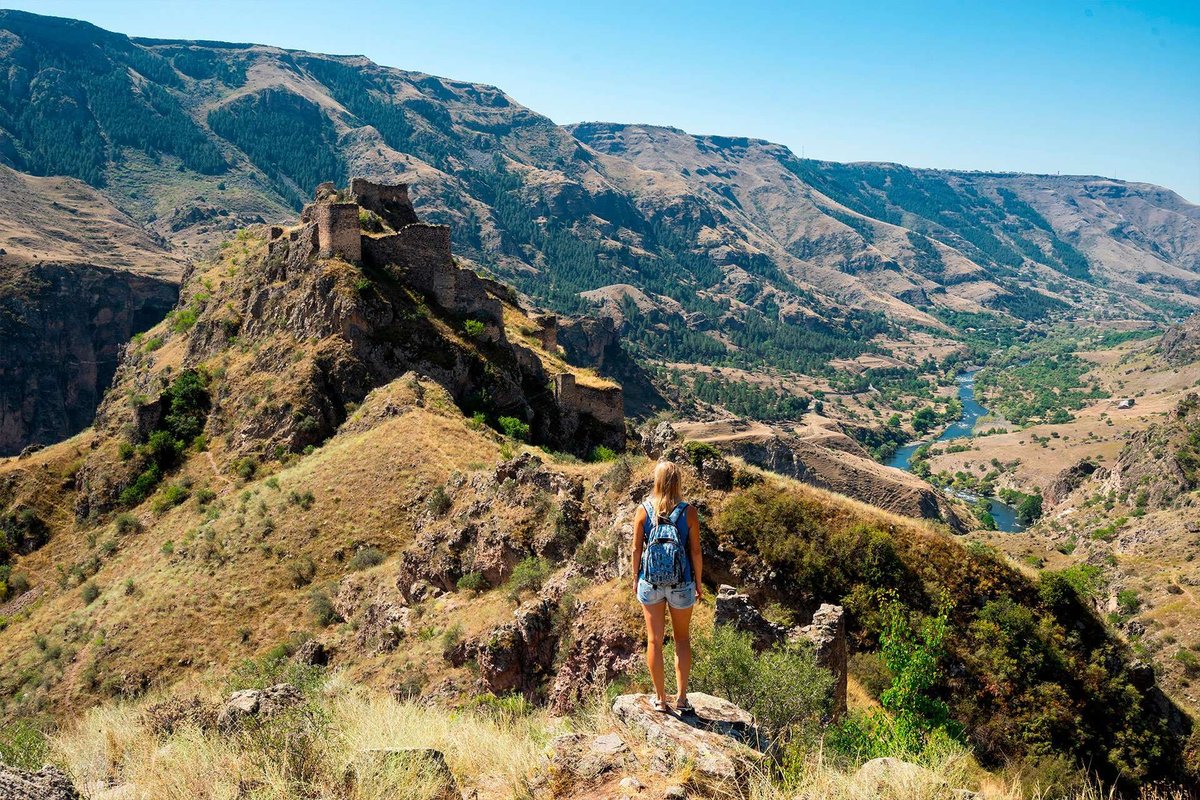
Tmogvi Fortress is a distinguished medieval fortress, once a military citadel, located in southern Georgia, in Samtskhe-Javakheti. It is located on the left bank of the Mtkvari River, in the Aspindza Municipality, near the village of Tmogvi, named after the fortress. It is also worth noting that a burial mound field dating back to the 3rd-2nd millennia BC was discovered near the fortress. The natural landscape and the man-made fortress, now in ruins, place this place among the most beautiful in Georgia.
History.
The name "Tmogvi" derives from the Georgian word "mogvi," which can be translated as "pagan priest" or "magician." The Tmogvi citadel is mentioned in ancient chronicles dating back to the 9th century. It served as a defensive fortification, guarding the ancient trade route linking ancient Georgia and Asia through the Mtkvari Valley. The first mentions of the fortress and its history date back to 914 and are associated with the conquest of the eastern and southern territories of Georgia by the Arab emir. After capturing several fortresses, the emir approached Tmogvi, but because of its magnificent defensive structure, he realized that an assault on this citadel would be futile and retreated.
In the late 10th and early 11th centuries, the fortress was under the control of the monarchy. Since 1073, it has been owned by numerous feudal families, including Niania Kuabulisdze and her heirs, and later by the Torels, Mkhargzelis, Shalikashvili, and Jakels families. The fortress was captured by the Ottoman Empire in 1578, and later the fortress and its surroundings came under the control of the Akhalkalaki Liwa. Following the Russo-Ottoman War of 1828-1829, according to the Treaty of Adrianople, the Ottomans lost both the citadel and other adjacent territories. The rich and eventful history of the structure and its surroundings makes it a landmark in Georgia, well worth a visit.
Architecture.
The Tmogvi Fortress is built on a high rocky mountain and is surrounded by three walled hills. Guard towers were erected on all three hills to provide the best view of the surrounding area. Due to the varying terrain, the walls stand at varying heights. The fortress has partially retained its appearance. The western part, with three fortification stages on its slope, is the most prominent. The walls of the southeastern side rest on a cave, beneath which lies a secret passage connecting the upper part of the fortress with the Mtkvari River below. The central square of the fortress is entirely occupied by various buildings.
The remains of the buildings allow us to trace how the structures were erected, repaired, and renovated. The earlier layers consist predominantly of smoothed tuff squares, aligned in even rows, while the roughly dressed stone walls indicate a later renovation. Beyond the fortress walls, particularly in the western ravine, stands the Church of St. Ephraim, carved into the rock along with its iconostasis. The second domed church, dating back to the 13th century, has unfortunately lost its former beauty, but fragments of its frescoes still remain in its ruins. I hope after reading this article, you have no doubts about what to see in Georgia.

32 comments
Log in to leave a comment
Мадлоба делится советами от месхетинцев: весна-осень без жары, удобная обувь, где парковка у трассы. Отзывы подсказали закатные виды, FAQ — трансфер 40 лари, с детьми ок. Планирую повторить с ночёвкой!
А вы покоряли Тмогви — что круче, башни или секретный туннель? Расскажите! 🤔