




Kvakhvreli: Cave Complex — History, Route
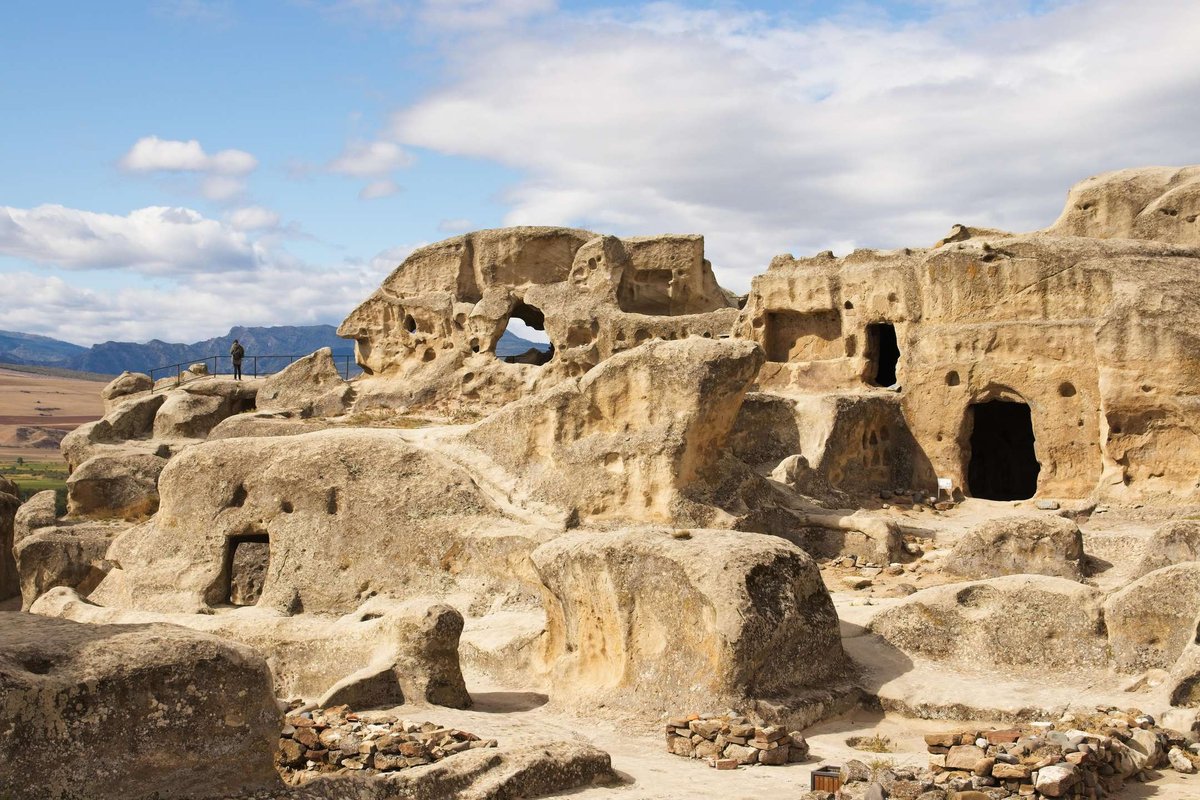
The cave city of Kvakhvreli is located in the Georgian region of Shida Kartli (translated as Inner Georgia), east of the village of Kvakhvreli.
On the other side of the Mtkvari (Kura) River stands an old fortress – the city of Uplistsikhe. This architectural monument dates back to the 7th to 9th centuries. In ancient times, an agricultural suburb called Uplistsikhe was located there.
Architecture of the Complex
The Kvakhvreli complex is carved high into the cliff face and comprises a church carved into the depths, several corridors, a belfry, and a parking lot. At the top, at the entrance to the complex, stands a bell tower, shaped like an irregular rectangle. It was built much later from large pieces of stone. The entrance is on the north side and is a large arch. Rectangular windows are on the opposite walls. The structure itself is quite low, cylindrical in shape, and the dome and roof resemble a cone. At the top of the dome's flat roof is an oval opening.
From the eastern wall of the bell tower, a dark corridor leads directly to the Kviratskhoveli Church. The Kviratskhoveli Church has a semicircular apse on the eastern side of the building. The altar of the church is located one step above the floor and may have previously been enclosed by an iconostasis. The church has two large rectangular doors through which sunlight enters and illuminates the hall. One door is on the north side, the other on the east. Later, Armenians carved 17 khachkars (cross-stones) into the cave's walls. (A khachkar is a large cross with an intricate design, a medieval Armenian symbol, still found throughout Armenia.)
History of the place
Georgia's landmarks have a centuries-old history, sometimes so long that it is difficult to reliably determine the earliest settlements and the time of their appearance. Many scholars speculate that the cave city may have been founded as early as 1000 BC. However, what is certain is that it was completely abandoned by the 19th century. The location of the ancient settlement was quite advantageous: on the trade route from the shores of the Caspian to the Black Sea, which proves the existence of settlements in these lands long before the Common Era. Over time, the natives made their lives more comfortable and safer in these areas and settled the caves.
Local legend has it that slaves carved and deepened these caves in order to gain freedom. The name Uplistsikhe translates as "Fortress of God" or "Fortress of the Lord."
For many years, Kvakhvreli served as a refuge for pagans who were fighting against Christian Mtskheta. Mtskheta subsequently won. After the religious change in this area, the new government destroyed the Temple of the Sun (dating back to the Iberian Kingdom) on the summit and founded a Christian church. Another landmark within the complex is the Uplistsikhe Church, built in the 10th century by Abkhazians who attacked the city.
Archaeologists began excavations at ancient Uplistsikhe in 1957. Since then, they have unearthed only 150 caves, although it is believed there are more than 600, as historians agree that in prosperous times, the city housed approximately 20,000 people.
How to get there
The Kvakhvreli complex is located between one and a half and two hours' drive from Tbilisi. A dirt road leads to the caves. Along the way, travelers can see and fully appreciate some of Georgia's most beautiful sights. Kvakhvreli is located near the municipal city of Gori, and a tour of the cave complex can be complemented by a visit to Stalin's birthplace.
On our portal, you can find even more information about what to see in Georgia on your next trip!

29 comments
Log in to leave a comment