




🕳️ Betlemi Cave: Georgia's Remote Cliff Temple and the Legend of Queen Tamar's Treasure
🕳️ Betlemi Cave on Mount Kazbek
A cave temple at around 4,100 metres, carved into a sheer andesite cliff on the Kazbek massif. Officially discovered in 1947-1948, though it appears in Georgian chronicles and in the notes of an 18th-century historian.
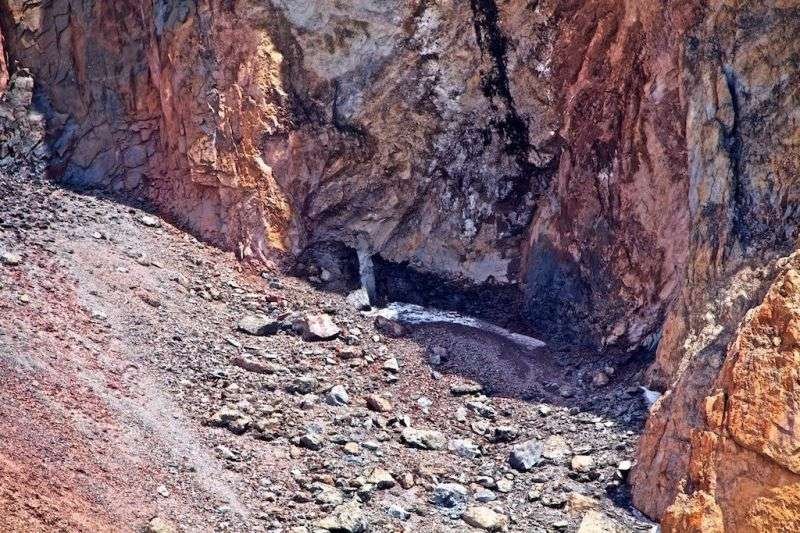
Betlemi Cave, or Bethlehem Cave, is a temple carved into the rock of the Kazbek massif in the Kazbegi Municipality, at around 4,100 metres above sea level. The name comes from Bethlehem: Georgians call the Palestinian town Betlemi, and several Georgian churches carry that name, including two in Tbilisi. But the cave on Kazbek has no connection to those Tbilisi sites. It's a separate place, known for a long time only through legends and the notes of historians.
The cave was officially discovered in 1947-1948, though the earliest written mentions appear in the Georgian chronicle "Kartlis Tskhovreba" and in the writings of the 18th-century historian Vakhushti Bagrationi. Inside, researchers found a church altar, medieval liturgical items and coins, and beside the entrance, cut into the sheer cliff, monastic cells. Researchers consider this cave complex a candidate for the oldest and highest Christian shrine.
🕳️ What Betlemi Cave Is, in Plain Terms
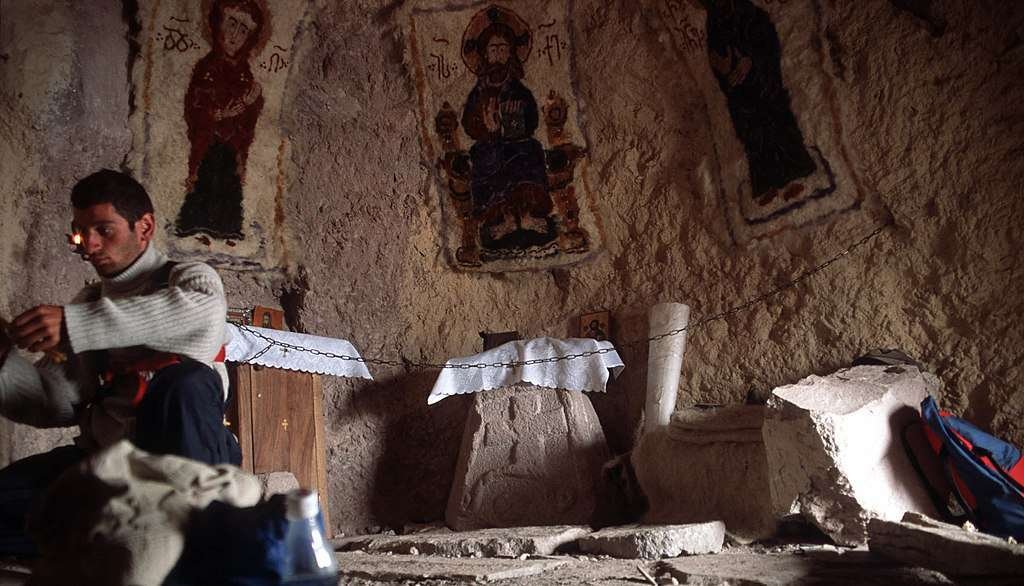
The cave sits on the ridge dividing the Gergeti and Abano glacial basins on the Kazbek massif (Mkinvartsveri). The entrance is cut into a red andesite cliff, 350-400 metres above the base. Inside, the cave has a domed vault, rounded walls and a floor laid with square stone slabs, with a window facing south.
This is not a natural cave but a man-made temple chamber inside the rock. Judging by the artefacts found, it was not simply a hiding place but a working place of worship, reached by an iron chain. Monastic cells were found nearby, also carved into the rock, which led researchers to describe a whole cave monastery complex rather than a single refuge.
💰 The Legends: Queen Tamar's Treasure and the Cradle of Christ
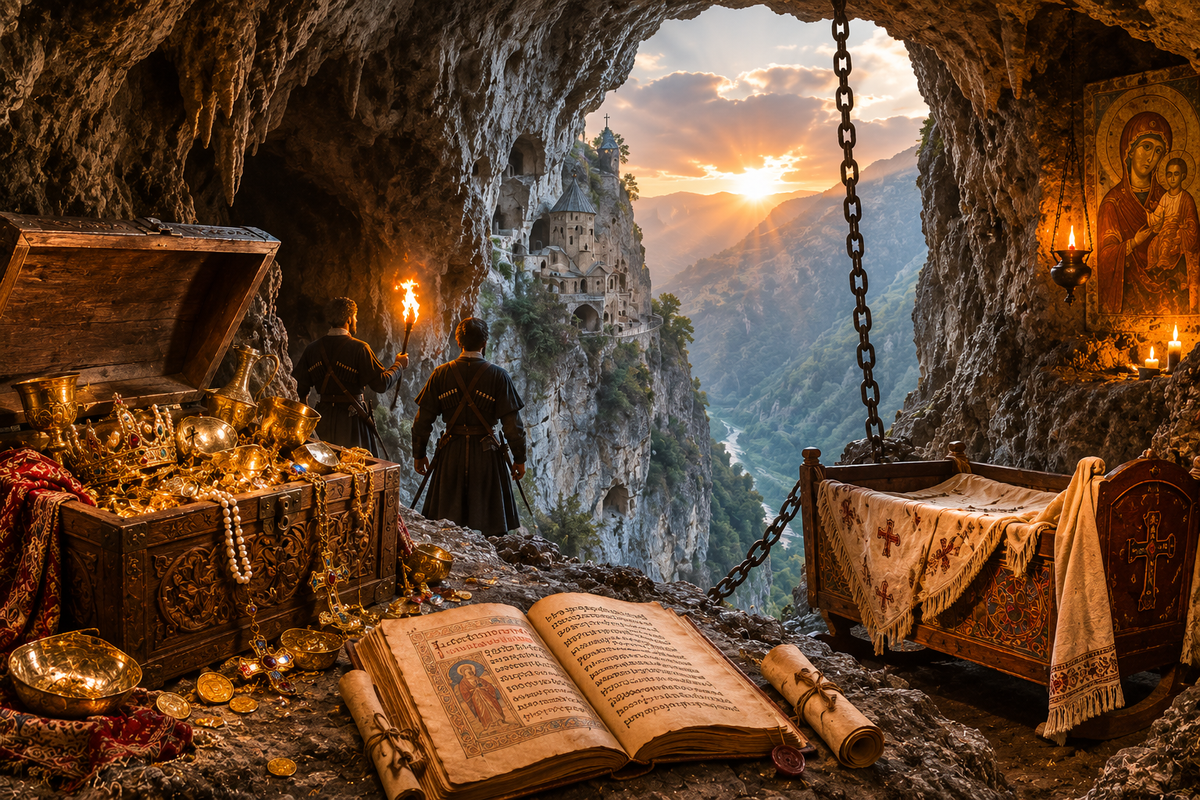
The earliest mention of the cave survives in the chronicle "Kartlis Tskhovreba." In that account, a hundred young Khevsur warriors hid the treasury of Queen Tamar in the cave while fleeing the armies of Tamerlane, then killed one another to keep the secret. The treasure has never been found.
The second legend comes from the writings of the historian and prince Vakhushti Bagrationi. In his "Geography of Georgia" he described a cave in the Mkinvari cliff, reachable only by a lowered iron chain, and mentioned that it supposedly held the cradle of the Lord and the tent of Abraham, standing without supports. Bagrationi added that he would pass over the other wonders in silence, and noted that below the cave lay another monastery, already deserted by his time.
There is a literary trace too: the cave with its chained entrance, as a hermit's refuge, is linked by some scholars to Ilia Chavchavadze's poem "The Hermit."
🧗 How the Cave Was Found in the 20th Century
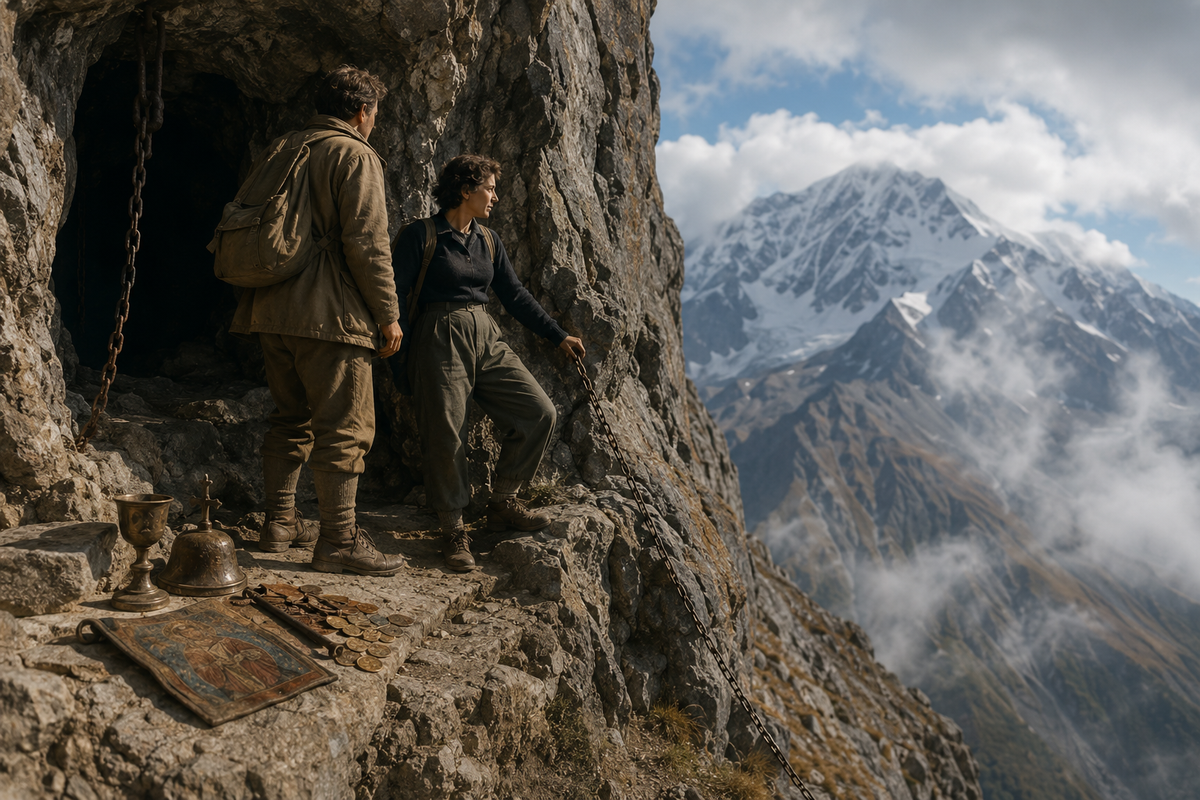
In 1947 the climber Levan Sujashvili, ascending Kazbek, spotted a cave with an iron gate and a hanging chain on the cliff northeast of the summit. The find did not go unnoticed: in January 1948 the Georgian government organised an expedition led by the climber Alexandra Japaridze.
At the entrance the team found an iron chain 5.5 metres long. Inside was a domed vault, rounded walls and a floor of stone slabs. There they found a church altar, medieval liturgical items, a church banner from the 10th-11th centuries and coins from the 15th-18th centuries. The expedition estimated that the last visitors had left the cave temple around a hundred years earlier, sometime in the first half of the 19th century.
Beside the entrance they found monastic cells carved into the rock, a gravestone, a stone cross and a pillar. These finds allowed researchers to date the monastic complex to the 6th-7th centuries and to call it the oldest known cave temple of Christianity at such an altitude.
📋 Betlemi Cave in Facts and Figures
⛪ The 2000 Consecration and Its Status Today
For the 2000th anniversary of the Nativity, a procession including clergy of the Georgian Orthodox Church climbed to the cave. It was consecrated as an active church. By the blessing given by Catholicos-Patriarch Ilia II, only men may enter this temple.
Since then Betlemi Cave has formally remained an active, if almost inaccessible, church. Regular services are of course not held here: the altitude and the difficulty of the climb make a permanent presence impossible. But its status as a consecrated site is preserved, and this is what sets Betlemi apart from a purely archaeological find: for believers it is still a church, not a museum object.
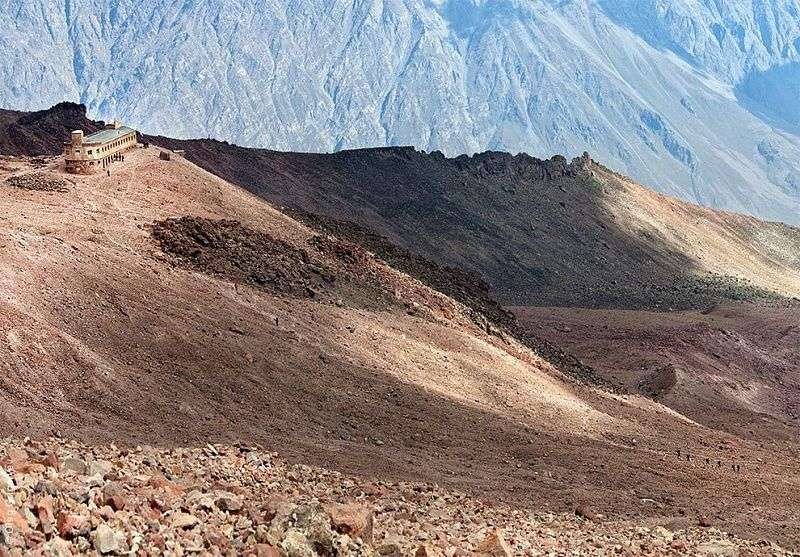
🎫 Can You Visit Betlemi Cave?
To be direct: the cave is effectively inaccessible to ordinary tourists. The entrance is cut into a sheer cliff 350-400 metres above the base, the cave itself sits at 4,100 metres, and reaching it by the existing chain requires serious mountaineering skill. There are no regular trails, tours or organised ascents, and we do not recommend that casual visitors try to reach it on their own.
What you can do instead of climbing:
See the finds from the cave in the Stepantsminda history museum, housed in the home of the writer Alexander Kazbegi. It holds artefacts, some of them from Betlemi Cave itself, including the iron gate from the entrance.
View the Kazbek massif and the Betlemi ridge from a distance, from Stepantsminda village or from the Gergeti Trinity Church, which offers one of the best views of the mountain. For more on the mountain, the Gergeti glacier and the church, read the feature on Mkinvartsveri, the Gergeti glacier and Gergeti Sameba.
For those seriously planning an ascent of Kazbek with professional mountaineering support, reaching the cave's area is theoretically possible, but that is a separate climbing challenge, not a tourist route, and it should be discussed directly with certified mountain guides rather than from general descriptions online.
🗺️ Cave Location (approximate)
Open in Google Maps🗺️ What to See Nearby in Kazbegi
Betlemi Cave is out of reach for an ordinary visit, but the region around Stepantsminda is one of Georgia's strongest for mountain sights. If you're heading to Kazbegi for the cave's story, here's what's worth seeing nearby.
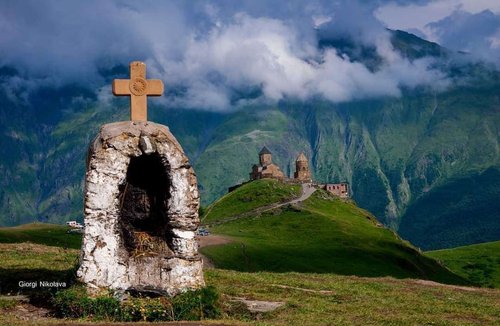
The Gergeti Trinity Church, a 14th-century church at 2,170 metres, is the postcard point of Kazbegi. It offers the best view of the Kazbek massif and the Betlemi ridge: what you can't approach up close reads clearly from here as a whole. The walk takes around two hours, or part of the way by 4x4.
The Stepantsminda history museum, in the house of the writer Alexander Kazbegi, holds finds from the cave, including the iron gate from its entrance. It's the closest you can actually get to the cave.
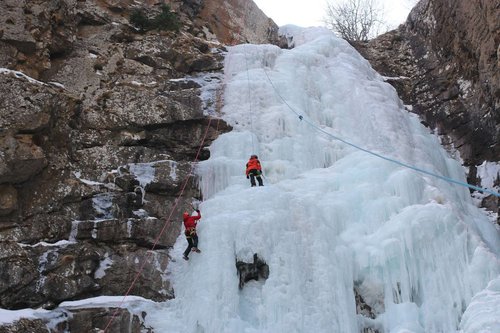
Kazbegi National Park, with the Truso valley, the Daryali gorge and hiking routes of varying difficulty. Trails to the Gergeti glacier and the weather station start from here too.
The Gveleti waterfall, 25 metres high, north of Stepantsminda near the village of Gveleti: a short, easy target for a day without a major climb.
📚 Read Next more on Kazbegi and the mountains
The cave remains one of Georgia's least-visited places precisely because it is physically out of reach: even trained climbers rarely go up, and a casual traveller risks not disappointment but a dangerous situation on the cliff without proper preparation. It's a rare case where the best way to touch a place is to not approach it at all: through its history, the finds in the museum and the view of the mountain from a distance.
Had you heard of Betlemi Cave before, or are you learning about it now? Share in the comments on Madloba: have you been to the Stepantsminda museum and seen the finds from the cave yourself?
Information is current as of Jule 2026. Details of altitude, dating and finds are based on historical records and the 1948 expedition report; the exact dating of the cave complex remains a matter of scholarly assessment.
❓ Frequently asked questions
No. Betlemi Cave is on a Kazbek cliff in the Kazbegi Municipality, 165 km north of Tbilisi. Betlemi Street and the Betlemi churches (Upper and Lower) are landmarks in Old Tbilisi, on the Sololaki ridge. Both names come from Bethlehem, but the sites are unrelated.
On the Kazbek massif (Mkinvartsveri), on the ridge between the Gergeti and Abano glacial basins, at around 4,100 metres. Administratively this is the Kazbegi Municipality, Mtskheta-Mtianeti region.
Not advisable. There are no regular trails, the entrance is cut into a sheer cliff 350-400 metres above the base, and the climb requires mountaineering skill and equipment. It's a task for experienced climbers with professional support, not a tourist route.
Officially in 1947, when the climber Levan Sujashvili spotted the entrance with its iron gate and chain. In 1948 the Georgian government organised a research expedition led by Alexandra Japaridze.
A church altar, medieval liturgical items, a banner from the 10th-11th centuries, coins from the 15th-18th centuries, and an iron gate with a chain at the entrance. Monastic cells carved into the rock, a gravestone and a stone cross were found nearby.
That's one of the legends recorded by the historian Vakhushti Bagrationi in the 18th century. He wrote that the cave supposedly held the cradle of the Lord and the tent of Abraham. There is no documentary evidence for it; it's part of local tradition, not an established fact.
Researchers date the monastic complex, including the cave and the cells beside it, to the 6th-7th centuries. That makes Betlemi one of the oldest cave temples of Christianity, and, thanks to its 4,100-metre altitude, one of the highest as well.
In the Stepantsminda history museum, housed in the home of the writer Alexander Kazbegi. Some of the artefacts, including the gate from the cave entrance, are displayed there.

1 comment
Log in to leave a comment