




🏔️ Svan Towers in Svaneti: Why the House-Fortresses Were Built
🏔️ Svan Towers: The Essentials
Stone house-fortresses in the mountains of Upper Svaneti, built between the 9th and 12th centuries. Dwelling, defence and a symbol of the clan all at once. Whole villages of towers are on the UNESCO list.
The densest clusters are in Mestia and the Ushguli community. The village of Chazhashi is an open-air museum, and Ushguli is one of the highest permanently inhabited settlements in Europe.
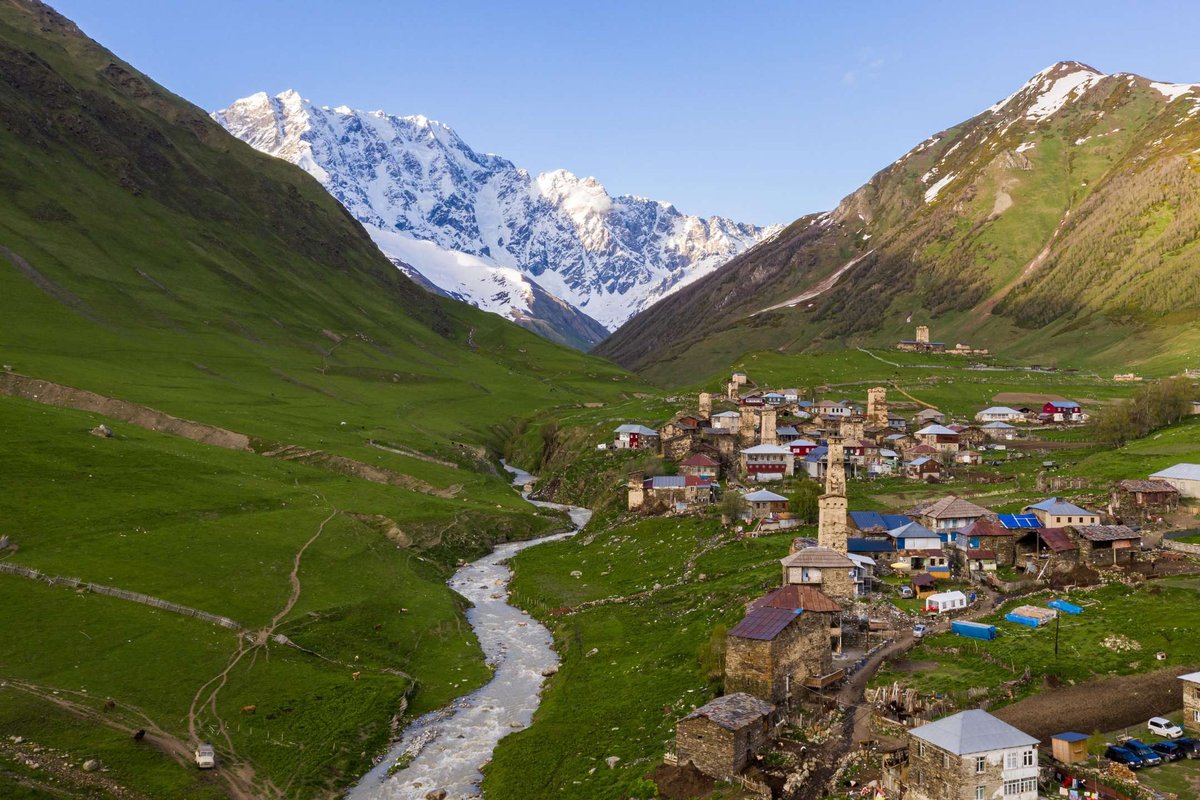
A Svan tower is a multi-storey stone fortress-tower that the Svans built onto their homes in the mountains of Upper Svaneti over the centuries. These towers are the region's most recognisable symbol: they rise above the villages, stand right among the houses, and create a skyline that's hard to mistake for anywhere else in Georgia. All the region's landmarks are gathered in the catalog on the Architectural Landmarks of Samegrelo and Upper Svaneti page.
The towers were built mainly between the 9th and 12th centuries, during the height of the Georgian Kingdom, though the stone-building tradition here goes back further still. Centuries of isolation shaped a culture of its own, and the towers are its material core. Below we look at how they're built, why they were built, and where they're best seen: in Mestia, Ushguli and the village of Chazhashi.
🏰 How a Svan Tower Is Built
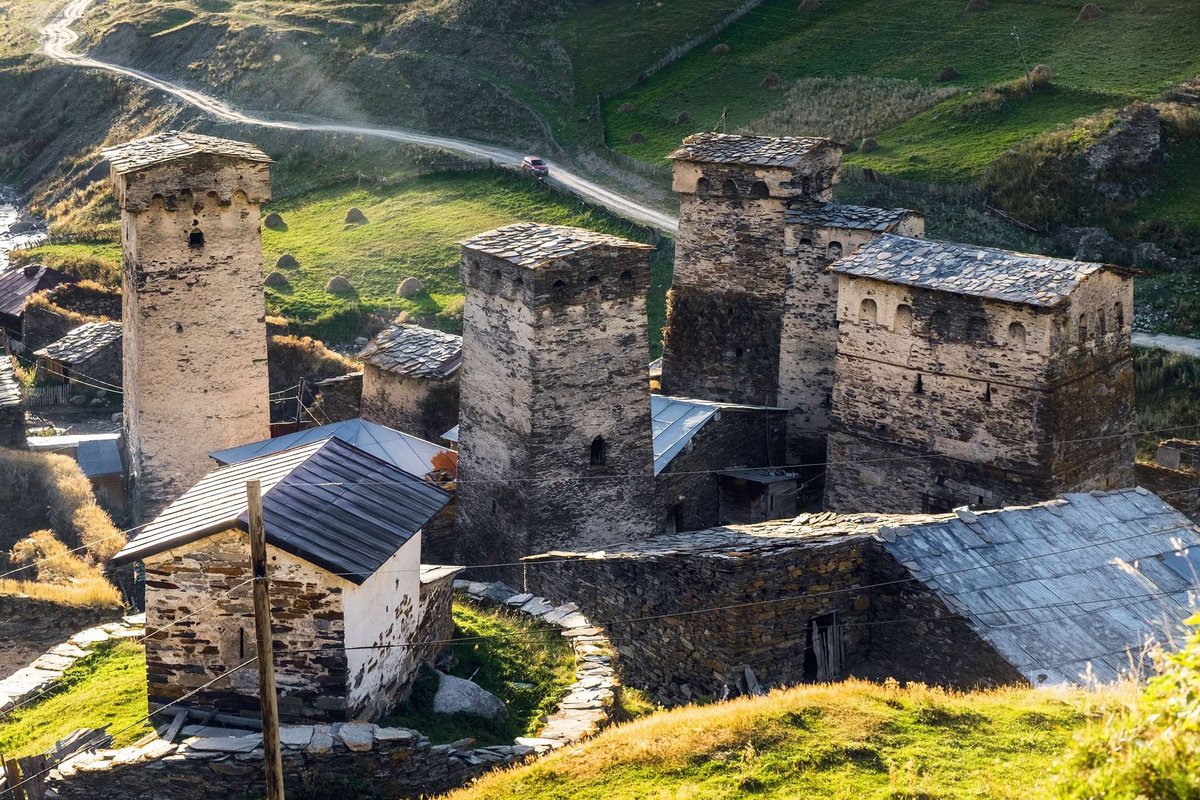
A Svan tower is part of a residential complex. The classic Svan yard has the tower itself, an adjoining house with a large hall (machubi), outbuildings and a stone wall around it. The tower is the tallest and most conspicuous structure of the set.
Towers were laid in dry stone masonry, with walls that taper towards the top, which makes them look as if they're reaching upward. They stand around 20-25 metres tall, usually 4-5 storeys. The ground floor is blind; the entrance sits not at ground level but on the second floor, 5-7 metres up, reached by a ladder that was then pulled inside. The floors are linked by a portable wooden ladder. At the top is a fighting platform with embrasures and a gabled roof. Instead of windows there are openings, narrow on the outside and widening inward, and the lookout slits face the roads leading to the village. The towers had no heating: they were used in summer and in moments of danger, while in winter the family lived in the warm machubi.
🛡️ Why the Towers Were Built
The main reason was safety. The tower was a family's refuge during raids and, no less important in Svaneti, during the clan feuds and blood vengeance that ran on for generations. When danger came, the family withdrew into the tower, pulled up the ladder and defended themselves from above through the embrasures. Sources name raids by Persians, Mongols and Turks among the external threats.
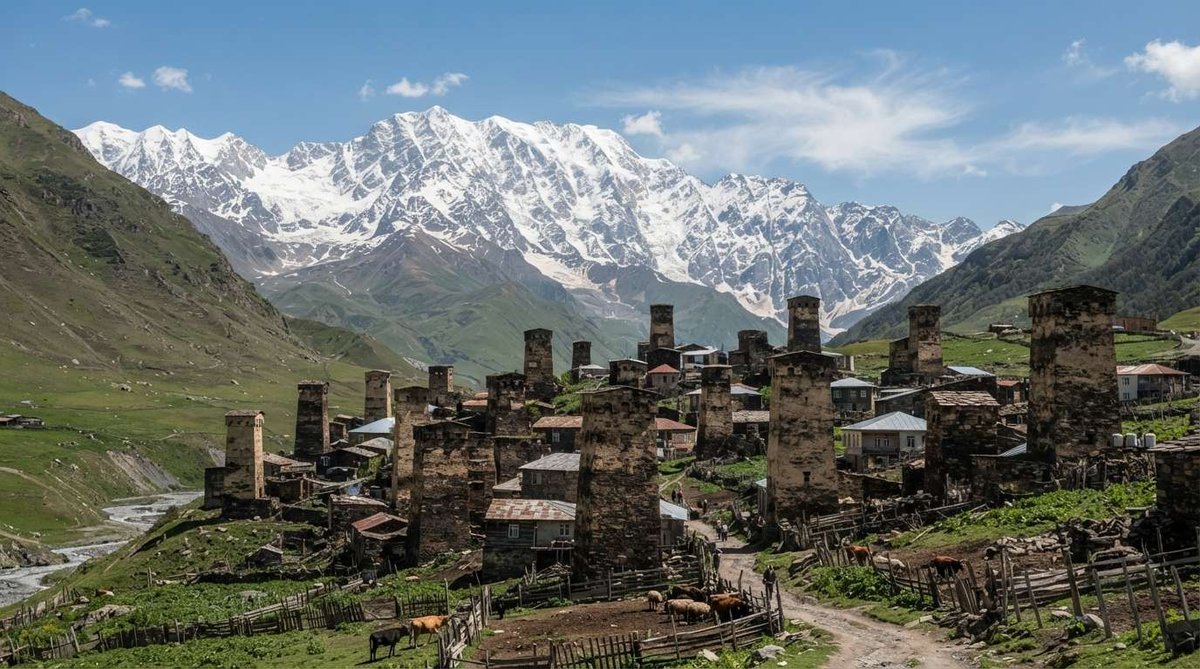
The towers had a second role too: signalling. When an enemy approached, a fire was lit on the platform of the main tower, the signal passed from tower to tower, and within minutes the whole valley knew. Another deliberate detail is the placement: towers were positioned so that the living part of the yard was shielded from avalanches, a constant threat in these mountains. That said, the precise function of some towers is still discussed by researchers: dwelling, defence, signal post, or a statement of a clan's strength and standing.
🗺️ Where to See the Svan Towers
The most towers survive in Mestia and in the Ushguli community. Below are the three main places, plus the towers you pass along the way.
The Margiani House Museum in Mestia deserves a separate mention: a traditional Svan yard with towers you can walk into and see how life inside a house-fortress was arranged. This "living museum" format, where the towers aren't fenced off as ruins but stand among ordinary homes, is what sets Svaneti apart from the familiar European castles.
⚖️ Ushguli, Chazhashi or Mestia: Where to Go
The best plan is usually a base in Mestia (lodging, transport, museum), a day trip to Ushguli and a walk through Chazhashi. Ushguli and Chazhashi are neighbouring villages of the same community, so people normally see both on one outing.
📜 History and Culture
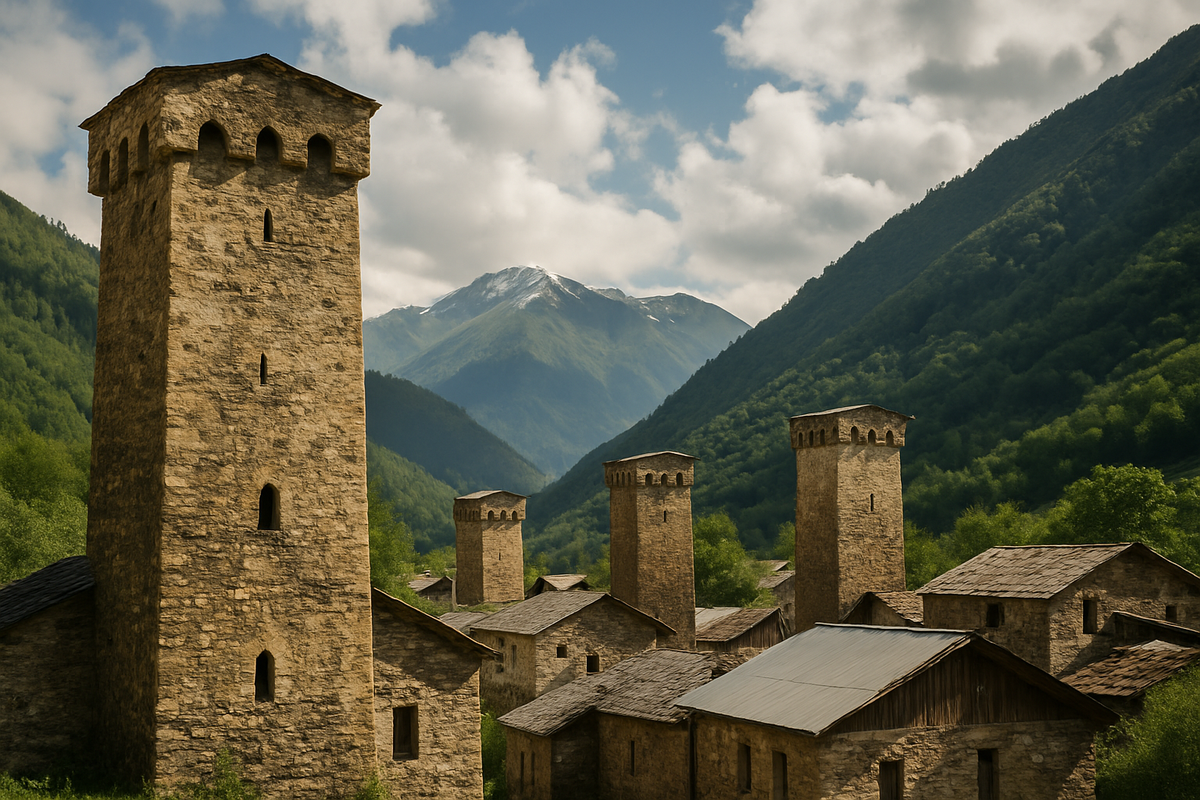
The towers are the product of a particular way of life: mountain isolation, a clan-based society and constant threat, both from outside and within. Each family raised its own tower, and by tradition the whole village helped. Hence the tower's role as a symbol: it spoke of a clan's strength, independence and honour as much as of its safety.
That's why Upper Svaneti was inscribed on the UNESCO World Heritage List in 1996, as an exceptionally coherent example of a medieval mountain landscape with villages and tower houses. Unlike European castle ruins, the Svan towers remain part of living villages: people still live beside them, farm and keep their ancestral homes. There's a flip side to that survival: harsh winters, snow loads, seismic activity and depopulation all threaten the towers, so restoration and stabilisation programmes are under way in the region.
🚗 How to Get to Svaneti
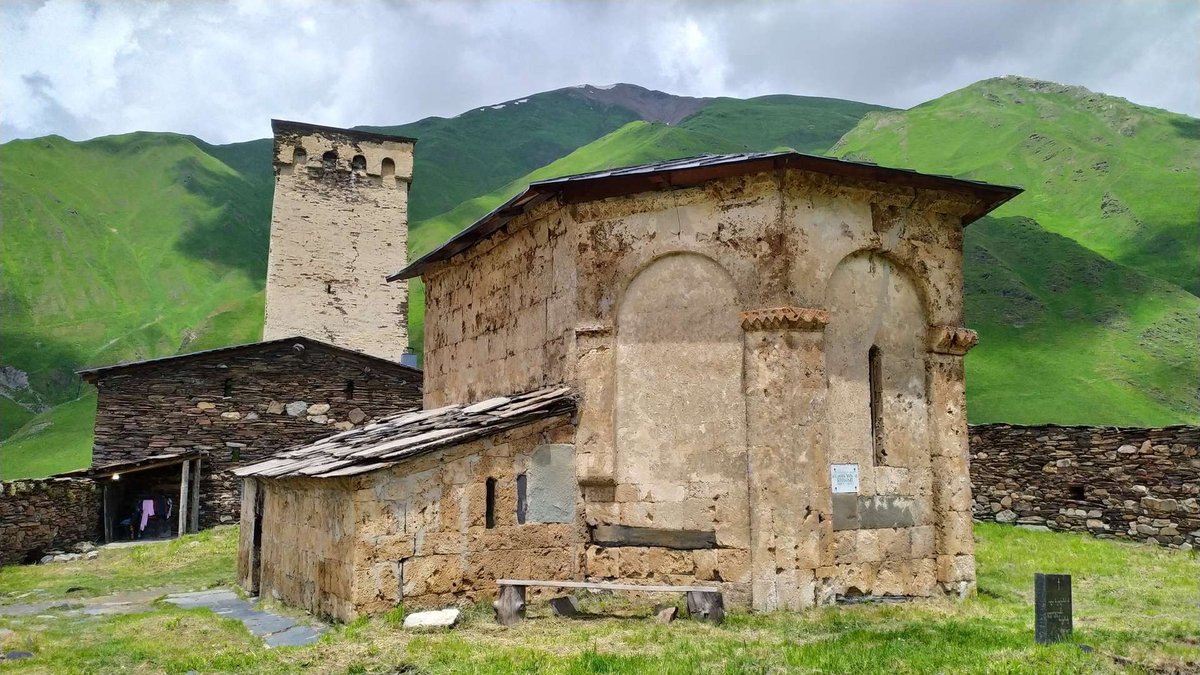
The gateway to Svaneti is the town of Mestia, about 450-475 km from Tbilisi. People travel via Zugdidi (by car or marshrutka, a long drive) or fly: small Vanilla Sky aircraft serve Mestia from Tbilisi and Kutaisi. From Mestia to Ushguli and Chazhashi it's about 45-50 km of mountain road, usually by off-road vehicle; in winter it can be closed by snow.
🧭 Where to Stay in Svaneti
Mestia is the usual base, with hotels, guesthouses, cafes and rentals. Ushguli also has places to sleep if you want to wake up among the towers. Below are the catalog sections.
Been to Svaneti? Leave a review on Madloba: tell us where the towers impressed you most, Mestia, Ushguli or Chazhashi, whether you climbed inside, and what you'd advise first-time visitors.
Information is current as of July 2026. Visiting conditions, roads and museum hours change; before you travel, check the current situation, the weather and whether the Ushguli road is open.
❓ Frequently Asked Questions
💬 Above all for protection: the tower was a family's refuge during raids, clan feuds and blood vengeance. They also served as signal posts (a fire passed the alarm from tower to tower) and were positioned to shield the home from avalanches.
💬 Most were built between the 9th and 12th centuries, during the height of the Georgian Kingdom, and the stone-building tradition goes back further still. So the oldest towers are around a thousand years old and more.
💬 The most towers are in Mestia and in the Ushguli community (the villages of Ushguli and Chazhashi). Mestia works well as a base, while Chazhashi is an open-air museum and the core of the UNESCO property.
💬 Upper Svaneti was inscribed on the World Heritage List in 1996 as an exceptionally coherent example of a medieval mountain landscape with villages and tower houses. The formally protected core is the village of Chazhashi with its 200-plus structures.
💬 Usually 20-25 metres, roughly 4-5 storeys. The base is square, about 5×5 metres, and the walls taper towards the top.
💬 Not in the towers themselves: they had no heating and were used for defence and in summer. Families lived in the warm adjoining house (machubi). Today the towers remain part of living villages, with people still living and farming beside them.
💬 The tower and the yard were positioned relative to the slope so that the living quarters were shielded from a possible avalanche. That's one reason the towers stand exactly where they do.
💬 Yes, some of them. In Mestia several museum-towers are open for climbing (for example at the Margiani House Museum and a few individual towers), with the portable ladders and fighting platforms still in place. Conditions and entry fees change, so check locally.

48 comments
Log in to leave a comment
побывал в ушгули этим летом, и знаете, ни один кадр не передаст того, как на фоне высоких гор запечатлевается этот контраст древности и природы. настоящая крепость, которая, в отличие от многих современных зданий, выглядит как будто сама природа помогла ей вырасти.
не могу не отметить и людей - они такие открытые, искренне гордятся своим наследием. разговор с местными сразу погружает в атмосферу. когда я смотрел на эти башни, не мог не думать о всех тех, кто здесь жил, защищал свою семью. это место действительно заставляет задуматься.
Сванетия покорила меня не только своими башнями и домами, которые носят оборонительный характер, но и своими традициями, культурой и обычаями. Я бы хотела отправиться в это место и постичь все тайны, которые эти башни скрывают. Я очень впечатлена тем, что сванские башни были летними строениями, без отопительной системы, и располагались к горному массиву таким образом, что основное жилое помещение защищено от лавин. К тому же, они высокие на 20-25 метров, и состоят из 4-5 этажей. Нижний этаж – глухое помещение; вход в башню находится на втором этаже, на высоте 5-7 метров. Эти факты просто поражают меня своей инновационностью и оригинальностью. Также мне понравилось, что вместо окон в башне находятся проемы, узкие с внешней стороны и широкие с изнутри. Наблюдательные отверстия сделаны в башне с той стороны, откуда можно наблюдать дороги, ведущие в деревню. Это доказывает, что жители Сванетии знают толк в обороне и защите жилища. Я не могу сдержать своего желания отправиться в это место. Я уверена в том, что я обязательно смогу постигнуть все тайны этой культуры и стать частью их наследия. Спасибо за эту замечательную статью, которая приоткрыла для меня дверь в фантастический мир сванской культуры!
Уникальная культура, колоритные традиции и обычаи сохранились и до нашего времени. Сванская башня – самое примечательное строение, носящее оборонительный характер, высотой 20-25 метров. Зимой оторвано от внешнего мира. Нижний этаж – глухое помещение, вход –на втором этаже, на высоте 5-7 метров. На последнем этаже – боевая площадка. Переносная деревянная лестница связывает этажи. Вместо окон – проёмы.