




Lykhny Temple of the Dormition in Abkhazia: History & Route
🎯 The Lykhny Temple is a gem of Abkhazia that you can't miss! ⛪
What awaits you in this article:
- 🗺️ How to get there and important practical information
- 🌟 The temple's history and cultural value
- 🏛️ What makes it unique: frescoes and architectural features
- 👀 Myths and secrets associated with this place
- 🍽️ Where to eat and what to see nearby
- 🏨 Where to stay for a comfortable stay
Read on to learn all about this amazing temple and plan your trip with comfort and confidence!
⚠️ Important warning for tourists from Russia
Be careful when visiting Abkhazia: when crossing the border, your passport may be stamped with a stamp indicating a visit to Abkhazia. This may create difficulties when entering Georgia, as Georgia does not recognize Abkhazia and considers it occupied territory. It is recommended to cross the border through Georgian-controlled checkpoints to avoid stamps in your passport, and to familiarize yourself with the laws of both countries before traveling to avoid potential legal problems.
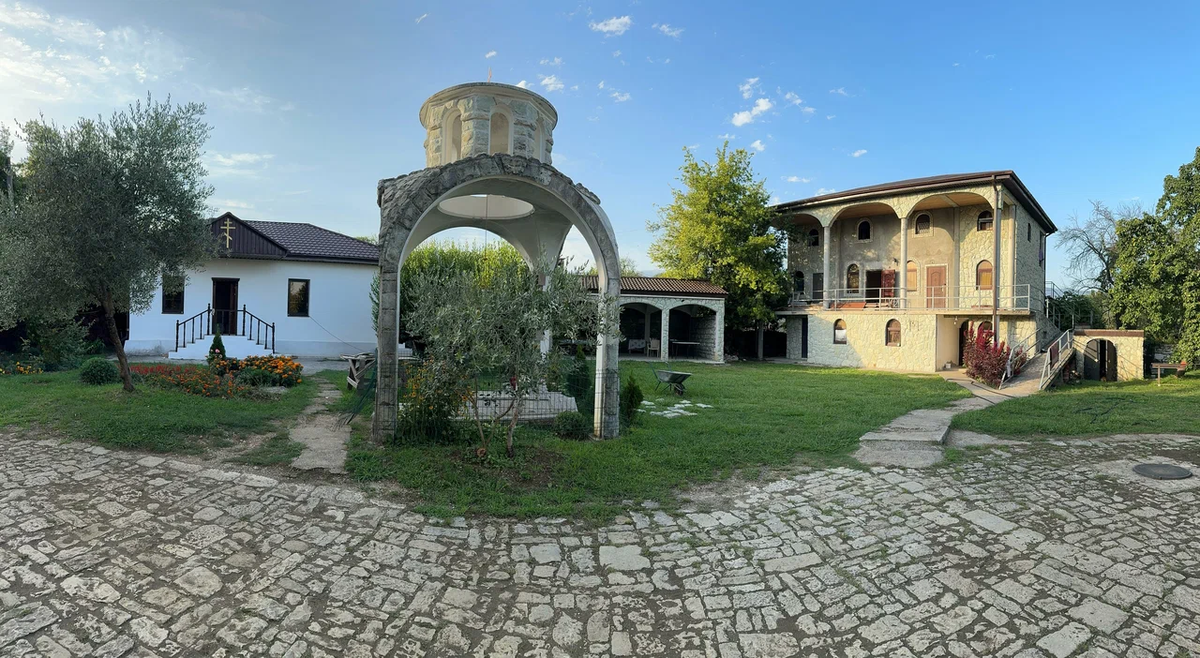
🏞️ The Lykhny Church, also known as the Church of the Dormition of the Blessed Virgin Mary, is one of the most unique and mysterious places in Abkhazia. Within its walls, centuries-old traditions, cultural heritage, and spiritual strength intertwine. Here, among majestic 14th-century frescoes and the tomb of princes, you can not only learn about the history of the region but also experience an atmosphere of vibrant faith and worship.
This church, built in the 10th century, has become a true shrine for the Abkhaz and a place of pilgrimage. Its exceptionally well-preserved frescoes, including unique depictions of saints and episodes from the life of the Virgin Mary, attract tourists and believers from all over the world. It has survived numerous destructions, but still serves as a living testimony to the past.
Where is it located and how to get there?
The Lykhny Church is located in a picturesque valley in the village of Lykhny in the Gudauta District of Abkhazia. It's approximately 35 km north of Sukhum, on the right bank of the Bzyb River. Incredibly, it can even be seen from afar thanks to its beautiful natural panorama.
💡 Incidentally, the village of Lykhny is one of the oldest villages in the region. In ancient times, it was an important center, the residence of the Abkhaz princes, and the church played a key role in the spiritual life of the population.
- GPS coordinates: 43.139880, 40.618003
- Opening hours: Daily from 8:00 AM to 6:00 PM (please check opening hours before visiting depending on the season and the temple's condition).
There are three options to get to the temple:
🚗 By car: The church is located 5 kilometers from the town of Gudauta. The road is good, but can be narrow in some places. If you're traveling by car, the journey will take about 15-20 minutes. The village of Lykhny is located immediately north of Gudauta. Slightly east of the Gudauta train station, there's a noticeable turnoff from which you can drive north for exactly 4 kilometers. You'll see a large clearing on the right, and beyond that, the church.
🚌 Public transportation: Minibuses and buses run from Gudauta to Lykhny. The journey takes 10-15 minutes. Buses are likely available, but looking for them in Gudauta can be a bit inconvenient.
🚶 On foot: If you enjoy walking, you can walk from Gudauta to Lykhny along scenic routes, enjoying the nature and history of the area. It will take about 1-1.5 hours. A taxi is also a quick way to get here.
The Lykhny Church is open to visitors year-round. However, in winter, roads can be difficult due to rain and snow, so it's best to plan your visit during the warmer months.
Special visiting requirements:
- 🚷 Photography is prohibited inside the temple, so as not to violate the sanctity of the place.
- 🧳 Dress code: Women are advised to cover their shoulders and knees, and men are required to wear long sleeves.
🚗 Don't miss the chance to visit one of the most ancient and sacred sites in Abkhazia!
🏰 Brief historical background
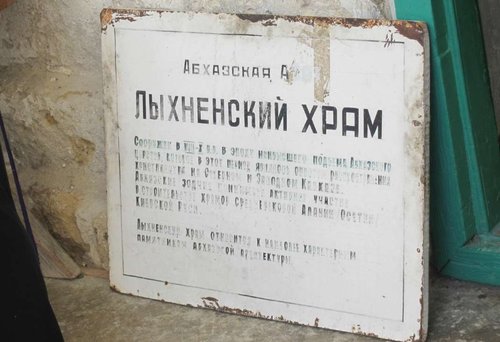
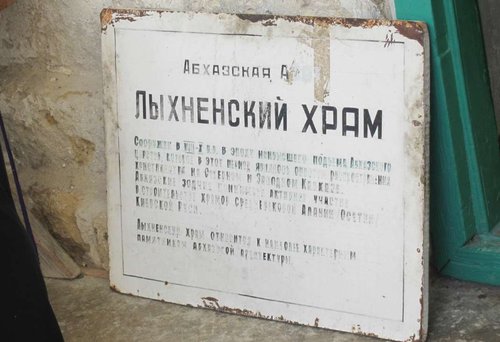
The Church of the Dormition of the Blessed Virgin Mary was built at the turn of the 10th and 11th centuries and is one of the oldest Christian buildings in Abkhazia that has retained its architectural and artistic value.
⏳ The exact date of its founding and the initiator of its construction remain unclear, but historians associate its construction with the reign of one of the early Abkhaz princes, such as Giorgi II, Theodosius II, or Levan III, who is known for his construction of numerous churches. 🏰
Significant Events:
- In the 11th century, the temple became a center of spiritual life and an important cultural symbol of Abkhazia. ✨
- In the 14th century, unique frescoes were added to the church, which have survived to this day. 🎨
- In 2007, it was included in the list of cultural monuments of Abkhazia. 📜
- The structure has undergone several restorations, including those in the early 21st century, which raised concerns among historians about the potential impact on its authenticity. ⚒️
- This place has been mentioned by many famous figures, including emperors and historians, in their works and travelogues. 🖋️
The Lykhny Church is a unique example of early medieval Abkhazian architecture, similar to churches built in neighboring regions of the Caucasus, such as the churches in Loo (Sochi) and the Zelenchuk churches in Kabarda. These buildings were erected in the 10th century, confirming the influence of the Abkhazian architectural school on the construction of North Caucasian churches. Furthermore, thanks to its location near the palace of the Shervashidze princes, the church retained its role in Orthodox life even during times of changing religious preferences in the principality.
In the 14th century, it was decorated with frescoes in the so-called Palaiologan style, characteristic of Byzantine painting of the time. These frescoes can be seen in the central apse of the church, depicting scenes from the life of the Holy Mother of God and other saints. Some of these frescoes are reminiscent of paintings found in other churches in Imereti, such as the Ubisa Monastery. Over time, the church experienced not only architectural changes but also political transformations. In the 15th century, with the spread of Circassian culture and paganism in Abkhazia, church life began to decline. Churches were abandoned, and some were converted into pagan shrines. However, the Lykhny church, thanks to its location next to the palace of the Shervashidze princes, continued to be an important center of Orthodox life. Even after the Shervashidze princes converted to Islam in the 18th century, the church continued to function, and in 1821, Prince Safar-Bey was buried there.
After the Russian army took control of Abkhazia's villages in 1830, the church in Lykhny began to regain its role. In 1855, Emperor Alexander II presented the church with an icon of the Mother of God. In 1866, during the Lykhny Uprising, Colonel Konyar was killed, and a chapel was erected on his grave, which still survives to this day.
🏰 Architecture and decoration
The Dormition Cathedral is a classic cross-in-square structure set within rectangular walls made of smooth, ash-colored stone.
📐 Its architectural highlight is its unique octagonal dome with a low drum and pitched roof, supported by four free-standing piers. The building's walls and facades are simple yet striking: they are faced with large slabs of reddish limestone, and three apses stand out on the eastern side. The western side features an upper gallery, adding to the building's grandeur.
💡 The cathedral has undergone several restorations, with the most recent work, carried out in 2010, raising concerns among heritage preservationists. 🔧
🎨 Frescoes and Icons
A distinctive feature of the temple is its unique 14th-century fresco paintings, which depict key biblical scenes.
- Scenes from the life of the Virgin Mary and the saints depicted in the central apse are captivating in their expressiveness and beauty.
- On the upper tier are the Virgin Mary with the Child and two angels, a composition of the Eucharist, and a scene with the Myrrh-Bearing Women at the Holy Sepulchre.
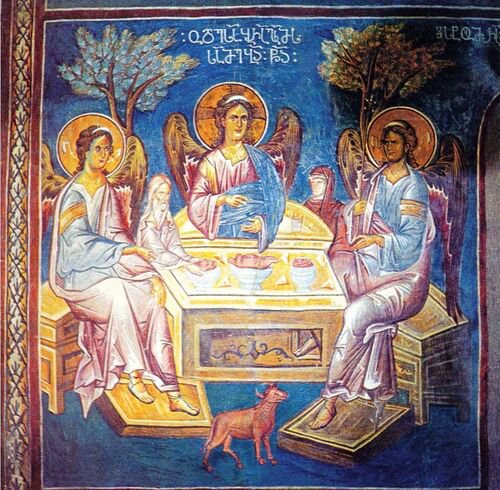
- The middle tier depicts Abraham's Hospitality and the Sacrifice, while the lower tier features figures of saints such as Basil the Great and Gregory the Theologian.
- In the western part of the church, one can see fragments of the Dormition of the Most Holy Theotokos and the scene of the Virgin Mary handing over the Belt to the Apostle Thomas. Also depicted are figures of Jesus Christ, John the Evangelist, and a scene from the life of John the Baptist.
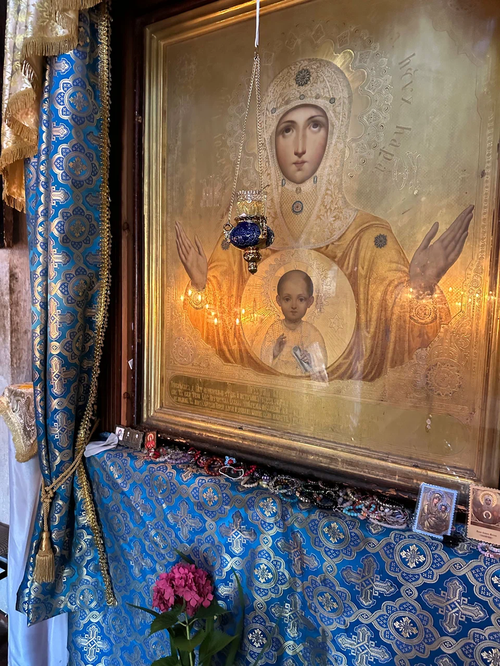
Among the icons that adorn the church, the icon of the Mother of God "of the Sign," or the Abkhazian Mother of God, stands out. This icon is renowned for its miraculous properties—it emits a delicate fragrance. The icon was donated to the church by Emperor Alexander II in 1855 and is one of the most venerated in Abkhazia.
💥 Myths and interesting facts
- 🌟 One of the most famous stories associated with Lykhny is the story of the construction of the palace of Prince Georgy Shervashidze. According to legend, to strengthen the palace walls, two people were immured in their foundations (Giorgiy Shervashidze himself, the last prince of Abkhazia, who died in 1918, and Prince Safar-Bey Shervashidze, who was buried here in 1821 (his reign was controversial among the Abkhazians, as he accepted Russian citizenship, which greatly changed the political landscape of the region). The walls did not collapse, and the palace itself became not only a symbol of power but also a unique architectural structure.
- ✨ Events took place here that inspired believers to experience miracles. The frescoes of the church feature images of Saint Zachariah, who was renowned for his healings. These images contain not only artistic value but also spiritual depth.
- 🌳 Near the church grow three ancient linden trees, over 500 years old. These trees are considered historical witnesses to all the events that took place in the village of Lykhny and are called Royal Linden Trees.
- 🌠The church's frescoes contain over a dozen Greek inscriptions, testifying to the strong Byzantine influence on the architecture and art of the time. One inscription mentions Halley's Comet, which appeared in 1066, a unique historical record. Another reads: "Christ, blessed by God and Lord of all things... In the month of April, a star appeared, from whose depths rays emanated..."

🍽️ Practical tips for tourists
Where to eat: There are several cafes near the church where you can try traditional Abkhazian dishes such as khachapuri, shashlik, adjika, and kebab.
Where to stay: If you plan to spend the night in Lykhny, it's best to stay in Gudauta or in the village itself, where there are several cozy guesthouses.
What to see nearby:
- The unique Lipnitsa, a place for public gatherings and celebrations, grows around the church.
- A few kilometers from the church is the Shervashidze Palace, a historical site with magnificent architecture.
If you know any guides, please let us know – we'll be happy to recommend trusted professionals.

🕊️ Pilgrimage and religious importance
The Dormition Cathedral remains a functioning church and an important cultural monument in Abkhazia. Despite the passing of centuries, it retains its unique character and attracts both believers and tourists from around the world. Services are held regularly, and those who wish can undergo baptism and communion.
The cathedral is currently undergoing restoration. The restoration work is not without its challenges, and although there are concerns about the potential impact on the authenticity of its architecture, specialists are doing everything possible to preserve its historical value. The structure was recently surrounded by scaffolding, and its roof was protected with wooden shields to prevent damage from rain and snow.
Thus, the Lykhny Cathedral continues to live on, preserving its grandeur and historical significance, and its restoration is a step that will preserve this architectural wonder for future generations.
💬"Visiting the Lykhny Temple was a true spiritual discovery for me. It's a place where time seems to stand still, and you feel a connection to something great and eternal. Even if you're not a believer, the atmosphere of this temple cannot leave you indifferent."
💬"I visited the Lykhny Temple for the first time and was stunned by its beauty and history. The 14th-century frescoes were striking in their detail and artistry. This place is shrouded in mystery, and you sense the spirit of antiquity and power that radiates through the temple walls."
💬"The Lykhny Temple is not just an architectural monument; it's a place of power. Here, you not only admire the frescoes and architecture, but also feel a deep sense of peace and tranquility. It was a truly unique experience for me."
🌟 Don't miss the chance to visit this amazing place. Share your impressions with other tourists, leave comments, and help them discover these hidden treasures of Abkhazia.
❓FAQ
🚗 You can get from Gudauta to Lykhny in 10-15 minutes by car or bus.
📸 Photography and video recording are strictly prohibited inside the church. To obtain permission, you must ask the priest for a blessing.
🎨 The church features 14th-century frescoes depicting scenes from the Bible, such as "The Hospitality of Abraham" and "The Myrrh-Bearing Women at the Holy Sepulchre."
🏨 In Gudauta or in the village of Lykhny itself, there are guest houses and hotels for tourists.
⛅ The temple is open all year round, but it is better to visit in spring or autumn, when the weather is most favorable for sightseeing.

26 comments
Log in to leave a comment
Но вот, что меня мучает, как к этому храму добраться проще? Могу рискнуть и проехать через ту границу, или лучше подождать? Может, у кого-то есть опыт?
Мне особенно понравились подробные советы от местных жителей — где лучше стоять, чтобы сделать эффектный кадр, как подобрать время посещения, чтобы спокойнее прочувствовать атмосферу, и на что обратить внимание, чтобы не упустить исторические детали. Благодаря этим рекомендациям я уже понимаю, что хочу приехать сюда с утра: в мягком свете он выглядит особенно величественно.
Отзывы других путешественников, собранные в рейтинге, помогли мне представить, как люди разных стран и интересов встречаются здесь на молитве, тихой прогулке или просто на фотосессии с видом на храм и окружающие горы. Читатели отмечают, как поражает сочетание мощи архитектуры и умиротворённой тишины внутри, где кажется, что время замедляет ход.
После прочтения статьи я бы точно задержался здесь подольше — не только чтобы осмотреть храм, но и чтобы посидеть на скамеечке в тени деревьев, почувствовать запахи и звуки этого места.
А вы бы предпочли посетить Лыхнский храм Успения Богородицы в тёплое время года, чтобы насладиться видами вокруг, или в более прохладный сезон, чтобы почувствовать его особую атмосферу?