




Rukhi Fortress: Dadiani’s Stronghold
The Rukhi Fortress, fortified with powerful walls and towers, is surrounded by the Rukhi River, which flows through three of its walls. It is believed that the river's course was artificially altered to increase the fortress's inaccessibility.
The Rukhi Fortress is the largest and most significant fortification of the Dadiani family (100 x 80 meters). It is located on the left bank of the Inguri River, in the village of Rukhi (Zugdidi Municipality).
The construction of the fortress is associated with the name of Levan II Dadiani, the Ruling Prince of Samegrelo, "the ruler of all Georgia" (as he called himself). Levan II Dadiani ruled the region for 46 years, and throughout this time, he relentlessly sought to expand and strengthen his domains. The Italian missionary Archangelo Lamberti wrote: "If Levan II Dadiani had been raised in our educated country, if he had received knowledge from our best teachers, no ruler would have been able to compare with him."
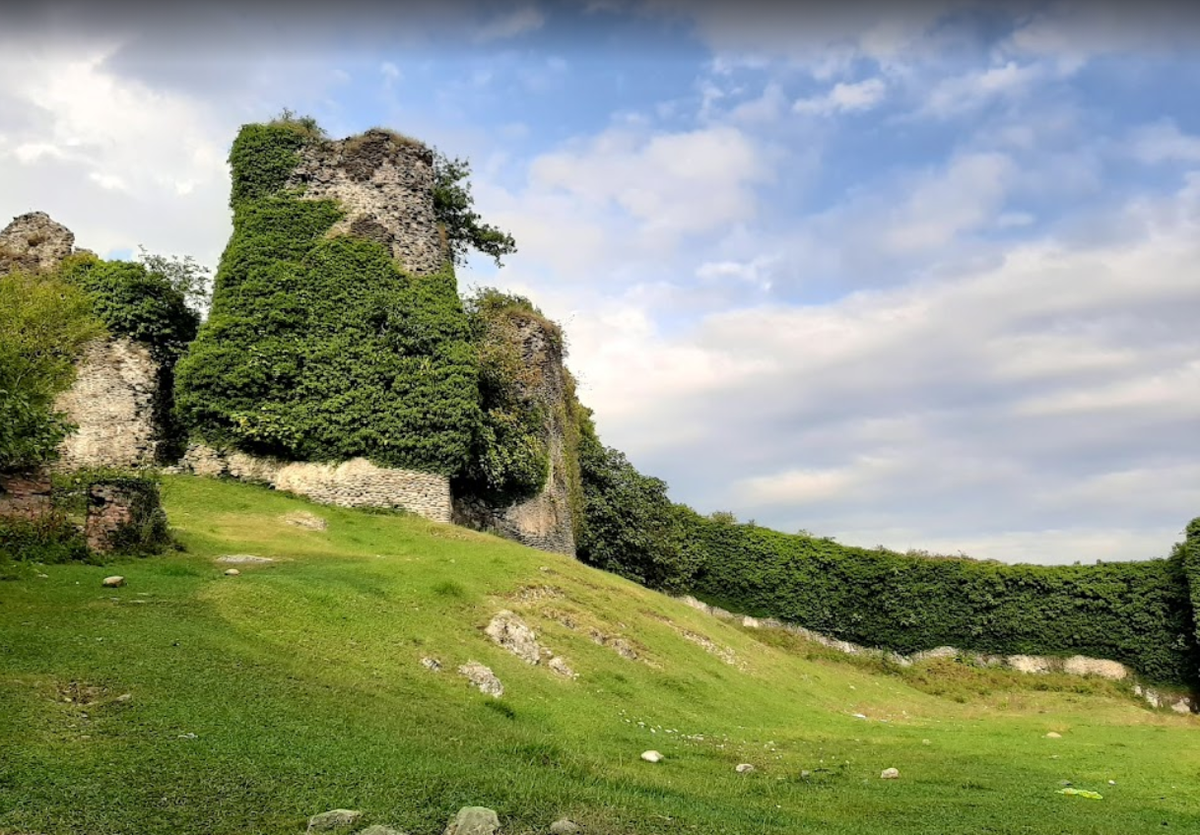
Levan Dadiani didn't limit himself to building a fortress; he settled merchants from Imereti here and turned Rukhi into one of the region's centers. The Rukhi Fortress played a significant role during the Georgian-Ottoman War and the Crimean War.
The fortress is surrounded by strong defensive walls 12 meters high. These walls are almost solid, with only the upper portion containing battle routes. The fortress itself consists of two parts: the citadel and the courtyard. Both parts are fortified with towers. The entrance is located in the lower courtyard and consists of two parts. The first door is fixed on the outer line and locked with a large bolt. The second door, also with a large bolt, is located on the middle line. Pilasters surround the citadel. The elongated citadel is located in the northern section of the fortress. The largest four-story tower served as the donjon (main tower) of the fortress. The garrison was equipped with artillery. Information about the fortress can be found in the works of historians Vakhushti Bagrationi and Gorgijanidze, in a lengthy inscription on the icon of the Khon Church (dated 1636), in the inscription of the Ilori icon, in the notes of the French traveler Jean Chardin, etc.

40 comments
Log in to leave a comment
нуть на эту крепость и на события которые происходили здесь во времена Ливана ll Дадиани.Неужели сохранились двери,засовы, о которых пишет
автор.Я с великим удовольствием, при возможности побываю в этих местах.История и природа всегда больше всего интересуют меня.Я люб-
лю читать исторические очерки.Спасибо Дарье за очередной, интересный рассказ.
Крепость состоит из двух частей - цитадели и двора. Высота стен 12 метров.
Леван Дадиани не ограничился строительством крепости, и превратил Рухи в центр, поселив сюда купцов.