




Batumi's Piazza Square: Venice on the Black Sea and What You Need to Know Before You Go
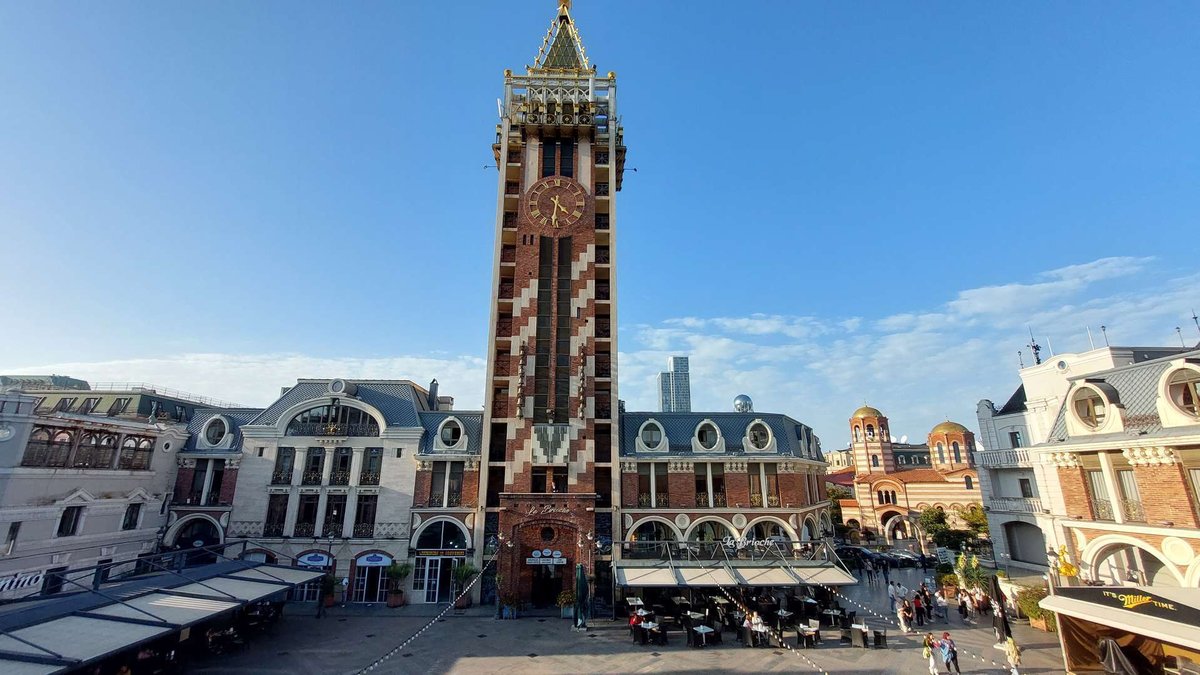
Batumi is Georgia's Black Sea port: subtropical palms, modern towers, a casino strip. And then, right in the middle of the old city, a Venetian piazza with a clock tower that plays the Georgian national anthem three times a day. It shouldn't work. It does.
Batumi's Piazza Square opened in 2010 as part of a broader reconstruction of the city's historic districts. The brief went to Georgian architect Vazha Orbeladze with a clear mandate: build something that doesn't exist elsewhere in Georgia. What he delivered: 5,700 square metres of Italian Renaissance ensemble, Europe's largest marble mosaic laid into the ground, and a clock tower styled after Venice's Campanile di San Marco: has since become one of the most photographed spots in the country.
Here is everything you need to know about it.
🏗️ How Piazza Square Came to Be
In the early 2000s, Batumi's city administration launched a reconstruction programme for the historic quarter near the old town hall. The lead architect was Vazha Orbeladze, who had previously shaped the current appearance of Old Tbilisi and the town of Sighnaghi (often called the "city of lovers" in the Kakheti region).
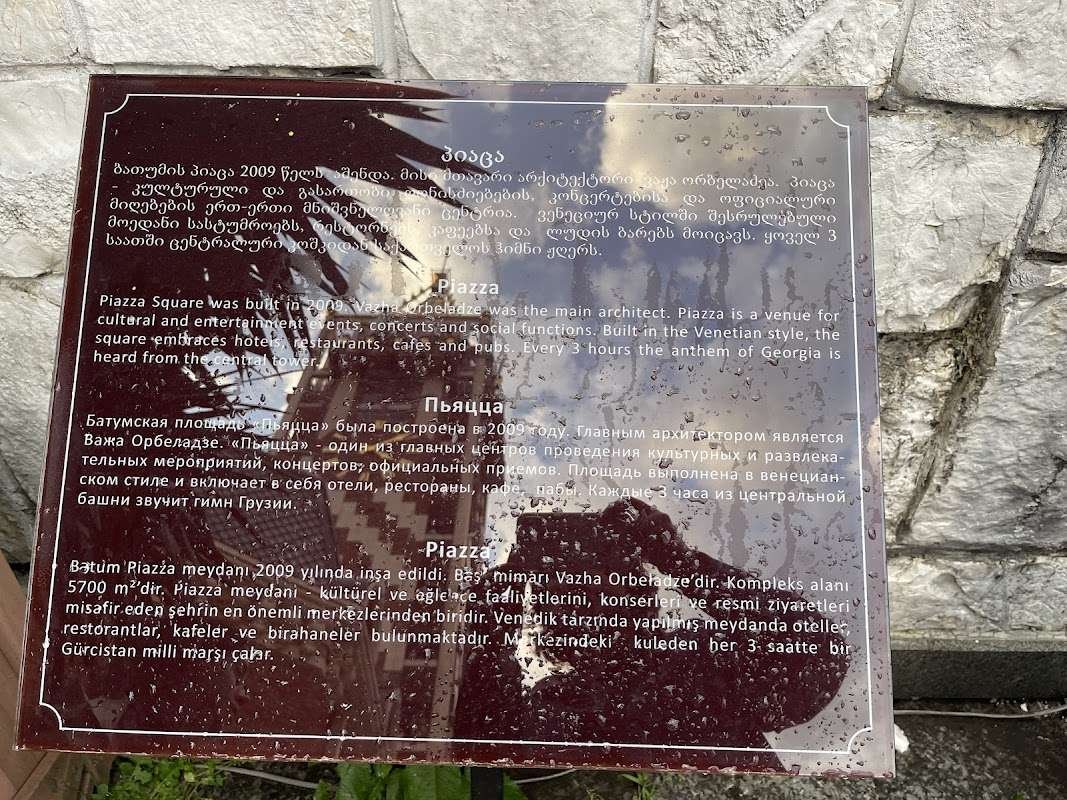
Orbeladze's proposal was unconventional: a Venetian-style public square modelled on the Piazza San Marco in Venice, built from scratch in a Georgian coastal city. The gamble paid off. Construction ran from 2009 to 2010, at a cost exceeding nine million US dollars. The result is a rectangular 5,700-square-metre pedestrian zone enclosed on all four sides by buildings with Renaissance-era facades.
The facade details are the work of two specialists: Estonian stained-glass artist Dolores Hoffmann and her team from a renowned Tallinn studio designed the windows that line the buildings; the floor mosaic in the centre of the square is the work of Georgian-Swiss designer Natalia Amiredjibi de Pita. The arched entryways to the square from surrounding streets are hand-painted and covered in plasterwork.
The square has no Georgian architectural references, no khachapuri-shaped windows, no Georgian script carved into the walls. Orbeladze built a deliberate quotation from Venice. Whether that was the right choice is a question locals still debate. But the square works, and it draws both residents and visitors in numbers that justify whatever the answer might be.
🕐 The Clock Tower: Anthem, Figures and Three Daily Shows
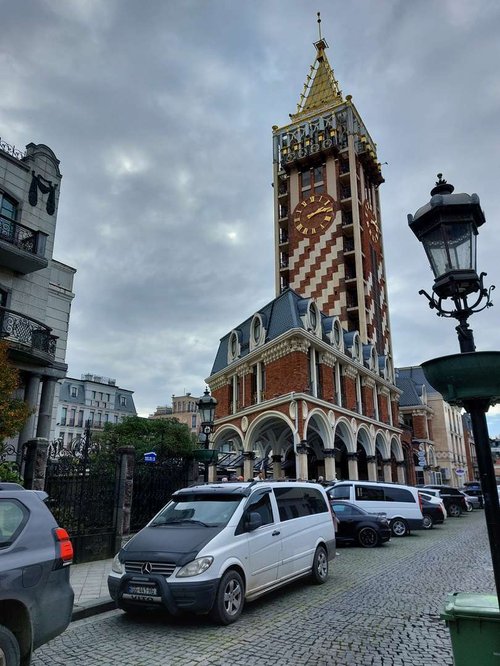
The dominant structure is the clock tower, styled after Venice's Campanile di San Marco. It serves a dual purpose: the tower houses three hotels (Piazza Boutique Hotel 4★, Piazza Inn 3★, and Piazza Four Colours 3★), and its clock mechanism delivers one of Batumi's few reliable daily spectacles.
Three times each day, at exactly 12:00, 15:00, and 18:00, the tower's carillon plays a passage from the Georgian national anthem. At this moment, niches in the tower facade open and two life-size figures dressed in traditional Georgian national costumes appear. Four different scenes rotate across the daily showings. The whole performance lasts under a minute.
💎 The Marble Mosaic: a European Record Under Your Feet
The floor at the centre of the square holds what is officially the largest figurative marble mosaic in Europe. A more detailed entry is available in the square's mosaic catalogue card; here is the essential version.
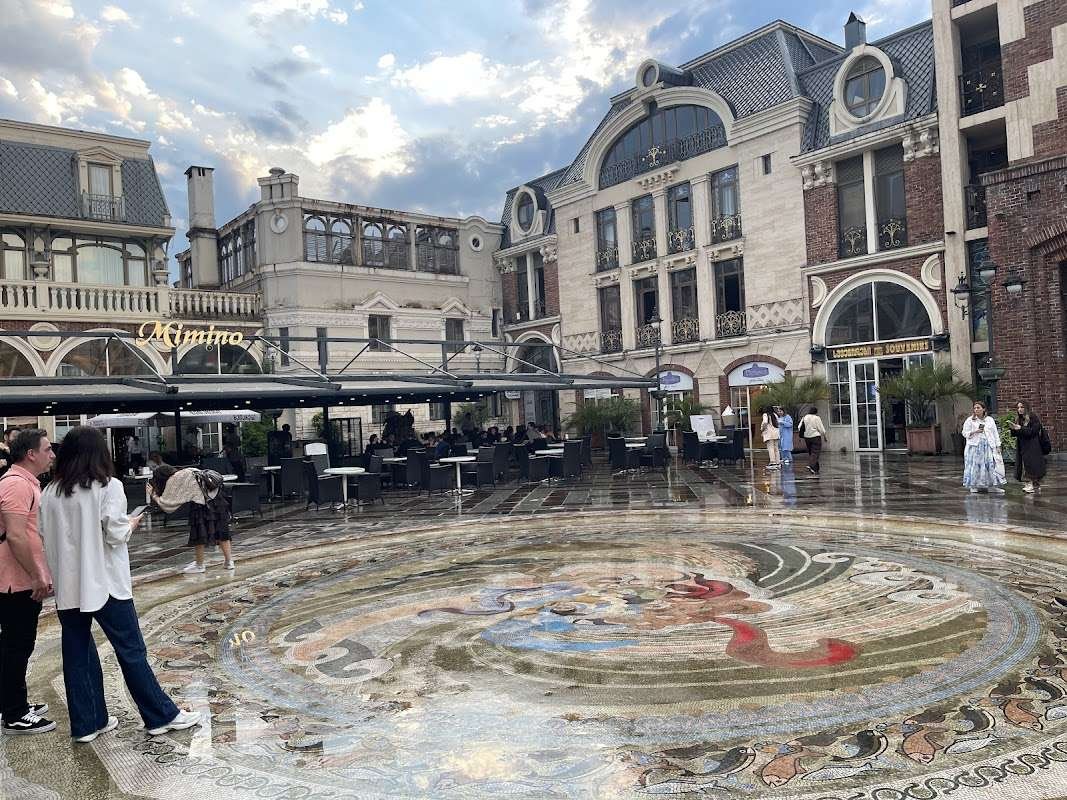
Designer: Natalia Amiredjibi de Pita, of Georgian-Swiss background. Sketches were produced in Georgia; individual marble elements were manufactured in Abu Dhabi (UAE) and then assembled on-site in Batumi. Marble was sourced from several countries; specific details: such as the central figure's blue garment: are ceramic rather than stone.
The composition consists of eight concentric circles, one inside the other. The designer's intent was a vortex or whirlpool on water. At the centre: a sea princess. Around her, five water deities in vivid multi-coloured garments.
The mosaic is horizontal: people walk on it. Seeing the full composition requires standing on a surrounding balcony or finding aerial photography. This means many visitors stand directly on a European record without knowing it.
🎨 Architecture and Stained Glass
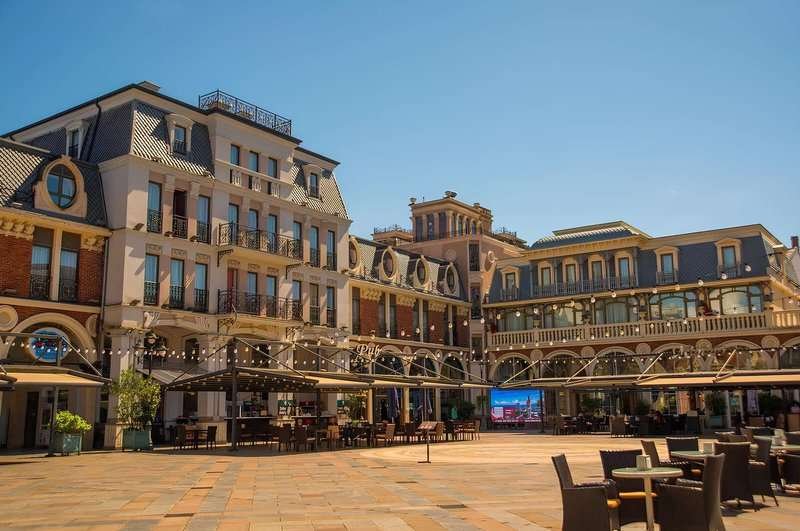
Beyond the mosaic and the clock tower, the square is consistently decorated. The stained-glass windows on the facades: Dolores Hoffmann's work with the Tallinn studio: cover the buildings' upper levels. They represent a significant piece of craft in their own right.
The four enclosing buildings draw from Renaissance references: the proportions of Venetian palazzo architecture, arched loggias, carved capitals, hand-painted ceiling vaults in the gateway passages. The ground-level entrances from adjacent streets pass through arched tunnels with elaborate plasterwork. The pedestrian perimeter consists of three narrow streets where vehicle traffic is technically allowed but practically rare.
At street level, most of the building frontage is occupied by restaurants, cafes, bars, and a few retail shops. Prices here run higher than the Batumi average.
🌆 Evenings: Concerts, Lighting and What to Expect
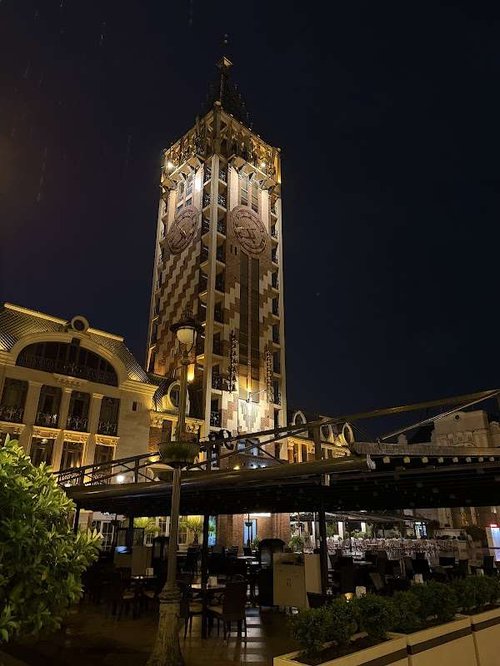
Piazza Square changes character at night. The buildings are illuminated in colour, the arched passages glow. Live musicians perform most evenings, ranging from solo performers to small ensembles. The square functions as Batumi's primary outdoor cultural venue.
The list of performers who have appeared here reads unusually well for a city of Batumi's size: Plácido Domingo, Sting, Michel Legrand, Macy Gray. The square hosts official city events, seasonal markets, and New Year celebrations.
Among the most romantic spots in Batumi, Piazza consistently appears: partly for the setting, partly for the evening atmosphere, partly because there is always something happening.
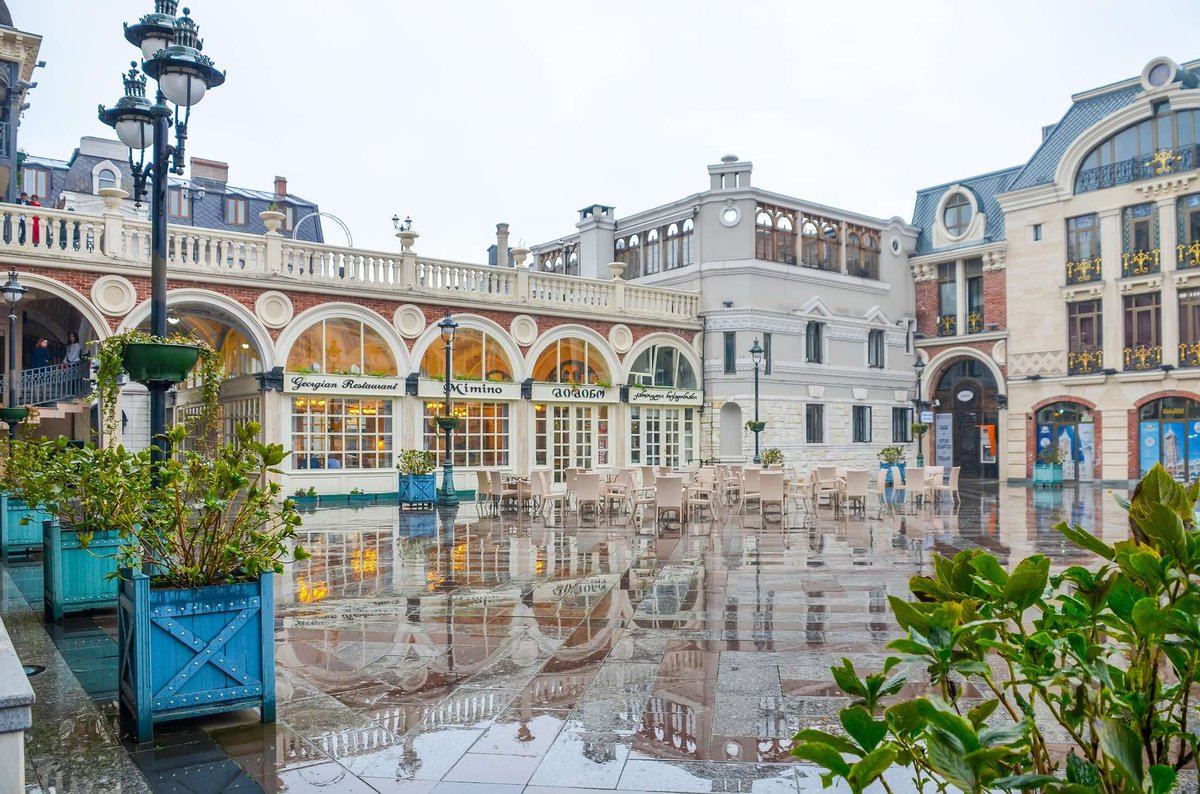
Restaurant pricing: expect to pay noticeably more than in surrounding streets. The most frequently mentioned cafe is Mimino, which serves Georgian food (ojakhuri, lamb kebab, goby fish, khinkali) at prices described as reasonable relative to the square's other options.
🗺️ Getting There and What's Nearby
Address: 25 King Parnavaz Street, Batumi. Next to the city hall.
Walking from the seafront: approximately 10 minutes through the old town quarter.
By bus: routes 1, 1a, 2, 4, 10, 13 along Gogobashvili Street to the Parnavaz Street intersection; route 7 to King Parnavaz Street.
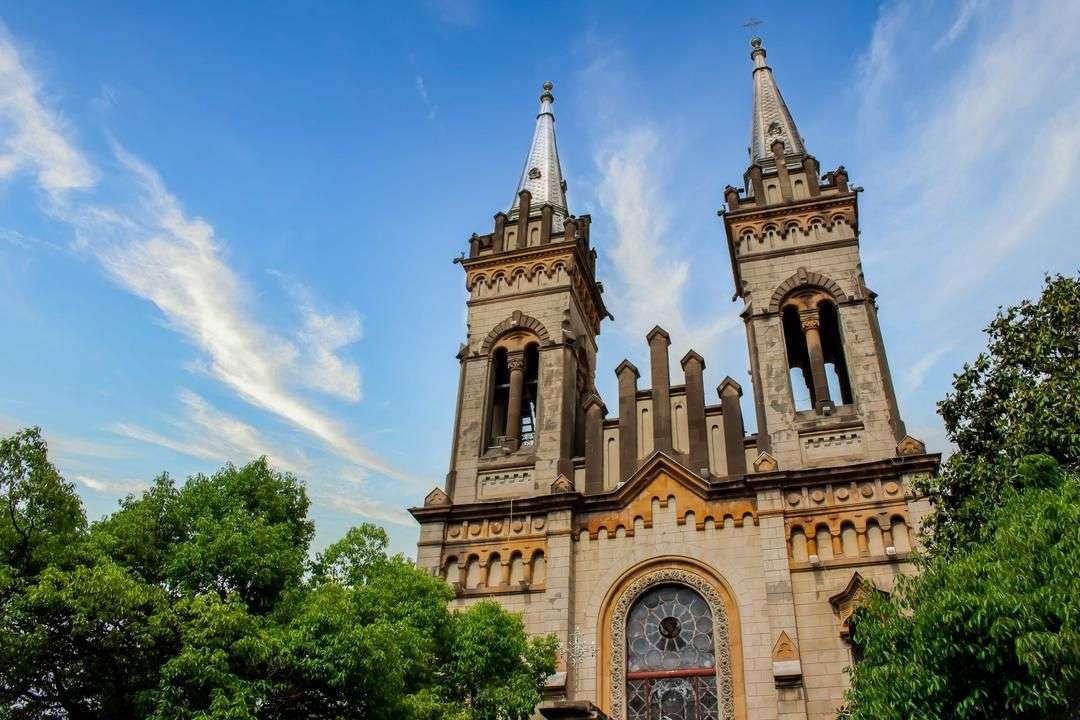
Within a five-minute walk: the Cathedral of the Nativity of the Virgin (Gothic detailing, Italian stone), the city hall building, and Orta Jame mosque (19th-century historical mosque). For a broader overview of Batumi's architectural heritage, the catalogue has dedicated entries for all major historic buildings.
Ten minutes brings you to the waterfront boulevard, where the Ali and Nino sculpture stands, one of the most recognisable landmarks of the city.
Piazza Square honestly: what to expect
Expect a busy pedestrian zone that gets crowded in summer evenings, with restaurant seating sometimes occupying most of the walkable area. Expect prices at the cafes and restaurants to be noticeably higher than the Batumi average. Expect the clock show to be brief, under a minute, and to require timing your arrival precisely.
Also expect: genuinely impressive craft work in the mosaic and the stained glass, a clock tower that plays a real national anthem (not a tinny chime), and an atmosphere that most visitors describe as distinctive and worth the ten-minute walk from the waterfront.
The square is free to enter and never closes. The restaurants are optional. The clock show is scheduled. Everything else is up to what you make of it.
A practical note on timing: the square is significantly less crowded in the mornings and outside the summer season. October through April, it functions as a genuine neighbourhood square, not a tourist set piece. Batumi winters are mild by Caucasus standards, and outdoor seating at the cafes remains feasible well into November. If you want the architecture without the crowds, that is your window.
A practical note for first-time visitors to Batumi
Piazza Square is about ten minutes on foot from the seafront boulevard. If this is your first visit to Batumi, the logical sequence is to walk the boulevard first, then turn inland through the old town toward the square. You pass the Ali and Nino sculpture, the casino strip gives way to older buildings, and the Piazza appears at the end of a quiet lane. The contrast with the waterfront makes the first impression stronger.
The free toilet in the clock tower is a practical detail worth knowing. Central Batumi has limited public facilities.
Over to you
Have you visited Piazza Square? Leave a comment below: did you catch the clock show, and which part of the square made the strongest impression: the architecture, the mosaic underfoot, or the evening atmosphere?
❓ Frequently asked questions
Piazza Square is an Italian Renaissance-style architectural ensemble in Batumi's old city, opened in 2010. It covers 5,700 square metres, enclosed by Venetian-style buildings on four sides. Key features: a clock tower that plays the Georgian national anthem three times daily, Europe's largest figurative marble mosaic in the centre, and a pedestrian zone with restaurants and cafes. Entry is free.
Three times every day, at 12:00, 15:00 and 18:00. The carillon plays a passage from Georgia's national anthem, and life-size costumed figures appear from niches on the tower facade. The performance lasts under a minute: arrive five minutes early.
No. The square is open around the clock, 365 days a year, with no entrance charge. Paying applies only at the restaurants and cafes surrounding the square.
Natalia Amiredjibi de Pita, a Georgian-Swiss designer. The mosaic elements were manufactured in Abu Dhabi and assembled on-site in Batumi. It is classified as the largest figurative marble mosaic in Europe. The composition depicts eight concentric circles, a water vortex: with a sea princess at the centre.
Vazha Orbeladze, a Georgian architect who also led the reconstruction of Old Tbilisi and shaped the current appearance of Sighnaghi.
Yes. Plácido Domingo, Sting, Michel Legrand, and Macy Gray have all given concerts at Piazza Square. It is Batumi's main outdoor cultural venue.
Address: 25 King Parnavaz Street, Batumi, near the city hall. About 10 minutes on foot from the seafront boulevard. Buses 1, 1a, 2, 4, 10, 13 stop at the Parnavaz Street intersection; bus 7 goes directly to King Parnavaz Street.
Information verified as of 6 June 2026. Restaurant hours and event schedules may vary: verify locally on arrival.

2 comments
Log in to leave a comment
可对我来说,这里不仅仅是个旅游景点,更多的是感觉到一种独特的氛围,人们的热情和那种悠闲的时光交织在一起。难以形容的情绪,让我心中充满了未知的期待。有时候我想,这样的地方,究竟是我向往的生活,还是只是短暂的幻想?也许,这就是我旅行的意义吧。
我在想,去巴图米的时候,最推荐哪个地方吃晚餐呢?