




Niakhura (Chailuri) Fortress in Kakheti: History & Route
Georgia's attractions are inexhaustible, but a few deserve special attention. The Chailuri Fortress has two names, one of which is Niahura. Each has its own story.
Location: Kakheti Region, Sagarejo Municipality. The intersection of the Kakheti Highway is a good landmark, as it is here, on the left bank of the Chailuri River, that the fortress, sometimes called a castle, rises. Arriving here, you realize this is 100% true; there's always something interesting to see in Georgia.
As you've already guessed, one of the fortress's names comes from the river and the village located on its banks. But what does this obscure word mean? It's actually not one, but two words of Turkish-Persian origin. They translate as follows: chai (water), luri (ravine), meaning water from a ravine. This phrase eventually evolved into one of the most common phrases in Georgia: "to drink Chailuri water," which translates as "to get lost" or "to disappear." History imbued this seemingly ordinary phrase with such a tragic meaning.
During the period of frequent attacks by Dagestani feudal lords, people would follow the enemy into the gorge to free captives and retrieve their livestock from the invaders. If they failed to outrun the enemy, the captives were destined never to return home, and the pursuers would announce this with the phrase "failed to drink Chailuri water."
The fortress owes its second name to the war of 1800. At that time, Irakli II died. This gave Omar Khan the opportunity to gather an army and march against the inhabitants of Kakheti. Alexander Iraklievich, who opposed Russian rule in Georgia, also spoke out in support of the Khan.
Two months later, the enemy reached the very same Iori Valley. All this time, George XII tried to resolve the issue through negotiations and conclude a peace treaty. However, the enemy, confident in its own strength, was uninterested. Gregory had no other choice: he had to gather his forces.
The Georgians, along with the Russians, quickly responded and formed their own army to resist. On November 7, a standoff took place at Niahur, lasting only three hours and ending with the victory of George XII. This memorable event gave the fortress its second name.
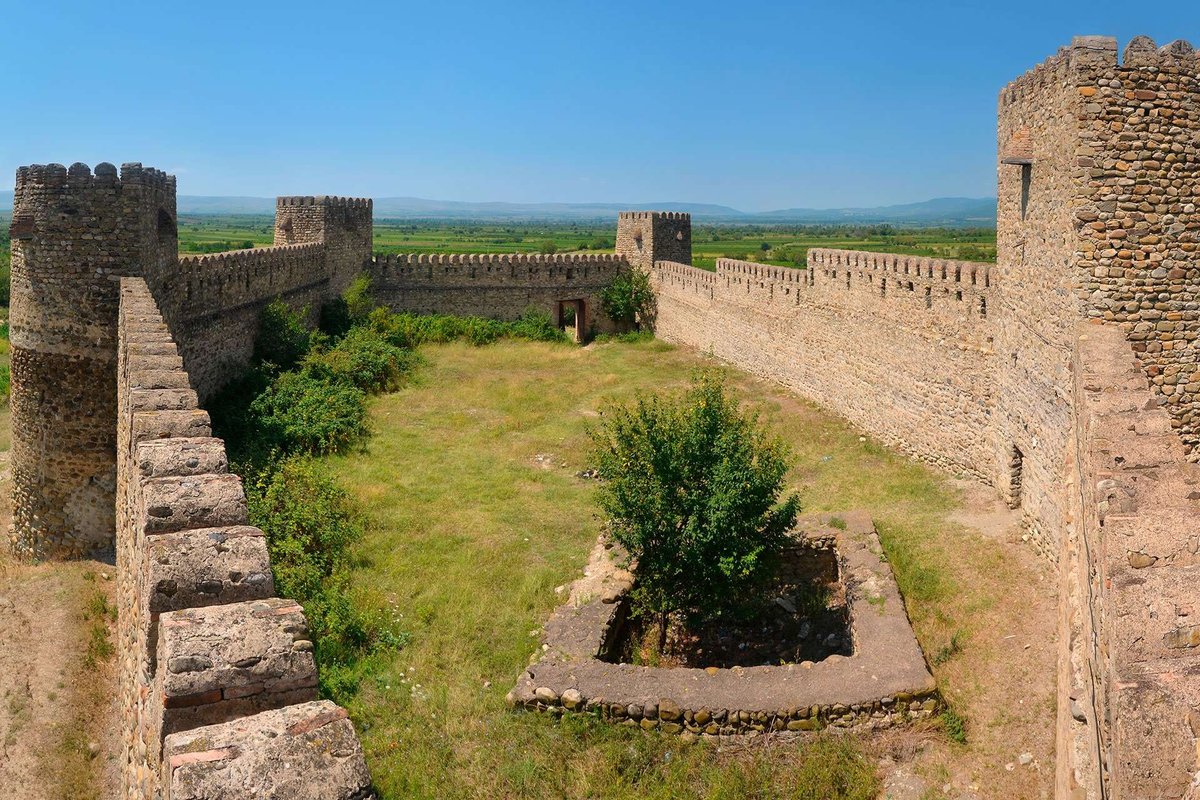
But it's not just the name that's intriguing. Judging by its architecture, the fortress was built in the Middle Ages, around the 16th century. Like most structures of that period, its primary purpose was defense. But for this location, this was especially important, as the entrance to the Iori Valley lay behind the fortress, and from there, the route to Tbilisi opened.
This fact explains why so many battles took place here. Incidentally, this place is significant for Georgians for another reason. Not far from the fortress, in 1801, the final battle for the newly independent Georgia took place. All this left its mark, and in the 20th century, the fortress suffered serious damage, resulting in the prison located here having to be rebuilt. Architecturally, the fortification is shaped like an asymmetrical five-pointed star. Each of the peaks is a tower with loopholes, located around the entire perimeter. For ease of combat, the wall is crowned with battlements.
Entering the fort, you notice that it clearly once housed a quadrangular building, the fate of which is unknown. This structure, which has endured so much throughout its history and still stands proudly above its surroundings, is worthy of inclusion on the list of "the most beautiful places in Georgia."

30 comments
Log in to leave a comment
Крепость Чаилури прям зацепила меня своим видом, надеюсь, вскоре у меня получится ее увидеть, съездить в это место.