


Churches and Temples of Batumi: A Guide to 30+ Sacred Sites Across Faiths
What to know before planning a route through the city’s churches, monasteries and religious communities.
30+ churches, cathedrals, monasteries, a synagogue and religious communities in and around Batumi.
The Cathedral of the Nativity of the Mother of God, St. Nicholas Church, Surb Prkich, the synagogue and Sameba.
The city centre is easy to explore on foot, while Sameba is best reached by taxi or car.
Entry is usually free; dress modestly, and take photos inside only when it is allowed.
Batumi is usually described through the sea, the boulevard, high-rise towers and Adjarian khachapuri. But the city has another layer — quieter, older and sometimes easy to miss. These are the churches of Batumi: Orthodox temples, an Armenian church, a Catholic basilica, a synagogue, monasteries and small communities that show Batumi not as a resort, but as a port city with a long memory.
If you search for “churches in Batumi”, you probably need three things: which church is the main one, what to see in the centre and where to go for a view. This guide brings together 30+ sacred and religious places: first the main churches, then time-based routes, then a wider list of Orthodox churches and places of different faiths.
For addresses, photos, reviews and current opening details, check the Batumi churches catalogue. Below, we explain where to start, how to choose a route and how not to turn a church walk into a tiring marathon.
Main churches in Batumi to see first
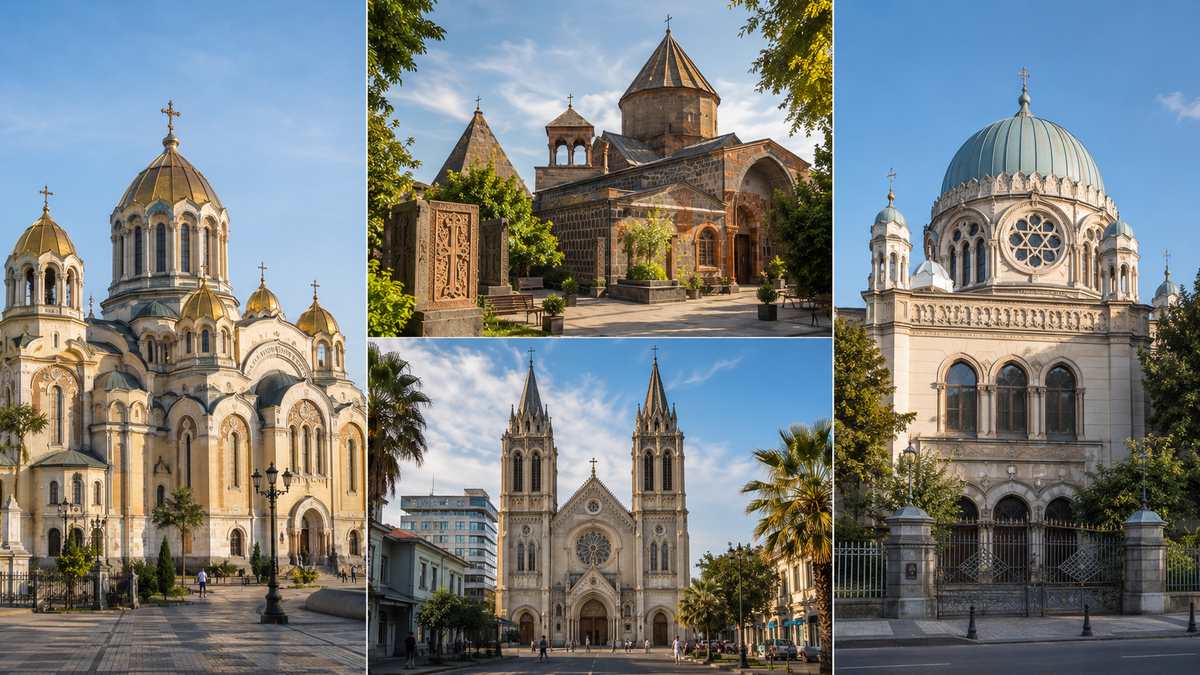
If you have little time, do not try to cover all 30+ places. For a first look at religious Batumi, six places are enough: the Holy Mother Virgin’s Nativity Cathedral, St. Nicholas Church, the Armenian Apostolic Church, the Holy Spirit Basilica, the Batumi Synagogue and the Holy Trinity Church on Sameba Mountain.
Together they give a good picture: Georgian Orthodoxy, the Greek community, Armenian history, Catholic heritage, the Jewish community and a monastery overlooking Batumi and the Black Sea. The route is not only religious; it is urban too. You walk through the centre, old quarters, port history and the mountain above the city.
If you have little time: 1 hour, 3 hours or half a day
Batumi has many churches, but a tourist route works better when planned by time. Otherwise it becomes a strange race: go in, glance at the façade, go out, run to the next one. That is not the best way to visit sacred places. Here, less is better — if you look properly.
1 hour in the centre. Start with the Nativity Cathedral and St. Nicholas Church. These are two different stories: a neo-Gothic cathedral with a Catholic past and an old Orthodox church connected with the Greek community. The walk between them is easy, with cafés, old streets and ordinary city life on the way.
2–3 hours. Add the Armenian Surb Prkich Church, the Batumi Synagogue and the Holy Spirit Basilica. This route already shows Batumi as a city of different communities. You do not need a taxi if you are ready to walk through the centre without rushing.
Half a day. After the central churches, go to Sameba Monastery. Closer to sunset is best: the mountain is quieter, the air feels lighter, and the view of the city and the sea gives the route a good ending. Sameba is easier by taxi or car; the Argo cable car gives a view over Batumi, but it does not go to the monastery.
With children. Choose central churches and short walking distances. Leave Sameba for another time unless the child is comfortable with the uphill drive and the return trip.
For photos. Shoot façades in the morning or toward evening, and Sameba at sunset. Do not take photos inside active churches without permission: this is not a museum hall, but a place of prayer.
Nativity Cathedral: the main church in the centre
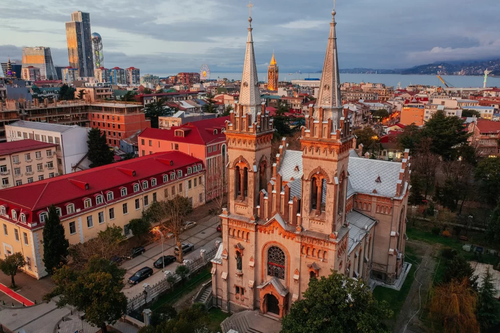
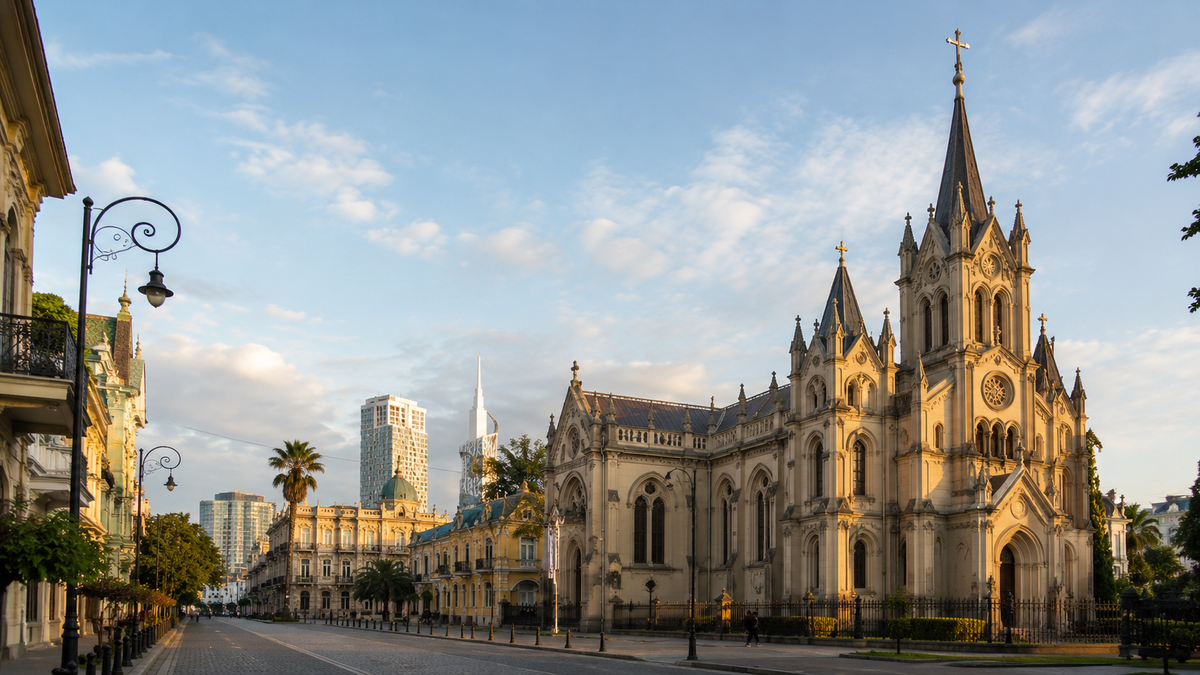
The Holy Mother Virgin’s Nativity Cathedral is Batumi’s most recognizable church. Many visitors take it for an old European cathedral, and there is a reason: the building was constructed in 1898–1903 as a Catholic church, funded by the Zubalashvili family. In 1989, it was consecrated as an Orthodox cathedral.
Outside, the neo-Gothic arches, towers and stained glass stand out immediately. Inside, the space feels calmer, and tourist curiosity quickly meets the reality of an active church: people pray, light candles and come for services. Enter quietly, avoid flash and do not turn the icons into a photo backdrop.
If this is your first time in Batumi, start here. The cathedral is central, and it is easy to continue to other churches, old streets and cafés nearby. This is one of those places where a single stop really helps you understand the city.
St. Nicholas Church: Batumi’s Greek trace
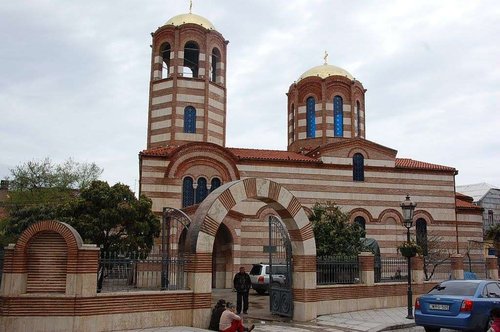
St. Nicholas Church is one of the city’s older Orthodox churches. Its history is connected with Batumi’s Greek community, and you can feel that even without a guide: the church does not stand like a new “attraction”, but like part of the old urban layer.
It has less exterior drama than the cathedral. You are less tempted to pull out a camera and hunt for angles. Instead, there is another feeling: a calm courtyard, the familiar rhythm of parish life, people who come not “to see” but for their own prayer.
If your time is limited, the pair “Nativity Cathedral + St. Nicholas” is the simplest church route in the centre. It is not tiring, but it gives a useful contrast.
Armenian Church of Surb Prkich
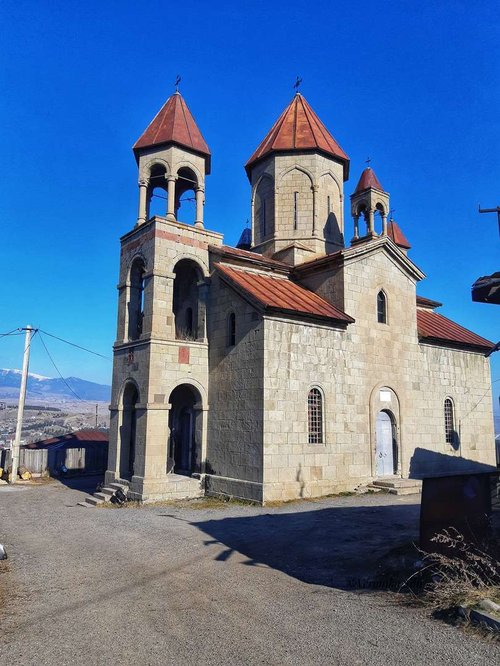
The Armenian Apostolic Church, or Surb Prkich, recalls Batumi’s Armenian community. It appeared in the late 19th century, when the port city was growing fast and receiving people of different languages, professions and faiths.
The church has a restrained façade without unnecessary noise. Against the tourist centre, it looks calm, almost reserved. That is a good thing: not everything in Batumi has to compete for attention.
Come here if you want to see more than Orthodox Batumi. The Armenian church adds an important layer to the route: the city was, and still is, a place where different communities live side by side.
Holy Spirit Basilica: Catholic Batumi
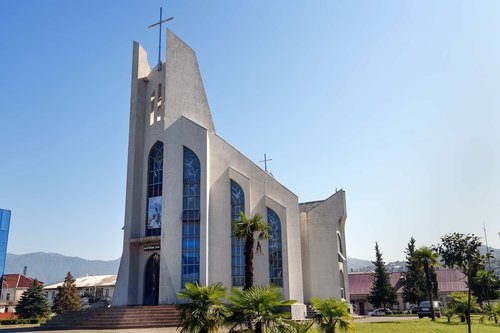
The Holy Spirit Basilica is Batumi’s active Catholic church. Architecturally, it differs clearly from the Orthodox churches in the centre: different shapes, a different rhythm, a different visual language. After the cathedral and St. Nicholas, the contrast is easy to notice.
Batumi’s Catholic community is linked to the history of the port, European merchants, craftsmen and families who lived here in the late 19th and early 20th centuries. So the basilica matters not only as a place of worship, but also as part of the city’s memory.
Check the Mass schedule before visiting. You can enter during a service, but behave like a guest: quietly, without moving around the hall and without taking photos.
Batumi Synagogue
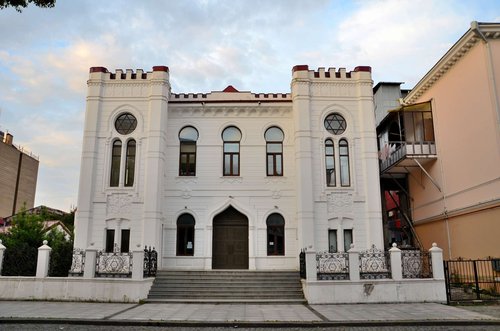
Batumi Synagogue was built in the early 20th century and remains an important address in the city’s Jewish history. It is easy to miss on a tourist route because it does not stand on the busiest walking line. But places like this often give the best context.
The synagogue shows Batumi as a city of communities, not only as a row of resort façades. Jewish history here is linked with trade, the port, families who lived in Adjara for generations, and the multilingual city that rarely fits into short guidebooks.
Before visiting, check the opening hours and conditions. Not every religious place operates as a tourist site with constant free entry.
Sameba Monastery above Batumi
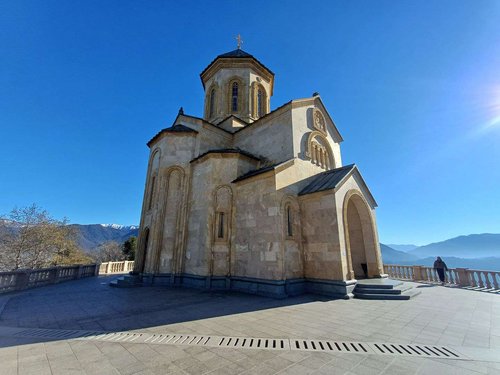
The Holy Trinity Church on Sameba Mountain and Tsminda Sameba Monastery stand on the mountain above Batumi. This is no longer a walk through the centre, but a separate trip. The reward is clear: silence, a light stone church, fresh air after the city noise and a view of Batumi, the sea, the port and the high-rise skyline.
Sameba works well as the final stop of the route. It is beautiful during the day, but closer to sunset the place becomes stronger: the city below softens, the sea darkens, and Batumi suddenly seems less restless. Even if you are not religious, the pause up there feels almost necessary.
Go by taxi or car. Walking from the centre is not a pleasant sightseeing route, and the Argo cable car goes to another viewpoint, not to the monastery.
Orthodox churches and monasteries in Batumi
Most sacred places in the city are Orthodox. Some are in the centre and fit easily into a walking route, while others are better planned separately: churches on the outskirts, monasteries and parishes where tourists rarely arrive by accident.
If you want to go beyond the main six places, start with this selection. It brings together Orthodox churches and monasteries in Batumi where you can check addresses, photos, reviews and visiting details in the linked cards.
Churches of different faiths
Batumi is not interesting only because of its Orthodox churches. Its religious map formed like the map of a port city: Greeks, Armenians, Jews, Catholic Europeans, merchants, craftsmen and families from different regions all came here. That is why, in one central walk, you can move from an Orthodox cathedral to an Armenian church, then to a Catholic basilica and a synagogue.
A tourist does not need to include all these places in the first route. But they matter for understanding Batumi: the city does not live by one faith or one historical layer. In some places, looking at the façade is enough. In others, you should check visiting conditions in advance. And in some cases, it is better to come only by invitation or during an open event.
Why Batumi has so many different sacred places
Batumi’s multi-faith character is not accidental. In 1878, the city became a free port, and merchants, craftsmen, sailors, officials and families from different regions came here. Greeks, Armenians, Jews, Catholic Europeans and Georgian Orthodox communities all left their mark on the urban fabric.
That is why a church route through Batumi does not feel like a list of “another church, another church”. Every place has its own layer. The Nativity Cathedral recalls the building’s Catholic past. St. Nicholas points to the Greek community. Surb Prkich opens Armenian Batumi. The synagogue brings in the Jewish history of the port. Sameba connects the city with the mountain and the Orthodox tradition.
If you look carefully, Batumi becomes more complex. That is a good thing. The resort image gets old quickly, but a city where different languages, rituals and family histories stand behind the façades holds your attention longer.
How to visit churches in Batumi: dress, photos and services
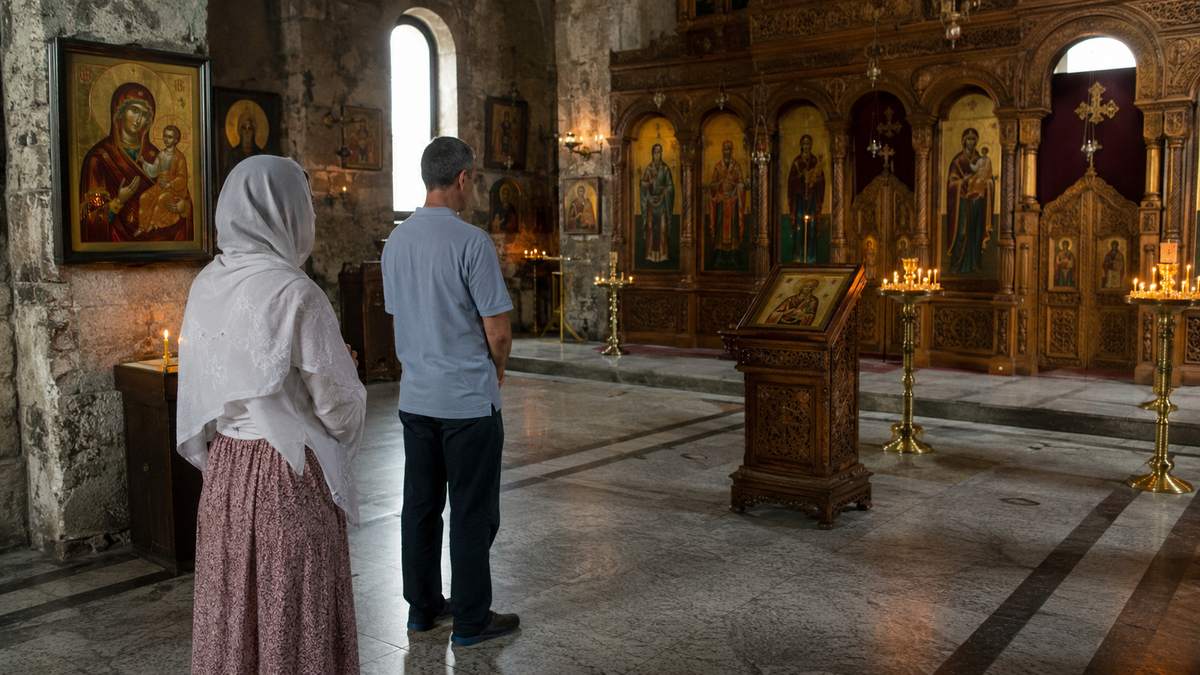
Entry to active churches is usually free, and donations are voluntary. But “free entry” does not mean “tourist mode”. A service, confession, baptism, holiday preparation or private prayer may be taking place. Sometimes it is better simply to stand near the entrance and not disturb anyone.
In Orthodox churches, cover your shoulders and knees. Women often need a headscarf; men should remove hats. In the Armenian church, the rules are similar: modest clothing, calm behaviour and respect for the service. In a Catholic church, avoid walking around during Mass. In the synagogue and other communities, check visiting conditions in advance.
Photography inside is the delicate part. Outside, taking photos is usually fine if you do not disturb people. Inside, ask permission or at least look for signs. Always turn off the flash. It rarely improves the photo, but it annoys almost everyone.
A one-day church route in Batumi
Start in the morning with the Holy Mother Virgin’s Nativity Cathedral. The centre is calmer in the morning, and the façade looks good in soft light. After the cathedral, walk to St. Nicholas Church: it is a short walk, and the contrast between the two churches is clear.
Next, add Armenian Surb Prkich, Batumi Synagogue and the Holy Spirit Basilica. Do not try to stay long everywhere. In some places, the façade and courtyard are enough; in others, you may want to linger. A good rhythm is 15–25 minutes for the main places and short pauses between them.
Do not pack the church route too tightly before lunch. Take a break: café, water, a walk, a bit of ordinary Batumi. After that, the trip to Sameba feels less like “one more stop” and more like the ending of the day.
Go to Sameba closer to sunset. If the weather is clear, you will see Batumi, the sea, the port and the surrounding mountains. It is a good moment to piece the whole route together: in the morning, a port city of many communities; in the evening, a monastery above it.
The route also fits well into a broader day of sightseeing: after the central churches, you can continue to old streets, cafés and the boulevard. For a full city plan, use the guide what to see in Batumi in one day.
Which churches to choose by interest
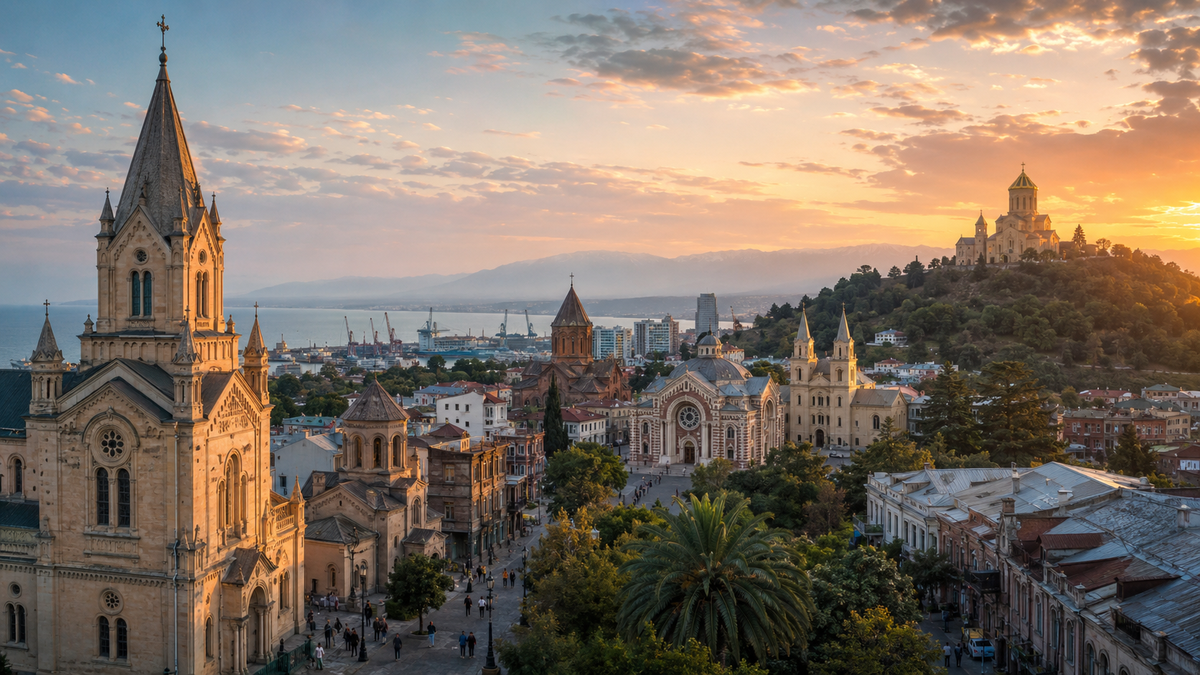
If architecture matters to you, start with the cathedral and the Holy Spirit Basilica. There, the difference in form is most visible: neo-Gothic, modern Catholic architecture and the surrounding city fabric.
If you are interested in community history, go to St. Nicholas, Surb Prkich and the synagogue. These are not the loudest tourist places, but they explain better why Batumi cannot be reduced to the beach and new apartment towers.
If you need quiet, choose Sameba or smaller churches away from the very centre. Central sacred places can be busy, especially in summer and on weekends.
If you travel with children, do not make the route too long. Two or three churches in the centre and a walk toward the sea are better than trying to see everything in one day.
Nativity Cathedral, Holy Spirit Basilica, Surb Prkich.
St. Nicholas, the synagogue, the Armenian church.
Sameba Monastery closer to sunset.
Central churches without long transfers or uphill trips.
What to see near the churches
The advantage of Batumi is that a church route easily blends with an ordinary walk. After the cathedral, you can move into old streets and cafés. After St. Nicholas, walk toward the square, the port or the boulevard. After the Holy Spirit Basilica, continue through less touristy streets and see the city without the postcard filter.
If you are going to Sameba, allow time not only for the church but also for the road. Views of the city open on the way, and sometimes you will want to stop. The taxi driver may not share your enthusiasm, but asking for a short stop is fair enough.
Central churches fit well into the route “old Batumi + boulevard”. Sameba works better as the evening part of the day: after the monastery, you can return to the city for dinner without wanting to rush anywhere else.
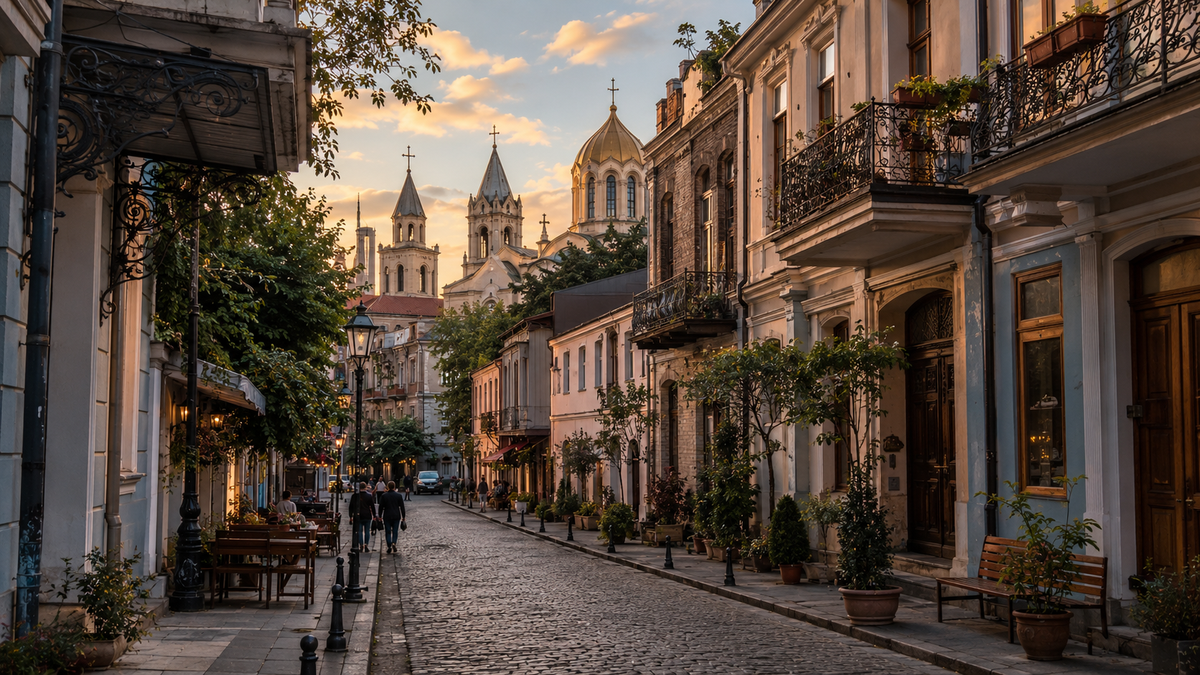
The churches of Batumi are not a list of places to enter for five minutes. They are a map of a city shaped by the port, trade, migration, faith and family histories. In one route, an Orthodox cathedral, an Armenian church, a Catholic basilica, a synagogue and a monastery on the mountain all sit naturally side by side.
For a first visit, start with the six main places. For a deeper route, open the Batumi churches catalogue and choose sacred places by area, faith, time or interest. The best version is not trying to see everything, but choosing a few places and giving them time.
Batumi becomes quieter on walks like this. Fewer signs, less beach noise, more stone, courtyards, candles, old communities and short pauses. Sometimes that is exactly how the city starts to stay with you.
❓ Frequently asked questions
The main church in the centre is usually considered the Holy Mother Virgin’s Nativity Cathedral. It is a recognizable neo-Gothic building, originally built as a Catholic church and later consecrated as an Orthodox cathedral.
In the centre, it is convenient to see the Nativity Cathedral, St. Nicholas Church, Armenian Surb Prkich, Batumi Synagogue and the Holy Spirit Basilica. They fit well into a 2–3 hour walking route.
Yes, tourists can usually enter active churches unless there is a closed event or restricted service. Inside, behave quietly, do not disturb worshippers and do not take photos without permission.
Women should ideally have a headscarf and modest clothing in Orthodox churches. Men should remove hats. Some churches may have scarves near the entrance, but bringing your own is safer.
The easiest way to reach Sameba is by taxi or car. The monastery is on a mountain above the city, so walking from the centre is inconvenient. The Argo cable car goes to another viewpoint, not to the monastery.
Start with the Nativity Cathedral, St. Nicholas Church, Surb Prkich, the synagogue and the Holy Spirit Basilica. If you still have time and energy, finish the day with Sameba Monastery.
Yes, Batumi has the Holy Spirit Basilica. It is an active Catholic church with architecture that differs clearly from the city’s Orthodox churches.
Yes, Batumi Synagogue is in the city and is connected with the history of the Jewish community. Check opening hours and visiting conditions before going.
With children, choose central churches: the Nativity Cathedral, St. Nicholas and Surb Prkich. Walking distances are short, and afterward you can go to the boulevard or a café.
The full list is easiest to check in the Batumi churches catalogue: it has cards for churches and religious places with addresses, photos, reviews and useful visit details.
Information about opening hours, visit rules and accessibility of churches is current at the time of publication. Before visiting, check service schedules, photography rules and entry conditions in the church cards or on official community pages.

5 comments
Log in to leave a comment
რა მიკვირსო, მაგრამ მიხარია, რომ ასეთი ყურადღება მიექცევა ამ ლამაზ ქალაქს, მაგრამ ალბათ თქვენ გაქვთ მეტი ინფორმაცია, როგორ შევიტანო იმ ქალაქში ეს ეკლესიები მოწყობილი ტურების პროგრამაში?