




📄 How to Translate Documents Into Georgian and Get an Apostille
📄 What an apostille is and when you need one in Georgia
An apostille is an international stamp confirming a signature and seal on a document are genuine, so another country will recognise it. Georgia joined the Hague Convention in 2006, so an apostille here replaces the much slower consular legalisation process for most destinations.

Apostilles and translations almost always come as a pair, and that's exactly where the confusion starts: people don't realise there's a set order to it. Some try to get a document apostilled before it's translated, others translate first and then go looking for where to take that translation. Getting it wrong costs days, sometimes weeks of waiting.
Here's where to go for an apostille, who's actually allowed to translate documents into Georgian, and what it all costs.
🏛️ Where to get an apostille on a Georgian document
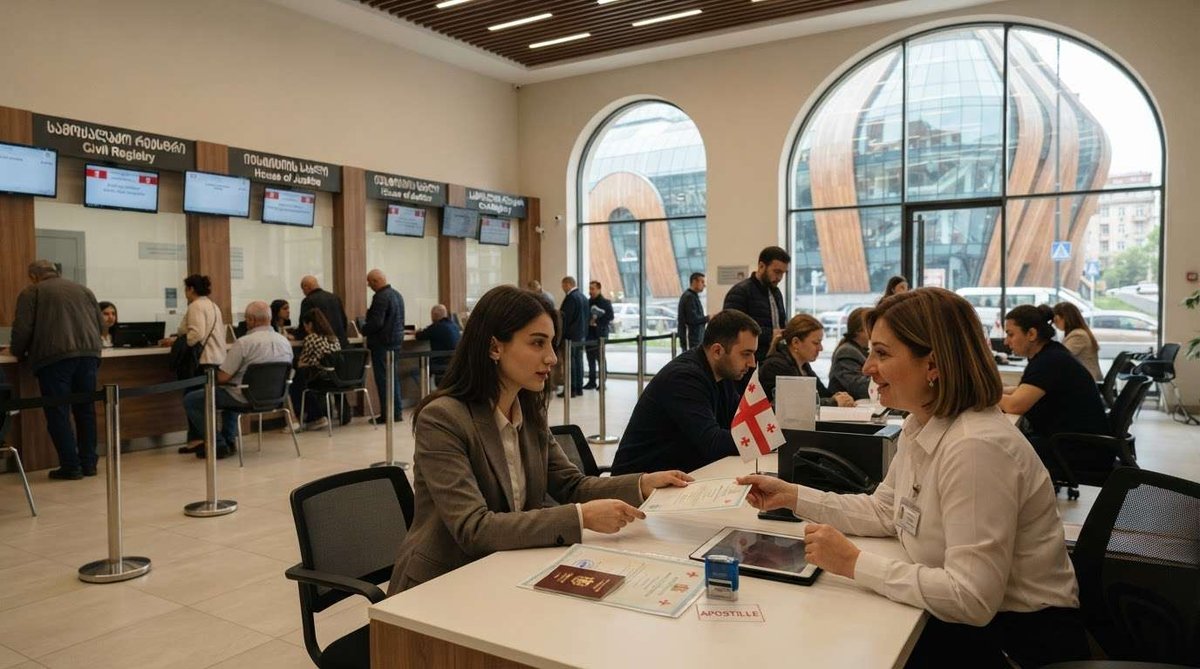
The first thing worth figuring out, so you don't lose a day at the wrong office: which agency handles it depends entirely on the type of document, and they aren't interchangeable.
If you have a notarial document, a birth certificate, or a marriage certificate, you're headed to the House of Justice, specifically its Civil Registry Agency. That's the most common case for anyone already living in Georgia, and it's probably where you'll end up too.
Diplomas and school certificates work differently: the Ministry of Education handles those, not the House of Justice, and this is where people most often get it wrong. A diploma and its transcript get apostilled with two separate stamps. Georgian school certificates are issued without a transcript, so if you need to show grades in individual subjects, you'll have to request that separately.
Court documents get legalised through the Supreme Court, though that's the case you'll run into least often.
A criminal record certificate is more complicated. Sources disagree here: some point to the House of Justice, others to the Ministry of Internal Affairs and its e-Apostille system. Based on how the Ministry handles it in practice, the certificate is issued in Georgian, translated by the agency's own certified translator, and then either the whole package gets apostilled together, or the original and translation separately. The exact process can vary depending on which country the certificate is headed to, so it's worth calling ahead to confirm the current procedure before you go.
We've covered the House of Justice and what it does in more detail separately.
⏱️ How long does getting an apostille take in Georgia

Here, timing is directly tied to money, and once you see how, it's actually convenient.
The system is built so that you can essentially buy speed: the shorter the timeline, the higher the government fee. Overall, an apostille takes anywhere from one day to twenty, and you choose where on that scale you land. We won't quote exact figures in lari, since they change, so confirm them in person or on the agency's site before you go.
One detail people often miss: the application doesn't have to come from the document's owner; a third party can file it too, though sometimes that needs a power of attorney. If you're getting an apostille on someone else's document, bring that authorisation with you the first time, so you're not making a second trip.
What you'll need to bring is short: the document itself, ID for the applicant, and proof the fee's been paid. It's a short list, but missing even one item means the application won't be accepted.
🔤 How to get a notarised document translation into Georgian
This is probably the single most common practical question of all, and Georgia has its own rule here that catches a lot of newcomers off guard.

Translations are only accepted from certified translators on the Justice Ministry's official list, full stop. Not from any translation agency, however good it is, however many glowing reviews it has. If the translator isn't on that list, the House of Justice or a notary will simply turn the document away, and you lose both the time and the money on a translation you now have to redo from scratch.
For pricing, a rough guide: translation itself typically starts around 10 GEL a page, depending on the language and who's doing it, and notarising the translation is a separate line item, from 2 GEL a page. These figures come from open sources, not a price list, so confirm current numbers with whichever agency you use.
The easiest way to find a translator on the list is through a translation agency; they already work with certified specialists and know the requirements from practice better than any article can tell you. Our directory has translation agencies in Tbilisi, Batumi and Kutaisi.
And one more detail worth remembering: translating from Georgian into Russian and from Russian into Georgian are technically two separate services. If you'll need documents in both directions, ask about both up front rather than sorting it out piecemeal.
More on how the process works at a notary's office, including fees for certifying powers of attorney and other documents, is in our separate piece on notaries in Georgia.
🎓 Getting a diploma apostilled and having your education recognised

A different story for anyone planning to work or study in their field, whether in Georgia or elsewhere.
An apostille on the diploma itself and an apostille on the transcript are two separate stamps, both handled by the Ministry of Education, but as separate procedures. That part's straightforward enough. The trickier bit is that an apostille only confirms the document is genuine; it doesn't automatically mean another country recognises your education.
Full recognition often requires a separate process, nostrification, and that's really a question specific to the country and field in question. Sometimes it's not needed at all, if there's a mutual recognition agreement between the two countries, but that's worth checking against your own situation rather than a general article online.
If a diploma is something you'll need for work in Georgia, we've covered that in working in Georgia as a foreigner.
Before you head anywhere, call ahead and confirm three things: which agency handles your specific document, what documents you'll need for your particular case, and what the turnaround you want will cost. Requirements for certain documents, criminal record certificates especially, vary between sources, and one phone call saves you a trip to the wrong office.
And order a few copies of the finished package at once. An apostilled, translated document often gets needed more than once, for a bank, an employer, a residency application. Order the translation in two or three copies up front; it's cheaper than going back to the translator a month later for one more.
Gotten an apostille or had documents translated in Georgia? Leave a review on Madloba: tell us which document, which agency, and how much time and money it actually took. Real timelines are worth more than official figures, which often don't match practice.
Information is current as of September 2026 and is provided for general guidance. Agencies, timelines and apostille fees change from time to time, and requirements for certain documents, criminal record certificates in particular, vary across open sources. Confirm current requirements with the specific agency or your translator before your visit.
❓Frequently Asked Questions
💬 It depends on the document type. Notarial documents, birth and marriage certificates go through the House of Justice. Diplomas and school certificates go through the Ministry of Education. Court documents go through the Supreme Court. Sources disagree on criminal record certificates, so confirm the current process locally.
💬 No. A Georgian document can only be apostilled inside Georgia; embassies and consulates don't offer this service. It's a common reason plans fall through for people expecting to handle everything from home.
💬 Anywhere from one to twenty working days, and the timeline is directly tied to the government fee: the faster you need it, the higher the fee. Confirm exact amounts locally before your visit, since they change periodically.
💬 Only certified translators on the Georgian Justice Ministry's official list. A translation from any other agency won't be accepted for official submission, not at the House of Justice, not by a notary.
💬 Translation typically starts around 10 GEL a page, depending on the language and translator. Notarising the translation is separate, from 2 GEL a page. These are guides from open sources; confirm exact pricing with a specific agency.
💬 Apostille first, translation second. If a document is foreign and needed in Georgia, the apostille goes on in the issuing country, and the translation and its certification happen here. A translation done before the apostille often needs redoing.
💬 Through the Ministry of Education, with separate stamps for the diploma itself and the transcript. An apostille confirms the document is genuine but doesn't replace recognition of your education; that can require a separate process called nostrification.
💬 Yes, a third party not named in the document can file the application, though sometimes that requires a power of attorney. Confirm in advance whether you'll need one for your specific case, so you're not making the trip twice.

0 comments
Log in to leave a comment