



Can You Drink Tap Water in Georgia?
Can you drink tap water? The essentials
In Tbilisi, GWP supplies drinking water to the city’s network. That does not mean every tap in Georgia is suitable for drinking in every situation. In Batumi, Kutaisi, Kobuleti and elsewhere, check your supplier, notices about maintenance and the water system in your building.
If there is a water-quality warning, the water has changed noticeably after an incident, or its source is unknown, use bottled drinking water for drinking and cooking until the situation is clear. Follow the specific terms of any official restriction: boiling is not suitable for every type of contamination.
| Where you are staying | Where to start | What to check for your address |
|---|---|---|
| Tbilisi | Georgian Water and Power, GWP | Any works or restrictions; who to contact if the water changes |
| Batumi | Batumi Water | Which notice applies to your street; whether the building is on this network |
| Kutaisi | United Water Supply Company of Georgia, UWSC | Works affecting your address, restoration time and any instructions afterwards |
| Kobuleti | Kobuleti Water (ქობულეთის წყალი) | Who serves your building; whether it is the city network or another system |
| A resort, village or guesthouse | The supplier named on the bill, or your accommodation manager | Whether the source is a network, well, spring or tank, and whether test results are available |
Reference pages and contacts were checked on 20 October 2026. Read current notices again before using the water. Start with GWP, UWSC and GNERC’s register of suppliers.
What to check before using the water
- Identify the water source and supplier for your address.
- Find a notice for the relevant date and street.
- Follow the supplier’s specific instructions.
- After work is completed, check whether restrictions have been lifted.
If the source is unknown or the water changes, use water confirmed as suitable for drinking while the situation is being checked, and contact whoever is responsible for the system.
Check the water at your address in four steps
Step 1. Identify the supplier and water source
Look at the company name on a bill or ask your accommodation host. Find out whether the water comes directly from the city network, passes through a shared storage tank, and who maintains the building’s internal system. At a guesthouse, ask specifically whether the water comes from a well or spring.
To check a supplier’s name and phone number, open GNERC’s register of water supply companies. On the Georgian-language page, use your browser’s find function to search for one of the names below.
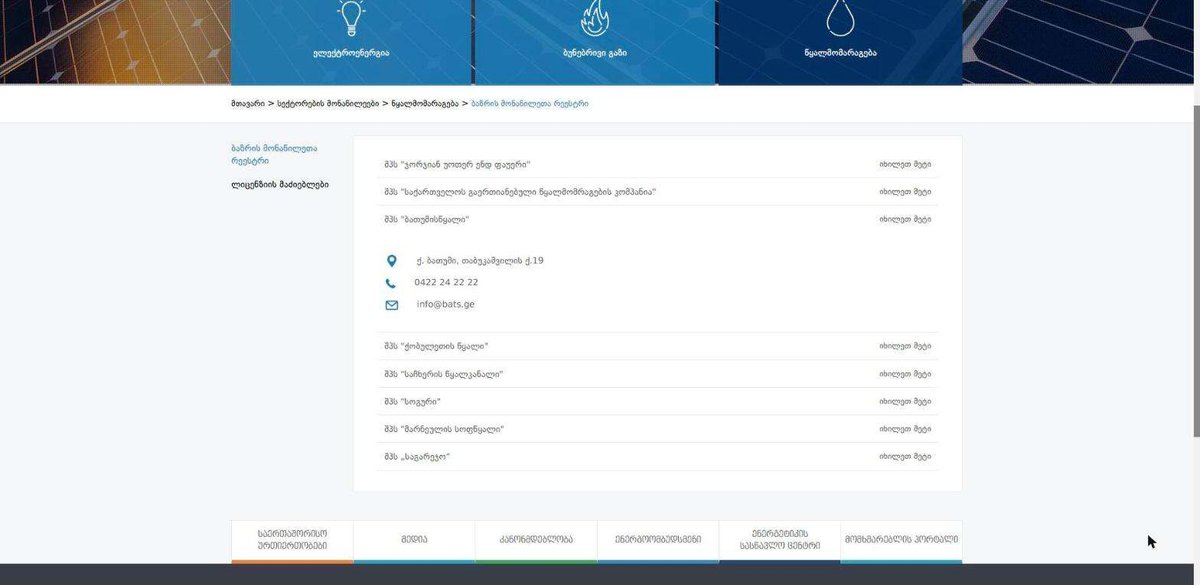
Where to check your water supplier. GNERC. Screenshot taken on 21.10.2026.
| Company | Name to search for in Georgian | Contact in the official register |
|---|---|---|
| GWP | ჯორჯიან უოთერ ენდ ფაუერი | 2 93 11 11; from abroad: +995 32 293 11 11 |
| UWSC | საქართველოს გაერთიანებული წყალმომარაგების კომპანია | +995 32 293 00 00, also listed at water.gov.ge |
| Batumi Water | ბათუმისწყალი | 0422 24 22 22; from abroad: +995 422 24 22 22 |
| Kobuleti Water | ქობულეთის წყალი | 0426 26 20 52; from abroad: +995 426 26 20 52 |
Step 2. Find a notice for your street
For Kutaisi and other UWSC service areas, open the planned and unplanned works page. The field “ძიება დასახელებით” lets you search by name. For Kutaisi, enter ქუთაისი, select the relevant period and click “ძიება” (“Search”). Check the date, street and building numbers.
In the result, look at the supply interruption and restoration times, then read the full list of addresses. “სრულად” opens the details. If you cannot find a relevant notice, try another period or clear the filter using “გასუფთავება”. The absence of a notice does not, by itself, confirm water quality.
For Tbilisi, start with “SUPPLY INTERRUPTIONS” and “PRELIMINARY PLANNED WORKS” on GWP’s page. For Batumi and Kobuleti, ask your water company about current notices using its official contact details. Batumi City Hall and Kobuleti Municipality can help you check which organisation serves the city.
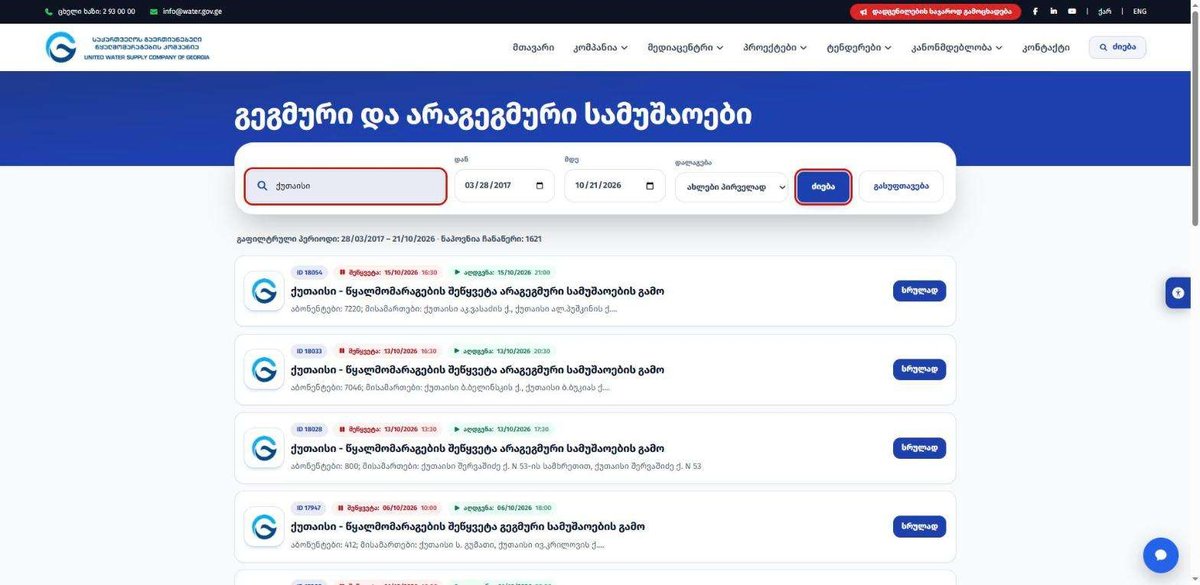
How to search for works by city and date. UWSC. Screenshot taken on 21.10.2026.
Step 3. Report any change in the water, giving your exact address
If the water has an unusual colour, contains particles or suddenly smells different, do not taste it to check. Until the situation is clear, use another source confirmed as suitable for drinking and contact the supplier. Ask whether the problem affects the main network or your building.
Example enquiry: “Hello. At [street, building], the water changed colour after the supply was restored at [time]. Is there a restriction on drinking or cooking with it? Does the water at this address need testing? When and where will a notice lifting the restriction be published?” Replace the brackets with your own details.
Ask your host or building manager whether work has been carried out inside the building and whether a storage tank is used. A photograph can help describe the problem, but it cannot replace laboratory testing.
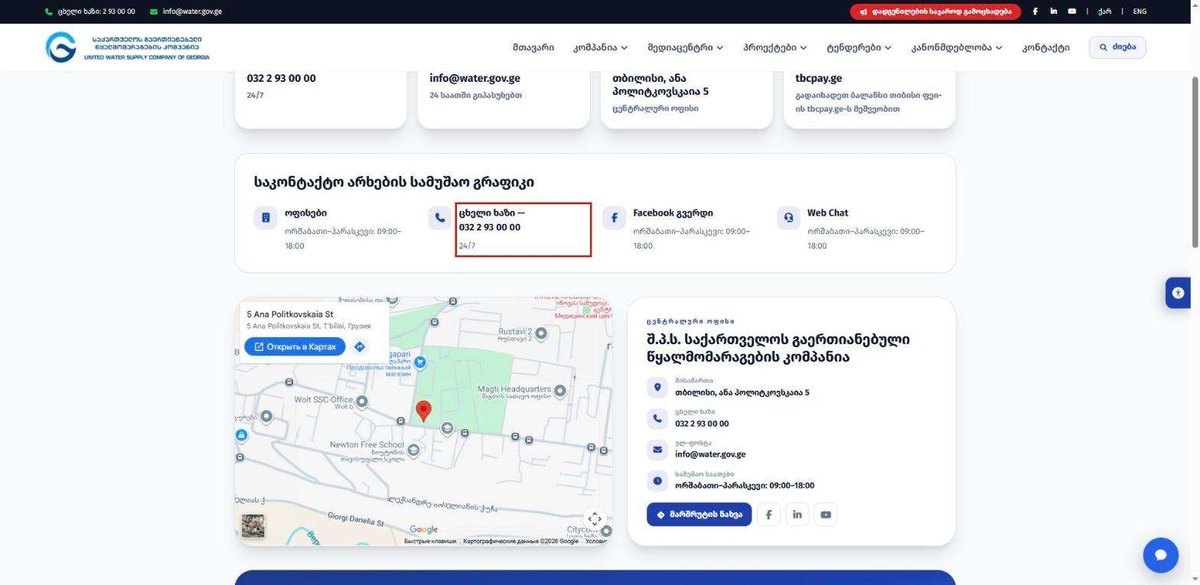
Official contact for an enquiry. Screenshot taken on 21.10.2026.
Step 4. Check what is permitted after work is completed
The time the supply is restored and permission to drink the water answer different questions. Following an incident, ask your supplier about any separate instructions, such as flushing the system, a temporary restriction or a requirement to boil the water. Do not choose a universal flushing time based on advice in a chat.
If a restriction has been announced, read it in full. The CDC explains the difference between a boil water advisory, a do not drink advisory and a do not use advisory. This is general guidance on responding to warnings. Your local supplier or the responsible authority provides the specific instructions for your address.
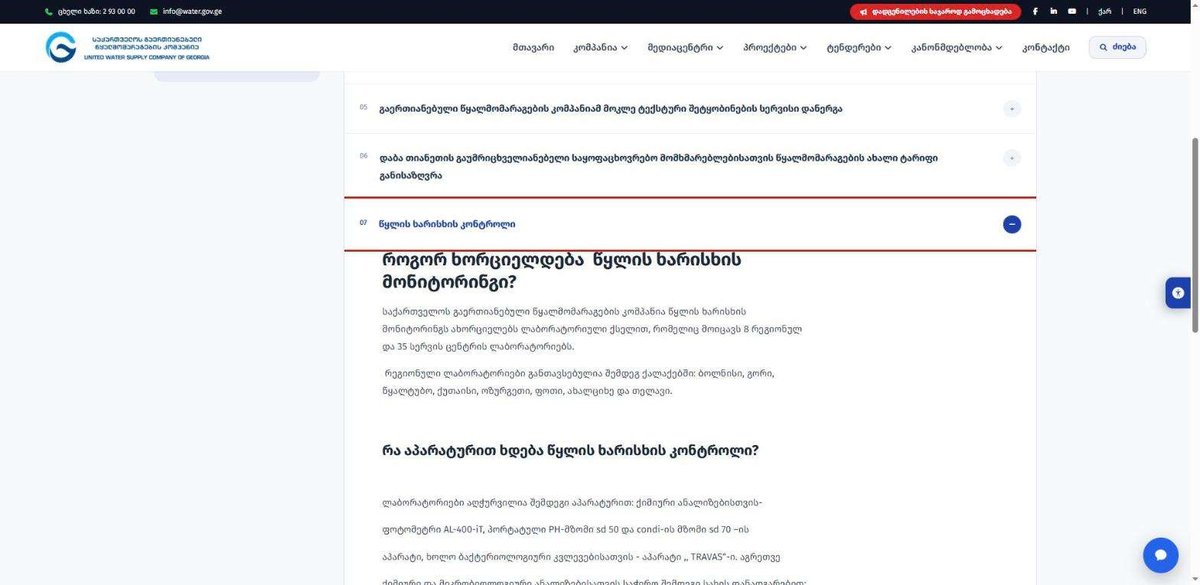
Where to find information about water quality. UWSC. Screenshot taken on 21.10.2026.
Tbilisi: what to check with GWP
GWP describes Tbilisi’s drinking water supply and laboratory monitoring. Use the official contact details and GNERC register for enquiries. GWP’s phone number is +995 32 293 11 11. Before visiting a service centre, check its current address and opening hours.
First look for notices affecting your area, then ask about the system inside your building. If unusual water appears only in your flat, tell both the supplier and the building manager. The aim is to locate the problem, rather than assume an answer from the district’s name.
Batumi: a notice for one area does not describe the whole city
GNERC’s register lists 0422 24 22 22 for Batumi Water. Batumi City Hall has a section for municipal organisations. Give the exact street and building when you contact the supplier: a notice about an interruption in one part of the city does not describe every network.
If the building has a storage tank, ask your host how it is maintained and whether water passed through it during the interruption. General information about the city system cannot replace checking the arrangements in your building.
Kutaisi: check the UWSC notice by date and street
UWSC publishes notices for Kutaisi. On the works page, search for ქუთაისი, then your street and date. The company lists the hotline +995 32 293 00 00. This is a different number from GWP’s.
Read the list of affected addresses in the notice, as well as the city name. If the restoration time has changed or the notice does not answer your question about water quality, ask the operator for more information.
Kobuleti and resorts: identify your network first
Kobuleti Municipality describes the city water company, Kobuleti Water, and GNERC’s register lists its contact as 0426 26 20 52. Do not automatically follow this route for accommodation outside the city network. Ask your host who is responsible for the water.
In a village, mountain house or resort, ask about the source and whether the water has been tested. Cool, clear water from a pipe, spring or well is not necessarily drinking water because of its appearance or origin. If its quality has not been confirmed, choose another drinking water source.
Boiling, filters and bottled water
| Situation | What to do | What is not a guarantee |
|---|---|---|
| The supplier issues a boil water advisory | Follow the timing and method in the current advisory, or use bottled drinking water | An ordinary filter does not cancel a boil water advisory |
| A do not drink advisory is issued | Use bottled drinking water for drinking and cooking, and follow the other instructions | Boiling does not remove harmful chemical contamination |
| A do not use advisory is issued | Follow the full ban and the authority’s instructions | Do not reduce it to a ban on drinking alone |
| The source is unknown or the water suddenly changes | Check the quality and temporarily use water confirmed as suitable for drinking | Taste, clarity, settling or a household filter cannot, on their own, confirm safety |
| Buying water in a shop | Choose water labelled for drinking; check the packaging, expiry date and storage conditions | A mineral water brand name does not make the water a medicine |
The CDC’s emergency guidance explains the general restrictions used during incidents. The right household filter depends on what needs to be removed and how the device is maintained. A filter jug or under-sink filter does not replace information about contamination or override an official advisory.
Springs, fountains and mineral water
Drinking fountains, decorative fountains and natural springs require different checks. Look for a drinking-water sign and current information from the organisation responsible. UWSC also warns that untested natural water needs disinfection. If you do not know what the water contains, do not choose a treatment method at random.


Other people collecting water is not evidence that it is safe. Without clear signage and information about quality, use water confirmed as suitable for drinking.


Read about brands and taste in our guide to mineral water in Georgia. The label and composition of the bottle you are buying matter more than a general description of its brand. This guide makes no claims that water has therapeutic effects.
What to ask when you check in
“Who supplies water to this building? Are there any restrictions now? Does it come directly from the network or through a tank? Who maintains the tank and internal pipes? Where can I find notices? Who should I tell if the water changes after an interruption?”
Keep the answers with your accommodation address. If you cannot establish the water source and condition when you arrive, buy a supply of bottled drinking water while you check.
Before using the water: a checklist
| Check | What you need to know |
|---|---|
| Supplier | The company name or who is responsible for the local system |
| Address | You have checked the street and building, rather than just the city |
| Date | You have read a current notice, rather than an old post |
| Restriction | Whether it concerns drinking, boiling or all water use |
| Building | Whether there is a tank and whether recent internal work has been carried out |
| Enquiry | You have saved the official contact and, if submitted, your case reference |
| Temporary alternative | You have water confirmed as suitable for drinking while the situation is being checked |
Frequently asked questions
GWP supplies drinking water to the city network. Check current notices for your address and the system in your building. If there is a warning or an unusual change in the water, ask the supplier for information first.
Check Batumi Water’s notices and the internal system in your particular building. The city name alone cannot confirm the quality of water at your tap.
UWSC, on +995 32 293 00 00. At water.gov.ge/planned-works, search for ქუთაისი, the date and your street.
Official sources list Kobuleti Water for the city network. For another settlement or a local system, ask your host which organisation is responsible.
Check the supplier’s instructions following the work. Restoring the supply does not, by itself, mean a water-quality restriction has been lifted.
Not always. Boiling is used against microorganisms, but it does not remove harmful chemical contamination. Follow the specific advisory.
That depends on the contamination and the filter’s specifications. A filter does not override an official boil water advisory or a ban on using the water.
Chlorine is used to disinfect water, as the CDC explains. Smell alone cannot determine water quality. Report any sudden change to the supplier.
No. Appearance cannot replace information about quality, and a lack of visible changes does not cancel an advisory.
During a restriction, treat cooking and ice-making in the same way as drinking. Read the supplier’s notice for the specific permissions.
Do not assume an untested source is safe because of its location or clear water. You need information about its quality. If that is unavailable, choose water confirmed as suitable for drinking.
Give the street, building number, when the problem began, what changed and whether it followed an interruption, if you know. Ask for your enquiry to be registered.
For a temporary alternative, look for bottled water intended for drinking. Check the composition and intended use on the individual bottle’s label.
Ask about its source, who is responsible for the system, whether there is a tank and whether test results are available. If the quality is unknown, use water confirmed as suitable for drinking.

Read also

Imeretian Khachapuri: History and Recipe Features
🥘 Peculiarities and nuances of cooking khachapuri from Imereti. How are khachapuri prepared and with what is served in the Western region of Georgia?

Georgian Cuisine: A Guide to National Dishesne
🥘 An article on madloba tells about the most delicious dishes of Georgian cuisine that are worth trying first.

Types of Khachapuri: A Complete Guide to Georgian Cheese Breads
🥘 Khachapuri is the most famous dish of Georgia. Madloba provides complete information about all its types and the history of "cottage cheese bread".
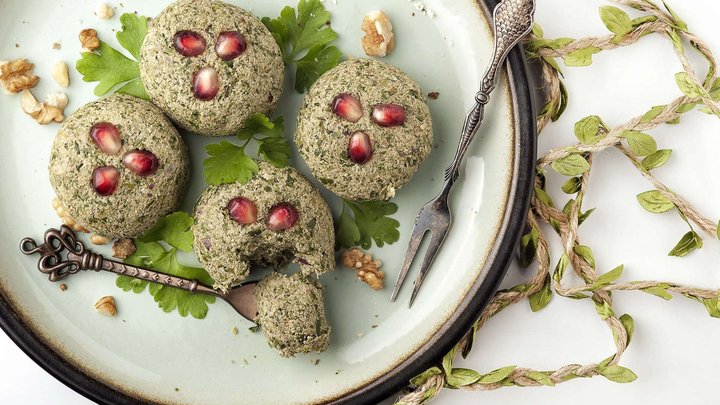
Pkhali: What It Is, Ingredients and Types of Georgian Dish
🥘 The most delicious dishes of Georgia are prepared not only from meat of animals or birds. One of the most popular Georgian dishes is phali, vegetarian.
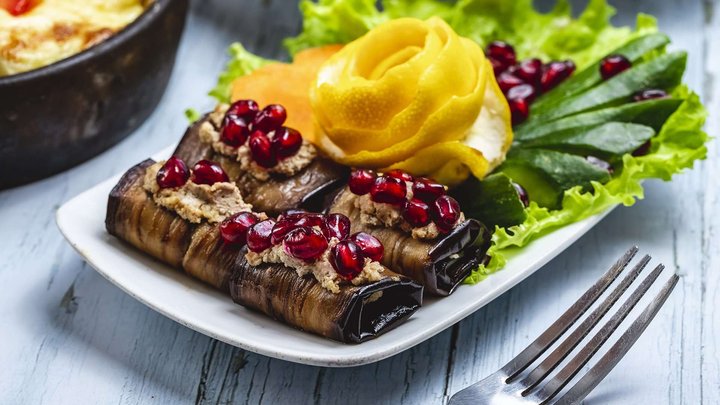
Badrijani: Georgian Eggplant Rolls with Walnuts
🥘 Eggplant and nut roll - badrijani is one of the most popular dishes of Georgia. It belongs to the category of vegetarian, badrijani is added to meat dishes.

Georgian Cuisine: What Is the Madloba Dish and More
🥘 Georgian cuisine is on a par with historical and architectural monuments of culture and the unique beauty of nature.
46 comments
Log in to leave a comment
Автор отлично показывает, что вода здесь — это не просто напиток, а часть природного богатства страны: от горных родников до минеральных источников Боржомского региона, которые местные считают настоящей целебной живой водой и используют её и для питья, и для здоровья.
Я особенно запомнила тот момент, когда после похода в регионе Тушети впервые попробовала родниковую воду прямо из природы — она была такой свежей и мягкой, что с тех пор я всегда ищу источники на маршрутах.
Очень полезны советы от местных — где искать безопасные источники, на что обращать внимание и почему вода из глубоких карстовых выходов считается особенно насыщенной минералами.
Отзывы других путешественников тоже вдохновляют: кто‑то вспоминает вкус воды из источника в Боржоми как невероятно мягкий, а кто‑то — как она помогла восстановить силы после долгой дороги.
Спасибо автору за такой живой и полезный материал!
А вы пробовали родниковую воду в Грузии — где вам она запомнилась больше всего: в горах, на маршруте или в минеральных источниках? 💦✨
Это правда, минеральные воды Грузии известны, кажется, абсолютно везде. Не удивлюсь, если и воздух в этой стране оздоровительный.
Соглашусь со статьёй, как бы то не было, пить воду из-под крана не лучшая затея, также, как и пить воду из любой, даже чистейшей реки. Кипячение или фильтр воды все же более безопасное решение.
В Грузии вода считается разрешённой для употребления, поэтому каждый сам решит пить ли ему из крана в этой стране.
В статье есть достаточно интересный момент, о котором я не знала. Оказывается расстройство желудка можно получить не только от некачественной воды, но и с непривычки. Я не люблю рисковать)