




💡 What Taxes You Pay in Georgia and When You Become a Resident
💡 What taxes individuals actually pay in Georgia
The system is simple, and that's its main appeal: no progressive brackets, just flat rates. But there's one exception, and it's the reason a lot of people consider Georgian residency in the first place.

Anyone moving to Georgia has usually heard two things about taxes: "it's really simple there" and "foreign income isn't taxed." Both are true. But there's a whole gap of detail between those two statements, and remote workers and freelancers fall into it constantly, mostly because the system's simplicity makes people assume it doesn't need looking into.
Let's go through it properly: when you become a tax resident, what actually gets taxed and what doesn't, and what to do about the filing.
📅 How the 183-day rule works in Georgia
You become a tax resident of Georgia if you spend at least 183 days in any continuous 12-month period that ends within the current tax year. The tax year in Georgia runs the same as the calendar year.

That's the dry version, so here are three things that follow from it.
First, residency kicks in automatically. There's no application to file; hit the day count and you're a resident, whether you meant to be or not.
Second, you don't need a residence permit for it. Tax residency and immigration status run on completely separate tracks in Georgia. Someone can arrive visa-free, stay six months, and become a tax resident without ever setting foot in the House of Justice.
Third, the days don't have to be consecutive. Left for a two-week holiday and came back? Every day actually spent in the country still counts.
Now for the part that trips people up most.
There's a second path to residency too, for people with substantial wealth who can't or don't want to spend half the year in Georgia: the high-net-worth individual programme. The income and asset thresholds are set by law but get revised periodically, so check the exact current figures directly with the tax authority. We've covered both paths, the certificate, and exiting your home country's residency in more detail in Georgian tax residency.
🌍 Is foreign income taxed in Georgia
This is probably why most people opened the article.

As a general rule, Georgian tax residents are considered taxable on both Georgian and foreign income. But there's a key feature of the system: a resident individual's income from a foreign source is exempt from personal income tax. In practice, a resident only pays tax on Georgian-source income, and foreign income falls outside taxation entirely.
What that means in real terms: sold shares in a foreign company, earned rental income from a property abroad, sold real estate outside Georgia, none of that typically gets taxed here.
Now for the disputed territory we flagged at the start.
The real question isn't "does a foreign company pay you," it's where your income actually comes from. Based on how consultants explain it, employment income is generally considered earned wherever the work is physically performed. So if you're sitting in Tbilisi working under an employment contract for a company based elsewhere, that income can count as Georgian-source, meaning it's taxed at 20%. Do the same work outside Georgia, and it's foreign-source.

For services and self-employment the picture gets murkier still: where the service is delivered, where the client is based, and which territory the project relates to all matter. That's why consultants recommend keeping documentation showing where you actually worked and for whom.
It's exactly this ambiguity that pushes a lot of remote workers and freelancers in Georgia to operate not as individuals but through a sole-trader business under small business status, where the tax is 1% of turnover up to a set threshold. How that regime works is covered in small business in Georgia. And as of 2026, new permit requirements for foreign workers came into effect too; more on that in working in Georgia as a foreigner.
💰 What taxes do non-residents pay in Georgia
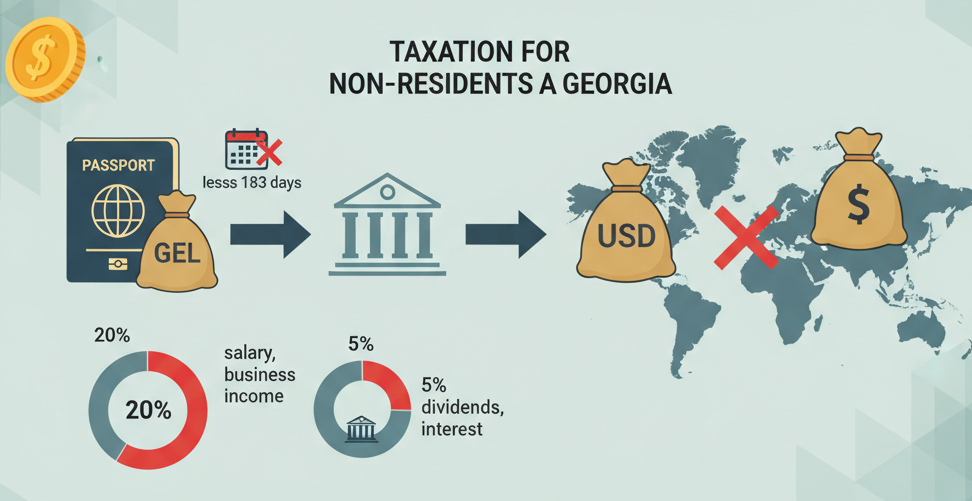
If you've spent fewer than 183 days in the country, you're a non-resident, and the rule is short: you're taxed only on income from a Georgian source. The rate is the same, 20%, on salary, business income, and other income earned in Georgia.
A non-resident's foreign income doesn't interest Georgia at all; no need to tax it or declare it here.
If you're employed by a Georgian company, tax on your salary is withheld and remitted by your employer as the withholding agent. It's taxed monthly, and you typically don't file separately for it yourself.
Dividends and interest from Georgian sources carry their own rate, 5%, also withheld at payment. That rate can shift if a double taxation treaty applies between Georgia and your country. Georgia has treaties with more than fifty countries; more on how to use them is in avoiding double taxation.
📝 How to file a tax return in Georgia
The most annoying part of this whole topic: you still need to file even when there's barely anything to pay.
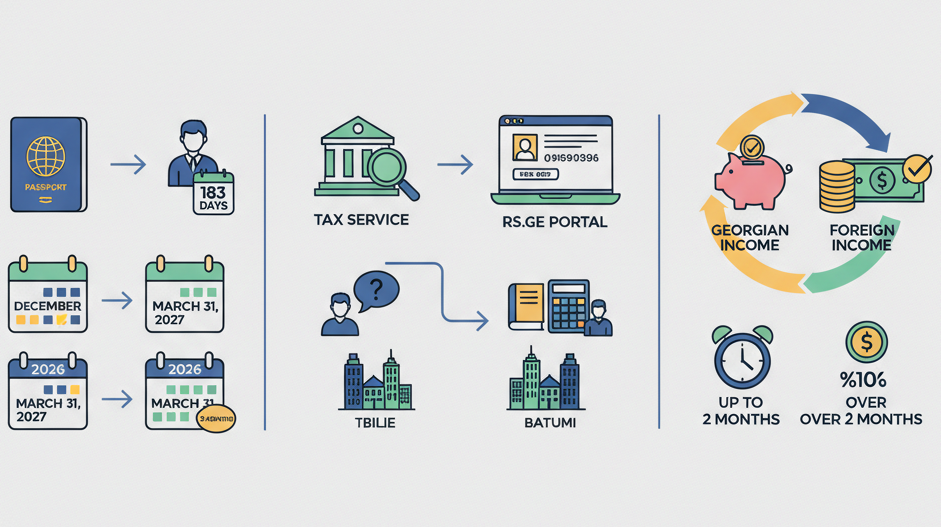
The annual return is due by 31 March of the year following the tax year. So for 2026, that's 31 March 2027. If you crossed 183 days in December, you're filing for that same year, and the deadline lands three months out, not a year, which is where a lot of people miscalculate.
The process runs like this. First you register with the tax authority and get a tax ID, then file the return online through the rs.ge portal. If the interface in English or Georgian is a struggle, accountants handle this routinely: the directory has accounting firms in Tbilisi and Batumi.
By some accounts, when filing, residents list income from every source, splitting Georgian from foreign: the foreign portion shows up for transparency but typically generates no Georgian tax liability.
There are penalties for filing late. By consultants' figures, a delay of up to two months adds 5% to the tax owed, more than two months adds 10%. Confirm the exact terms with the tax office itself.
For the practical mechanics of the portal and paying taxes, we've got a step-by-step walkthrough.

Keep a running log of your days in the country from day one, not from whenever you remember taxes exist. Entry and exit stamps are in your passport, but reconstructing a year of travel after the fact is a pain, and a dispute over whether you hit 183 days or landed at 181 can get expensive either way.
And remember Georgia is only half the story. Becoming a resident here doesn't automatically make you stop being a tax resident of your home country. If that's the actual goal, the rules for exiting residency belong to the country you left, and a Georgian residency certificate is one argument there, not the whole case.
Sorted out taxes in Georgia? Leave a review on Madloba: tell us what came up, whether an accountant helped, and what turned out trickier than the articles online promised. Real experience like that helps people who are just arriving.
Information is current as of September 2026 and is provided for general guidance, not tax advice. Georgian tax law changes, and how the source-of-income rules apply depends on individual circumstances. Official information is published by the Georgia Revenue Service at rs.ge. Before making decisions, especially around relocating or changing tax residency, consult a tax professional.
❓Frequently Asked Questions
💬 At least 183 days in any continuous 12-month period that ends within the current tax year. The days don't have to be consecutive, and residency kicks in automatically, no application, no residence permit needed.
💬 Whichever year the 12-month period actually ended in. Arrive on 1 October 2025 and stay the following 12 months, and you're a resident for 2026, not 2025.
💬 A resident's income from a foreign source is exempt from personal income tax. What counts as foreign-source is the tricky part: by consultants' interpretation, salary for work physically performed in Georgia can count as Georgian-source income, even if a foreign company is paying it.
💬 20% on salary and most other income from a Georgian source, a flat rate with no progression. Dividends and interest are taxed at 5%, withheld at the point of payment.
💬 Only on income from a Georgian source, at the same 20% rate. A non-resident's foreign income isn't taxed or declared in Georgia. Tax on salary from a Georgian employer is withheld by the employer.
💬 By 31 March of the year following the tax year. Returns are filed online through rs.ge after registering and getting a tax ID.
💬 By consultants' figures, a delay of up to two months adds 5% to the tax owed, beyond two months it's 10%. Confirm exact terms with the tax authority.
💬 No. Tax residency is determined by days spent in the country, not immigration status. You can become a tax resident while staying in Georgia visa-free.
💬 Not automatically. Exiting your home country's tax residency is governed by that country's own rules. A Georgian tax residency certificate, issued per calendar year, helps support that case, but the actual requirements come from wherever you're leaving.
💬 It depends on your situation, but a lot of remote workers and freelancers in Georgia go with sole-trader small business status, taxed at 1% of turnover up to a threshold. It's worth deciding with an accountant, factoring in the work-permit requirements that took effect in 2026.

0 comments
Log in to leave a comment