




🥞 Russian cuisine in Tbilisi — 8 places with borscht, blini, and pelmeni
It's easy to find vibrant gastronomic experiences in Tbilisi, but sometimes a completely different scenario is needed: not a noisy dinner or signature presentation, but familiar home-cooked food. When searching for "Russian cuisine" in the city, people usually search not for the grandiose restaurant canon, but for the familiar dishes that people come for: borscht, pelmeni, blini, cutlets, Olivier salad, syrniki, and pirogi. This rating is for those who want to choose a place based on its format, not its name: for a quiet lunch, a family dinner, a nostalgic mood, or simply a plate of familiar food without the gastronomic lottery. Below is a selection of addresses worth considering if predictable taste, a clear menu, and a comfortable pace are important, rather than showiness for effect's sake.
WHO WILL THIS RATING SUITABLE FOR
- Those looking for Russian cuisine in Tbilisi, not a random mix of genres.
- Those who crave borscht, blini, pelmeni, and other familiar home-cooked food.
- Families, groups of friends, and those who prefer a quieter atmosphere over a noisy bar.
- Tourists, expats, and city residents who want predictable service and familiar tastes.
- Those looking for a place for lunch, dinner, or simply familiar comfort food without unnecessary pretension.
The best places according to the MADLOBA rating




Where to find Russian cuisine in Tbilisi: a ranking map
This map is especially useful for this page, as Russian cuisine in Tbilisi is often spread across various urban settings: near residential areas, along business streets, in local neighborhoods, and off the typical tourist route. Here, the address is sometimes as important as the menu: one place is convenient for a quick lunch, another for a family dinner, and a third for a special visit for pelmeni, blini, or soup.
How to choose Russian cuisine in Tbilisi and distinguish a strong spot from a haphazardly mixed menu
Quick guidelines:
- the menu has a clear core, not just one borscht among dozens of other genres;
- strong points are soups, dough dishes, home-cooked hot dishes, salads, and desserts, not decorative selections;
- blinis, pelmeni, vareniki, or syrniki look like kitchen staples, not random additions;
- home-style doesn't mean sloppiness: temperature, texture, dish assembly, and presentation are all important;
- if the menu chaotically combines too many cuisines, you're looking at an international format rather than Russian cuisine as a choice scenario.
In Tbilisi, demand for Russian cuisine is often met not by a strict restaurant canon, but by a desire for familiar, calm, and predictable food. Therefore, it's easy to find both places with a clear focus and establishments where Russian dishes sit alongside Georgian, European, or broader Slavic offerings. This in itself isn't a problem. What's important is whether the establishment has a strong, home-style core that draws people there specifically for this intent.
A strong position in this category is usually determined by internal discipline. If borscht, blini, or pelmeni are only listed nominally on the menu, but the cuisine operates by a different logic, the guest isn't getting a specialized menu, but a random item on the spread. But if the home-style section is consistently assembled—soups, pastry dishes, familiar salads, simple main courses, tea, and desserts—even a mixed menu can remain relevant for this rating.
In this category, dishes that immediately reveal mistakes are especially revealing. Borscht demonstrates the balance of broth, vegetables, and accompaniments. Pelmeni and vareniki demonstrate the quality of the dough, the juiciness of the filling, and the careful cooking. Blini and syrniki (pancakes) require a lot of work with dough, frying, and fillings. Therefore, it's more logical to evaluate Russian cuisine in Tbilisi not by the length of its menu, but by how consistently the kitchen maintains these key elements.
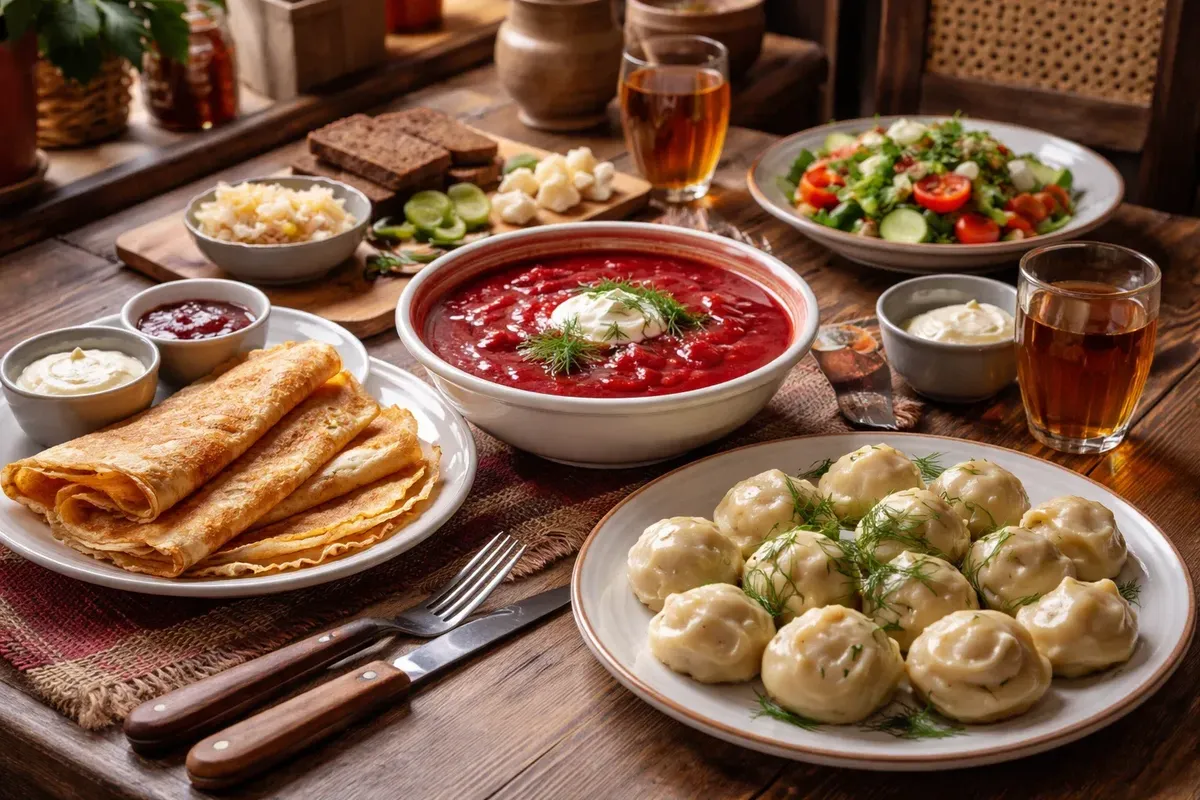
What to check before visiting a Russian restaurant in Tbilisi to ensure you're choosing the right format
What to look for first:
- Are you going for a full lunch, pelmeni and blini, or just a relaxed tea party?
- Is the full range of home-cooked dishes available all day, or is some of the menu more focused during lunchtime?
- Do you want a family-style table, quiet seating, and a clear selection of dishes for children or older guests?
- Is a classic, unadulterated taste important, and is it worth checking the recipe for individual dishes in advance?
- Is a service charge included, are reservations accepted, and is the location convenient for your itinerary?
If you're visiting for the first time, it's best to order one "test" soup dish and one item from the dough or hot section of the menu. In Russian cuisine, such a pairing offers more information than the most impressive dishes in a photo. A good borscht shouldn't be watery or have a distinct sweet and sour taste. Pelmeni and vareniki should hold their shape and not turn into dense rubber. Blini are important not only for their filling, but also for their base: dough that's too thick, too dry, or undercooked quickly betrays weak cuisine.
Before visiting, it's also worth considering the pace of the establishment. Some places in this category are especially strong during the day, when the soup and home-cooked food sections are regularly open. By evening, some items may run out, especially in smaller cafes. For a family visit, a weekend dinner, or a group outing, it's best to confirm seating arrangements in advance: in Tbilisi, a relaxed, home-style setting often means a compact dining room rather than a large restaurant space.
If you're looking for a familiar taste without the signature twists, don't hesitate to ask how specific dishes are prepared. This is especially helpful for Olivier salad, syrniki, blini fillings, types of vareniki, and accompaniments to borscht. In this category, the distinction between "classic" and "custom" is often more important than the decor or a catchy name.
Review from a catalog reader
Anastasia Petrova, Riga, Latvia
This rating was a very warm and slightly nostalgic discovery for me. In Tbilisi, you can really find places with familiar home-cooked food—borscht, pelmeni, blini—and thanks to this selection, it became clear where to go.
I liked that the city has establishments with Russian and Eastern European cuisine, serving classic dishes like borscht, vareniki, and blini, often in a cozy, homey atmosphere.
The rating is conveniently structured: you can quickly choose a format—from a simple cafe to a more atmospheric place. As a result, I not only had a delicious meal but also experienced a familiar taste far from home. An excellent guide for those who sometimes miss home cooking 🥞🍲✨
Why Russian cuisine in Tbilisi often feels like a home-cooked or Slavic style
What's important to understand:
- Local demand is more often associated with familiar comfort food than with strict historical canon;
- In Tbilisi, Russian dishes often coexist with Ukrainian, Slavic, and traditional dishes.
- Guests value recognition, consistency, and the service format, not symbolic "genre purity."
- A strong rating should explain this specificity, not promise something the market doesn't actually offer.
For Tbilisi, this is a natural fit. When searching for "Russian cuisine," many are not looking for a ceremonial restaurant style, but for a selection of familiar dishes associated with the home table: borscht, Olivier salad, cutlets, mashed potatoes, blini, syrniki, pelmeni, and pirogi. Therefore, the words "Russian," "Slavic," "homemade," and "Eastern European" may overlap on the sign and menu. It's best to clearly communicate this distinction to the reader so that expectations are clear before the visit.
That's why the purpose of this rating is not to portray an ethnographic encyclopedia, but to help with a realistic choice. If someone is looking for a relaxed lunch, a family dinner, a nostalgic taste, or a straightforward menu without gastronomical experimentation, a working script is more important than arguing over the formal name of the genre. A good text here should explain how Russian cuisine is practiced in the city and the criteria for choosing a place that best suits their needs.
❓ Frequently Asked Questions about Russian cuisine in Tbilisi
In this ranking, not only the label matters, but the core of the menu. If a place consistently offers borscht, pancakes (blini), dumplings (pelmeni), familiar salads, home-style hot dishes, and desserts of this kind, it fits the intent — even if it presents itself more broadly than just a “Russian restaurant.”
Places where soups are part of the main menu logic tend to perform better. If borscht is part of a consistent home-style section rather than lost among dozens of unrelated cuisines, the chances of a good result are higher.
Look for a clear section dedicated to dough-based dishes, multiple filling options, thoughtful presentation, and the sense that these are not just decorative additions. If pelmeni or vareniki are a core part of the kitchen, it is usually visible in the menu structure.
No. The city has not only nostalgic venues but also modern, calm cafés where the focus is on familiar food rather than theatrical design. For many guests, this is even more comfortable: recognizable flavors without the “decor of the past.”
In most cases, yes. Russian cuisine is convenient because of its familiarity: soups, mashed potatoes, pancakes, cutlets, syrniki, and other well-known dishes are easy to fit into a family scenario. Still, before visiting, it’s worth checking seating, noise level, stairs, and the overall pace of the venue.
For a spontaneous lunch, not always. But if you are planning an evening visit, a weekend, a small group, or a place with limited seating, it’s better to check availability in advance. This is especially useful for a calm family visit.
No. This category includes both more affordable home-style cafés and more structured restaurant formats. It’s better to focus not on the expectation of “it should be cheap,” but on the type of place and the price badge: ₾ / ₾₾ / ₾₾₾.
A good approach is to take one soup and one dish that reflects dough or home-style cooking. Combinations like borscht with pelmeni, blini with syrniki, or a soup with a classic hot dish reveal more about the kitchen than the most visually impressive item on the menu.
Yes. In this type of ranking, location matters a lot: some places are convenient for a quick meal on the go, others for a family dinner or a calm destination visit. That’s why it’s important to actually check the map rather than choosing only by dish names.
📌 Help us keep our rating up-to-date
Have you been to any of these Russian cuisine spots in Tbilisi? Tell us in the comments what you ordered, how great the borscht, blini, or pelmeni were, and which place you'd like to add to our next update. If you notice any changes to the hours, menu, address, or service format, please report them using the form—the editors manually check for such reports.
Know a place in Tbilisi that truly fits this intent and deserves editorial review? Leave a comment below the rating.
❓ How this rating is compiled
This rating is compiled by the MADLOBA editorial team using the "Where to Eat" category methodology. We look at how well the establishment matches the page's intent, how the menu is structured, whether the cuisine has a clear focus, how consistent the key dishes are, what user signals indicate, and how up-to-date the establishment's listings are.

12 comments
Log in to leave a comment
Согласен с автором: главное здесь — не искать «музей русской кухни», а ловить тот самый домашний вайб. Я для себя открыл, что лучший способ проверить место — заказать блины со сметаной и тарелку супа. Если блины тонкие и не сухие, а в борще чувствуется наваристость — значит, сюда стоит идти с семьей. Отдельный лайфхак: иногда в таких заведениях подают отличные сырники, которые отлично заходят после долгой прогулки по старым улочкам.
Это, конечно, совсем другая история, но в ней чувствуется та же искренность, то самое грузинское гостеприимство, только выраженное через знакомый нам формат «как у бабушки».
А у кого был опыт? Часто ли вы, путешествуя по Грузии, сворачиваете в такие русские или славянские кафе, чтобы просто перевести дух? Или все-таки до последнего держитесь за национальную кухню? Делитесь своими находками в Тбилиси! 🍲🥟
И вот эта озабоченность, что привычная еда вдруг окажется стильной, с жульеном и что-то там «инстаграммным». Как думаете, где реально можно найти борщ без заморочек, чтобы не было ощущения, будто пытаюсь проглотить искусство?