



What a local business is and whether it suits you
Share
Save
Author: Alex Nekrashevich. Data current as of late November 2026. We update this article, check back for updates.
Who it is for: for all five readers of the guide: the dreamer leaving a salaried job, the skilled craftsperson, the person who has moved to a new country, the owner whose business has gone badly, and the cautious beginner who wants to "do it like everyone else".
In short
A local business is tied to one door and the circle around it. Customers live or walk nearby: a coffee shop, a salon, a neighbourhood shop, a car service, a clinic, a guest house. You cannot fix a mistake here with one click, as you can online: the money is already in the renovation, the deposit and the sign. From our observations, most money is lost on the location and the lease, and most energy goes on people. We write honestly and without "success for the sake of success". If this article talks someone out of it in time, that is a result too.
What we call a local business
A local business is tied to a specific door and a radius of 500 metres to 2 kilometres. We advise our clients: print a map and draw a 2-kilometre circle around your location. That is the furthest people will come to you from.
Why do people come to you at all? People used to do their nails at home, now they go to a salon near home: they will not travel to the other end of the city. They used to make coffee at home, now they sleep a little longer and pick up a coffee and a croissant on the way to work. You live off being nearby or on the way.
How a local business differs from an online business, a chain and a franchise
| Online business | Chain | Franchise | Your own local business | |
|---|---|---|---|---|
| If you make a mistake | a new website or logo in an hour | the rules and the brand already exist | the manual already exists | the money is frozen in tiles, the deposit, ventilation, the sign, flyers with your address: everything has to be redone |
| Why customers come | advertising and search | the brand: the same taste, price and speed in any city | the franchise brand | only what you prove yourself |
| What you pay on top | a fee, royalties, branded supplies from head office | no royalties | ||
| Freedom | high | none | limited: you cannot add your own drink or cupcake | complete, but all the mistakes are yours too |
Why chains are strong: people go for the brand and know they will get roughly the same price, quality and speed in any city. You do not have that, you will have to prove everything yourself. On the other hand, you do not pay royalties "for thin air" and are not obliged to buy supplies from head office.
Tip: do not print a lot of business cards and flyers at once "because it is cheaper". If the address, the menu or the idea turn out to be wrong, you will have to reprint everything.
The main thing that distinguishes one local business from another is how the customer comes to you:
| How the customer comes | What it means | Examples | What decides |
|---|---|---|---|
| Impulse demand | The person bought "on the way", without a plan. They will not leave their usual route even by 100 metres. | takeaway coffee, a bakery, a small grocery, quick repair of watches, shoes, umbrellas | the location and the flow of people on your side of the street |
| Destination visit | The person comes to you on purpose, having chosen you by rating, photos and reviews. | a dental practice, a car service with a strong listing, a restaurant with strong cuisine, a specialised clinic, a narrow niche shop | the maps listing, reviews, a narrow niche; the location matters less |
From our observations, with impulse demand even a 5.0 rating will not make a person walk into a courtyard for a cup of coffee. With destination visits you can take premises on the second line or in a basement: rent there, from our observations, is 40-50% cheaper than on the first line, and you can put the difference into advertising and your listing. But the niche must be narrow and the listing strong.
The ten niches we write the guide for
In the guide every article has short blocks for these niches. If we have no experience in a niche, we say so: "data is being clarified".
| Niche | What matters most (from our observations) |
|---|---|
| Coffee shop | the morning side of the street, on the way to a bus stop, office or university; a clear shop window |
| Café and restaurant | balance between daytime, evening and weekends; easy access by car; space for a powerful extractor |
| Bakery and patisserie | the evening side, on the way home; an extractor without complaints from residents; no strong supermarket competitor nearby |
| Beauty salon and barbershop | location ("the 3 Ls: location, location, location"), convenient parking for an hour or an hour and a half, a clear entrance |
| Neighbourhood shop | dense housing nearby, evening routes, a well-lit approach (data is being clarified) |
| Pet shop | parks and vet clinics nearby, parking at the entrance (food in 10-15 kg bags) |
| Shoe repair and household services | being seen on the way: next to a supermarket, a market, a bus stop |
| Car service and car wash | direct access from a main road, a waiting area in front of the bays |
| Dental practice and clinic | premises that meet medical standards, access for wheelchairs and older people, a clear entrance |
| Hotel and guest house | quiet at night, access for taxis, small things in the room (see below) |
Guest house: the small things decide
Many owners of guest houses and short-let flats react to remarks only after bad reviews. It is better to stay at a competitor's and look at the small things in advance.
- A high chair for children, an extra inflatable mattress, wrapped soap, disposable kits, slippers, a paper toilet seat cover. They cost pennies, but the level is noticeably higher.
- A card with the Wi-Fi password and a QR code "leave us a review", so the guest does not need to ask.
- Complaints happen over a kitchen spatula or two tea bags for five guests. We have also seen a "5-star" hotel where the air conditioning did not work at +35 in summer: check the equipment before the season.
- The main thing for a guest is quiet: they came to get a good night's sleep.
- Work out the cleaning in advance: find out from neighbours and from adverts what it costs, call a cleaner as if the house were already yours. Guests vary: after one host's guests the flat smelled of smoke and grease, and it took 2 days to clean, more expensive than usual.
- There will always be planned small repairs: sockets, taps, plumbing.
Plumbing and appliances: not like at home
In a coffee shop, café, restaurant or guest house the tap, the toilet and the mixer are used many times more often than at home. A household tap "like the one I have, it works well" will break quickly here. Commercial equipment is more expensive, but you will be replacing cheap equipment all the time, and someone has to take out the old and put in the new. Add a separate line to your budget called "delegation": whom you will hand this to and what it costs.
Recognise yourself: the five readers of the guide
| Who you are | The main mistake (from our observations) | What to read in the guide |
|---|---|---|
| The dreamer leaving a salaried job. A former financier, manager or company employee, you are opening a business "for yourself". You have savings and are ready to invest in a beautiful renovation. | You believe that beautiful service will sell everything by itself; you take contractors at their word; you hire "stars" before there are customers. | "How to choose a location", "Lease agreement: what to check before you sign", "How much money you need to start" |
| The skilled craftsperson. A barista, chef, car mechanic, dentist, tired of working "for someone else". Little money. | You believe that "people will come by themselves"; because of money you take a basement or a courtyard; you cannot read a lease; you stand behind the counter 24/7. | "How to view premises", "Lease agreement", "How much money you need to start" |
| The person who moved to a new country. You are opening a business in a new place. Average money, losing your reserve is frightening. | You carry old habits over to a new country, do not know the local rules, end up in a dead location or with hidden bans (sign, extractor). | articles for your country: registration and taxes, "How to view premises", "Lease agreement" |
| The owner whose business is going badly. You opened 3-8 months ago, takings cover roughly half the rent. | You opened where there are many people, but they are not your customers; you did not count the flow before moving in. | "When things go badly: pivot, close or sell" |
| The cautious beginner. You want to "do the same" as the successful examples. The money is from a loan or pooled. | You do not understand that profit depends on the location, not on the sign. | "How much money you need to start", "Competitors and the cost of a mistake", "How to choose a location" |
If you have moved to a new country
In a new country the rules are often stricter than you are used to, and the fines are bigger. Many people open following their old habits and read the local rules only when something has already happened. It is like reading the instructions for an appliance after it has burnt out. Read before, not after.
An example from Georgia: even offering or promising money to a police officer, on the road or anywhere else, is a criminal offence, whether or not they took it (Article 339 of the Criminal Code). You need to know such things in advance.
How much of your time the business will take
Plan for 60-80 hours a week, not 40. Warn your family that you will disappear. Nobody but you will think about your business, and it is better to live with this from the very start.
- You will be the manager, the cleaner, the delivery person, the electrician and the plumber. Employees get ill, their children get ill, they go on holiday, and you stand in for them.
- A contractor promised to do it in 5 days: good if they do it in 10. The result will not match the picture in your head if you did not write a detailed brief.
- A craftsperson's experience is not an owner's experience. A great barista may not know how to close the till. An excellent dentist may not cope with the alarm system or may be thrown by a question off the subject. And they will call you.
- We do not explain each employee question orally, we write it down in our own knowledge base. Franchises are strong because their processes are already written down. You will have such a base in years, and for now you think one thing and the person doing the work does another.
- Forget about the country house, football and Saturday visits to relatives. The result will not come straight away, and that is very demotivating. You need to be mentally ready.
Our rule of the best employee. The best employee (1) sees the problem, (2) knows how to solve it, (3) solves it, (4) does it without pressure from above. Until you have such people, the best employee for every situation is you.
Our case. We had an employee who looked after a dozen premium clients, and they were all delighted. She got married, and 2 weeks later she left with her husband for a village to keep bees. Clients called her, she switched off her phone, and we did not know where to start.
Guides like "open a business in 2 weeks and break even" make money only for the people who sell them. There is no general recipe for everyone: what works for a coffee shop will not suit a salon, a car service or a shop. Someone else's checklist without adapting it costs a lot.
When it is better not to open right now
| Sign | Why it is dangerous (from our observations) |
|---|---|
| You are opening on your last borrowed money, with a reserve of less than 6 months | the first six months are only spending; a reserve for 3 months is the road into a debt pit |
| You are leaving a salaried job on emotion, "to spite a bad boss" | you see the takings, but not the rent, salaries, taxes, supplies and advertising |
| The landlord is rushing you: "there is another viewing at 5, another one at 6" | in a hurry people do not read the lease, do not check the kilowatts, the extractor, the neighbours and the flow |
| You are hoping for a wizard: a miracle marketer or a friend who will "bring a queue" | you cannot bring a queue to bad premises, and you will pay the money upfront |
| Money from relatives or friends "on a verbal agreement" | no contract, no deal: without paper it ends in quarrels |
Where to get the money. Usually it is relatives, friends or a bank (a business loan is rarely given to a beginner, a consumer loan costs more because of the interest). An investor, in our view, is the most expensive money for a local business: an early investor expects a return many times over, secures themselves with a pledge of your property and wants a share in the business. Relatives do not ask for a share, but you need a contract with them too: when it comes to money, people hear everything differently.
The "a friend in need" test. One entrepreneur gave this advice: while everything is fine, tell a few acquaintances that you need a little help and see who helps. Out of eight acquaintances, the one who helped was the one he counted on least. (The debt was repaid with interest.) Thinking that people will help you and knowing it are different things.
The craftsperson leaving "someone else's" business. A typical story: a stylist sees that the client pays 100 euros for a haircut, the stylist keeps 30 and the owner 70. He opens a one-chair salon that loses money already on paper. Then he pays rent, salaries, taxes, supplies and advertising and gets the same 30, only with much more hassle. And before he had a workplace, light, water, heating, coffee and biscuits.
The miracle marketer. A recent case: a car service's marketer was asked to run ads on Google Maps, the budget is being spent, but there is no result. We suggested checking the listing and the goals first, and she replied: "Let's go straight to the ads." A good doctor will first send you for tests, not give you a pill for back pain. The mistake here was the owner's: he put an inexperienced person on advertising while he repairs cars himself and does not know the business is going under. Before you entrust your marketing to someone, do an audit: you will be given awkward questions to ask the marketer, and the picture will become clear.
"I want it like theirs": franchises and copying
Franchise presentations sound beautiful: "pay the fee, pay the royalties, and you will be given everything". But the location decides here too. The best-known coffee shop on the "evening" side of the road, where people walk home rather than to work, will close, and the royalties will only speed up the closure.
What to do before buying a franchise: 1. Get the contacts of the 5 most recently opened locations and call them (you will definitely get through to two). 2. Find 3-5 closed locations and ask why they closed. 3. Read the contract with a lawyer: look for one-sided, onerous terms. Do this before you sign, not when you are already paying royalties every month.
Does a local business suit you: signs of "no"
- You expect creativity. A local business is not only latte art and a friendly atmosphere. It is cleaning, write-offs, constant staff turnover and demanding customers who ask for the manager over the toilet paper, write complaints and call the police.
- You are not used to counting every day. Most of the money in the till and in the account belongs to the tax office, the landlord and suppliers, not to you. Spent it on yourself, got a cash gap.
- You expect the business to wait. You did not pay a supplier because you bought your child a bicycle: the goods will not be delivered. Rent runs every day, so in the first six months forget about days off and holidays.
- You cannot handle rush jobs. Friday, a full house, the circuit breakers trip, an employee did not show up after a birthday. You need to decide quickly, not freeze.
- You are counting on partners "on a verbal agreement". We got together as four, and two of us did the work. Failure is always an orphan, while success has many relatives.
- You cannot say "no". Hiring a relative is easy, firing them is hard: you lose not only them but also your relationship with their whole family.
Six beginners' myths
- "I will make a great product, and word of mouth will bring customers." Remember how many people you yourself recommended something to in a month: usually the fingers of one hand are enough. Today people search on their phones in maps and ask AI assistants (ChatGPT, Claude, Gemini). If the AI does not know about you, for these people you do not exist.
- "Friends said they would come." People do not tell the truth, but not out of malice. Ask "Will you come to me?", and they will answer "Of course". You need to ask how often the person does this now: where they drink coffee, how often they buy cakes and why. A case: a franchise coffee shop was opened in a courtyard because the rent was cheap. People came to the opening for free coffee and cupcakes, and when coffee started to cost 3 euros and a biscuit 2, they stopped coming.
- "I will hire a manager and come in on Saturdays." If such a person exists, why would they work for you rather than open their own? First you have to find them and train them, then you need standards, recipe cards and step-by-step processes: opening the till, opening the booking system and so on. And decide in advance what to do if they leave, get poached or open the same kind of place next door.
- "The first month is hard, then it will take off." From our observations, it will be hard for about six months: lack of sleep, lack of money and of people.
- "Employees will queue up." Good people are never free. A person who changes jobs every 1-2 months will leave you too. An employee you poached from a competitor will leave you just as easily. At our interviews, about five out of 30 people were adequate. At an interview a person shows the best version of themselves, and then may shout at a guest over a broken cup, and within half an hour you have 6-7 bad reviews. People decide everything.
- "I will manage everything myself." A person does one task at a time. Standing in for an employee, looking for a new one, answering calls, the wiring, suppliers, complaints, neighbours, the tax office, the accountant and the family all in one day: this skill is not innate and cannot be bought, it comes with years.
Our experience: a lounge bar in Tbilisi
To understand a local business from the inside, the author of this article spent about a year setting up a turnkey lounge bar in Tbilisi himself: he chose the premises (a private house), hired people, put together the menu. He worked as a waiter himself and asked for reviews himself in order to put together a checklist. He does not regret this experience, but he will not do it again. Expectations and reality turned out to be as different as heaven and earth.
- Small things nobody counted. The internet was more expensive than we thought. The sewer was old: one wet wipe, and the whole courtyard smelled.
- Money. For cups, tableware and small items we planned 3,000 dollars and spent 10,000, because we did not take many things into account. And it still was not enough. At first we bought on a grand scale, then we realised that money runs out instantly.
- The good. Once a whole bus of about 30 people came on a recommendation. An arrangement with a person from the fashionable crowd worked: he brought groups, and the bar paid his bill (about 200 dollars).
- People. Guests behave differently after alcohol, and that is your concern too. We went to bed at 3-4 at night and got up at 7: linen, cleaning, purchasing, meeting the shift at 9 in the morning. The first week was a buzz, then burnout.
- Flyers and street advertising. Complaints came in, and it was explained to us that handing out flyers on the street requires permission from the city hall and is allowed only at agreed times. Check the rules for your district with the city hall in advance. A promoter cost not 10 but 50 dollars for 2 hours. Street musicians turned out to be expensive.
- Neighbours. They complained about cars and music in the courtyard. Next door there turned out to be a private kindergarten (in Georgia a kindergarten in a private house is normal): children shout until 4 pm, smoking in the courtyard is not allowed.
- The owner of the house. She came to inspect, and an argument began about what could and could not be changed, up to "move out tomorrow".
- Partners. There were four owners, and the agreement had a clause that any of them could leave. That helped.
The main conclusion: you will always owe everyone, and while you drive to the shop, nobody else does the other task. If this article stops even one person in time, that is already a result.
Does a local business suit you: 10 questions to ask yourself
Answer honestly. If the answer to several questions is "no" or "I do not know", it is not a ban but a list of tasks to do before signing the lease.
- Can you say in one sentence how your business differs from ten similar ones nearby? (USP)
- Do you understand how the customer will come to you: "on the way" or on purpose? (Impulse demand or destination visit.)
- Have you counted the flow of people at the entrance: in the morning, on a weekday evening and at the weekend, not for one hour?
- Do you know why the previous tenants of these premises moved out?
- Did you check the electrical power, the ventilation and the right to a sign before signing?
- Have you read the lease and do you know what it says about the deposit, the penalty and your renovation?
- Have you calculated your break-even point, and do you have a reserve for at least 6 months?
- Have you written down a loss limit: the amount and the date after which you will close?
- Are you ready to work 60-80 hours a week for the first six months, and have you warned your family?
- Do you have a person or a lawyer who will read the lease and say "no" if necessary?
What to do next
- Choose a niche: the article "Choosing your field and niche".
- Choose a location: the article "Choosing a location".
- View the premises: the article "How to view premises before you rent: 15 questions to the landlord and neighbours".
- Check the lease: the article "Lease agreement: what to check before you sign".
- Work out the money: the article "How much money you need to start".
- If you have already opened and things are going badly: "When things go badly: pivot, close or sell".
This article is not legal or financial advice.
Frequently asked questions
It is a business tied to one door and the circle around it, from 500 metres to 2 kilometres: a coffee shop, a salon, a shop, a car service, a clinic, a guest house. Customers live or walk nearby.
A franchise gives you a manual and a brand, but you pay a fee and royalties, buy branded supplies and cannot add anything of your own. In your own business you have complete freedom, but no manual and no brand: all the mistakes are yours.
If you have impulse demand, no: a person will not leave their usual route. If it is a destination visit and a narrow niche, you can take a cheaper place (the second line, a basement: rent there, from our observations, is 40-50% cheaper) and put the difference into advertising and your listing.
From our observations, 60-80 hours a week in the first six months, not 40, without days off or holidays. Rent runs every day.
A craftsperson's experience helps, but an owner's experience has to be built from scratch: the till, employees, suppliers, taxes, complaints. Be ready to do everything yourself at first.
Not your last borrowed money. You need a reserve for at least 6 months. Put money from relatives and friends on a contract. An investor, in our view, is the most expensive money for a local business.
Only after calls: to the 5 most recently opened locations and to 3-5 closed ones, asking why they closed. And only in the right place: on the "evening" side of the road a coffee shop will close even with a famous brand.
You cannot count on it: people rarely recommend. Today customers look for you in maps and ask AI assistants. If you are not there, for them you do not exist.
Do not ask "will you come?". Ask how often the person does this now: where they drink coffee, where they get their hair cut, how often they buy cakes.
If the location is not yours (there is a flow, but they are not your customers) and maps cannot pull it out, it cannot be saved. How to count honestly and what to do, we cover in the article "When things go badly".
We will check your location or lease before you sign
If you would rather not dig into this yourself, the Madloba Consult team will look at your location on Google Maps and go through the questions from this guide with you before you sign the lease. We do not give legal advice: the lease itself is checked by a lawyer. Own a business in Georgia? What is included and what it costs is on the advertising page: For businesses in Georgia. You can leave a request in the form there.
Starting a business? All the steps in order, from choosing a location to your first customers, are in our guide: How to start and grow a local business.
Share
Save

Read also
Registration and taxes in Georgia: what to do before you open
IE or LLC, 1% small business status and who cannot get it, the 100,000 lari VAT threshold, cash register, staff and permits. November 2026.
How much money you need to start and for the first 6 months
Budget plus 50%, a 6-month reserve, break-even on a sheet of paper, six holes in the calculations and a loss limit. Niche examples, 2026.

Lease agreement: what to check before you sign
The second bill, rent holiday, deposit, exit without a penalty, permitted use and lease registration in Georgia. A practitioner's experience, 2026.
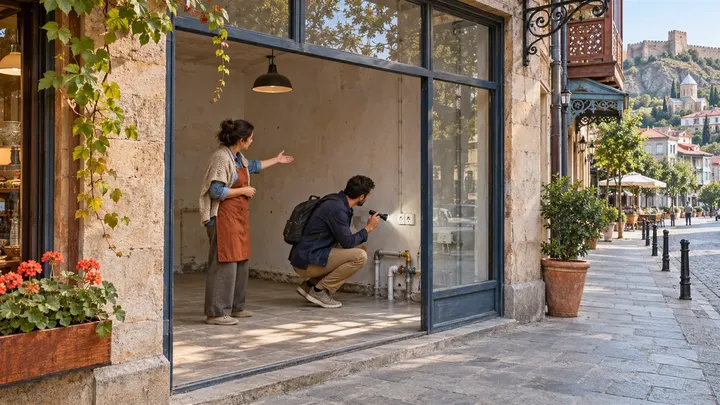
How to view premises before you rent: 15 questions for the landlord and the neighbours
What to ask the landlord, neighbours and previous tenants before you sign: power, water, extraction, sign, parking. A practitioner's experience, Georgia, 2026.
0 comments
Log in to leave a comment