



🏙️ Akhaltsikhe on Foot: The Fortress, Five Faiths in One Quarter and the Route Through Town
Akhaltsikhe in four figures
A frame for planning: how far it is, how long to allow and what to expect underfoot.
The town is compact and you will not need a car inside it. You will need shoes you do not mind walking on stone in: the drop between the lower and upper parts of the fortress is considerable.
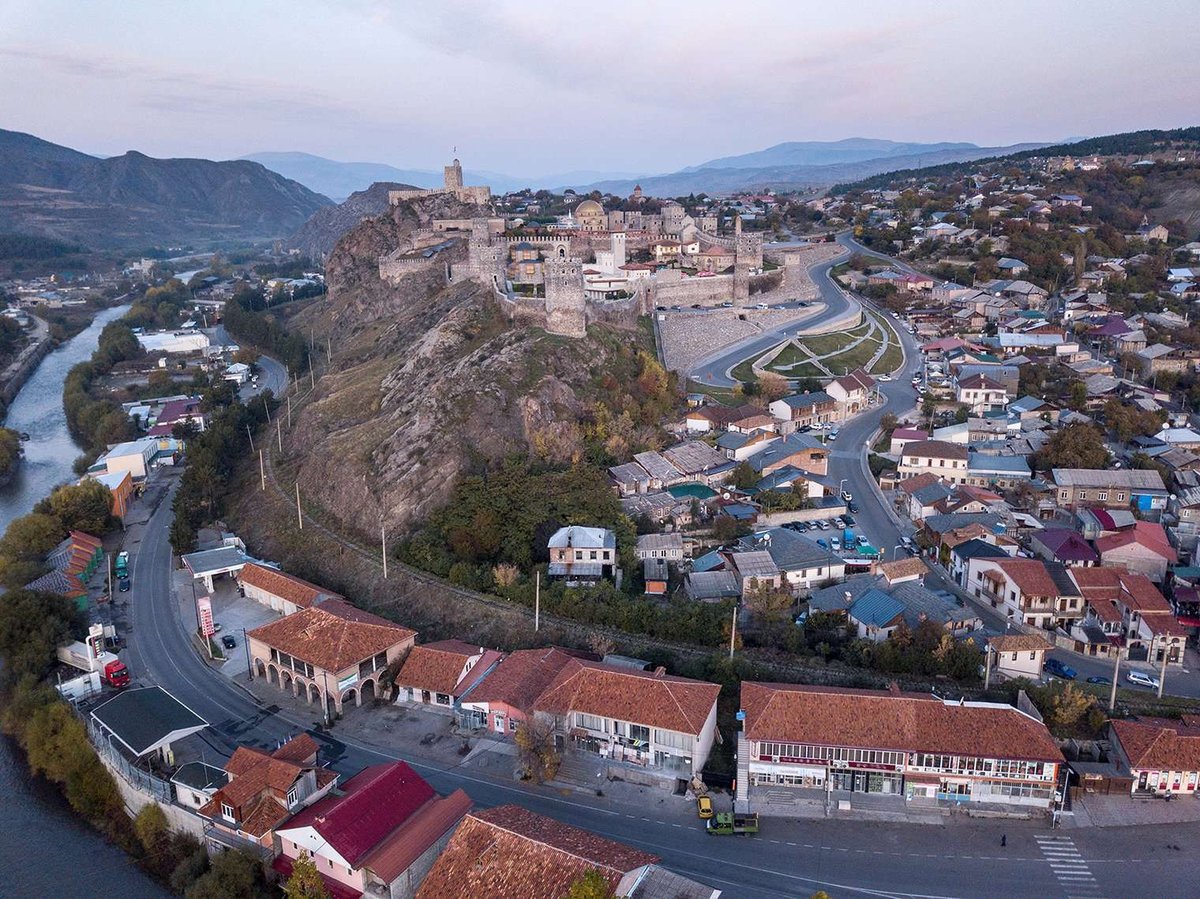
Akhaltsikhe is the administrative centre of Samtskhe-Javakheti, a town in southern Georgia where almost everything of interest fits into a single walk. The landmark is visible from everywhere: the fortress hill above the Potskhovi river. Around it lies the old quarter, where buildings of five religious traditions stood side by side for centuries. Below that begins an ordinary southern Georgian town with a theatre, a square, a park and its monuments.
The names are worth sorting out at once. The official historical name of the monument is Akhaltsikhe fortress. 'Rabati' for centuries referred not to the fortress but to the old town quarter. It attached itself to the whole complex only after the 2011-2012 restoration, and today more people search for it than for the historical name. Both spellings occur, Rabati and Rabat, with no difference between them.
The main reason to come is not the fortress itself. Georgia has plenty of those. The reason is that within a few hundred metres stand buildings of the Orthodox, Catholic, Jewish, Armenian Apostolic and Muslim traditions, and nearly all of them have survived.
Below I take the town in parts: the fortress, the places of worship, the museum, the monuments, the town itself, then the route, the roads and the surroundings. The full list of sites with addresses and photographs is in the things to see in Akhaltsikhe section.
🕰️ Why the town has such a complicated biography
Akhaltsikhe changed hands several times, and every change left its mark on the buildings.
It began with a stronghold that was destroyed and then rebuilt, and from that 'new' came the town's own name: akhali tsikhe means 'new fortress'. For three centuries afterwards it belonged to the Jaqeli, the lords of Samtskhe, for whom the town was a capital.
The turning point came when Samtskhe-Saatabago passed to the Ottoman Empire. The Jaqeli did not disappear: part of the family converted to Islam, and it was from them that the pashas of Akhaltsikhe were appointed. The same family went on ruling the town, only in a different faith. Hence the mosque, built not by Turkish conquerors but by the local hereditary rulers.
Three centuries later the fortress was taken and another period began. The chronology by date is below.
Lomsia
The first stronghold on the hill, its building associated with Guaram Mampali
Destruction
Lomsia falls in the wars of the century
The name Akhaltsikhe appears
The fortress is rebuilt and enlarged; the settlement becomes a town
Seat of the Jaqeli
The town becomes the administrative centre of Meskheti
The Akhaltsikhe pashalik
The Ottoman period; pashas are appointed from the Jaqeli who converted to Islam
The fortress is taken
Services cease in the mosque and the Russian period begins
🏰 Rabati Fortress: what to know before the climb
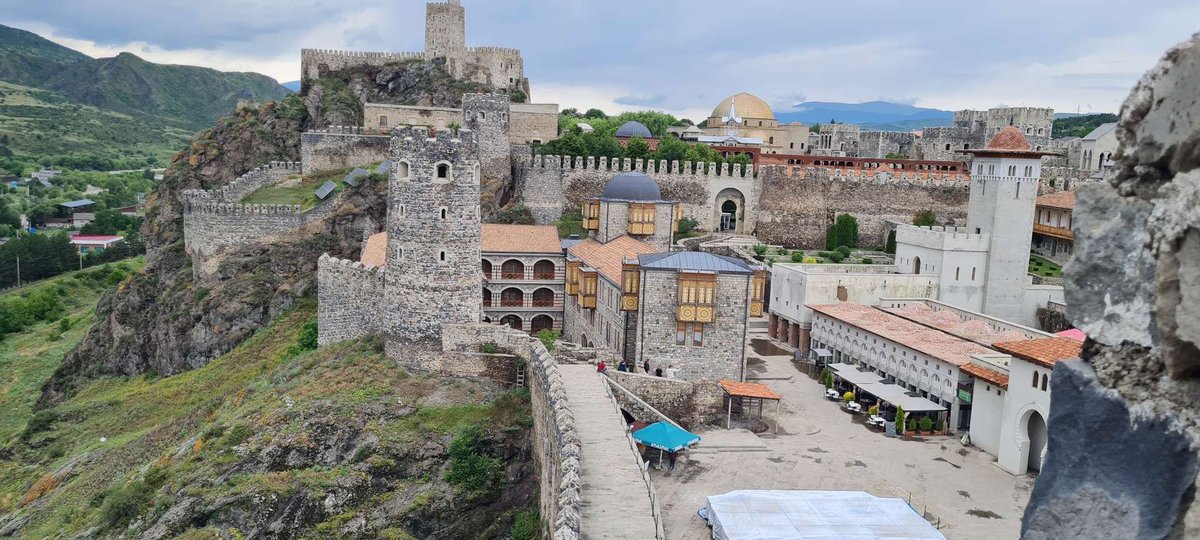
The complex covers about ten hectares, the figure given by the site's administration. It divides into two parts, arranged quite differently.
The lower part is freely open. This is a promenade area with cafés, shops, a hotel and a restaurant, where locals walk in the evenings.
The upper part is the museum zone, entered by ticket. It holds the citadel, the walls, an Orthodox church of the ninth or tenth century, the mosque with its medrese and minaret, the Jaqeli palace, prison quarters, an amphitheatre and a viewing platform over the town and the gorge.
The 2011-2012 restoration gave the complex the look for which it is both loved and criticised. Some hold that the monument was saved from ruin. Others say little original masonry remains and what emerged is a reconstruction rather than a restoration. Both positions are still voiced in the Georgian press, and it is worth arriving aware of the argument.
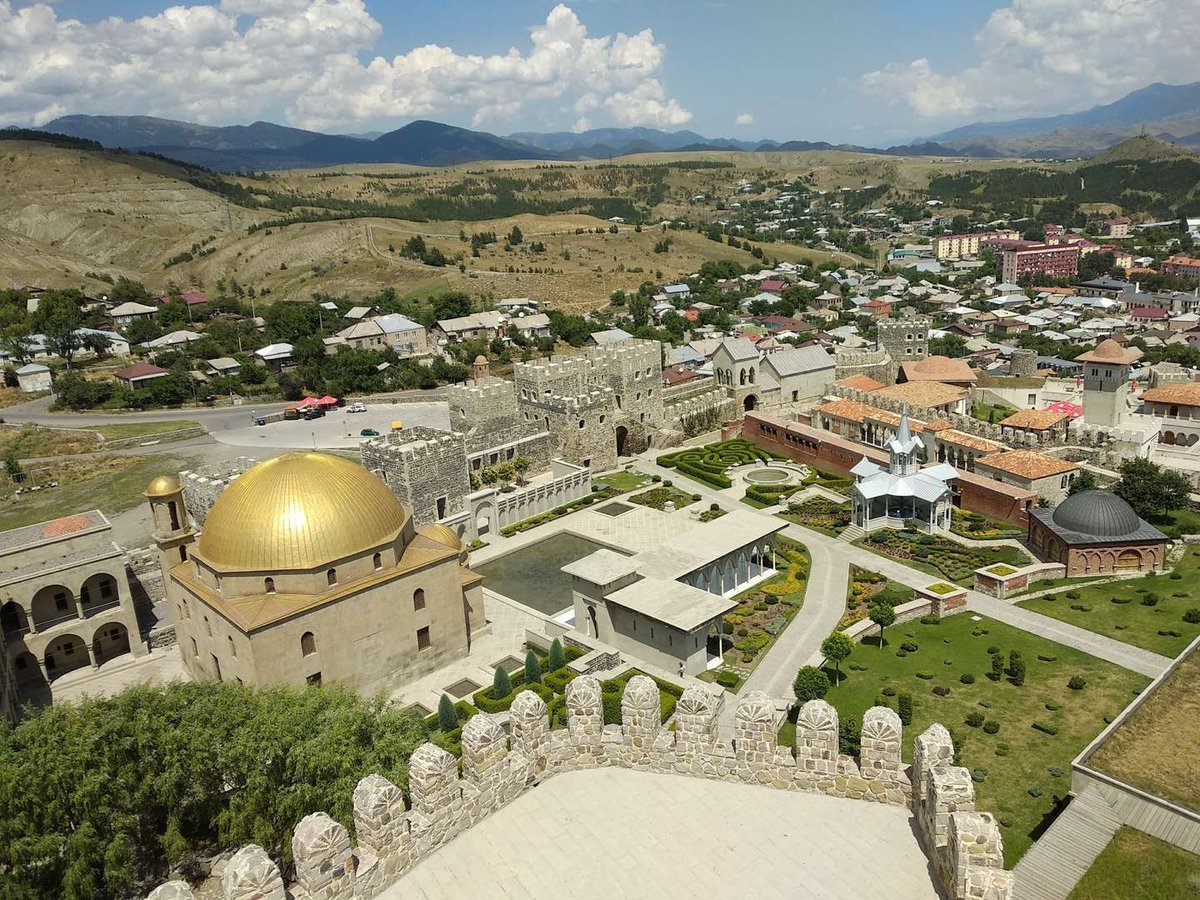
A detailed account of the fortress is in a separate piece on Rabati fortress in Akhaltsikhe. What follows here is about what surrounds it.
☪️ The Ahmediye Mosque and the legend of the executed architect
The mosque was built in 1752 by Haji Ahmed Pasha Jaqeli, a descendant of those atabegs who converted to Islam and became hereditary pashas. This is not imported Ottoman architecture but a building raised by the local ruling family in a new faith.
Services continued for around a century and ceased on 15 August 1828, when the fortress was taken. Since then the building has functioned as a historical monument. Its status is a subject of periodic debate in Akhaltsikhe.
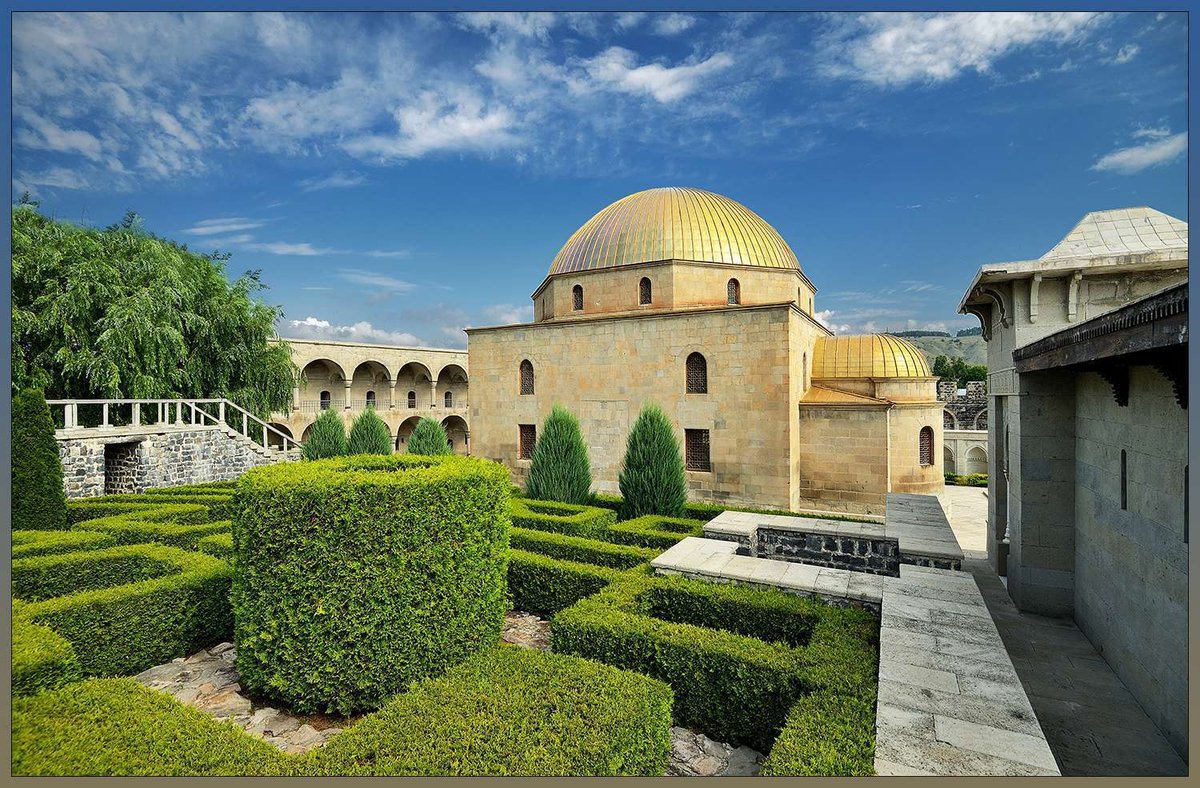
Two accounts attach to its construction, and both are worth knowing. By one, the pasha invited an Italian architect. By the other, local and far more durable, the mosque was built by a Georgian master who gave it a resemblance to Hagia Sophia in Istanbul; the pasha saw through the design and had him executed. Neither version is documented; this is town legend.
Beside it stands a medrese of the same period. The dome was reroofed in coloured sheet metal during the restoration, so it looks different in photographs from different years. The map point and photographs are in the catalogue, the Sultan Ahmad Mosque.
🕌 Who prayed where, all in one quarter
This is what makes walking through Akhaltsikhe worth doing deliberately. The fortress administration puts it this way: in the Rabati quarter, a Georgian Orthodox church, a Georgian Catholic monastery, a Jewish synagogue, an Armenian Apostolic church and a Muslim mosque all operated side by side for centuries.
Such a set in a single quarter is unusual even for the Caucasus, where mixing is the norm. But not all of them function today, and that is worth knowing before you go.
What is open and what is not
The five traditions of the Rabati quarter and the state in which they reach us.
When planning, allow for seeing some of these only from outside. The mosque is the exception: it lies inside the museum zone and can be entered.
✡️ Two synagogues and the Jewish quarter
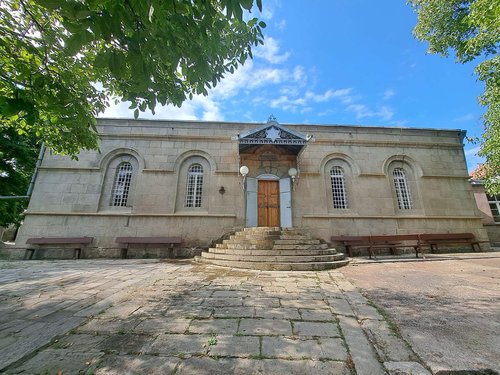
The Jewish community lived in Akhaltsikhe for a long time: the local cemetery is around four hundred years old. The Akhaltsikhe rabbi was significant enough that for a period he kept the register of births for the Georgian Jews of Tbilisi as well.
The upper, or Great Synagogue, was built in 1863. It is called the oldest surviving synagogue in Georgia, built of stone in a neoclassical manner. The lower is younger, from 1902, and in considerably worse condition. Both were listed as cultural heritage monuments in 2010-2011.
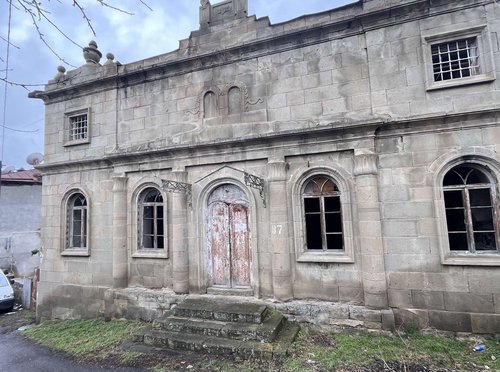
Then comes the part of the story usually left out. In 1953 both synagogues were closed and handed to the town. Through the Soviet decades the premises housed in turn a library, a cinema, a billiard hall and a boxing gym. After the aliyah began, the Jewish population of Samtskhe fell sharply, and today only a handful of families remain in the town, maintaining the building on donations from visitors.
The catalogue lists them separately: the Akhaltsikhe synagogue and the old synagogue.
⛪ Armenian, Catholic and Orthodox churches
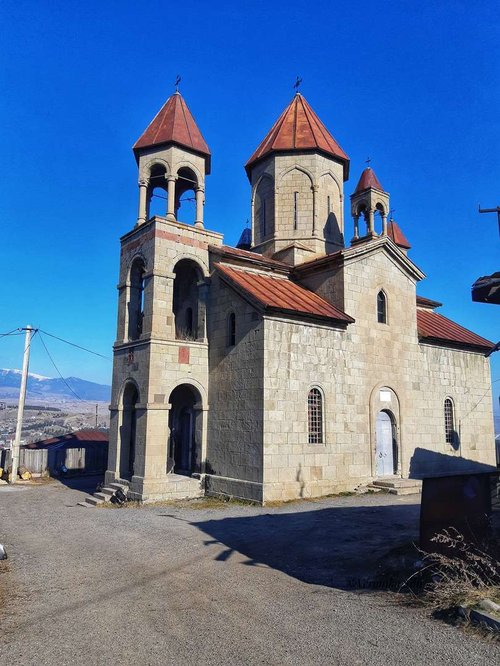
The Armenian Apostolic church of St Gregory the Illuminator was built in 1832 and is one of the anchor points of the town's Armenian history. A second Armenian church bears the name Surb Nshan, 'Holy Sign'. There is also the church of Surb Stepanoz.
The Catholic strand is no exotic import here but the norm: parishes operate in Ude, Arali, Abastumani and Akhaltsikhe itself. The town church of Our Lady Queen of the Rosary attracts noticeable search interest in Georgian. A Capuchin church and bell tower survive separately.
The cathedral of the Akhaltsikhe and Tao-Klarjeti eparchy is the Church of St Marina, with a convent attached. A church of the same dedication stands inside the fortress.
The town also has the Ascension cathedral, Amagleba. I could not establish its date of construction from open sources, so I quote none: the dedication is known, the dating needs verification.
Two more points: the Church of St Barbara and the church with the convent of St Grigol Khandzteli. The name is not incidental here: it is also borne by the theological seminary at Sapara Monastery.
🏛️ The Samtskhe-Javakheti Museum in the Jaqeli palace
The museum belongs to the Georgian National Museum and occupies the Jaqeli palace in the upper part of the fortress. The building has a history of its own: after 1828 the Russian army used the palace as barracks, and only the restoration returned it to an exhibition function.
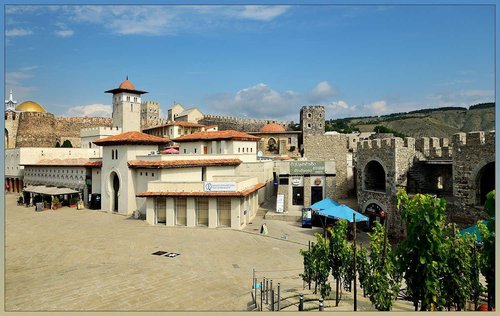
The collection covers not just the region but finds from across the country. The archaeological layer here is deep: excavations in the town confirmed that settlements existed on this site long before the fortress. Dozens of dwellings, burials and outbuildings have been found, along with metalwork and ceramics of the third millennium BC.
For the route this is convenient: the Samtskhe-Javakheti History Museum is inside the same museum zone you have already bought a ticket for.
🗿 Monuments: Tamar, George V and Rustaveli
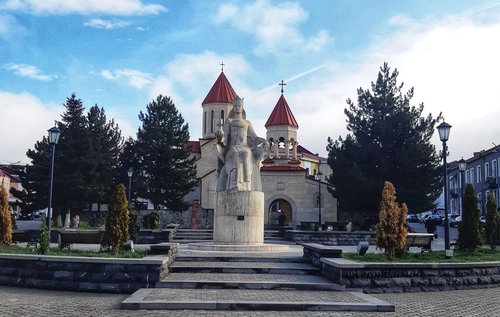
The monument to Queen Tamar stands on the central square, and it is the first monument to Tamar in Georgia. The sculptor was Malkhaz Tsiskadze and Eduard Shevardnadze opened it. The date is disputed: some sources say 1998, others spring 1999, so I give none. On 14 May, the feast of St Tamar, the monument to Queen Tamar is decorated with flowers and wreaths.
The monument to George V the Brilliant was unveiled in December 2021, and it is not there for decoration. George V was the son of Demetre II the Self-Sacrificer and Natela Jaqeli, and he grew up in Samtskhe at the court of his maternal grandfather, Beka I Jaqeli. The king who restored Georgia's unity after the Mongol period was raised in exactly these parts. The statue of George V draws more search interest than many larger sites in town.
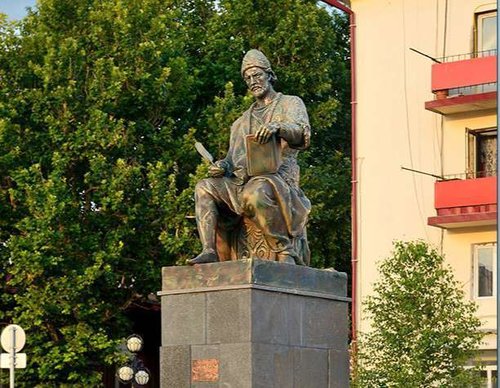
The Shota Rustaveli monument, one of the town's older ones, was recently returned to its original appearance after restoration. There is more in the separate piece on the Rustaveli monument in Akhaltsikhe. There is also a monument to Mesrop Mashtots, creator of the Armenian alphabet: a logical presence in a town with this much Armenian history.
🏞️ Amirani Hill, the ruined baths and the town itself
Not everything of interest is religious or commemorative.
Amirani Hill offers a view of the town from a different side than the fortress platform, and it changes the shot noticeably. A walking area has been laid out at its foot.
The ruins of the Turkish baths are linked to the same Ahmed Pasha Jaqeli: Georgian sources list the baths among the buildings raised at his order. Today they are ruins, and are best seen as a trace of Ottoman daily life rather than a working site.
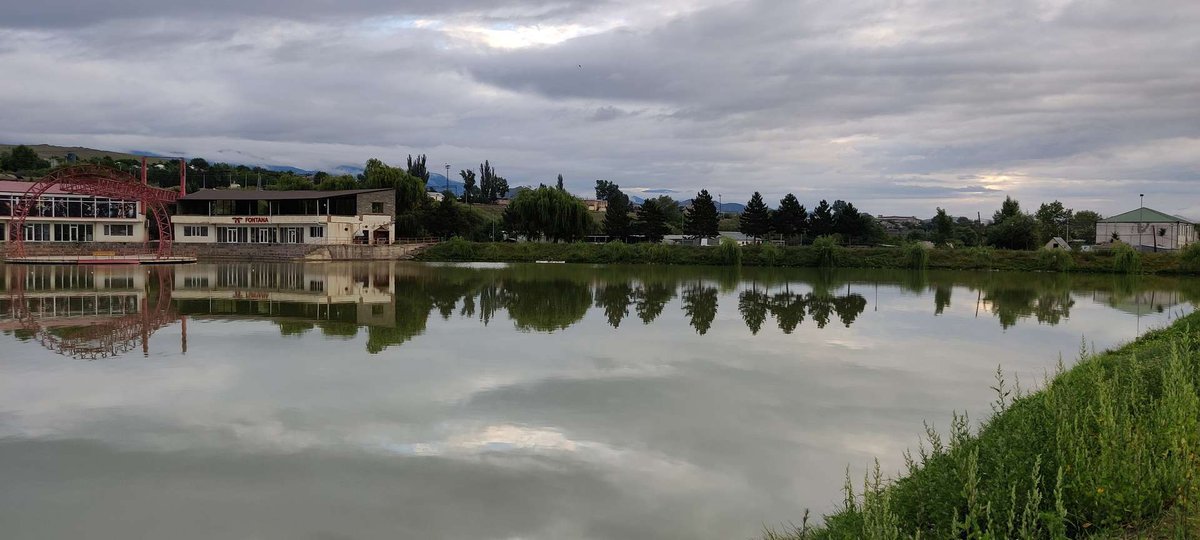
For a family walk there is Lake Akhaltsikhe, the town park opposite the drama theatre, and the Meskheti Theatre itself, which keeps a normal repertory.
👨👩👧 Does the town work with children?
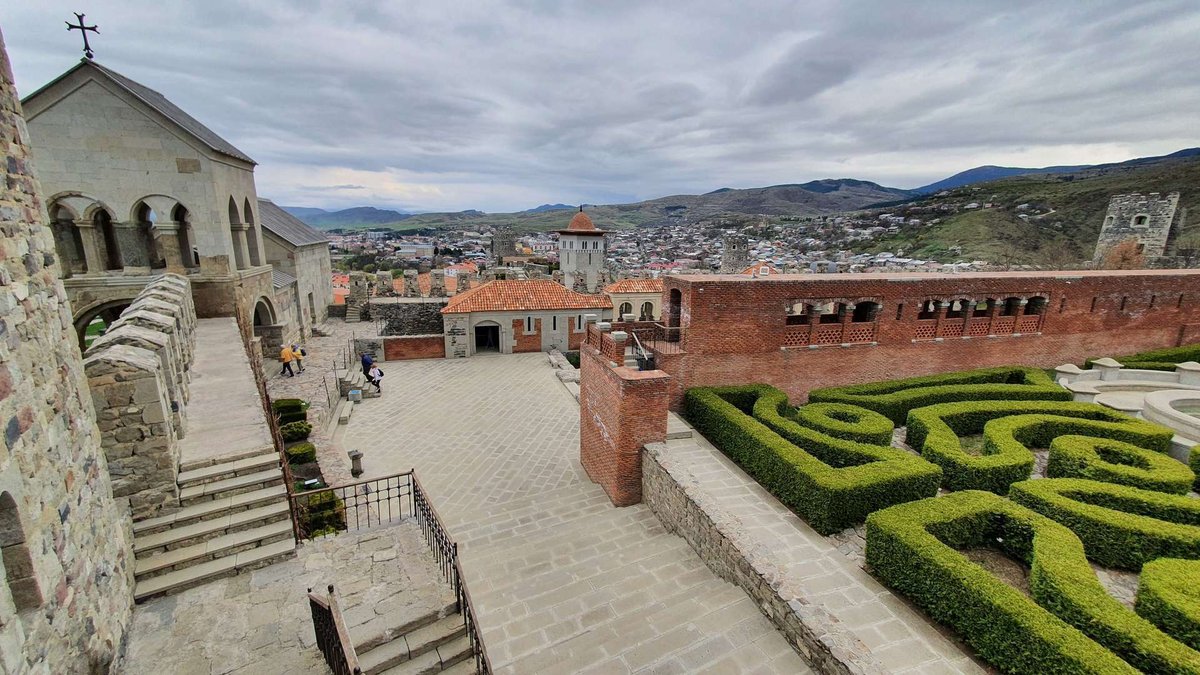
On balance yes, with a caveat about the terrain. The fortress means constant climbs, descents and steps, and a pushchair is awkward there. The grounds are safe and spacious, though, children have room to run, and the museum part is small enough not to exhaust anyone.
There is a children's entertainment centre in town and a playground on Rustaveli Street, if you need a break between historical sites.
In winter the road from Batumi over the pass can be closed. Check road conditions before setting out, particularly from November to April.
🚗 Getting to Akhaltsikhe
From Tbilisi the road runs through Gori and Borjomi, about two hundred kilometres. From Batumi either through Khulo or via Kutaisi, depending on the season and the state of the pass. From Kutaisi through Sachkhere and Borjomi.
Marshrutkas run from Tbilisi, Kutaisi, Batumi and Borjomi, but the timetable shifts with the season, and the return service is best confirmed at the bus station on arrival.
A word on the train. There is a railway line in this area, but it is inconvenient as a primary means of getting here. The popular claim that the fortress is a short hop from Akhalkalaki does not match the geography: Akhalkalaki is some seventy kilometres from Akhaltsikhe, a separate town and a separate trip.
🚶 A walking route through town
The logic is simple: start at the bottom, climb to the fortress, come down to the square. That takes you from the everyday town to the historical one and back, with the hardest climb falling in the middle of the walk while you still have energy.
Half a day in Akhaltsikhe
An order of stops that spares you climbing the hill twice.
The central square
The Queen Tamar monument, coffee, getting your bearings
The lower Rabati quarter
Synagogues, the Armenian church, old streets. Free to walk
The lower fortress
The promenade area and shops. Tickets for the upper part are bought here
The upper part and the museum
Mosque, church, citadel, Jaqeli palace, viewing platform. The longest stop
Amirani Hill
The fortress from the opposite side, better towards evening
The park by the theatre
The end of the walk, shade and ordinary town life
If you have only an hour, keep points three and four and sacrifice the rest: the upper fortress gives the most in the least time.
What to check before you go
🗺️ What to see in the surroundings
Akhaltsikhe works well as a base: almost all of southern Georgia is within an hour or two.
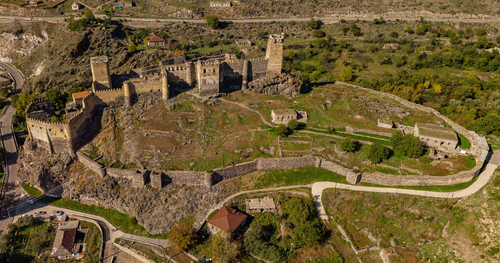
Closest is Sapara Monastery near the village of Greli. The complex was founded no later than the tenth century, and the earliest surviving building, the Church of the Dormition, dates from then. A new era began at the end of the thirteenth century, when the mechurchletukhutsesi Sargis Jaqeli took monastic vows here under the name Saba. The main church, the domed Church of St Sabbas the Sanctified, was built at the turn of the thirteenth and fourteenth centuries, and the bell tower and Jaqeli palace date from the same time. A portrait of the Jaqeli survives inside, and the smaller chapels on the grounds belong to the fourteenth to sixteenth centuries.
Further down the Mtkvari valley stand Khertvisi Fortress and the cave monastery of Vardzia. To the north-west, hidden in the mountains, is Abastumani with its astrophysical observatory, and on the Borjomi road stands Atskuri Fortress.
How far to the neighbours
An overview of the municipality with its villages is in the Samtskhe-Javakheti section, and the churches of the whole region in churches of Samtskhe-Javakheti.
🗣️ Over to you
Been to Akhaltsikhe? Tell us how long the fortress took you, whether you managed to get inside a synagogue and which spot gave the best view of the town. Leave a review on Madloba: details like these help anyone planning a first visit.
Information is current as of August 2026. Before travelling, check the opening hours of the museum zone, road conditions, access to individual sites and the weather: the town sits at a thousand metres and winters here are snowy.
📚 Read next
FAQ
💬 Yes, two spellings of one name. The official historical name of the monument is Akhaltsikhe fortress, while Rabati for centuries referred to the old town quarter. The name attached itself to the whole complex after the restoration.
💬 The history of a stronghold on this hill begins in the ninth century, when it was called Lomsia. It was destroyed in the eleventh century and rebuilt in the twelfth, when the name Akhaltsikhe appeared. From the thirteenth century it was the seat of the Jaqeli.
💬 Half a day is enough for Akhaltsikhe itself. Adding Sapara or Abastumani makes a full day. With Vardzia and Khertvisi it is better to plan two days with an overnight stay.
💬 No. Services ceased on 15 August 1828, after the fortress was taken, and the building now functions as a historical monument. It was built in 1752 by Haji Ahmed Pasha Jaqeli.
💬 Neither synagogue functions as a community building. The upper one, from 1863 and the oldest surviving in Georgia, is maintained by the families remaining in town. Access inside is not guaranteed, so ask locally.
💬 Yes, the monument on the central square is described as the first in the country. The sculptor was Malkhaz Tsiskadze and Eduard Shevardnadze opened it. Sources differ on the year: both 1998 and 1999 are cited.
💬 By marshrutka from Tbilisi, Kutaisi, Batumi or Borjomi. The timetable depends on the season, and the return service is worth confirming on arrival. There is a railway, but it is inconvenient as a primary route.
💬 The range of faiths in one small area. In the Rabati quarter an Orthodox church, a Catholic monastery, a synagogue, an Armenian Apostolic church and a mosque all operated side by side for centuries, and nearly all of it survives.
Read also
- Rabat Castle in Georgia: A Thousand Years of the Akhaltsikhe Fortress and What to See Today
- Berisakdrebi Temple in Kvibisi: Ancient Ruins near Borjomi
- Religions of Tbilisi: Temples of Seven Faiths in One City
- Why Zubi Fortress in Lechkhumi Is Called Impregnable: A River on Three Sides and a Single Eastern Gate
- The Artificial Lake in Akhaltsikhe: Boat Hire, the Waterfront and the Sports Complex

36 comments
Log in to leave a comment
Kale etrafındaki manzara da efsane! Bir çay içerken çevremdeki doğal güzelliklere bakmayı çok seviyorum. Sanki her köşede başka bir hikaye var. Bu yerin ruhunu yakalamak, fotoğraflarla değil, hislerle mümkün. Unutmayın, müze gezmekten çok, o anı yaşamak önemli!
Peki, oraya giden en iyi yollar hangileri gerçekten? Hangi ulaşım şekli en keyiflisi? 🚗✨
Обязательно нужно гулять и изучать крепость с экскурсоводом, чтобы полностью погрузиться в её историю. Перед поездкой стоит изучить погоду и график работы крепости. На территории есть как платные, так и бесплатные постройки.
Также в крепости есть отель, ресторан и SPA-центр, что делает её подходящим местом для поездки всей семьёй. Здесь будет интересно как детям, так и взрослым.