




🥟 8 Best Georgian Restaurants in Kutaisi: Where to Try Khinkali and Other Traditional Dishes
🍷 If you are looking for Georgian cuisine in Kutaisi, it is important to understand from the start what kind of experience you want. It is one thing to quickly find a good place for khinkali and khachapuri, and quite another to choose a restaurant that gives a fuller impression of the Georgian table: with appetizers, hot dishes, a home-style rhythm of service, and a clear, welcoming atmosphere. This ranking is compiled for those who want not just to eat in the city, but to choose the right format for lunch, an evening with friends, a family dinner, or a first introduction to local cuisine. In Kutaisi, it is especially useful to look not only at the tourist-recognizable items, but also at the quality of the dough, broth, meat, appetizers, and at how confidently the venue works with the traditional menu of western Georgia.
Who this ranking is suitable for
- For those who want to choose, in one article, a place both for khinkali and for a full Georgian dinner.
- For tourists who need a clear guide without making a random choice based on the first sign they see.
- For those who want to try not only khachapuri and khinkali, but also other traditional dishes.
- For families and groups who care about seating, the format of the dining room, and convenience for sharing a table.
- For those who are looking for a Georgian cuisine restaurant in Kutaisi for lunch, a calm evening, or a long feast.
Georgian cuisine restaurants in Kutaisi where it is convenient to begin your introduction to khinkali and the traditional menu


4 Georgian cuisine restaurants in Kutaisi for khinkali, hot dishes, and a relaxed dinner



Use the map where you can find restaurants in Kutaisi with Georgian cuisine near you.
A map is especially useful in Kutaisi if you are choosing a restaurant for a specific route rather than abstractly “somewhere in the center.” In the city, the difference between a place on a busy passing street and a restaurant a few minutes away from the main flow can strongly affect the overall impression: in some places it will be noisier and the seating pace will be faster, while in others the dining room will be calmer and the feeling of a local dinner will be stronger. That is why here it is better to look at the map together with the card descriptions, rather than separately.
How to tell that you are looking at a strong Georgian cuisine restaurant in Kutaisi, and not just a menu made for a random tourist dinner
Quick guidelines:
- khinkali keep a balance of broth, dough, and meat filling, rather than standing out only because of their size;
- the menu is built around Georgian culinary logic instead of mixing all cuisines at once;
- in a strong place, both the basic items, the appetizers, and the hot dishes are prepared confidently;
- the restaurant has a clear format: a quick lunch, a family dinner, a feast-style evening, or a calm visit for two;
- the kitchen looks consistent not only in an empty dining room, but also during busy hours.
A Georgian restaurant in Kutaisi is not just any place where khachapuri, khinkali, and shashlik appear on the menu. A strong venue in this category is usually recognized by how cohesive it feels. It has a clear Georgian foundation, and the menu does not turn into an endless list of overly different genres. When a restaurant tries to sell everything at once with equal intensity — from random international dishes to a tourist set “just in case” — it often weakens both the kitchen and the format itself.
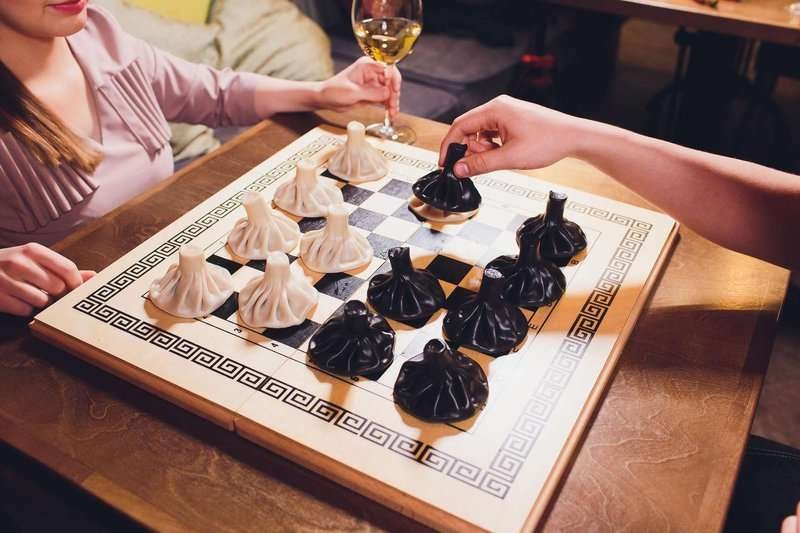
With khinkali, what matters more is not size and not the number of folds, but balance. Good khinkali should hold the broth, not fall apart in your hands, not disappear into overly thick dough, and not hide the flavor of the meat behind nothing but pepperiness. They show very quickly how well the kitchen controls its basic technique. If the starter dish is made confidently, that is a good sign for the rest of the menu as well.
But in Kutaisi, it is worth looking beyond khinkali alone. A strong Georgian cuisine restaurant shows depth in cold appetizers, bean dishes, pastries, hot meat dishes, and in the way the whole table comes together. A good sign for the city is when the menu includes not only widely known classics, but also western Georgian and Imeretian accents. That helps you understand that you are not just looking at a restaurant with a universal tourist set, but at a kitchen with local logic.
Finally, pay attention to the rhythm of the dining room. A place that lives only on passing foot traffic is often easy to recognize by the rush, the overloaded menu, and the uneven pacing of service. A stronger restaurant usually feels steady both on a weekday and on a busy evening: it has clear service, predictable kitchen work, and the sense that not only random guests come here.
How to choose a Georgian restaurant in Kutaisi for khinkali, a family lunch, or a long dinner
What to look at first:
- decide whether you want to compare khinkali specifically or put together a full Georgian table;
- if you are going with family or a group, check in advance about reservations, table size, and whether there will be live music;
- if conversation matters to you, ask about a quiet dining room, not just a beautiful location;
- for your first visit, order not only the “must-try” hits, but also one dish that shows the character of the kitchen;
- for tourists, it is useful to check in advance the language of the menu, cashless payment options, and the full kitchen hours.
If you are visiting a Georgian restaurant in Kutaisi for the first time, do not try to order the entire classic set at once just because it feels familiar. For a first visit, it is more practical to choose one dish that clearly shows technique — for example, khinkali or khachapuri — and one dish that reveals the character of the kitchen: lobio, ojakhuri, chkmeruli, kupati, a seasonal appetizer, or a hot dish for sharing. This makes it easier to understand how consistently the restaurant performs, rather than whether it simply covers a tourist’s basic expectations.
If you are coming with family or a group, think not only about the menu, but also about the seating format. A Georgian dinner is rarely built around one dish per person; more often it is a shared table, several appetizers, hot dishes, and a more relaxed pace of service. For a larger group, it is convenient to ask for appetizers and cold dishes first, and khinkali and hot dishes in separate rounds: this way the table does not get overloaded, and the dishes do not have time to cool down. That is why it makes sense to clarify in advance whether you need a large table, whether there is a quiet dining room, and whether there will be live music at your chosen time if conversation is important to you.
In Kutaisi, this is especially useful in the evening and on weekends: the same place may work during the day as a calm city restaurant, and later turn into a louder feast-style venue. If you are visiting between lunch and dinner or closer to closing time, it is better to check not only the opening hours, but also how the kitchen works at that time and whether all the key menu items are still being prepared.
Tourists should check in advance whether the menu is easy to understand, whether cashless payment is available, and whether reservations can be made by phone or messenger. These things may seem secondary, but they are often exactly what separates a pleasant spontaneous dinner from unnecessary fuss. And if you are planning to judge the khinkali specifically, it is better to ask for a fresh serving rather than order them after a large meal, when the flavors on the table have already started to blend together.
Valeria Romero, Buenos Aires:
“When I first tried khinkali in Kutaisi, it was a moment of absolute happiness. I didn’t even expect that a simple dish could be so tasty and aromatic! I was especially struck by the broth inside — hot, rich, with spices. And the dough — thin and tender. The restaurant was decorated in a traditional style, with wooden furniture and patterns on the walls — you felt like you were in real Georgia. The waiters were very friendly and even told me the legend of the “28 folds”. It’s not just food — it’s a cultural adventure that I will never forget.”
What to try in Kutaisi besides khinkali: how to read the Georgian table and Imeretian accents
What is important to understand:
- Kutaisi and Imereti are not only about khinkali — they are also about cheese pastries, bean dishes, pkhali, and home-style hot dishes;
- Imeretian khachapuri is no less important for getting to know the local tradition than the more famous tourist formats;
- lobio, mchadi, cheeses, vegetable appetizers, and hot poultry or meat dishes often show the depth of the cuisine better than a single set of greatest hits;
- a Georgian place in the city may be a dukhani, a classic restaurant, or a hall for feasts — and these are different scenarios for the guest.
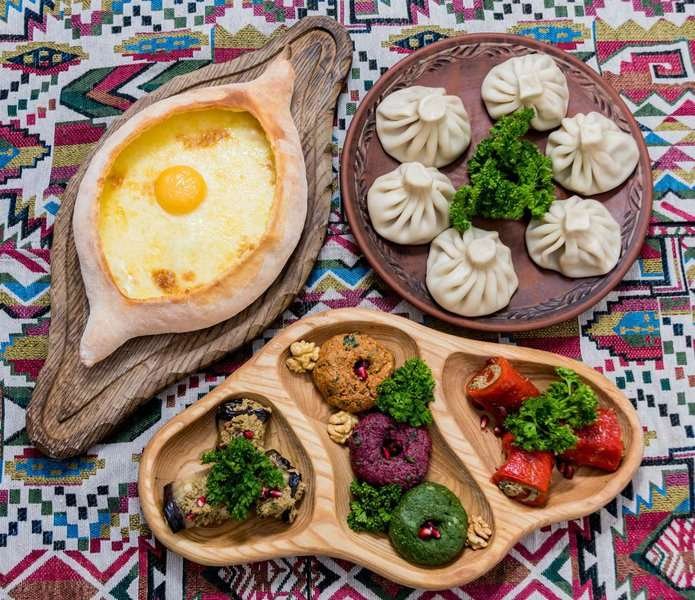
One of the most common tourist mistakes in Kutaisi is reducing all Georgian cuisine to just a couple of the most recognizable words. Yes, khinkali matter here, but the city is in Imereti, which means it makes perfect sense to look at how a restaurant works with the home-style culinary tradition of western Georgia as well. Imeretian khachapuri, pkhali, lobio, mchadi — cornmeal flatbreads, cheeses, chicken and pork dishes, simple but precise appetizers — all of this gives a much more honest sense of the local table than just the set of “khinkali + mtsvadi.”
That is why in Kutaisi it is especially useful to try not only the most impressive dishes, but also the most ordinary ones. Imeretian khachapuri, for example, does not look as theatrical as Adjarian khachapuri, but for western Georgia it is much more organic and shows the quality of the dough, the cheese, and the balance of the baking much better. The same applies to lobio and pkhali: it is precisely through such dishes that you can often see whether the kitchen truly understands the home-style tradition or is simply reproducing a set of tourist hits.
Understanding the format also helps. A dukhani is usually simpler in its interior and shorter in its menu, but it can be very strong in basic traditional dishes. A classic city restaurant is better suited for a longer dinner, wine, and a calm choice from the menu. A hall for feasts or large groups is convenient when you are going with a group and want the atmosphere of a supra — a large Georgian table with toasts and a long flow of dishes — but it will not always be the best choice for a quiet conversation. Once this difference is clear, choosing a restaurant in Kutaisi becomes much easier.
Soo-Jin Park, Seoul:
“Georgia was a gastronomic revelation for me. I tried khinkali in different cities — in Tbilisi, Kutaisi, and even in small villages, and each time they were different. I was especially impressed by the vegetarian options with suluguni cheese and herbs — perfectly balanced, light, but very aromatic. In one cafe in Kutaisi, the chef even told me what spices they use — it was very heartfelt. I also fell in love with Georgian white wine — it goes so well with khinkali! Now I know for sure: if you want to understand the culture of a country, you must first try its food.”
❓ Frequently asked questions about Georgian cuisine in Kutaisi
If you want to compare khinkali specifically and nothing else, a more specialized khinkali-focused place may be the more precise scenario. But this ranking is about Georgian cuisine restaurants in a broader sense: here khinkali matter, but they are considered as part of a full dinner with appetizers, pastries, and hot dishes.
For a first introduction, Imeretian khachapuri, pkhali, lobio, mchadi, ojakhuri, chkmeruli, kupati, and other hot dishes work very well because they show not only dough and broth, but also the overall logic of the Georgian table. The more broadly you look at the menu, the easier it is to understand the character of the cuisine.
Focus not on the size, but on the balance. Good khinkali hold the broth, are served hot, do not tear too easily, but also do not turn into rough, overly thick dough. The filling should be juicy, and the spices should support the flavor of the meat rather than hide it.
For dinner on Friday and Saturday, for a large group, and for places with live music, it is better to book in advance. For a daytime visit on a weekday, getting in without a reservation is usually easier, but this depends on the season, how busy the city is, and the format of the specific dining room.
Yes, this is one of the most natural formats for a family or friendly dinner. But it is better to check in advance whether there is a large table, quiet seating, how many people can comfortably fit in the dining room, and whether the music might interfere with conversation.
Yes, this is often a sensible choice. In Kutaisi, a restaurant a few minutes away from the main route may offer calmer seating, less random foot traffic, and a more cohesive dinner experience. That is exactly why it is worth looking at the map in this ranking.
No. The city has both simple urban formats and more substantial restaurants for a long dinner. The point of the ranking is not the price itself, but the quality of the cuisine, the format, and how well the place fits your scenario. For convenience, the cards can use badges such as ₾ / ₾₾ / ₾₾₾.
Imeretian khachapuri is a closed round cheese pie, more everyday in style and very organic for Imereti. It is less theatrical than the Adjarian format, but precisely because of that it shows the quality of the dough, the cheese, and the overall baking culture much better. For Kutaisi, it is one of the most fitting items on the menu.
📌Help us keep this ranking up to date
Have you been to one of these Georgian cuisine restaurants in Kutaisi? Tell us in the comments where you liked the khinkali most, which dishes besides them are truly worth ordering, and which place the editorial team should check in the next update. If you noticed an inaccuracy in a listing or represent a venue that fits this ranking, let us know through the form — the editorial team will verify the information manually.
Have you already been to these places, or do you know a strong Georgian cuisine restaurant in Kutaisi that the editorial team should check? Write about it in the comments under the ranking.
❓ How this ranking is formed
This ranking is compiled by the MADLOBA editorial team based on the criteria of the “Where to Eat” category: analysis of the concept, menu consistency, user signals, maps, gastronomic scenarios, local context, and the up-to-dateness of the listings. For Georgian restaurants in Kutaisi, we additionally take into account not only the presence of tourist-recognizable dishes, but also how confidently the venue works with classic and regional dishes, serving formats, and the overall rhythm of the Georgian table.
Read also
Expert review

44 comments
Log in to leave a comment
Помню, как однажды мы просто гуляли по городу и решили зайти в небольшой ресторанчик. Заказали классический набор: хинкали, хачапури и ароматный шашлык. Казалось бы, простые блюда, но вкус был настолько насыщенный, что дети до сих пор вспоминают тот ужин. В Кутаиси вообще удивительная атмосфера — рестораны здесь часто небольшие, семейные, и чувствуешь себя не как турист, а как долгожданный гость.
Кстати, когда планируем поездки, я часто смотрю рекомендации через каталог Madloba.info. Там удобно находить рестораны в Кутаиси, читать отзывы путешественников и выбирать места, где действительно стоит попробовать грузинские блюда.
А у вас в Кутаиси есть любимый ресторан или место, куда хочется возвращаться снова и снова? Очень интересно узнать ваши рекомендации! 😊
Каждое место, которое мы посещали, дарило ощущение уюта и тепла, как будто нас принимали в доме. Отправляясь туда, не забудьте заказать местное вино — оно идеально сочетается с хинкали и просто восхищает своим вкусом! Этот опыт точно запомнится надолго.
Спасибо за статью! Она вдохновила меня на то, чтобы посетить эти рестораны и попробовать настоящие грузинские блюда!